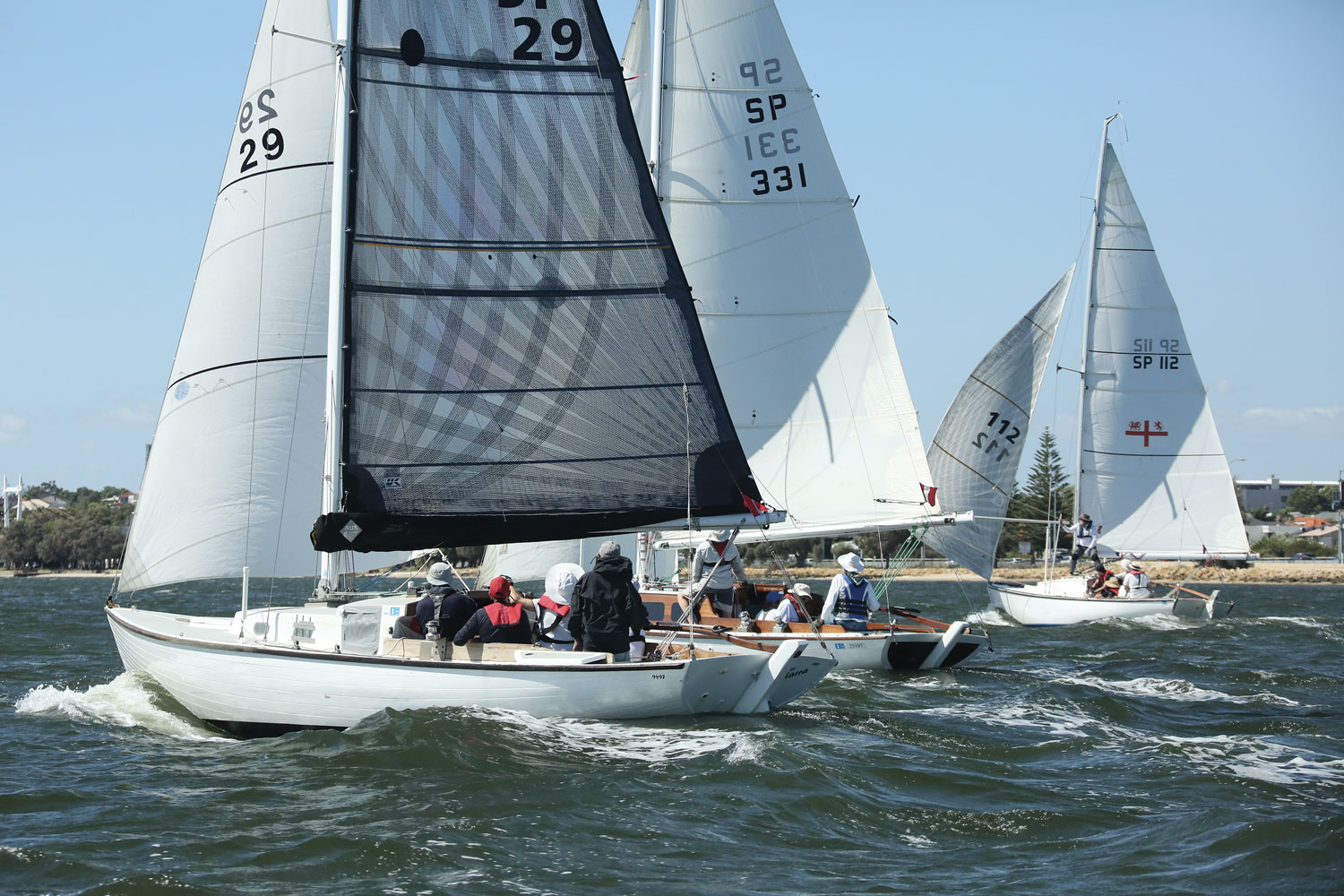
Nigel SharpTHE FIRST JINDARRA (left), ANNA (center), and SWIFTSURE SAGA (right) are among a fleet of wooden-hulled H28s that continue to race regularly as a one-design class out of the South of Perth Yacht Club in Western Australia. About 40 of the boats have been built in the state since the 1940s, following plans by L. Francis Herreshoff.
Western Australia is the home of a modest fleet of wooden-hulled sailboats that has its roots in the World War II pages of an American sailing magazine. Based at the South of Perth Yacht Club on the Swan River since the early 1960s, this fleet is not, unfortunately, as big as it was in its heyday, but the camaraderie remains strong among the enthusiastic owners and crews who race the boats twice a week and occasionally cruise on them.
In its December 1942 edition, The Rudder announced that it was “pleased to introduce as the latest ‘How To’,” a 28′ auxiliary cruising ketch designed by L. Francis Herreshoff. This was the H28. “For some time past,” editor Boris Lauer-Leonardi wrote, “readers have been urging us to turn out a small round bottom auxiliary suitable for general coastwise cruising, yet able enough to take dirty weather she might encounter in some of her longer hops in open water.” Throughout 1943 and into January 1944, The Rudder included a series of detailed instructions to allow and encourage amateurs to build H28s. “It is thought a small transom is such a saving in expense and workmanship that the designer has adopted it, for particularly the amateur would have great difficulty with the sharp bends of a quickly tucked up stern,” Lauer-Leonardi wrote as one example of the consideration that was given to potential amateur builders.
Mystic Seaport Museum, Daniel S. Gregory Ships Plans LibraryL. Francis Herreshoff published his plans for the H28 in The Rudder starting in December 1942 and republished them in his book Sensible Cruising Designs of 1973. He chose a ketch rig for the yacht and included extensively detailed specifications for such fittings as the gooseneck (top right) and the masthead tangs (lower right), making the design especially appealing to amateur builders. In Western Australia, however, most of the boats have been rigged as sloops, following Herreshoff’s later sail plan.
Roughly 150 sets of plans were sold to Australia after World War II. The first to be produced there, in the state of Victoria, was MARLOO, and she was soon followed by the first Western Australian boat, SAGA, which was built in a Perth suburb in 1947 by R.E. Johansen, who soon afterward also built the next Australian H28, NOVA. MARLOO and SAGA were ketches, but NOVA and almost all of the subsequent Australian boats were built with a sloop rig, which Herreshoff drew about 18 months after he had produced his original H28 design.
In all, at least 18 different builders have built about 40 H28s in Western Australia, half of them before 1960. Ten or more of those builders were also their first owners, emphasizing that Herreshoff’s intention to make them suitable for amateur construction was successful.
“There is hardly any tuck in the bilge, nothing like a wine-glass shape, so fitting the garboards is easy,” said Len Randall, a 98-year-old retired Australian naval architect, “and the remainder of the planks are simple—they almost fall into place.”
Mystic Seaport Museum, Daniel S. Gregory Ships Plans LibraryThe H28 plans show gentle curves in the bilges, and according to Len Randall, an Australian naval architect who sails with the Perth H28 fleet, “…fitting the garboards is easy, and the remainder of the planks are simple—they almost fall into place.”
The most common wood species used for the construction of these carvel-planked boats in Australia was jarrah for the hull planking, occasionally with Douglas-fir above the waterline, and New Zealand kauri for the frames. Three boats have been cold-molded: ALMA in 1977, GUNDARRA in 1994, and SWIFTSURE SAGA in 2011.
The original SAGA, which was built in 1947, had come to an untimely end after she fell into disrepair after a sinking in 2000, and Bill Richards—who had been sailing other H28s for several years—decided to salvage what he could from her for a new boat. He worked with a boatbuilder, Brian Phillips, on her construction, and he gave her the original boat’s name with the addition of a prefix that came from a naval vessel on which Bill’s father had served. Bill also asked Len Randall if he could tweak the lines a little, so SWIFTSURE SAGA has a little more beam in the waterline aft to add buoyancy to support the weight of five people in the cockpit. As it turned out, of SAGA’s hull parts, only the deadwood and floor timbers could be reused. But the ballast keel—which was made of lead, rather than the more typical cast iron—was also saved, albeit only to be melted down with additional lead to form a new keel that is about half a ton heavier than the original.
SWIFTSURE SAGA’s hull was cold-molded from three layers of 1⁄4“-thick strips of marine plywood, all laid diagonally and sheathed in fiberglass set in epoxy. Tasmanian oak was used for her timber keel, laminated stem, hull timbers, and some deckbeams. The remaining deckbeams and the ring frames were laminations of mahogany, and the deck was of 3⁄8″ plywood. SWIFTSURE SAGA isn’t the only boat that was built with a slightly modified hull shape: for GUNDARRA, the sheerline was altered to increase the freeboard by about 4″.
Mystic Seaport Museum, Daniel S. Gregory Ships Plans LibraryThe cabin plans emphasize simplicity, with Herreshoff’s favorite head—a cedar bucket—visible forward.
(In the 1970s, a company on the other side of Australia in Geelong, Victoria, began to produce fiberglass-hulled derivatives of the H28 that are slightly longer and heavier than designed; some of them are rigged as sloops and others as ketches. More than 100 have been built and have mainly been sailed in Port Philip Bay and New Zealand.)
Until the early 1960s, H28s were spread among several of the clubs on the Swan River. But Loyal Weaver, the owner of SAGA almost since she was new, was keen that all the H28s should be based in the same place, and naturally he favored his own club. Weaver was a prominent member of the South of Perth Yacht Club, or SoPYC, as they prefer to abbreviate it. After some vigorous lobbying, a meeting was held at SoPYC in February 1963, and it was agreed that the club would adopt the H28s as a class. Ever since then, and still to this day, H28s have raced there twice a week despite Herreshoff’s having written in the January 1943 issue of The Rudder that the H28 was not designed for racing. “We believe we are the only yacht club in the world that regularly races H28s as a class division,” said Ernie Little, who has been the class captain since 2022.
Over the years, H28s have frequently ventured outside the Swan River for both cruising and racing. To do so, however, they must drop their masts to negotiate three low bridges near the river entrance at Fremantle. To facilitate this, almost every boat has, or has had, a mast mounted in a tabernacle. This may sound like a great inconvenience, but with practice and the aid of an A-frame, it usually takes no more than about 15 minutes for two people to lower the rig and the same amount of time to raise it again.
About 10 miles west of the Swan River entrance is the spectacular Rottnest Island, which has been a popular cruising destination for boats of all kinds, H28s among them. In the 1980s, Ernie owned KAROLEEYA, an H28 built in 1958, and he recalls taking her to Rottnest with his wife and young children for long weekends several times a year. “At Easter and Christmas, there would be up to five H28s anchored together at any one time,” he said.
In 1955, several H28s—including ANNA and NERIMA, which are still sailing at SoPYC today—took part in the inaugural Cape Naturaliste Race from Fremantle about 100 miles south to the cape and back again. H28s continued to sail in subsequent editions of this race as well as in the Mandurah Return Race of about the same distance and the Bunbury Return Race, which is a little shorter. A crew member racing on the H28 LINDA in one Cape Naturaliste Race later spoke of huge seas in which it was impossible to see, from one trough to another, the ship that they were supposed to round—the 186′ corvette HMAS JUNEE. For most of the race, as LINDA heeled the water in the cabin was up to the berth level.
No H28s have raced outside the Swan River for almost 20 years, partly because they are unable to comply with the Department of Transport’s modern safety regulations, in particular with their lack of self-draining cockpits. Also, “enthusiasm has waned for the extra travel time to the river entrance and the lowering of masts,” Ernie said.
Nigel SharpANNA’s straightforward interior is set up for spartan cruising.
Not surprisingly, all H28s have had various modifications over the years. All their masts are now of aluminum, with a few of those changes imposed after the original wooden ones were carried away in strong winds. Although the additional stiffness of the aluminum masts negates the need for the forward-facing jumper stays that were essential to the wooden masts, a few boats still have them for the sake of a traditional appearance. The chainplates on most boats have been moved inboard to improve the headsail-sheeting angle; and while Dacron is generally favored for the upwind sails, a few high-tech laminate sails have been adopted and most mainsails are fully battened.
Almost all the boats have had their original engines, most of them gasoline-powered Stuart Turners, replaced. Today, diesel engines are favored, although a few—SWIFTSURE SAGA, GEORGINA, and THE FIRST JINDARRA—have electric motors. Engines are mainly used for getting in and out of marina berths, but the offset propellers that most boats have can hinder maneuverability.
Nigel SharpOne corner of the South of Perth Yacht Club is set up for H28 race memorabilia dating back to the late 1940s.
H28s were originally fitted out for family cruising, with several berths, a head, a stove, and an icebox. But most of today’s boats are used as simple racing boats, so those amenities have gradually been removed. There are several variations in cockpit and coach roof configurations; for example, SWIFTSURE SAGA was built with a shorter trunk cabin and a deeper and longer cockpit than most other boats.
In 2013, the SoPYC’s current commodore, Brian Cross, purchased MARINER. “She leaked like a sieve when Brian bought her,” said Rick Steuart, the class archivist. “But he was prepared to throw good money at the old girl, and he and professional shipwright David Locke worked on her for almost a year putting new bulkheads in and tightening her up generally with splining and ’glassing.” CORELLA and GEORGINA have also had their plank seams splined and their hulls sheathed with fiberglass cloth set in epoxy. “They are all different, there’s no question about it,” Rick said. “But each boat expresses the personality of its builder and eventually its owner.”
For 30 years or so after the H28s were adopted at SoPYC, the class thrived. At their peak there were 25 of them, and between 15 and 20 of those regularly raced. Ernie can remember one race in which 22 took part. The social side of things thrived as well. For instance, 116 people attended a clubhouse dinner to celebrate the half-century of Herreshoff’s design in 1992, and another big party was held in 2023 to commemorate the club’s 60-year relationship with the design.
The H28s still race on summer Saturdays, when spinnakers are allowed. Wednesday racing continues year-round, without spinnakers. I was lucky enough to join them on both days during a week in Perth in February of this year. Despite Ernie’s sterling efforts to encourage a good attendance on those days, he found that several boats were unable to race due to a variety of unfortunate circumstances. In fact, he was a victim of such circumstances himself: WYNELLA, the boat that he now co-owns with Glen Stanley and Russell Anderson, was out of commission following a recent collision that severely damaged her rudder. Nevertheless, four boats were able to cross the start line on Wednesday and five on Saturday.
Nigel SharpH28 sailors gather before a race on the yacht club’s “Herreshoff Hill,” which has a permanent table built on the stem of SAGA, a 1947 boat that sank in 2000 but parts of which were incorporated into a reconstruction renamed SWIFTSURE SAGA.
Before going afloat, H28 owners and crews gather at the wonderfully named Herreshoff Hill. The word “hill” is a bit of an overstatement, but it is an enchanting piece of grass adjacent to the SoPYC’s floats where the H28s are berthed. Here another surviving component of the original SAGA plays a crucial role: her old stem provides the main support for a table that was constructed by David Locke in the shape of an H28 bow and foredeck around which the gathering sailors assemble. It was here that the camaraderie among the H28 sailors first became apparent to me, and where Ernie worked energetically to make sure that everyone had a boat to sail on and every boat had a good balance of crew. While we were waiting to get aboard, I listened to plenty of observations in praise of the H28s.
“On a very windy day when we’re sailing upwind against what we call the Tupperware boats,” said Glen, who has been sailing H28s since 1985, “and a strong gust of wind comes, we just lean over a bit, and they go all over the place.”
“We would often round the top mark in a 30-knot southerly and hoist the spinnaker,” Ernie added, “and then someone would go to the icebox and hand the beers around. We’d be surrounded by all these plastic-fantastics, which would be struggling to stay on course, and they would look down at us drinking beer as we’re sailing along at the same speed, and they would make some comment like, ‘How can you guys do that?’ H28s are very forgiving boats.”
Nigel SharpThe H28s in the Perth fleet show a variety of cockpit and coach roof configurations. Most of the boats are rigged as sloops, and the absence of a mizzenmast leaves their cockpits clear and functional for racing, as seen here on ANNA.
Along with many other SoPYC boats and others from nearby clubs, the H28s race in the open part of the Swan River—almost three miles across in places—that lies between the relatively narrow, twisting lower reaches and the city of Perth. It is a beautiful place to sail.
Partway through the Wednesday race, after I had been taking photographs from a chase boat, I transferred to John Wright’s ANNA; and then, on Saturday, I sailed the whole race aboard ALMA, which, in the absence of her owners, was helmed by Glen. In both races, I experienced the celebrated “Fremantle Doctor,” the sea breeze of some 20 knots that is so named because it provides welcome relief from the high temperatures, although on the Saturday we had to put up with a light and shifty breeze at the start before it kicked in. Both races were glorious, and the easy, powerful motion of these boats was memorable.
Toward the end of the Saturday race, Glen kindly offered me ALMA’s helm, and I accepted it eagerly. For the last few legs of the course, I relished the easy way in which the boat seemed to let me steer her; she was light on the helm and yet controllably powerful.
Nigel SharpANNA powers to windward, taking advantage of the strong sea breeze known as the “Fremantle Doctor” for its cooling effect on hot summer days.
After each of the races, the crews gathered again, but this time inside the clubhouse. There were many people from other boats there, too, but the H28 sailors were at their own reserved long table—as they are, apparently, after every race. Again, the camaraderie came alive, helped along by shared jugs of beer. Ernie recalled the days of 20 boats or more on the starting line, when they “were always known as the gentlemanly fleet, but the language on the water was anything but gentlemanly, I can tell you. It wasn’t only the spinnakers that were colorful, the language was, too. But when we walk into the bar and have a beer afterwards, we’re all good mates and it’s like nothing’s happened.”
Kate Lammonby talked about a decade of sailing SORAYA of 1960, which her husband Phil raced on Saturdays and she raced on Wednesdays with an all-women crew. “We may not have come first very often, but we certainly had a lot of fun and laughs,” she said. “What the girls really liked was that H28s are very kind boats. They never do anything very suddenly.”
As a professional shipwright, David Locke has done a lot of work on H28s, including his own boat, CORELLA, which he has owned since 2005 and is the current club champion. Over the years, he has lost some of his crew for the very best of reasons: at least three of them have bought their own H28s. “They are really comfortable boats,” he said, “and they’re pretty easy boats to sail.”
John Wright, who is now in his 80s, first became interested in H28s as a teenager. “I vowed that one day I would own one,” he said, “but it wasn’t until I was nearly 60 that I did. I have never regretted it.” He has owned ANNA since 1994 and is the oldest of all the H28 owners.
A few weeks after I left Perth, I heard the sad news that it had been decided to break up an H28, KOOMELA, that was deemed beyond repair after sinking at her berth in the marina. She was built in 1966 and was previously owned by a commodore of the SoPYC. While her lead ballast and engine went to scrap, a couple of winches and the boom were saved, and the aluminum mast was sold to the class for $1 to be available for an economical price and at short notice should another boat need one in an emergency.
Several of the H28s still sailing at SoPYC, and other boats elsewhere in Western Australia, have been saved from early graves. In the late 1950s, ANNA broke her mooring in Bunbury Fishing Boat Harbour and was driven against a jetty; with her starboard topsides stove in, she sank. But 44-gallon drums were used to raise her the next day, and she was repaired. In the 1970s, NAPEA OF CARRICK was a near derelict, with little of the deck remaining, before she was brought back to life. At one stage, three-quarters of WYNELLA’s frames were broken and had to be replaced. In 1968, GREETA (later LARA) was on her way to the Swan River from Albany, where she had just been built, when she was driven ashore by a storm near Chatham Island. Her owner, a schoolteacher who had built the boat himself, managed to get ashore safely along with his crew. But when it subsequently became apparent that the cost of salvaging the boat would be beyond his reach, he emptied a can of gasoline inside the cabin and set fire to her. This resulted in an explosion that sent the deck and cabintop into the air. However, soon afterward she was salvaged by a local bulldozer contractor who managed to rebuild her and get her back in commission, although her whereabouts since the early 1990s have been unknown.
Nigel SharpTHE FIRST JINDARRA, with the 98-year-old naval architect Len Randall at the helm, was racing well on one Wednesday race in February 2025 when she started taking on water “at an alarming rate” and had to retire; she has since been repaired.
Among the people I met after the Wednesday race was Len Randall, who was due to celebrate his 99th birthday the following month. A few months earlier, in response to some cajoling by Ernie, who was keen to boost the numbers of participating boats, he had agreed to spend the season sailing the THE FIRST JINDARRA, whose owners were away. She was, he said, “a bit of a wreck” but he spent some time making some improvements and had been racing her regularly with some respectable results. Partway through our race, he was in the lead and hoping for his first H28 race victory, when THE FIRST JINDARRA began to take water through her seams at an alarming rate. “I have never, ever sailed a boat in my life that leaked like this thing did today,” said Len, who has been sailing since he was eight years old. After doing the right thing by retiring and bringing the boat safely back to the marina, he said that he wouldn’t be sailing her again. Ernie was initially concerned that it might lead to a sad demise for THE FIRST JINDARRA as he suspected her owners wouldn’t have the time or the budget to fix the problem properly. But he has since arranged for Phil Lammonby (a past commodore of SoPYC) to take over the boat, and together they have fitted four sister frames and recaulked some seams. “Phil has since raced her once, demonstrating that he is going to provide some challenge in the future competition,” Ernie said.
“We have to keep maintaining these wooden boats so they don’t deteriorate,” Ernie said. “You only need some rudimentary carpentry skills and mechanical knowledge, and you can do 90 percent of the work yourselves. We’re lucky with WYNELLA, as we’ve got a Saturday crew and a Wednesday crew, a total of seven guys, including the three owners. And when we go up on the slip, the crew come and give us 100 percent of their time. They’re really good.”
Ernie has had two separate periods of his life owning and sailing H28s. The first was in the late 1980s and early ’90s, when he had KAROLEEYA. The second began in 2019, when he bought his share in WYNELLA. “When I came back, it felt as if I had never left,” he said. Between times, he owned a 45′ Beneteau called ALPHEE on which he did charter work. After purchasing ALPHEE in the Caribbean, he and three other SoPYC members sailed her back to Perth, and on the way they happened to moor near an H28 in Cairns, Queensland, in the northeast of Australia. “I said to the solo sailor on board that I had sold one of those to buy one of these,” Ernie told me. “And he looked up at me and said, ‘Well, you made the wrong decision there, mate.’ That typifies the sort of regard people have for these old boats.” ![]()
Nigel Sharp is a lifelong sailor who worked for 35 years in the British boatbuilding industry before leaving in 2010 to become a freelance marine writer and photographer; for more of his work, see www.nigel sharp.co.uk.