
 Richard Jagels
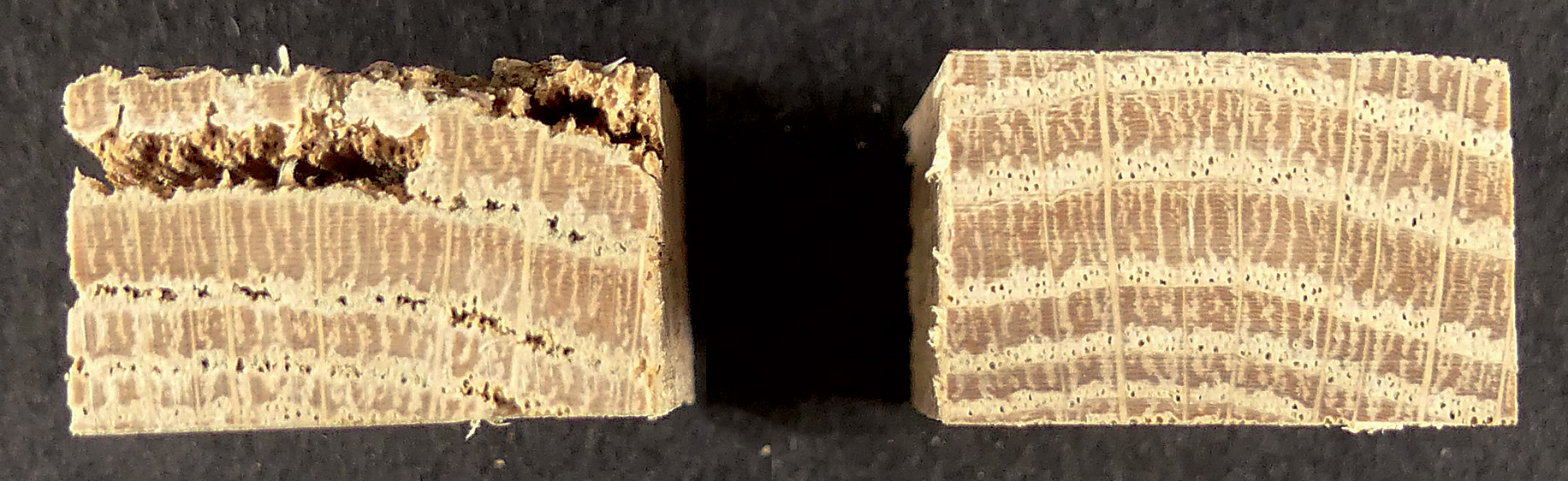
In these end-on views of two red-oak beams, the one at left shows that steam-bending failure occurred on the upper, tension side, in the weak earlywood pores, compared to an unbent beam (right). Even where failure has not occurred in the unsuccessful bend, the earlywood pores have become weakened and enlarged.
WoodenBoat reader Peter Collins Huber recently wrote, “I spend several days a week working as a volunteer in the boatshop of the Lake Champlain Maritime Museum here in Ferrisburgh, Vermont. Our work to build and maintain large rowboats (among these are 32′ pilot gigs and 25′ Whitehalls) regularly includes the involvement of teens from local high-school programs. The practical work of the shop also routinely calls for steam-bending white-oak frames and occasionally applying steam to assist the bending of white-pine garboards. To help our students, I try to be knowledgeable about what’s going on, including what’s up in the steambox. While I have some understanding of the fundamentals, I’d benefit from a deeper examination. My questions form along these lines: In steam-bending, how much of the effect is due to the presence of steam, of moisture, or of heat? If heat alone can be used to bend wood, then why use steam at all? Simply soaking wood in water can promote easier bending, but since that lacks both heat and steam, what’s at work here? What is the most effective way to bend wood in boatbuilding applications?”