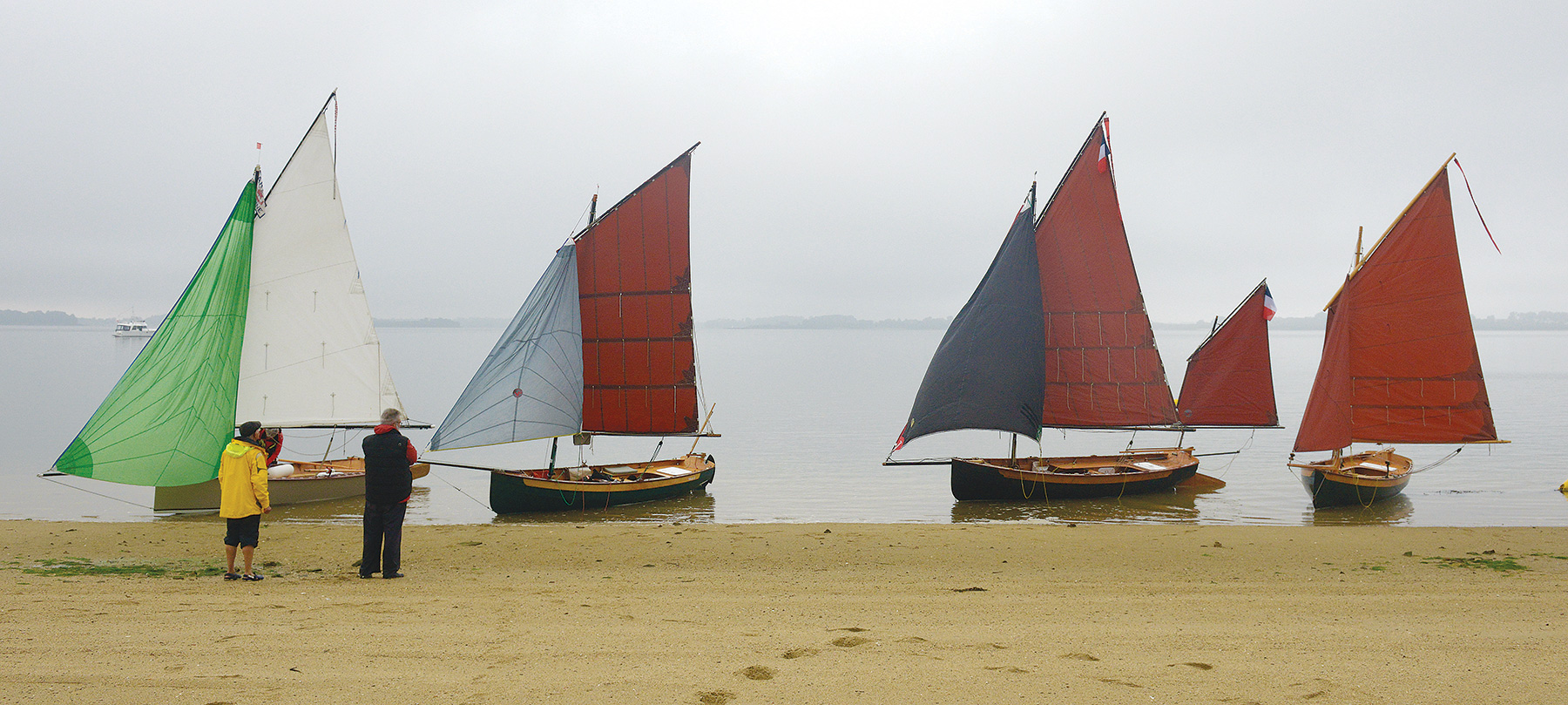
Goat Island Skiff EPIK, Silmaril TRUK 2, the Grand Silmaril VITAE BREVIS, and the Silmaril KERELEN 4.

Hauled up for a lunchtime break on a beach on the Île d’Arz in France’s Gulf of Morbihan are, from left to right: the Michael Storer–designed Goat Island Skiff EPIK, the François Vivier–designed Silmaril TRUK 2, the Grand Silmaril VITAE BREVIS, and the Silmaril KERELEN 4. VITAE BREVIS’s builder, Emmanuel Conrath, scaled up the Silmaril design by 10 percent, with Vivier’s blessing, to create the Grand Silmaril.

Four boats were tacking through the fog when I arrived at Arradon, in Brittany, on the northwest coast of France. Four brown sails and one white, all lug-rigged, faded in and out of view as they were swallowed up and then re-emerged out of the haze. It looked mysterious and strangely timeless, as if I’d just stumbled across a bunch of 16th-century smugglers waiting to load their contraband.

Monsieur Compton?” said the skipper of one of the boats, as it came alongside the pontoon. “C’est Emmanuel. Bienvenue à bord!

I lowered my camera bag into the boat and clambered aboard. No sooner had I sat down than we were off, heading south, away from land, in the company of the other three boats. As the fog closed in around us, the port of Arradon disappeared and we found ourselves surrounded by mist. We might have been headed off across the Atlantic for all we could see, though in truth we were very much near the safety of land, sailing “between the trees,” as one of the other skippers put it.

This was not what I had in mind when I contacted Emmanuel Conrath the week before on the off chance he might have a boat available for me to test while I was on an impromptu holiday in Brittany with my family. Yes, he said, but I would have to drive down to the Gulf of Morbihan to see it. I had seen photos of the famous Semaine du Golfe, an event that gathers more than 1,000 boats for a weeklong mix of regattas and cruises in the sheltered waters of what is essentially a large, enclosed bay, so I readily agreed. No one said anything about fog.

For the event, Emmanuel gathered not one but four boats: a 15′1″ (4.6m) Silmaril skippered by Denis Le Saicherre, who bought the boat in 2024; a second Silmaril built by Yves Monfort and Emmanuel in 2019 and skippered here by owner Yves; Emmanuel’s own 16′7″ (5.06m) Grand Silmaril, a stretched version of the design he built in 2022; and a Goat Island Skiff, built by Pierre Mucherie and Emmanuel in 2020—the third boat they’ve built together—and skippered by Pierre, who owns it.

Over the next few hours, I had the immense good fortune of trying out the three designs while sailing from island to island across a small section of the Gulf of Morbihan. Not only that, but the fog eventually cleared and we were treated to glorious sunshine, which was much more like the postcard scenes of my imagining.

It felt every bit like a mini-raid, and indeed three of the skippers regularly take part in raids all around France and Holland. I was possibly a little over-excited by this outing with my new friends; for Emmanuel and the others, it was just another jaunt in the exquisite archipelago that is their backyard. Four wooden boats, a beach, convivial company, a hunk of cheese, and some vin rouge…of such things are true happiness made.

The Silmaril prototype.

Emmanuel built the Silmaril prototype in 2013. The starting point for the design was the Whitehall skiff; it was beefed up for coastal cruising.

Emmanuel came to boatbuilding relatively late in life. After studying computer science and completing a master’s degree in business law at Loyola University in Chicago, he worked as an IT consultant for 30 years, including long stints in the United States and the Netherlands. Although the work was lucrative, he found it unfulfilling as he wistfully recalled his childhood messing around on boats in Brittany. His brother, Gilles, had devoted himself to traditional wooden boat building his whole working life, setting up a yard in Paimpol on the north coast of Brittany, and in 2006 Emmanuel took the plunge and joined him for a six-month apprenticeship.

“Having watched Gilles’ career develop over 30 years, I knew it would be a pipe dream to try to get into traditional boatbuilding at the age of 50,” he says. “But I still wanted to build beautiful boats—and for me that meant wooden boats.”

The solution, he decided, was to build epoxy-plywood dinghies. His first project was an 8′ plywood tender that he named ARWEN, after a character in one of his favorite novels, J.R.R. Tolkien’s The Lord of the Rings trilogy. Tolkien’s elf princess has to choose between remaining immortal or renouncing her immortality in order to marry a human, Aragorn—a predicament Emmanuel could relate to.

“The renunciation of a known, comfortable, but futureless situation in favor of committing toward a magnificent goal loaded with risk and sacrifice, as chosen by Arwen, seems to me a beautiful analogy for my business creation,” he wrote on his website. “That is, if one dares to compare the sacrifice of immortality to that of a good job in IT!”

Emmanuel at the helm of the Grand Silmaril VITA BREVIS.

Emmanuel at the helm of the Grand Silmaril VITA BREVIS. For steering while sailing singlehanded, the helm has control lines on each side that run forward to the mast.

Emmanuel’s first Arwen dinghy sold before it was even finished and, when he displayed it at the Grand Pavois boat show in La Rochelle, he promptly sold it again—this time to a South African couple who wanted to it take home with them right away. He quickly built a second boat for the original buyers.

Emmanuel’s plan was to be a boatbuilder, not a boat designer. In order to develop a range of boats, he teamed up with John Harris at Chesapeake Light Craft (CLC) in Annapolis, Maryland—which was by then already the largest manufacturer of kit boats in the world—to become the company’s French agent and builder. In 2007, he set up a workshop on the Oise River, 50 miles north of Paris, and so Arwen Marine was born.

Emmanuel’s first CLC collaboration was a 15′ Chester Yawl, a classic Whitehall-type rowing dinghy. That was followed by a long line of skiffs, dories, kayaks, prams, and sailing dinghies. Over the past 17 years, he has built about 130 boats—first at his workshop near Paris and since 2023 at his new base in Plougoumelen, near the Gulf of Morbihan. He has averaged about eight boats a year, most of them designed by Harris. His biggest project so far has been a 16′ Gabian, a double-ended Mediterranean fishing boat designed by François Vivier; his smallest is a 3′10″ cradle boat—a scaled-down CLC Eastport Pram mounted on rockers.

The Goat Island Skiff EPIK.

The Goat Island Skiff EPIK, under construction in November 2020, shows a modified centerboard trunk and wide inwales for hiking out.

For his own use, he built a 15′ Harris-designed Skerry, which appealed to him because it “looks like the designer has simplified the design and taken out every part that is not strictly necessary.” He loved that boat so much that in 2012 he decided to build a larger version, scaling up the design by 20 percent to create the 18′ GANDALF (no prizes for guessing where that name came from). The Grand Skerry, as the design was called, was followed in 2019 by a Goat Island Skiff designed by Michael Storer, which Emmanuel spotted online and says he was “stunned by mix of modern hull and traditional rig.”

For his most recent boat, Emmanuel went back to his first love: the Whitehall skiff. While he loved the shape of these boats, he knew they were too narrow to sail in the offshore raids that he was increasingly drawn to. Instead, he asked Vivier to draw a boat based on Whitehalls but with some special characteristics.

“I wanted six strakes per side, a flat bottom, water ballast, all plywood to save weight, and 15′ maximum length,” he says. “I wanted the boat to still be as narrow as possible, so that it would row well, but sufficiently beamy to sail well too. Because dinghy cruising is the thing to do with these boats. You sail to a nice beach, you pull the boat out of the water, and you sit there a while. That way, you can travel rather far; you just have to find a reasonably sheltered beach every few miles.”

Emmanuel built and quickly sold the first Silmaril (named after the three jewels in Tolkien’s book The Silmarillion) in 2013, but in 2022 he returned to the design and, inspired by the success of his Skerry magnification, decided to build a bigger version by scaling up the original lines by 20 percent. “If a boat is sufficiently narrow, and not too beamy,” Emmanuel explains. “You can enlarge it and you won’t have a monster.”

Vivier wasn’t happy about a 20 percent increase in size but eventually agreed to a compromise of 10 percent. To put that in perspective, a 10 percent increase in length results in a 33 percent increase in volume, while 20 percent more length means 73 percent more volume. No wonder Vivier was nervous.

VITA BREVIS.

VITA BREVIS is a wolf in sheep’s clothing, with water ballast and carbon-fiber spars belying her traditional color scheme.

It was the 16′7″ Grand Silmaril that I stepped into at Arradon, soon to be engulfed by fog. Unlike several previous boats, this one wasn’t named after a Tolkien theme but has a more philosophical root: VITA BREVIS, from Ars longa, vita brevis (Art is long, life is short), the Latin version of an ancient Greek aphorism, meaning that skills take a long time to acquire and there may not be time to become truly proficient in one lifetime.

There was only a light breeze blowing on the Gulf of Morbihan that morning—not enough to really put the boats to the test, but enough to reveal something important about the Silmaril concept. While VITA BREVIS’s black hull and tan sails looked traditional enough from a distance, she wasn’t (as I momentarily feared) yet another pastiche of “ye olde clinker dinghy,” which often give wooden boats a bad name. Quite the opposite. The design’s Whitehall origins mean that, with her water ballast tanks empty, she sits daintily on top of the water and responds to the slightest puff—or so it seemed as we sailed quietly across the bay in the gentle morning breeze.

The numbers say it all. The total weight of the Grand Silmaril, including sails, carbon-fiber spars, and oars, comes to 350 lbs. By contrast, a standard Laser 16 weighs over 700 lbs. Fill VITA BREVIS’s ballast tanks with 140 liters (37 gallons) of water, which adds an extra 308 lbs, and the boat becomes quite a different beast: steady, yet powerful.

Goat Island Skiff EPIK.

A lightweight gennaker set on a carbon-fiber bowsprit more than doubles EPIK’s sail area, compared to a standard Goat Island Skiff.

Although the boat is barely three years old, its rig has already been through several incarnations. The original sail plan shows a lug main with a jackyard topsail set above it—in the style of the famous French bisquines—giving a very manageable 107 sq ft of sail. But Emmanuel went to the opposite extreme, adding a jib and staysail on a 2.5m-long (8′2½″) bowsprit, plus a mizzen and boomkin, bringing the sail area up to 205 sq ft. By the time I sailed the boat, the bowsprit had been cut back to a mere 2m, or 6′6½″, (though it still looked improbably long to my eyes) and the twin headsails had been replaced by either a small jib or a large gennaker. Even that, Emmanuel told me, was a bit much.

“You gain a lot of speed, but you pay very dearly in complexity,” he said. “Since I mostly sail on my own, the boat was much simpler before, and whatever gains I’ve made are costly in maneuvering time. In future, I will leave the mizzen off and just keep the mainsail, jib, and gennaker.”

There are said to be about 40 islands in the Gulf of Morbihan, in an area about 1/100th the size of the Chesapeake Bay, where CLC is based. There are many more rocks that are submerged at high tide, requiring careful navigation. Emmanuel had a tiny handheld GPS, which helped us navigate through the fog, as well as a small compass, though mostly he seemed to use his nose, having sailed these waters dozens of times before. The main hazards are oyster beds, which provide the area’s main source of income, and extensive yacht moorings, another important source of income. Most of the islands we passed had lines of oyster beds off them marked out with sticks and flags that would be easy to miss in the fog or the dark.

The hiking-out seat and a moveable cam cleat.

Emmanuel and friends are constantly trying out new things, including the hiking-out seat and a moveable cam cleat shown here.

We had by now lost sight of Pierre on his Goat Island Skiff, EPIK, but a quick call on the hand-held VHF, which all the skippers carry, re-established contact. Watching Pierre sail his boat toward us was like observing a demonstration of man-machine coordination. He was constantly on the move, sitting on the thwarts or the gunwales or standing up, continuously adjusting his body to the angle of heel and the pressure of the wind, as if the boat was an extension of his body. It looked both athletic yet also quite exhausting. Did the boat really require so much attention or was this just Pierre’s personal style? There was only one way to find out.

The next time EPIK came near, we drifted alongside and I climbed aboard. I’ve long admired the Goat Island Skiff (GIS) and been intrigued by its deceptively simple design. It seems incredible that such a basic flat-bottomed hull can perform so well—speeds of over 20 knots are often claimed—and I’ve often wondered what the downsides might be.

My first impression once aboard was the difference in scale of the two boats. Although only 1′2″ shorter than the Grand Silmaril, the GIS has a very different feel, with nothing like the volume of the French boat. Again, the numbers say it all, with the GIS weighing a mere 128 lbs compared to the Grand Silmaril’s 350 lbs. The result is a more easily driven hull but also less protection from the elements. Climbing from VITA BREVIS onto the GIS felt like changing from a jacket to a T-shirt.

“It’s a nice boat to play on,” says Pierre, a retired Air France pilot. “It’s not very stable, but that’s why it’s fun. Before, I had a Pirmil built by Canotage de France, which was much more traditional,” and much heavier, at about 600 lbs. “This one, you always have to take care. I’ve been sailing it for about 10 years. I like to sail between the trees—by which I mean inland, not out at sea. I like this boat because it’s very light and easy to use it. I sail on my own most of the time. It’s easy to adjust, and to make everything as you want.”

Not that EPIK is a typical GIS. Pierre and Emmanuel couldn’t resist adding an outlandishly long bowsprit, from which a huge green gennaker can be set, adding 114 sq ft to the standard 105-sq-ft sail plan—something he made good use of in the light airs on the Gulf of Morbihan during my visit. They also changed the conventional daggerboard to a pivoting centerboard—as devised by François Vivier—which installs just like a daggerboard but can pivot into a centerboard trunk once inserted. Both the builder and skipper felt this was absolutely necessary for sailing in the gulf, where submerged rocks are plentiful and hard to spot, and running into them with a dagger­board could cause serious damage.

The wind died soon after I swapped boats, so Pierre was able to demonstrate how well the GIS rows. He has a sliding rowing seat that just sits on top of the thwart when in use; he’s rigged lines to hold it in place but finds they are never needed. The GIS’s lightweight hull is well-suited to rowing, and Pierre was soon putting the boat through its paces, once again showing the same man-machine synchronicity he displayed under sail. Things went less well when I took over the rowing—possibly because I’m not used to a sliding seat—and the boat stuttered toward the shore.

I was reminded of something Emmanuel had said to me earlier: “A boat’s performance is always a combination of boat and skipper. If people say a boat is fast, you have to think about the skipper. If people say a boat is tippy, it’s same thing.”

The plan had been to go to Ilur Island, the namesake of one of Vivier’s better-known designs, thanks to the adventures (and videos) of the British author Roger Barnes, but with the wind dying we decided to pull in at a beach called the Plage de Brouhel at the far end of the Île d’Arz. The beach would have been teeming with tourists in summer, but on a Tuesday morning at the end of October we had the place to ourselves. We didn’t see any other boats during the entire day, apart from a couple of ferries right at the end. We were, as Emmanuel put it, maîtres du monde—masters of the world—at least for a short while.

A sliding seat in TRUK 2.

Yves has fitted a sliding seat in TRUK 2 to facilitate rowing, an important element of the raid concept.

With the boats pulled up on the beach, this was a chance for the skippers to examine each other’s craft, compare notes, and chat about future plans. The Challenge Naviguer Léger (CNL) is an informal raid initially sponsored by Le Chasse Marée magazine; it changes location each year, and was high on the agenda. For years, I’ve been trying to report on it, but the timing has never been quite right. Now, by pure accident, I found myself sharing a bottle of wine with some of the core participants. Emmanuel has attended all 10 editions of the CNL—once in his Skerry, three times in his Grand Skerry, four times in his Goat Island Skiff, and twice in his Grand Silmaril—and he built five of the dozen boats that took part in 2024. Pierre has also taken part in all editions of the CNL, including four times in EPIK, while Yves has taken part seven times, mostly in TRUK 2.

Silmaril TRUK 2.

Retired teacher Yves Monfort ghosts along in his Silmaril TRUK 2. Carbon-fiber spars are now standard on all of Emmanuel’s boats.

This active engagement with the raid community means that Emmanuel and friends are constantly looking at ways of improving the boats they use, either by trying out different designs or experimenting with different rigs, as in the case of VITA BREVIS, or inventing new bits of gear, such as moveable sheet blocks or cleats. In the same vein, the gunwale of Pierre’s GIS has been widened to allow him to hike out, and he’s trying out rolled-up bedding and fenders to make it even more comfortable.

Building boats is much more than just a job for Emmanuel, and the line between “customers” and “friends” can become blurry. As he himself puts it: “I haven’t made any money building boats, but I’ve made nice friends. That’s a good tradeoff.”

Denis Le Saicherre’s 2015 Silmaril KERELEN 4.

The old and the new: Denis Le Saicherre’s 2015 Silmaril KERELEN 4 (right) still has her wooden spars, though he plans to switch to carbon fiber soon.

Emmanuel’s next challenge is building an even bigger Silmaril, the full 20 percent increase he originally wanted, which he’s provisionally named the Mega Silmaril. François Vivier has given his tacit approval to the idea, and Emmanuel hopes to have it ready in time for the 2025 CNL. Is he biting off more than he can chew? Time will tell.

I joined Denis, a retired high-school teacher, on his “standard” Silmaril for the return journey to Arradon. He is new to this type of sailing, and was modest about his boat’s performance, fitted as she was with wooden spars and a small jib. He had come down to the Gulf of Morbihan from his home in northern Brittany to pick up a set of carbon-fiber spars that he hoped would improve the boat’s performance. Since 2019, Emmanuel only offers his boat with carbon-fiber spars. The extra expense of this, he says, is worth it for the time he saves gluing, shaping, and varnishing wooden spars, as well as producing a much lighter and stronger product.

Despite his misgivings, and being doublehanded with a smaller rig, Denis’s boat seemed to find an invisible zephyr and glided past the other three in its own bubble. It didn’t last, of course, and soon the wind dropped completely and it was time to get the oars out for the last mile and a half back to the dock. I transferred to Emmanuel’s boat and took up the oars, expecting I might flag after a few strokes. But the Silmaril’s Whitehall origins came to the fore and I found her an absolute pleasure to row. Indeed, I could have carried on for much longer had we not been constrained by time and tide.

Emmanuel, Pierre, and Yves sail on their home waters of the Gulf of Morbihan.

Emmanuel, Pierre, and Yves sail on their home waters of the Gulf of Morbihan. All three are veterans of France’s burgeoning raid scene, including the popular Challenge Naviguer Léger.

By now the mist had cleared, and I disembarked at Arradon in glorious sunshine. The other boats were already headed to a nearby slipway to haul out, and after a brief au revoir, Emmanuel headed off to join them. With the mainsail lowered, VITA BREVIS was tricky to row, so he took one of the oars, placed it in the notch in the transom, and proceeded to scull expertly. As he headed up the coast, I thought about the remarkable journey he’s been on, from an international career in IT to commissioning, building, and navigating his own boat across the Gulf of Morbihan. And he’s not finished yet for, as the sayings goes: Ars longa, vita brevisArticle ends.


Nic Compton rowing the VITA BREVIS.

Nic Compton takes the oars of VITA BREVIS for the final leg of his outing.

Nic has reported on three raids: the Blekinge Archipelago Raid in Sweden twice (see WB No. 187) and the Lakeland & Inland Waterways Raid in Ireland (WB No. 230). He was also part of the reconnaissance for a raid in Poland that never happened. Nic is a regular contributor to WoodenBoat.