
A Letter From The Author
Dear Readers,
My most recent Sketchbook offering, in WoodenBoat No. 297, was for an electric-powered catamaran. The concept generated some enthusiasm, but my description of it also pointed out some of the shortcomings of electric power versus gasoline power. I wrote that “1kg of gasoline contains 13kWh of energy. That is almost 80 times more than the ubiquitous lithium-ion battery. It’s a truly massive difference, and unfortunately it is the reality we must contend with today.” I noted that there are many ways to travel effectively with electric marine propulsion, including “slowing the boat down, reducing the range, increasing displacement to allow for a large battery pack, and choosing the most efficient motors available.” I added to that list an efficient hull form and explored that idea with that issue’s concept, the eCat.
That article made it seem that pure electrical propulsion was less than ideal in practice, especially for semi-displacement and planing hulls. With this Sketchbook, I’ll explore the idea further with a boat that presents a workable compromise for a sustainability-minded boatbuilder.
—JF Bedard
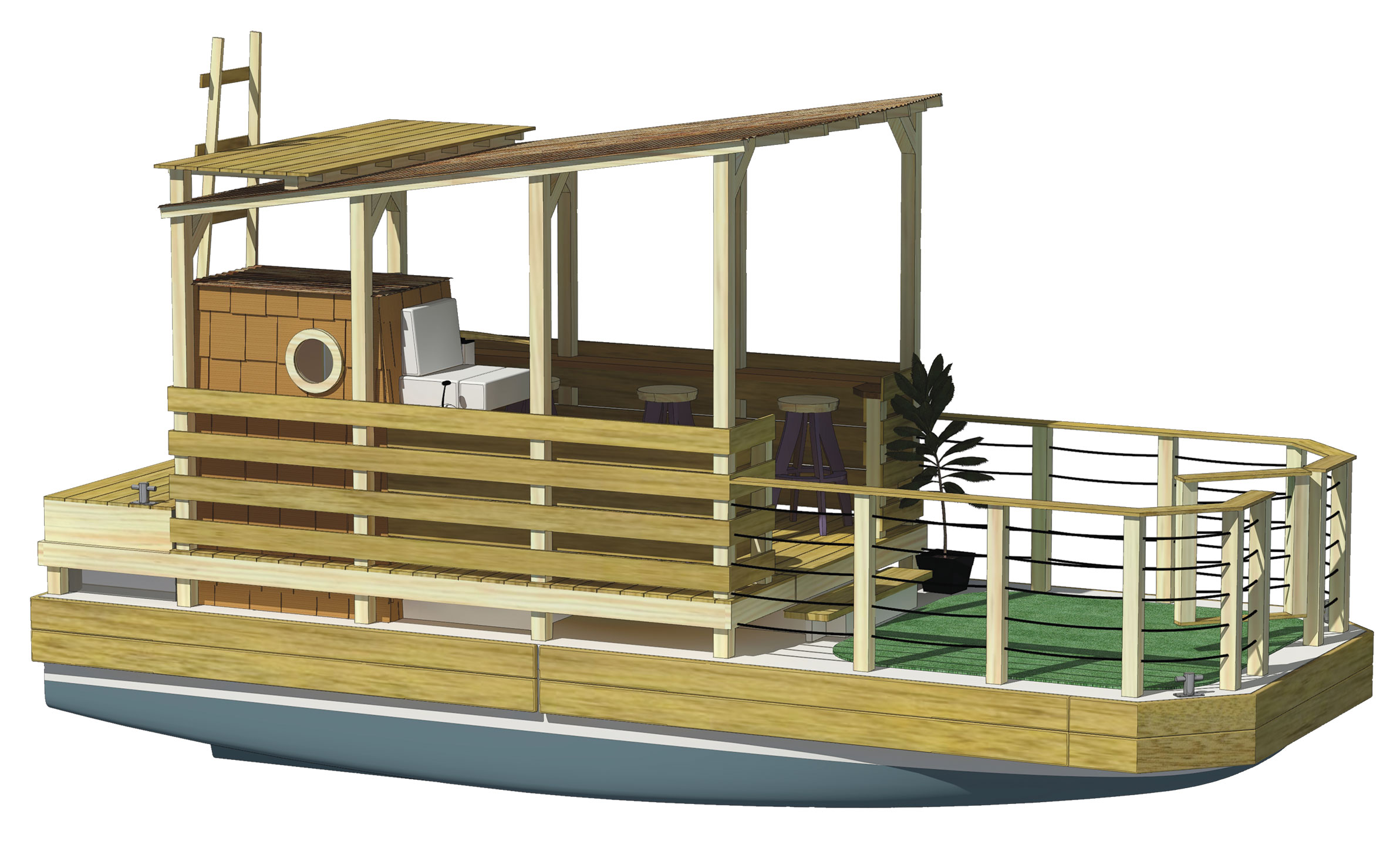
HUCK’N’JIM combines elements of pontoon boats and tiki boats, but updates them with a distinctly Americana style.
Introducing HUCK’N’JIM
One accessible solution to integrating electric propulsion into recreational boats, while not relying entirely on large battery banks, is hybrid power—specifically, diesel-electric propulsion. To study such a system, we need a boat, and I think I have the perfect candidate in my back pocket. She is the lovechild of the ubiquitous pontoon boat and a tiki boat. I had doodled her for a client who eventually decided against moving forward, but I’m quite fond of her and think that her design brief is a perfect fit for our diesel-electric experiment. She is a day boat for a lake or river, with the ability to explore shallow areas and quietly approach wildlife or simply anchor in peace up a creek in 2′ of water for an afternoon. The styling is a variation of the tiki boat idea—which is essentially a floating, thatch-roofed patio—but it has a definitive Americana twist. It is somewhere between a shantyboat and Huckleberry Finn’s raft. Based on this admittedly loose association, I’ll name her HUCK’N’JIM.
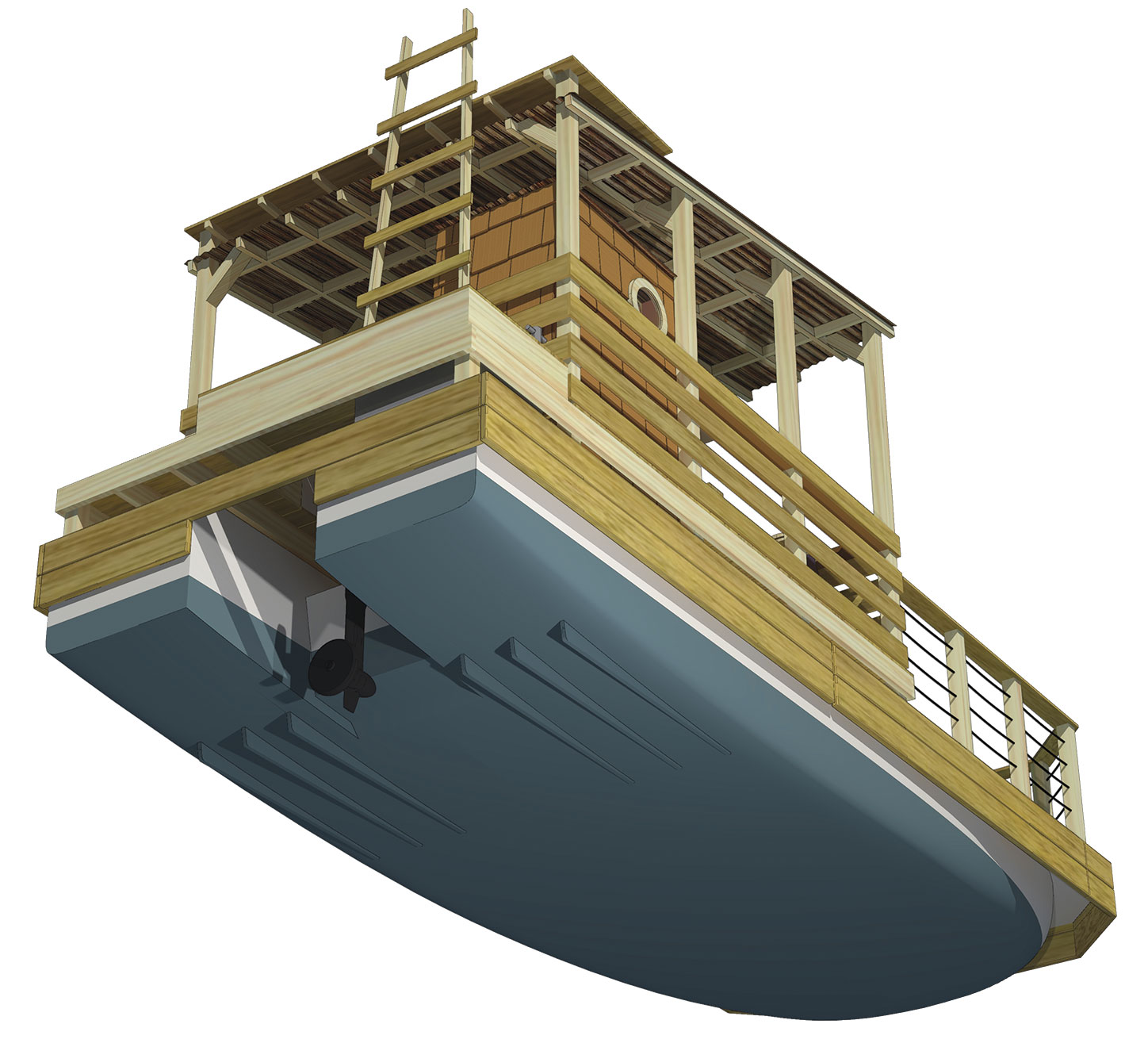
The outboard motor lives in a tunnel and can be raised for shallow-water operation. Six shallow skegs aft will counter the boat’s tendency to slip sideways in a crosswind.
Hull
The goal of the design is comfort rather than speed or efficiency, and this allows us to maximize hull volume. A simple plywood barge would do the trick and would be extremely quick to assemble, but it might be wet from spray slapping the forward topsides. A nice, rounded scow entry maintains lots of volume outboard, which translates into stability. The after end of the bottom sweeps up but not quite to the waterline, a signature feature of a semi-displacement hull. The hull speed for a craft of this length is 6.4 knots, and I’m designing for a top speed of under 8 knots.
The outboard motor is hidden in a tunnel, which maintains volume aft, and you’ll notice the shallow bottom notch forward of the outboard—a tunnel-within-a-tunnel of sorts. This allows the motor to be raised for shallow-water operation.
HUCK’N’JIM has quite the large, flat bottom and precious little lateral area, so I’d expect that directional stability and docking in a cross-breeze could be a challenge. To counter this, I added six shallow skegs, three per side, which should mitigate the worst of it.
A fully loaded displacement of 8,500 lbs accommodates the genset, the propulsion battery, and a 25-gallon diesel fuel tank, while still allowing us to invite 12 of our best buddies for an on-the-water barbecue. This is reflected in a displacement-to-length ratio of 314, which is decidedly on the high side.
The rubrail, consisting of a pair of stacked pressure-treated 2×6s, reinforces the boat’s character while doubling as an effective sprayrail. The hull is capped with a watertight deck.
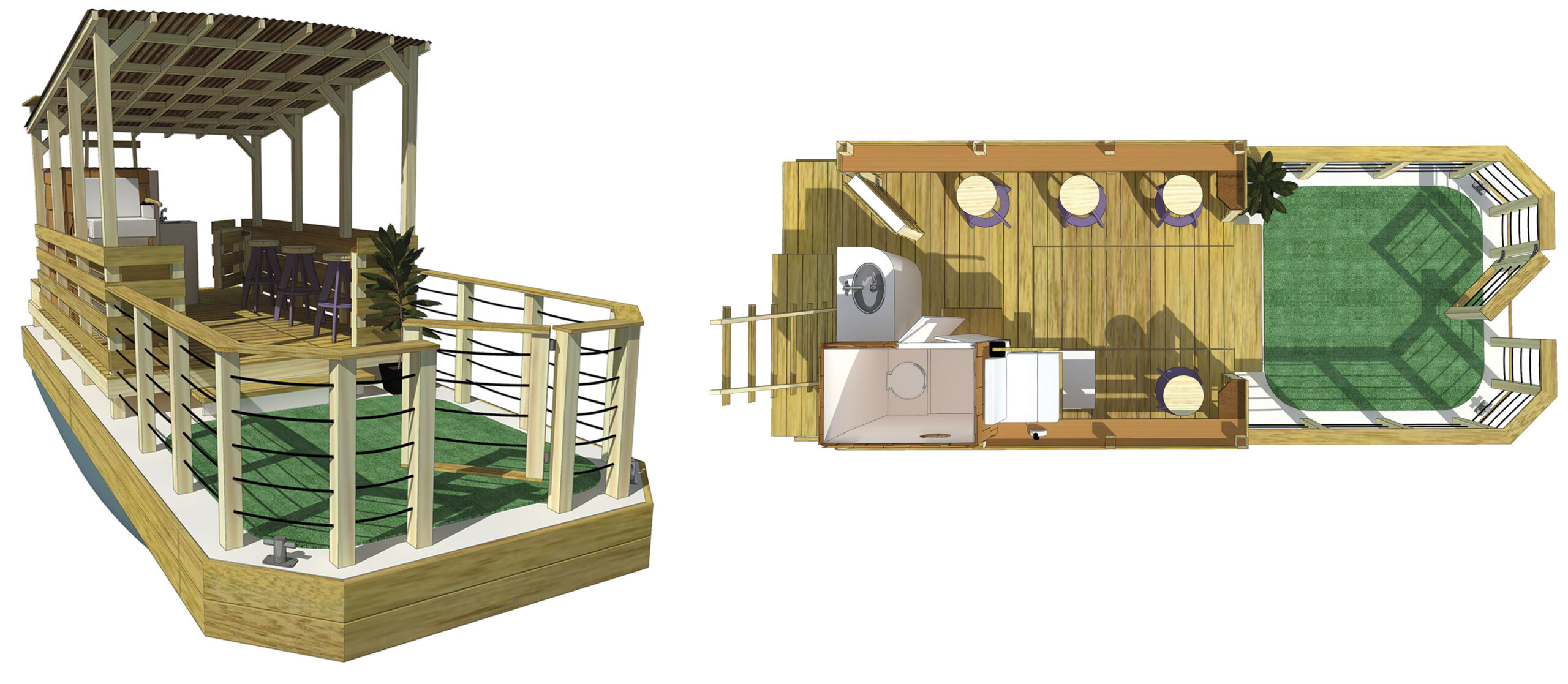
Left—HUCK’N’JIM is like a floating garden shed built of hardware-store lumber.
Right—The gazebo-like main passenger area includes a bar with fastened-down stools, a sink, and a head.
Layout
This is where it really gets fun. I wanted a deck layout that screams, “Take your time, what’s the rush? Life is not that serious!” This boat is like a floating garden shed built of hardware-store lumber, with an outboard clamped on the stern.
The main passenger area is elevated and built like a typical gazebo, and is enclosed by a wooden privacy fence, on top of which is a narrow bar to put drinks. The helm, to starboard, is further elevated so the skipper can see over the guests, and the fact that the head is recessed allows a clear 360-degree view from the helm. Probably my favorite aspect of the design is the absence of a console cocooning the helmsman. A throttle to the skipper’s right (mounted on the bar) as well as a decoupled tiller to the left keeps the operator within the social circle. Should there be a need for a small GPS, we’d gimbal-mount it on the bar as well, just forward of the throttle. This will keep the vibe very informal.
The head is clad in cedar shingles and roofed by a corrugated tin panel, and recessed by two steps. Inside is a manual toilet discharging into a 20-gallon holding tank. The sink is actually on deck, outside the head, for the very simple reason that the outboard motor, when tilted up, needs a bit more clearance than the elevated deck offers, and the sink vanity conceals this space. The entire deck area is roofed by corrugated-steel panels over a conspicuous lumber structure. The aft gate leads to a small sundeck, and a step up to starboard over the fuel tank serves as a base to the ladder leading to a crow’s nest. Teenagers young and old will no doubt use this as a diving platform. The foredeck is accessed via a large step down to an Astroturf carpet on the weather deck, which will set the mood like nothing else. I envision this area populated by a few bean-bag or lounge chairs, as well as secured bar stools.
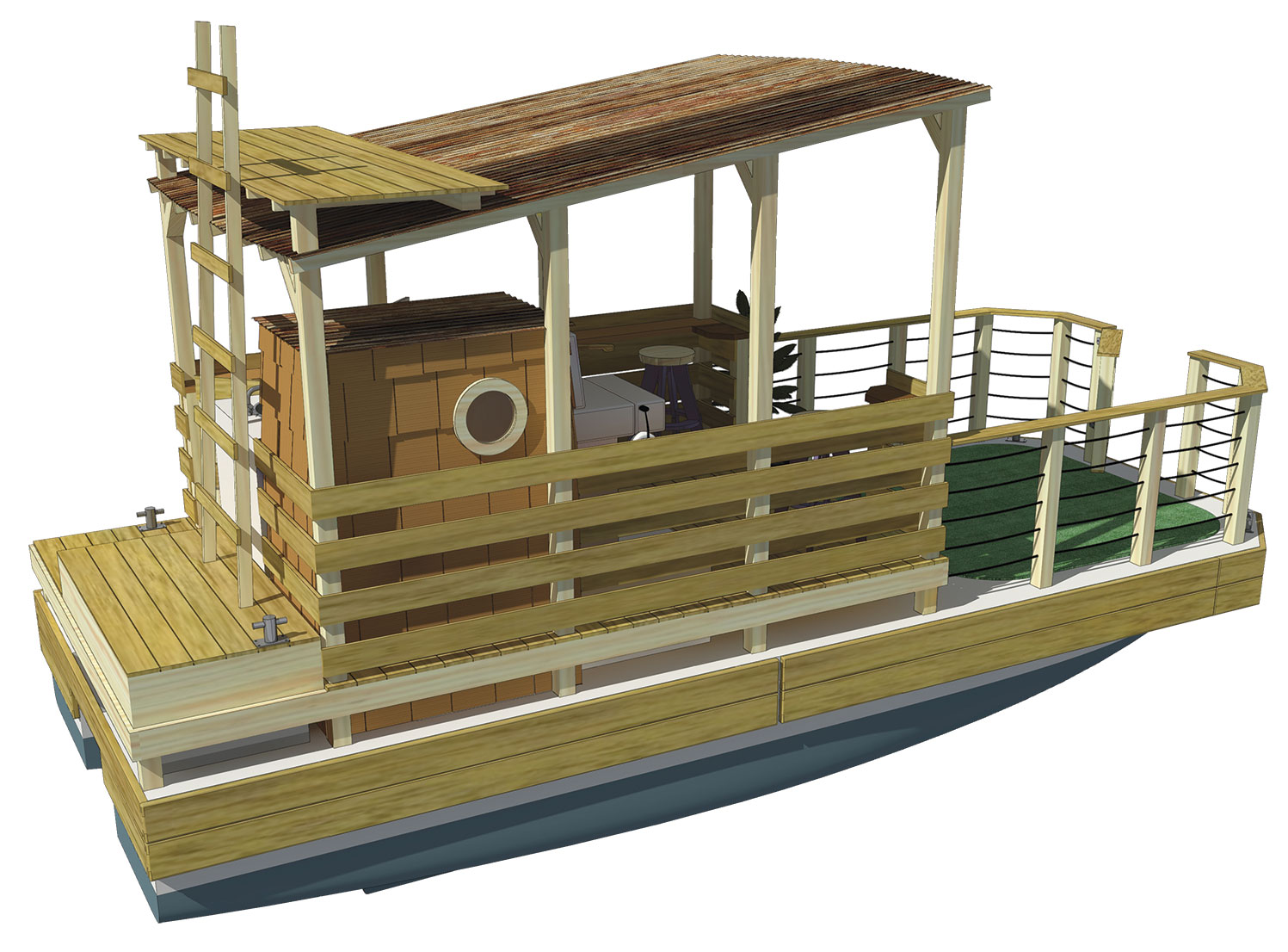
The passenger deck is protected by a corrugated roof. There’s a crow’s nest up there, accessible by ladder.
There is a large hatch amidships that opens via block-and-tackle, through which one can access the generator, propulsion and house batteries, and other systems. The small and simple electrical panel is mounted to the side of the helm seat; it can be removed for access as well.
Propulsion
I’m not proposing anything new, modern, or revolutionary for propulsion. Diesel-electric has been used in submarines for a very long time—since 1904, to be precise. That’s how tried and true this technology is.
I would venture that the main reason for considering hybrid propulsion in the 21st century is to reduce average fuel consumption, but in our case this might not be the driving factor. In fact, the serial hybrid setup I’m proposing here is not as efficient as a parallel system. No, the main driver in this case is that we can use the boat in one of two distinct modes: range or stealth. Each offers advantages that the other does not, much like pre-nuclear submarines.
When you expect anything less than a range of 40 miles per day, you can use battery power exclusively. You don’t even have to plan carefully, because if the battery runs low the genset will just pop on. On days that you expect to cover more ground, just pick the times when you want peace and quiet; then run the diesel the rest of the way. This system is really a diesel-battery-shorepower hybrid, the first 40 miles of every cruise being powered by the grid. For trips of that length, leave with a full battery, return it nearly empty, and let it recharge at the dock. I find this versatility appealing and expect that it should increase the boat’s usage. The generator takes range anxiety out of the equation, yet there is a real possibility that 75 percent of the boat’s use will be exclusively battery-powered.
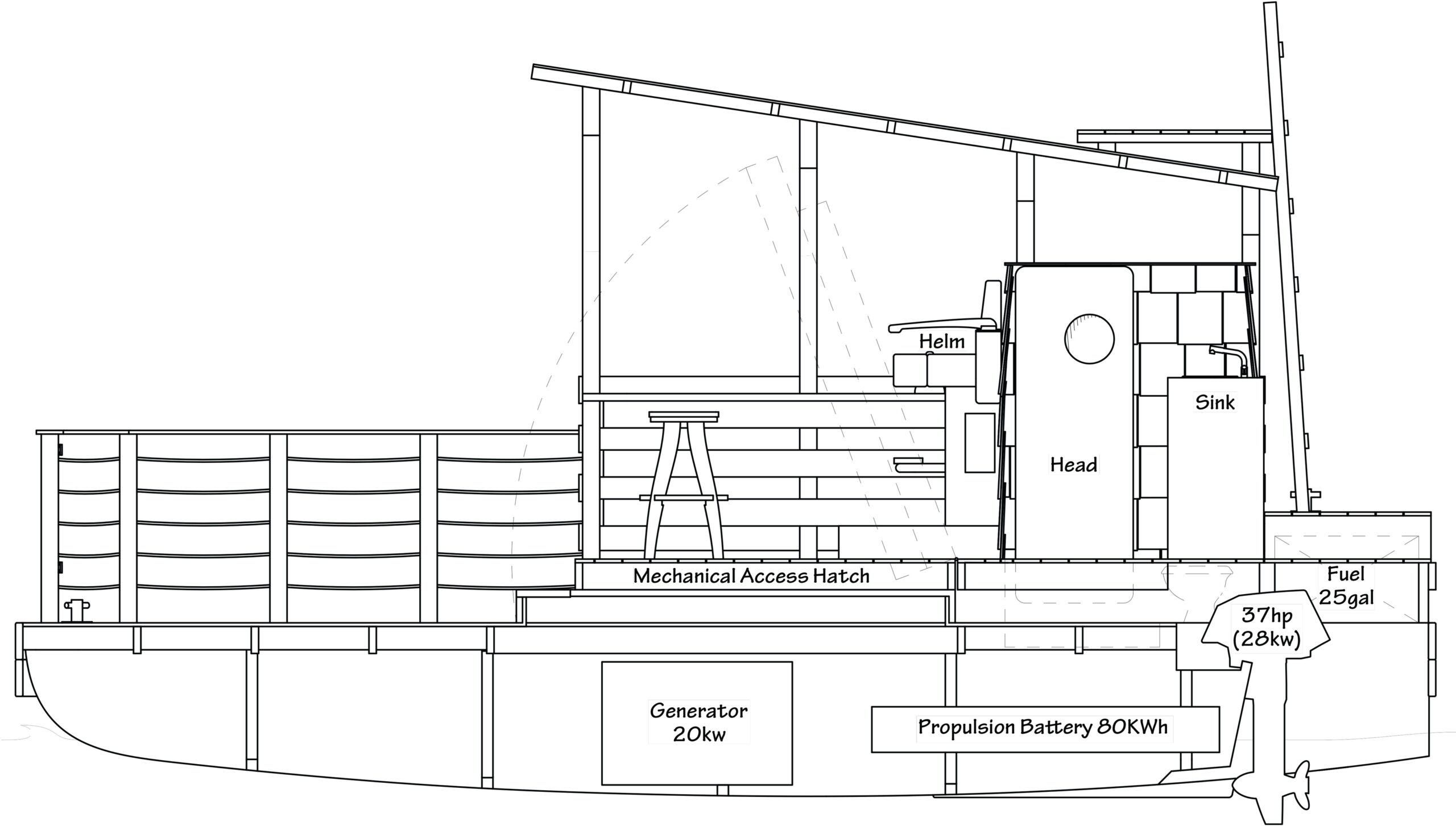
A diesel generator and propulsion battery live low in the scow-like hull. As battery technology advances, the hybrid system might be replaced with an all-electric one.
Particulars of HUCK’N’JIM
- LOA: 24’1″ (7.4m)
- LWL: 22’11” (7m)
- Beam: 9’6″ (2.9m)
- Draft: 1′ (0.3m)
- Displacement: 8,500 lbs (3900kg)
- Power: 37hp (28kw)
- Battery: 80kWh
Here are some numbers: A 37-hp (28kW) electric outboard motor will propel HUCK’N’JIM to her maximum speed of 7.8 knots; at that speed, the generous (i.e. heavy and expensive) 80kWh battery will last only 22 nautical miles. At the other end of the spectrum, our 27-hp (20kW) genset which, after accounting for various losses, is more like a 22-hp conventional shaft-driven power plant, should develop 6.8 knots, or a range of 71 miles on the 25-gallon tank.
Note that the internal-combustion engine is not powerful enough to bring the boat to top speed, but I don’t think that matters when we consider the big picture. We have a theoretical range of 93 miles when traveling above hull speed (7–8 knots)—one-fifth of it at full throttle. Not many people will range 90 miles on a day trip. As a matter of fact, I bet the majority of days don’t add up to 30 miles. That means most day trips will be pure-electric. Now drop to hull speed, 6.5 knots, and the range climbs to a respectable 123 nautical miles. And if you and Joey want to do the Huck Finn thing and float down the river for a week, stow a few jerrycans of dinosaur juice and eliminate range anxiety. That’s not to say that Huckleberry Finn wouldn’t have charged his raft overnight at a marina if the option had been available to him, so why shouldn’t you? The point is you can go and you don’t have to worry.
That’s why, in my opinion, hybrid power, despite not being as sexy on paper as pure electric, is an excellent option in real-life 2024: There’s no range anxiety, no range limit, no forced downtime due to charging, yet near 100-percent battery-powered propulsion on most days. And consider this: If next year a new battery technology mitigates the issue of range, just remove the genset and old battery, and swap in the new battery.
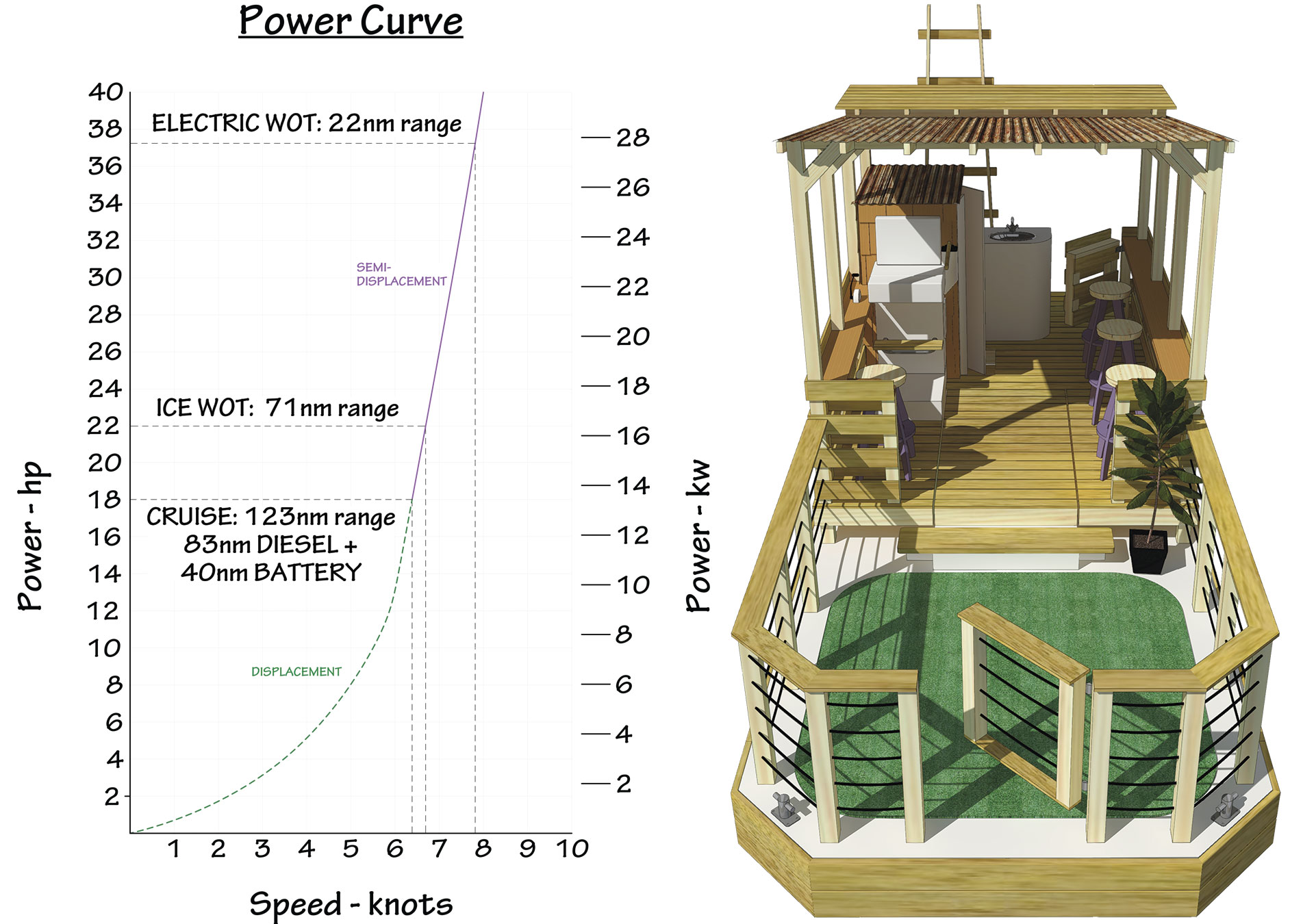
Left – HUCK’N’JIM will reach a maximum speed of 7.8 knots with a 37-hp (28kW) electric motor and have an electric-only range of 22 nautical miles at that speed. The genset will yield 71 miles at 6.8 knots—with a 25-gallon fuel tank.
Right – The passenger deck is built of pressure-treated lumber. The “stanchions” are 4×4 fence posts. These elements are meant to weather to gray and to be easily replaced as needed.
Construction
HUCK’N’JIM will be a very simple boat to put together. The passenger deck will be especially easy, which is why I don’t mind making the hull a bit more work. We’ll strip-plank her with 5⁄8″ western red cedar, sheathed in a couple layers of 6-oz cloth outside and a single one inside. Deckbeams are 1½” × 5½”, 24″ on center and frames are 2¼” × 2¼”, 48″ on center, both fir. The weather deck is ¾” meranti marine plywood.
The passenger deck is made entirely of dimensional pressure-treated wood, left unprotected to acquire a weathered look. The verticals are 4×4 fence posts, joists are 2×6 (as are the rubrail and bartop), deck planking is 1×6. The canopy structure is made of 2×3 dimensional lumber. The structure of the head is ¾” meranti marine plywood, covered with cedar shingles. Once individual boards become unsafe or too old, just replace them and bask in patchwork glory.
HUCK’N’JIM would be a fun and laid-back boat to build and own, and she would be very practical to use. Her propulsion system could be retrofitted on existing boats, big and small, for a variety of applications. I hope I’ve made a good argument for thinking green, yet keeping our feet rooted in today’s reality. Remember: Whoever watches the wind will not plant; whoever looks at the clouds will not reap. 

JF Bedard is a graduate of the Westlawn Institute of Marine Technology. He owns Bedard Yacht Design of Tarpon Springs, Florida.
Send concept proposals for Sketchbook to sketchbook@woodenboat.com.