
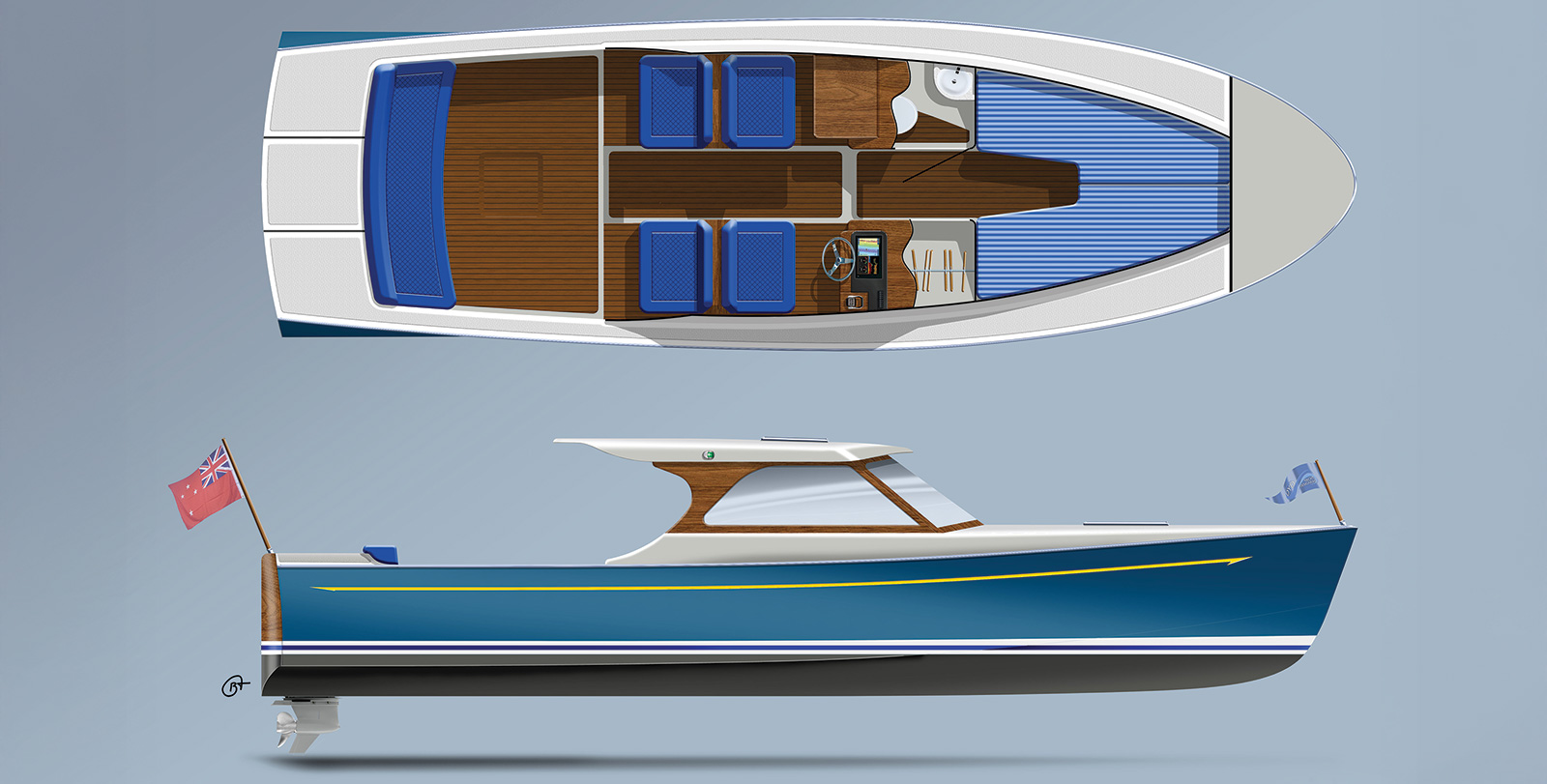
The Kevin Dibley–designed Weekender 28 is traditional in its styling but imitates nothing. Moderate outboard power and a dayboat layout provide a perfect combination for current-day needs.
Most designers struggle to keep up with changes in market demand, technology, and cultural trends. Very few are out in front, leading the way to something new. The sweet spot is somewhere in between, adapting to new technology and requirements while sympathetically updating traditional styles. Kevin Dibley’s new Weekender 28 lands in this sweet middle ground; it is identifiably traditional but imitates nothing. It’s a very attractive boat.
The coupling of sheathed plywood construction, moderate-sized outboard power, and a traditional sheerline with a dayboat’s layout seems the perfect combination for our times. While many modern outboard boats are high-sided and aggressively hard-edged, the Weekender has relatively low freeboard and minimal superstructure with a soft, curving housetop. The graceful appearance makes a promise about performance; it will be comfortable and quiet. Obviously not intended for high-speed offshore distance runs, this boat will be perfect for day trips or evening cruises with family and friends in semi-protected coastwise waters. The Weekender raises visions of dropping the lines and idling out of the bay for a half-hour evening cruise in flat-calm summer weather, going no place, just being on the water.
This sheerline is worth some study. In profile, all the bend seems to be bunched up amidships. It’s not what I would do, but luckily for us, creative talent is diverse and there are endless solutions to a given set of requirements. The computer renderings from the designer show that once our viewpoint moves forward or aft and above or below the straight profile, the sheerline becomes a sinuous and attractive S-curve. This magic is partly due to the Weekender’s beam; the sheer is a three-dimensional curve, and beam changes how the ends of the sheer appear. A hull with moderate beam can have a flatter (when viewed in profile) sheer and still appear shapely.
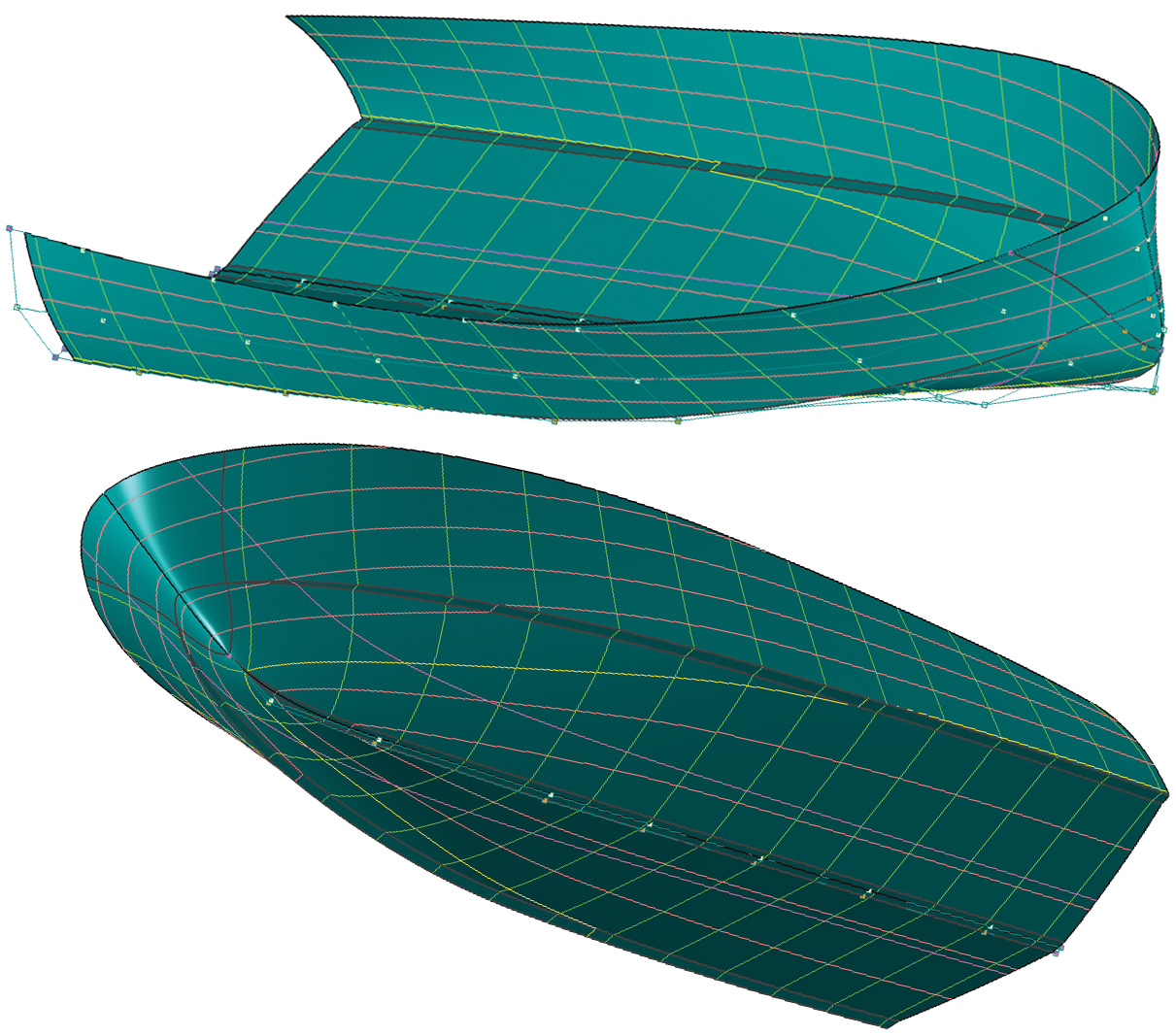
This will be an easy hull to propel, with its narrower-than-usual shape and light displacement.
Length-to-beam ratio for the Weekender’s running bottom is 3.3:1, while today we often see runabouts with length-to-beam ratios of 3.0 or less. A narrower shape eases the boat’s transition from displacement up through the speed range to full planing. Total weight or displacement also plays a role here, because weight will be commensurate with drag or resistance. The Weekender’s displacement-to-length ratio at half load is a very low 76, again confirming the idea that this will be an easy hull to push through the water.
The low displacement was achieved through numerous fundamental decisions, key among them being a relatively small hull and superstructure, as well as low power by today’s standards. The small hull and superstructure reduce weight by minimizing surface area, and smaller panels require less support, which in turn reduces the required framing. Also, bottom and topside loads increase with speed, so lower operating speeds reduce the need for heavy planking or framing.
Deadrise at the transom is about 13 or 14 degrees, which is entirely in character with the Weekender’s use as a protected-water cruiser. There is no apparent twist to the after section of the hull bottom, and the buttock lines run dead straight and horizontal. This distribution of volume will keep the boat running flat without a lot of trim through the transition from displacement to planing speed. The forward bottom sections are noticeably convex, an idea that originated in the late 1950s. The convex surface sheds water and lifts the hull even when sharply heeled, which is when it’s needed.
This boat could benefit from a small full-length lifting strake about 10–12″ inboard of the chine flat. Because the hull is so light, it will lift easily and a sharp-cornered lifting strake would reduce wetted surface quickly, adding speed at no cost. I would also advocate adding a small external keel, maybe 2″ tall, just forward of the motor and tapering to nothing under the forefoot. It’s a personal choice, but giving up a fraction of a knot in speed for some real directional stability is a worthwhile exchange when trying to dock in a crosswind or current.
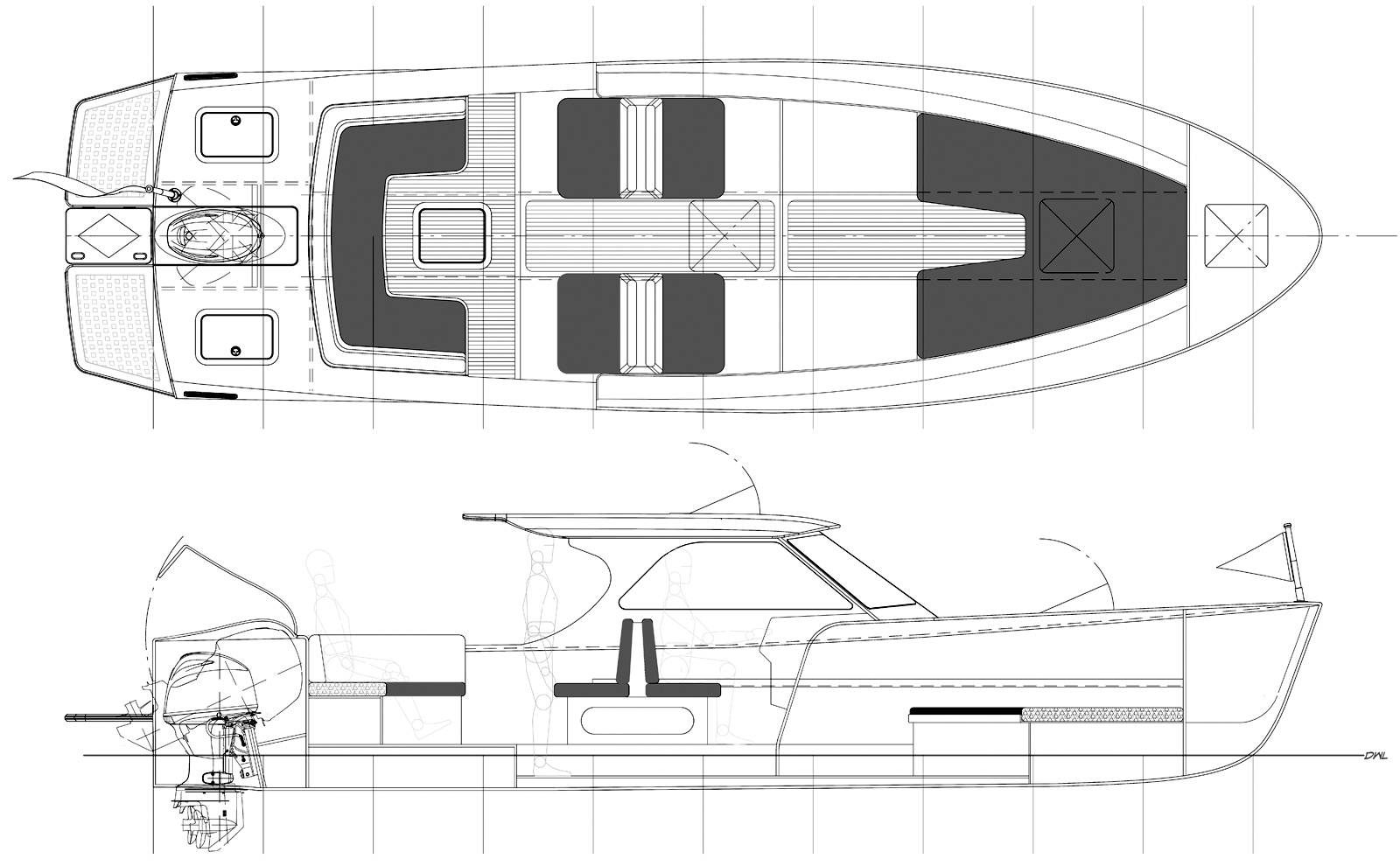
The boat has comfortable seating for up to eight people and standing headroom in the cabin. There is crouching space forward under the deck.
The bottom planking is 12mm plywood, as are the bulkheads, stringers, cockpit sole, and berth flat. The topsides and deck are 8mm plywood. The entire hull and all structural members are fiberglass-sheathed inside and out, and this sheathing is doubled at the centerline and on the chines. Sheathing both sides adds stiffness to the panel and increases impact-resistance a great deal. A couple of the forward bulkheads have plywood doublers where they cross the centerline under the cabin sole; these act as substantial floor timbers and will be a comfort when banging over waves in a big tide rip.
Particulars:
- LOA: 28′
- LWL: 26′5″
- Beam: 8′6″
- Draft (hull): 10″
- Displacement (half load): 3,130 lbs
- Cruising speed: 20 knots
- Power: 60-hp outboard
While the fuel-tank location is not indicated on these drawings, I would guess the designer is thinking of placing it under the after bench seat. That would probably be the best location for fuel weight at top speed, but another option might work better at 15–20 knot cruising speeds. Two big portable tanks under the midship seating at station 5.5 would get the weight forward enough to help reduce bow rise and keep the boat running flat for good visibility forward from the helm.
The Weekender is designed around a 60-hp four-stroke Yamaha outboard tucked neatly in a well under a cover forward of the transom. The well is open aft under the swim platform so hot air can exhaust that way, while a couple of clamshell intakes on the afterdeck would get fresh air into the engine space. Owners always seem to decide on a slightly larger motor; in this case, the 70-hp Yamaha could be used as it’s the same physical size and only 5 lbs heavier.
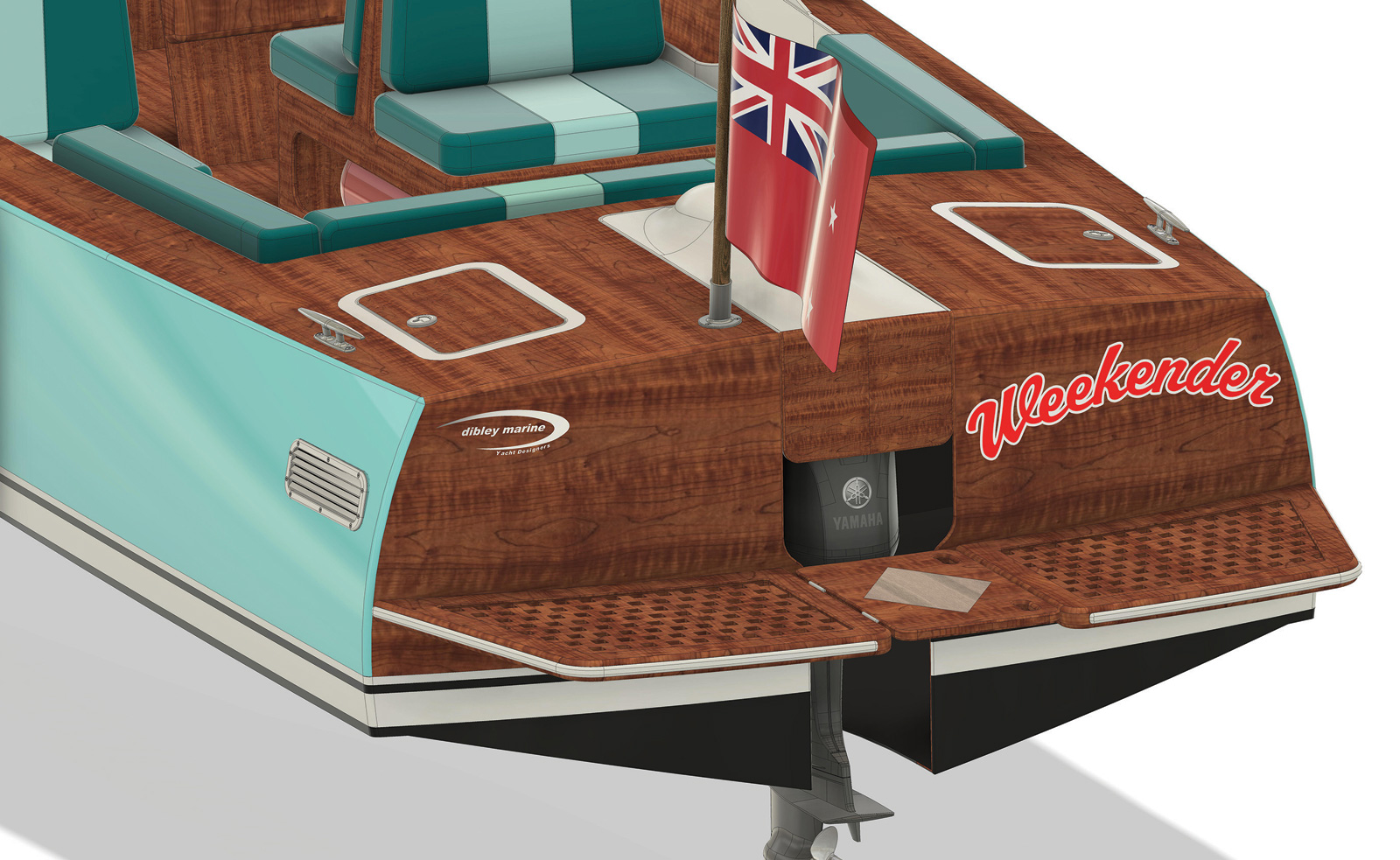
The Weekender is designed around a 60-hp four-stroke outboard concealed in a well.
The outboard motor is by far a market favorite today, but let’s examine the choice for a moment. When up against an inboard diesel, the outboard is simple to install at minimal cost, but in my experience outboard service costs are rising significantly and parts availability is chancy at best. Today I own two outboards to do one job because if one stops running, I might wait a month for a replacement part, and we use the outboard every day.
Obviously, fitting an inboard diesel would be problematic in the Weekender with its current layout. Possibly a V-drive arrangement could be done, but weight would certainly go up, as would initial cost. Over the next few years, I’m sure that an electric outboard or steerable pod drive will become the usual power source for this type of boat. A battery under the cockpit sole and solar panels fitted to the cabintop and afterdeck would be the perfect system, again at considerable cost above the gasoline-fueled outboard.
With comfortable seating for six to eight people, the Weekender can take a crowd out for the afternoon. There is standing headroom in the cabin; its open below-waterline sole area is not self-bailing, and thus should be fitted with an oversized pumping system. A canvas cockpit cover would keep the rain out while the boat is moored. There is crouching space forward under the deck. If the head is a self-contained composting type, it could be used on the centerline between the berths, where there’s just adequate headroom.
Dibley has given us a good design that is also very attractive; it’s well suited to day or overnight use. One couldn’t ask for better than to row home looking back at the pretty Weekender. 
Tad Roberts designs boats on Gabriola Island in British Columbia, Canada.
For more information on the Weekender 28, visit www.dibleymarine.com.