
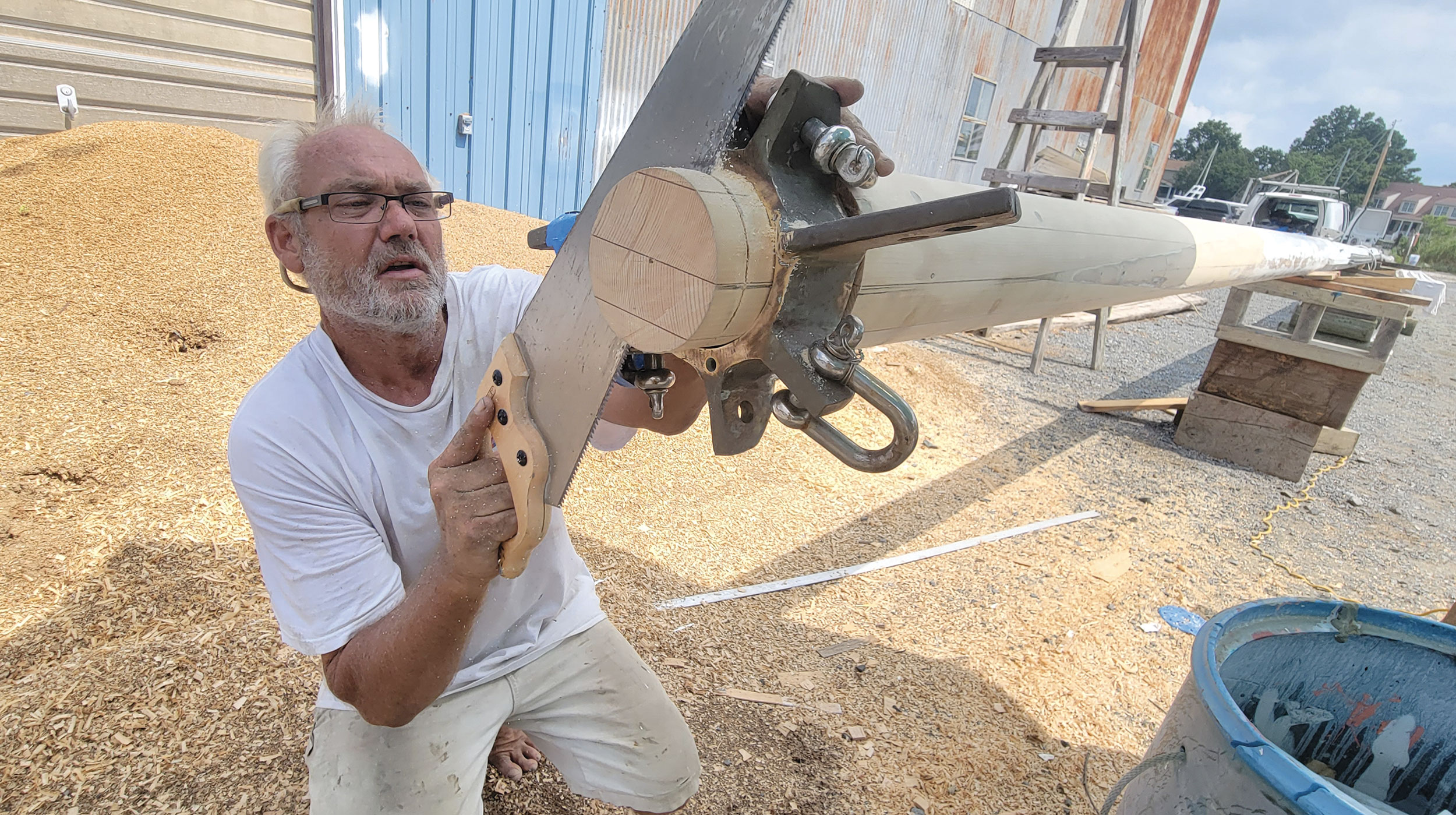
When the 80,000-lb William Hand–designed ketch STEADFAST suffered a mast failure off Cape Hatteras, her crew of two limped nearly 24 hours to Tilghman Island, Maryland, to thoroughly assess the damage. They then proceeded to replace the masthead with a new section of Sitka spruce glued in place with a two-sided clothespin scarf.
On June 6, 2023, as we rounded North Carolina’s Cape Hatteras, the split backstay and upper shrouds on our mainmast went inexplicably slack. “Something is very wrong,” my husband, Capt. Steven Uhthoff, said, astonished. The 8′ seas and winds of 20 knots or more tossed our 80,000-lb wooden ketch around like a toy. Green water poured over the bow as we scrambled to drop the reefed mainsail and furl the jib, stabilizing the rig as much as possible so we could assess our situation. We left the reefed mizzen up to lessen the roll, with the understanding that if we lost the main, the triatic—the stay connecting the tips of the two masts—would risk the mizzen as well.
Steve and I live aboard STEADFAST, a 1934 William Hand Jr.–designed 56′ motorsailer. We were sailing toward our summer dock on Tilghman Island, Maryland, when the rig failed, and there was no point in turning back. The yacht’s impeccably maintained, decades-old Detroit Diesel 4-71 rumbled along dutifully as we contemplated what was wrong 65′ above us.
After 20 more hours of wakefulness, we found calm water north of Norfolk and sent the drone up, unwilling to risk the weight of a bosun’s chair. Photos showed a sizable crack across the top of the mast, and that the bronze collar to which the standing rigging attaches had slipped down 1½” and crushed the wood beneath it, particularly on the after side. This resulted in slack backstays, a bouncing headstay with jib furler, and loose upper shrouds. Still taut, the inner forestay and its staysail furler, standing backstays, and intermediate and lower shrouds seemed strong as we disconcertingly found wood shards that had fallen onto the deck. We arrived safely at Severn Marine Services, and its team of shipwrights was standing by to help us with diagnosis and repair.
Four days after we arrived, we unstepped both masts with an ancient boom truck and chose the shadiest spot to tackle the repair. We pulled the mizzenmast to assure that whatever the problem turned out to be, it would not be repeated there. Those big masts looked even bigger on the ground; the intricacies of a sailing vessel and the scope of the project came into focus. We would use Sitka spruce, bronze, sweat, epoxy, innovation, and time-tested methods to repair our decades-old spar.
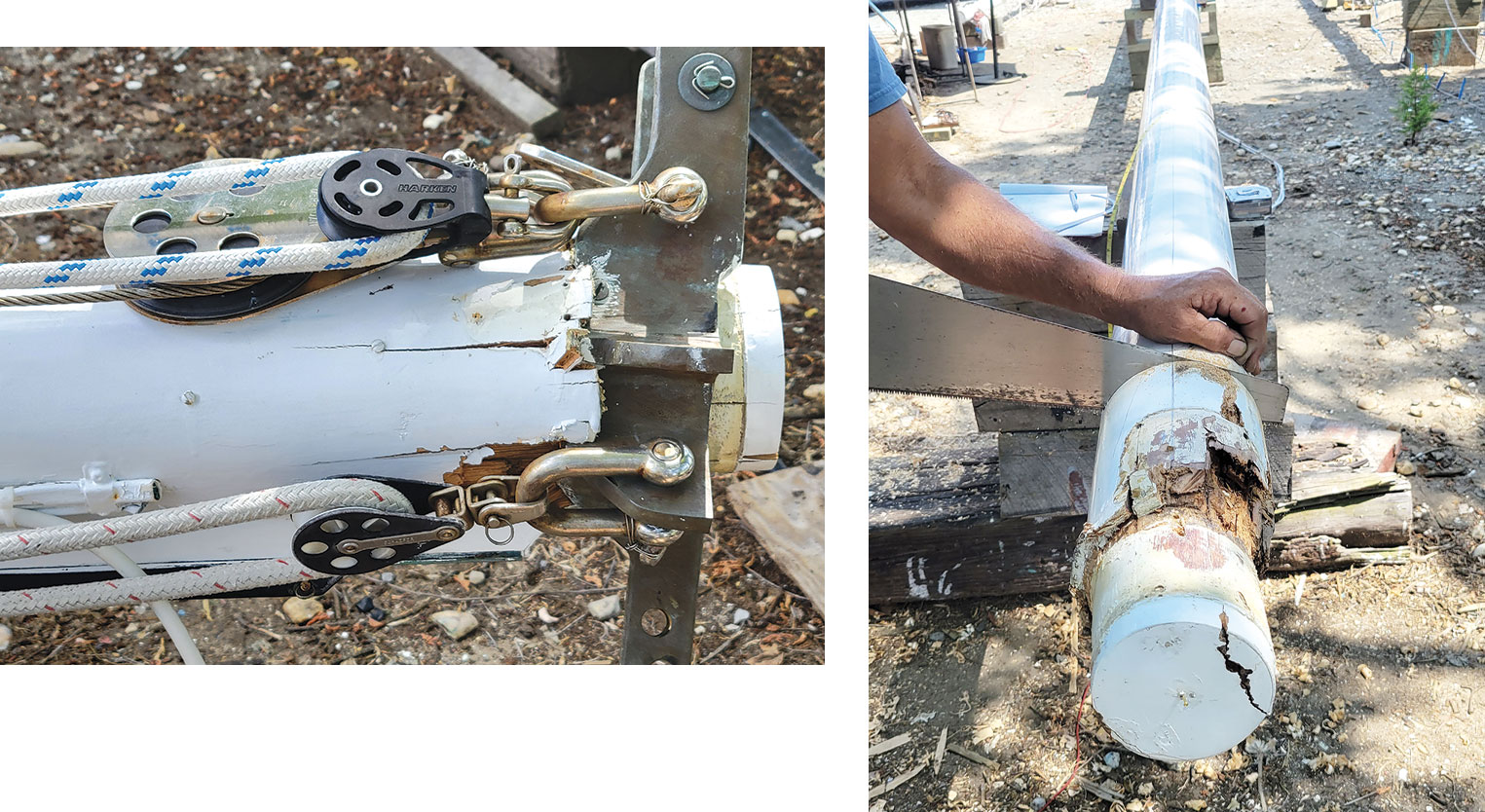
The deconstruction and investigation began as soon as the spars were on the ground. Rubber chafing gear and a protective stainless-steel plate had been attached just below the bronze collar, using ½” stainless-steel screws; water ingress had likely rotted the wood around those fastenings, causing the eventual failure.
Steve removed the collar and sail track, then sawed away the top 13½” of the Sitka spruce mast. There was no rot below this area. After several days in the steaming, storm-riddled sun with temperatures close to 100 degrees Fahrenheit, we decided that the shade of our trees wasn’t enough; we purchased and installed a 12′ × 20′ tent to shelter the project from the Maryland summer. A small pop-up tent and a classic blue tarp draped from a neighboring century-old skipjack to an antique scaffold served as the rest of our work area.
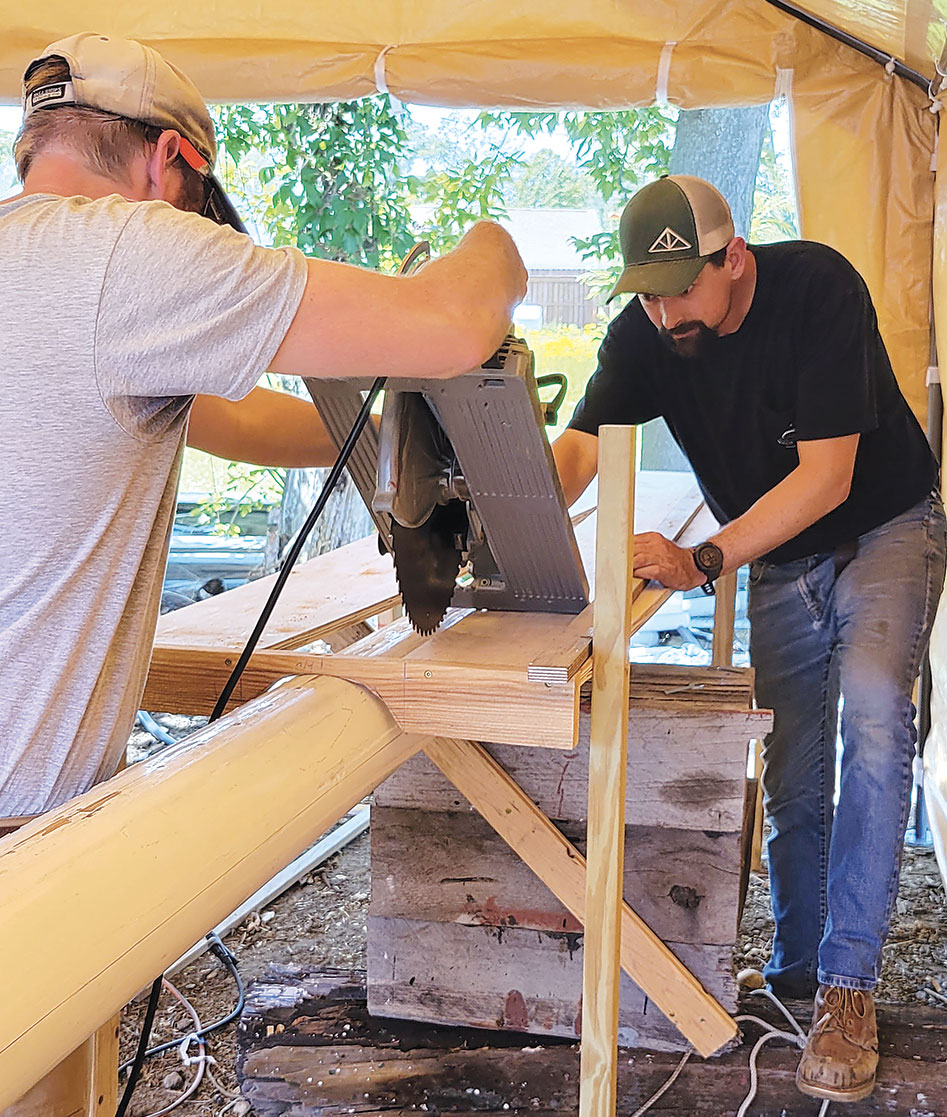
Next came the marking and cutting of a scarf on each side of the mast. We would then cut a matching scarf into a new section of mast, allowing us to join this new piece to the original mast. This style of scarf is called a clothespin (or “needle”) scarf, because of the shape of the new section. Local shipwrights Mark Wiest (right) and Michael Allen helped with the work.
At the standard 12:1 scarf-joint ratio, our 6″-diameter mast would call for a single 6′-long scarf. Although we were halving the spar’s effective diameter by creating a clothespin scarf (in other words, the scarfs on either side of the mast would each account for only 3″ of thickness), we decided to stick to the 6‘ length, creating a durable scarf slope of 24:1 on each side of the mast. Lines were drawn, measured, and remeasured; the plywood cutting jig shown here was clamped to the mast, and it guided a 15“ circular saw for a precise cut. The blade, on the first cut, hit five hidden bronze bolts; we were able to finish the cuts, but the blade was ruined, and we were left wondering what else we might come up against.
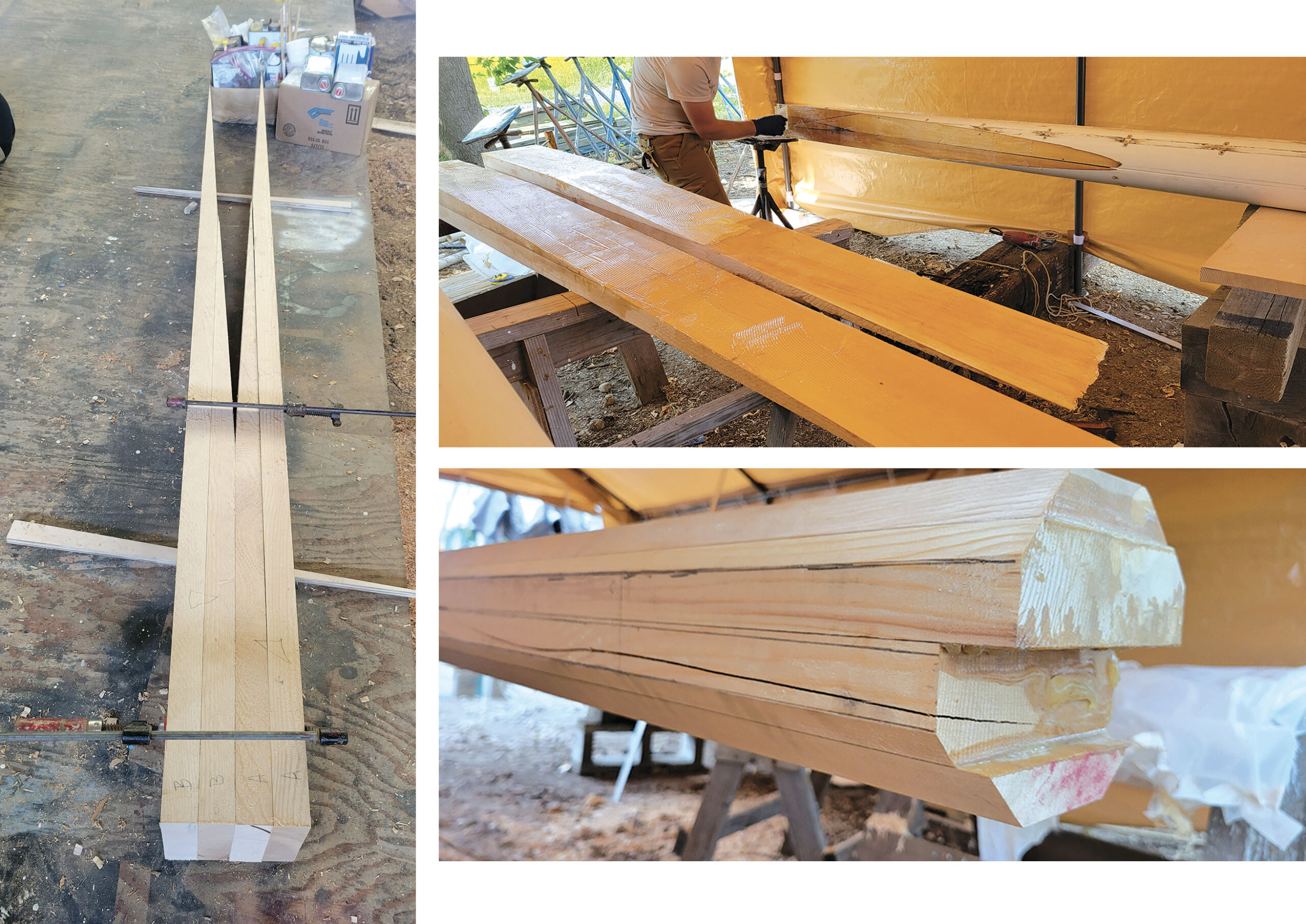
The new section of mast consisted of four Sitka-spruce 2″ × 8″ × 10′ boards—two for each side. We built these two identical sides separately and then glued them together and onto the mast with G-Flex epoxy. A dozen clamps held those pieces as the epoxy cured, and we breathed a sigh of relief thinking that the largest obstacle was behind us.
The next afternoon, we began the preliminary shaping of the new length of spar. For this, we used a circular saw to eliminate the square corners and create an octagonal section; we then used a power planer to make the new section 16-sided. This work released internal tension in the boards and revealed a large check—a separation in wood fibers across the wood’s annular rings—nearly the length of the inner plank of one scarf. Such a fault could have occurred any time between the felling of the tree and the kiln-drying of the wood. We were disappointed at this setback, but undeterred as booming thunder ended work for the evening.
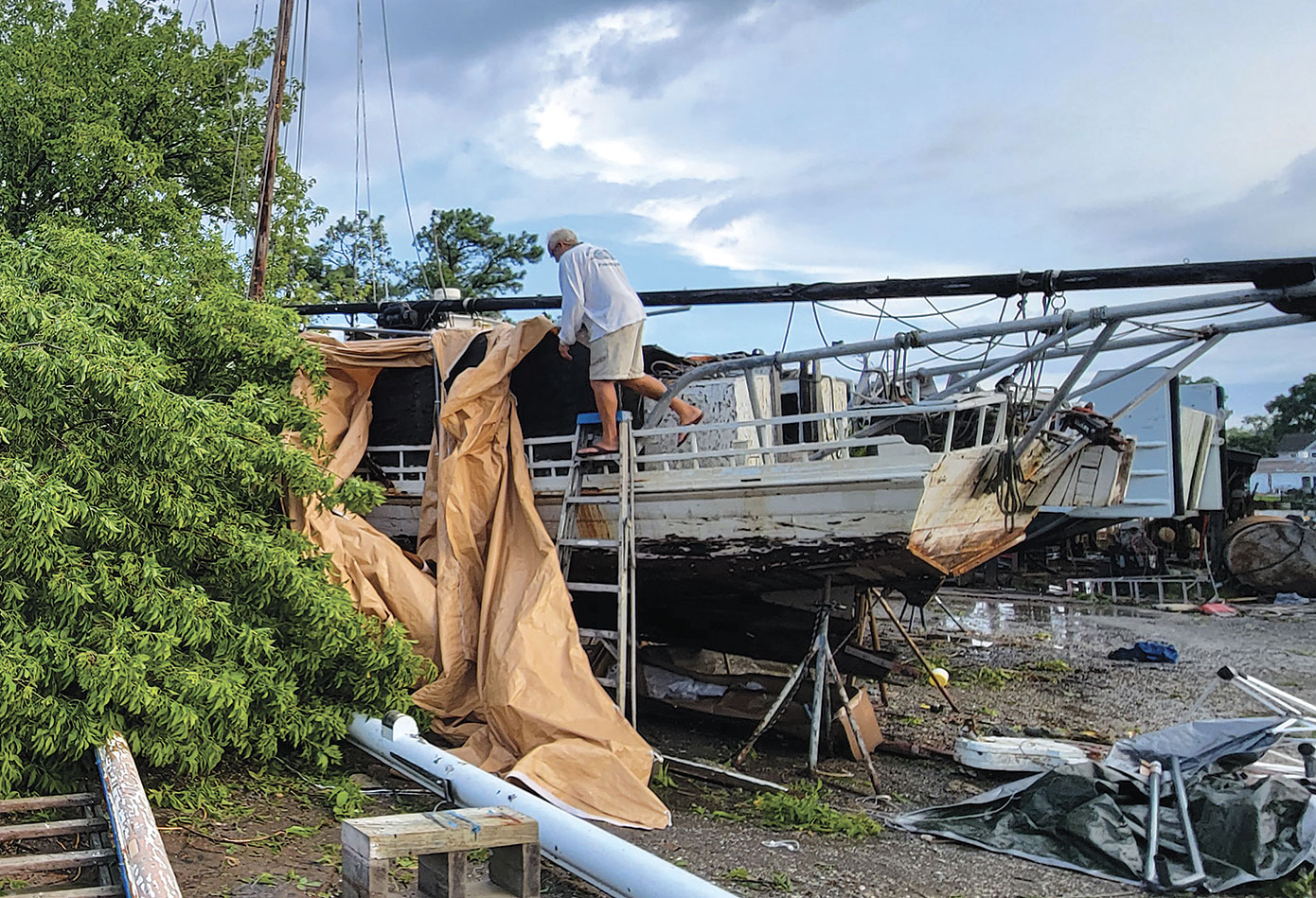
At 7:05 p.m. on July 3, the north section of Tilghman Island saw “tornadic winds” clocked at 84 knots; the storm’s intensity was frightening, and we believe it was a true tornado. The storm destroyed the new tent and crumpled the pop-up. The two gnarled old trees that had served as shade were uprooted in seconds and landed across the entire worksite; that old wooden skipjack might just have saved us. One hundred and fifteen combined feet of mast toppled to the gravel. Just before dark, we were rescued by another one of our shipwrights, Taylor Williams, chainsaw in hand, and with relief we determined that the damage was reparable, despite many dents and gouges. Even the radar dome had survived.
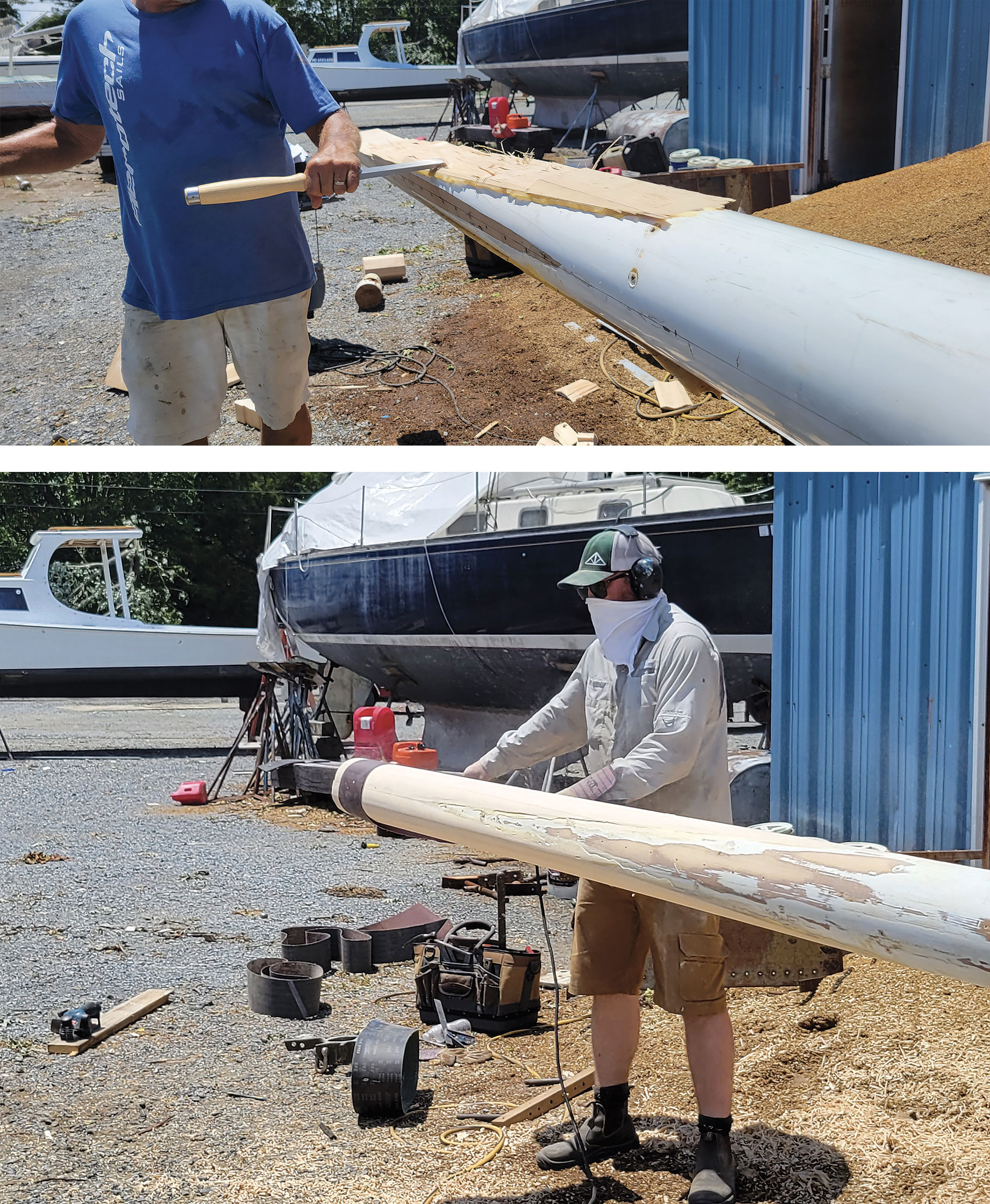
We spent the Fourth of July moving spars, stands, and equipment to the opposite side of the boatyard into the intense Maryland sun. The checked port side of the scarf was painstakingly removed using a chisel and power tools, adding another long day to the project’s timeline. The compromised portion was replaced, repeating the processes of the previous week. The board we used for this had significant sapwood, but it was trimmed away in the final shaping.
Using a power planer, hand planes, and an inverted sanding belt, Michael carefully shaped the new laminated section to the specifications of the original spar.
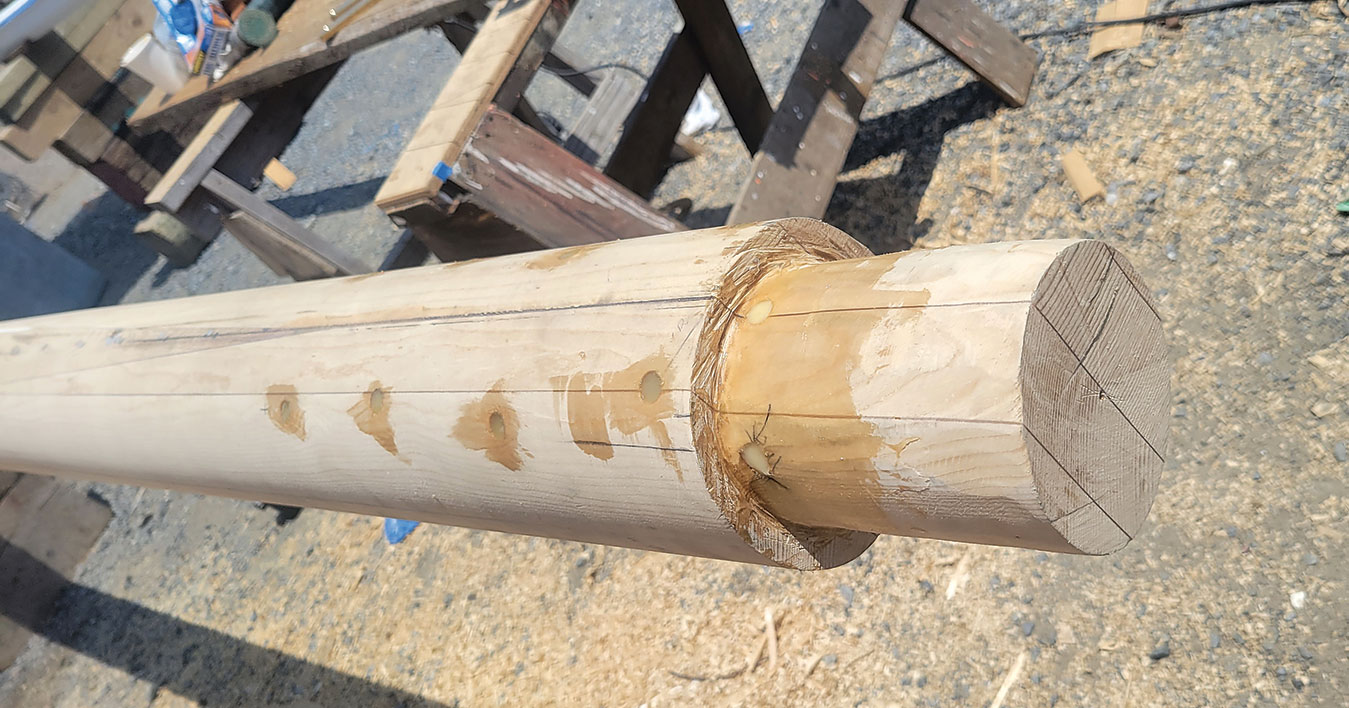
Here you can see the mainmast’s finished shape before being trimmed to its final height. The overdrilled fastening holes filled with epoxy will hold screws more securely than the soft Sitka spruce. We decided that since our entire rig was already out of the boat, we should strip, sand, repaint, and varnish the seven spreaders as well as rebed all hardware with Dolfinite.
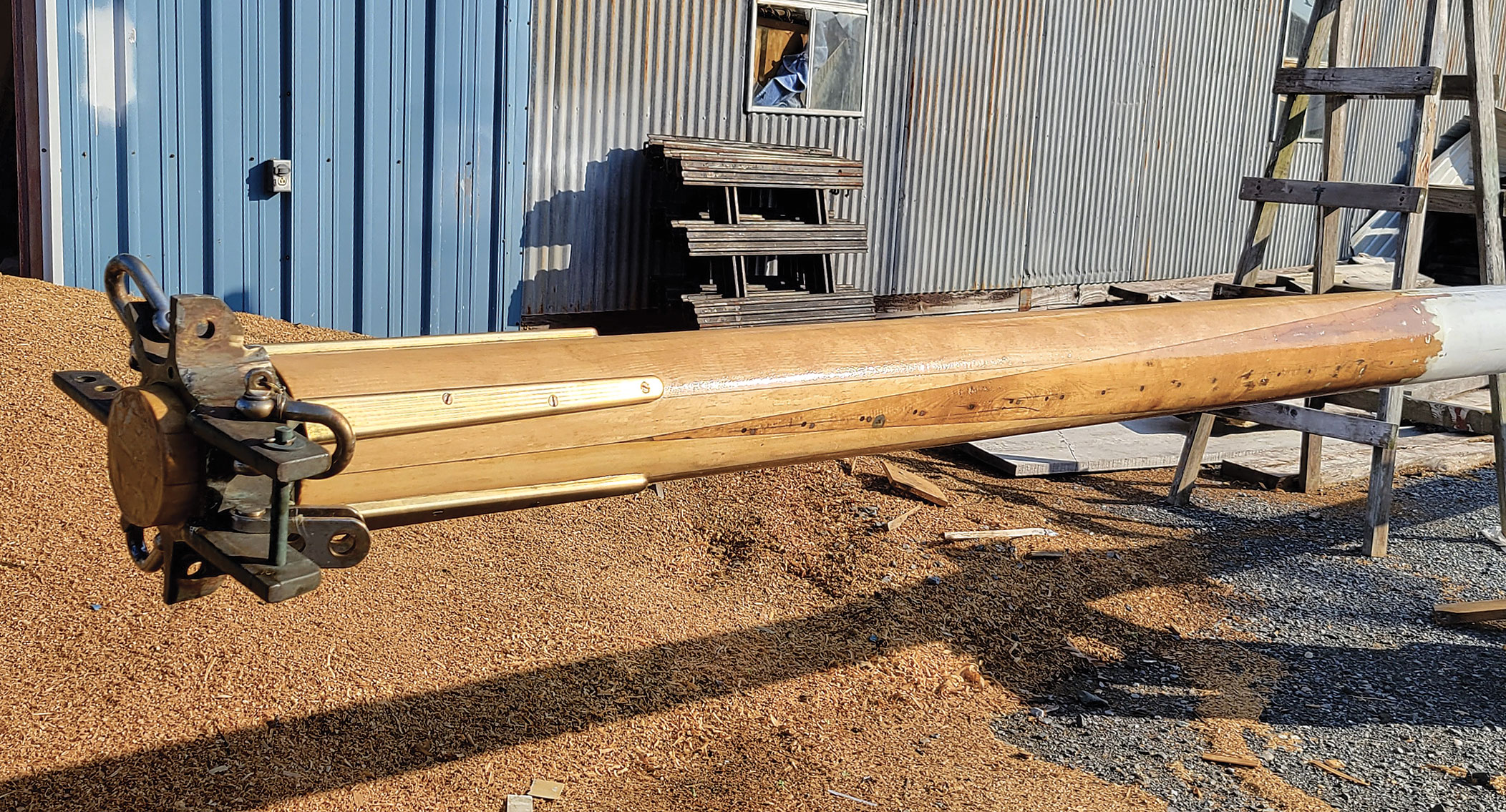
We were plagued from the beginning by the question of how to improve on the traditional collar to ensure that the slippage that caused the failure would not happen again. The mizzenmast had a chafe guard similar to the one on the mainmast, and it was showing just a bit of water ingress. We addressed these areas with thickened epoxy, and then enlisted the Annapolis-based Rhode Fabrication to create custom naval-bronze reinforcing hounds beneath each collar, four for the mainmast and three slightly smaller ones for the mizzenmast. They are glued on with G-Flex epoxy and fastened with just a handful of wood screws to avoid weakening the wood. They are an attractive addition to the rig, although we wish we had never needed them.
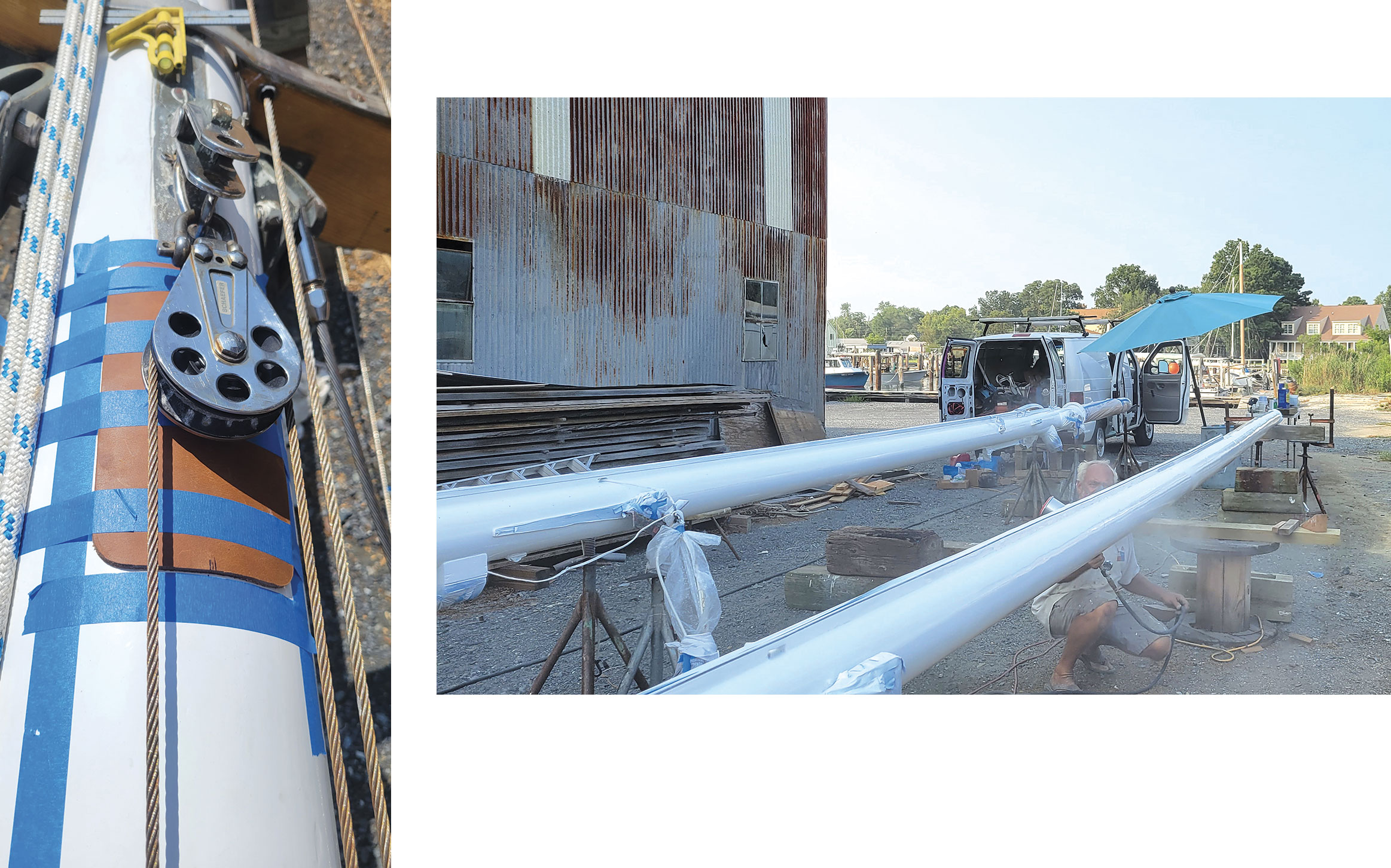
To replace the chafing gear, we chose ⅜”-thick full-grain-leather patches, which we glued on with G-Flex so that if they were to wear through in the distant future a chafe barrier would remain.
With the storm damage repaired, we repainted the spars by first brushing on primer coats and then spraying on a top coat. We chose a calm evening, July 18, for the final coat, but the air was too quiet: hundreds of gnats descended on the still-tacky surface. I stood by with a compressor nozzle in hand, blowing them off as well as possible. Their legs will forever remain with us, but fortunately they didn’t affect the gloss. Unused wiring was discarded, and the encrusted custom stainless-steel wire hangers were cleaned with wire brushes and a grinder—all 137 of them.
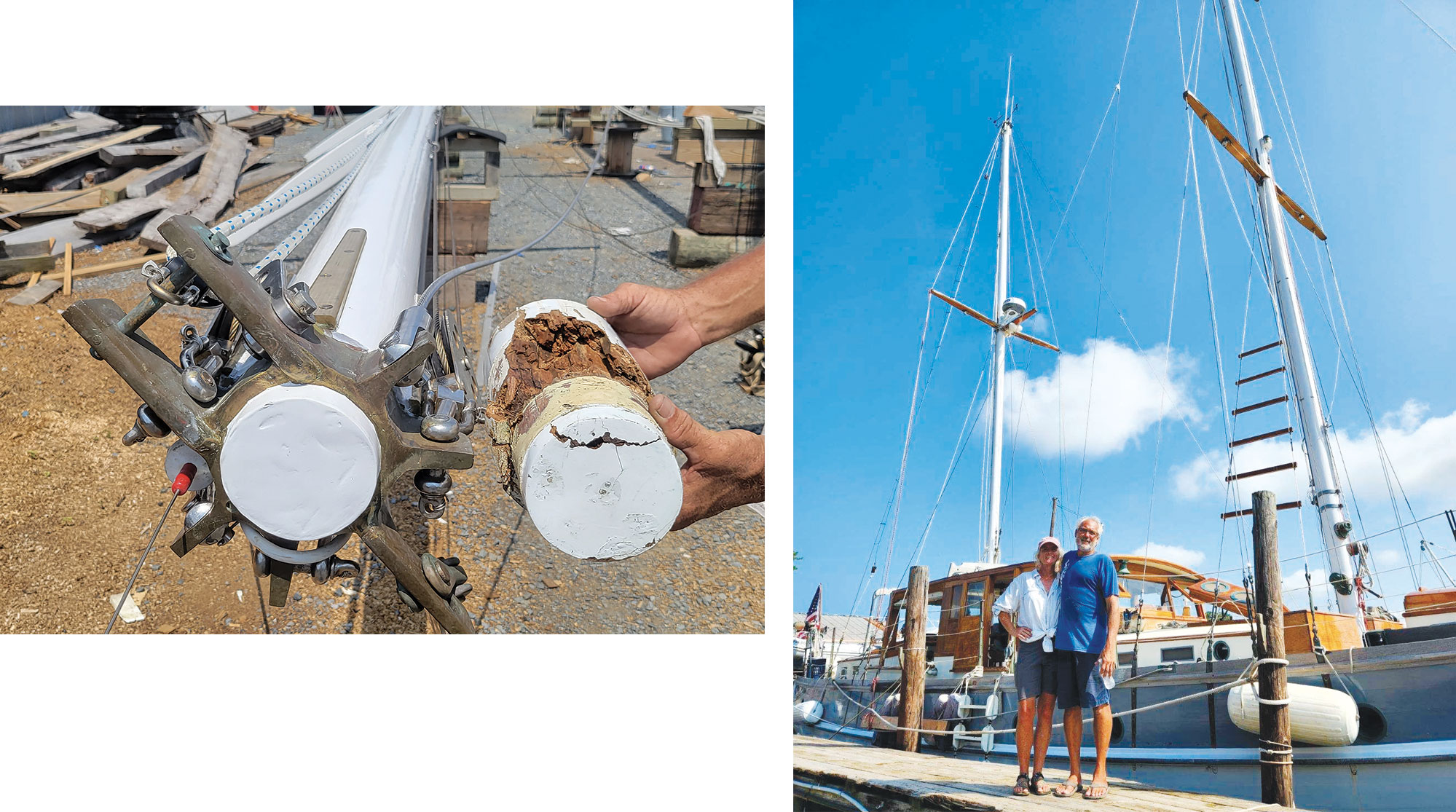
Here is the old masthead, alongside its replacement. STEADFAST did well to get us safely to Tilghman Island for repair.
On July 26, we restepped and rerigged both masts, and the following week we bent on the sails. STEADFAST was ready for her next adventure.
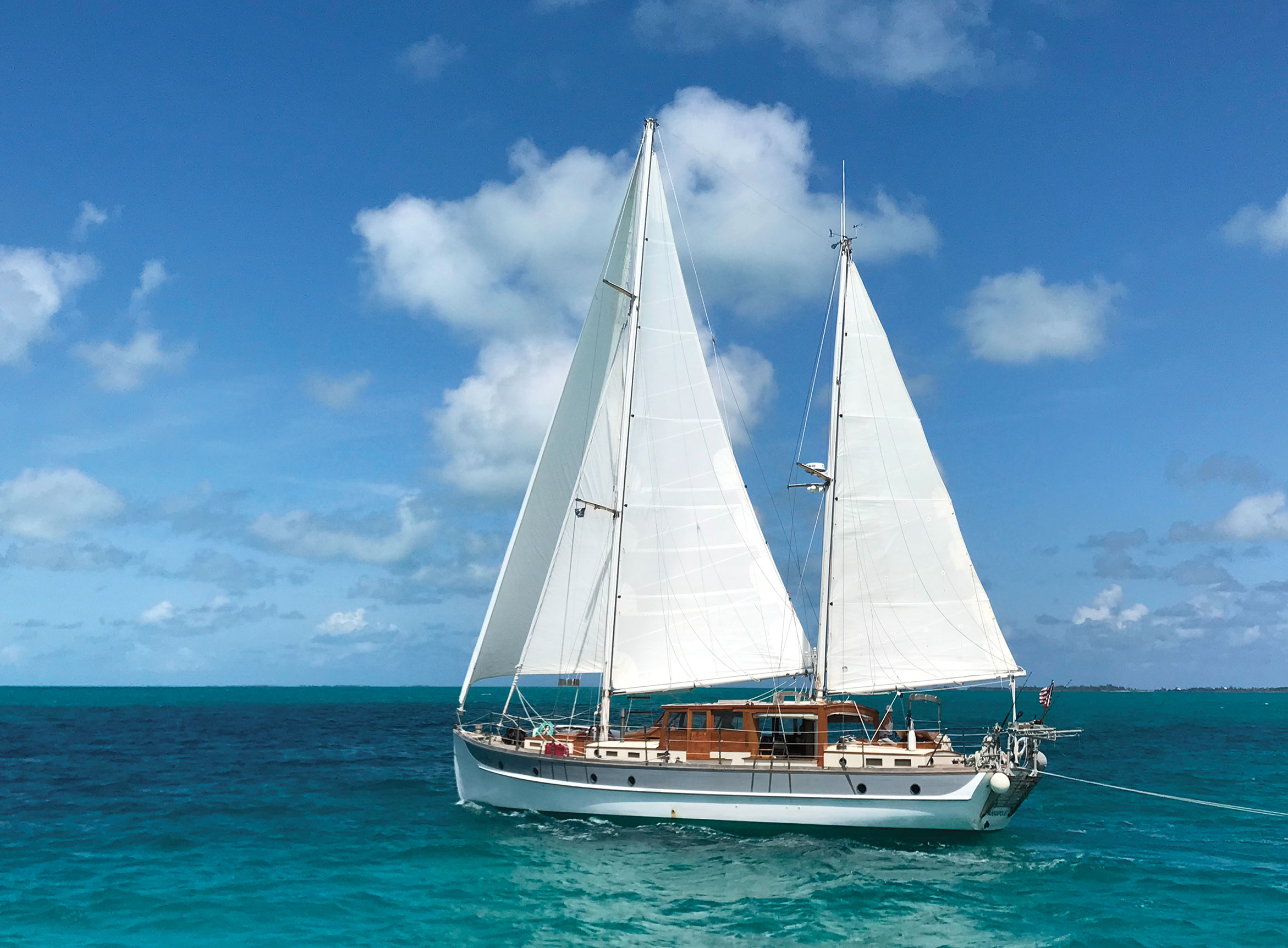
We understand the physics, dangers, beauty, and science of crossing blue water, with full knowledge that we can only do our best against Mother Nature’s powerful elements. On January 3, 2024, we took those reinforced, refit, and refreshed spars and successfully sailed this beautiful old wooden boat to the Caribbean. Here is STEADFAST in the Bahamas.
Janice Anne Wheeler is a liveaboard sailor, chef, entrepreneur, and writer.