
 Reuel B. Parker
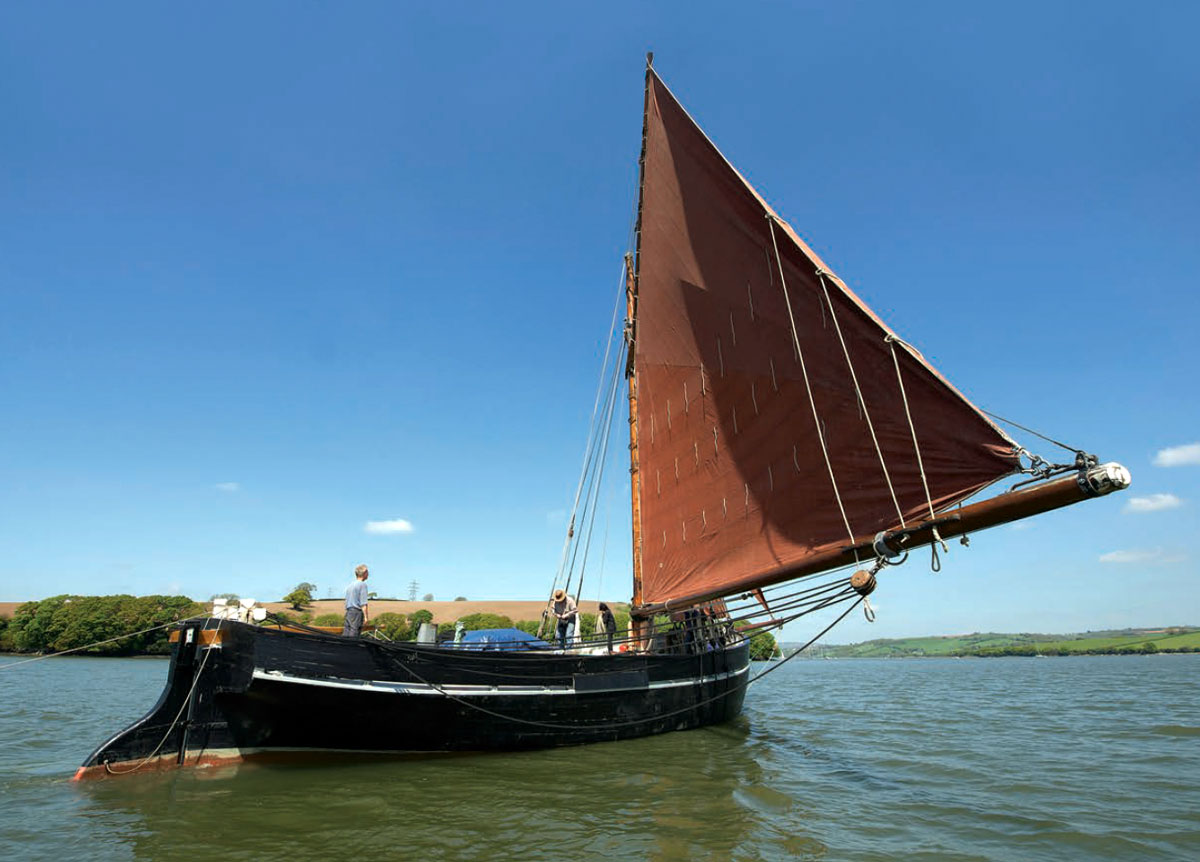
Wooden bee rails mounted near the aft ends of booms to organize reefing lines and clew outhauls have a long history in traditional rigging, as proven here on the 1896 Tamar River barge LYNHER. She was rescued from dereliction in the early 1990s and was rebuilt. Since 2018, she has been daysailing with up to 12 guests out of Plymouth, England (see www.tamarbarge.org.uk).
Mounting “bee rails” on a sailboat’s boom is a traditional way to rig clew outhauls to simplify and facilitate reefing. The rails are usually made of hardwood, mounted opposite each other on each side of the aft end of a boom.
The port bee rail has simple holes to hold the bitter ends of outhaul lines, which have stopper knots, such as figure-eights, tied under the rail. These lines are used in what is known as slab reefing, also called jiffy reefing, which works equally well on gaff and marconi rigs. From there, the lines lead upward and through their corresponding clew grommets at each reefpoint on the sail, downward to reeve through corresponding sheaves in the starboard bee rail, and then forward to be made off on cleats mounted on the boom.