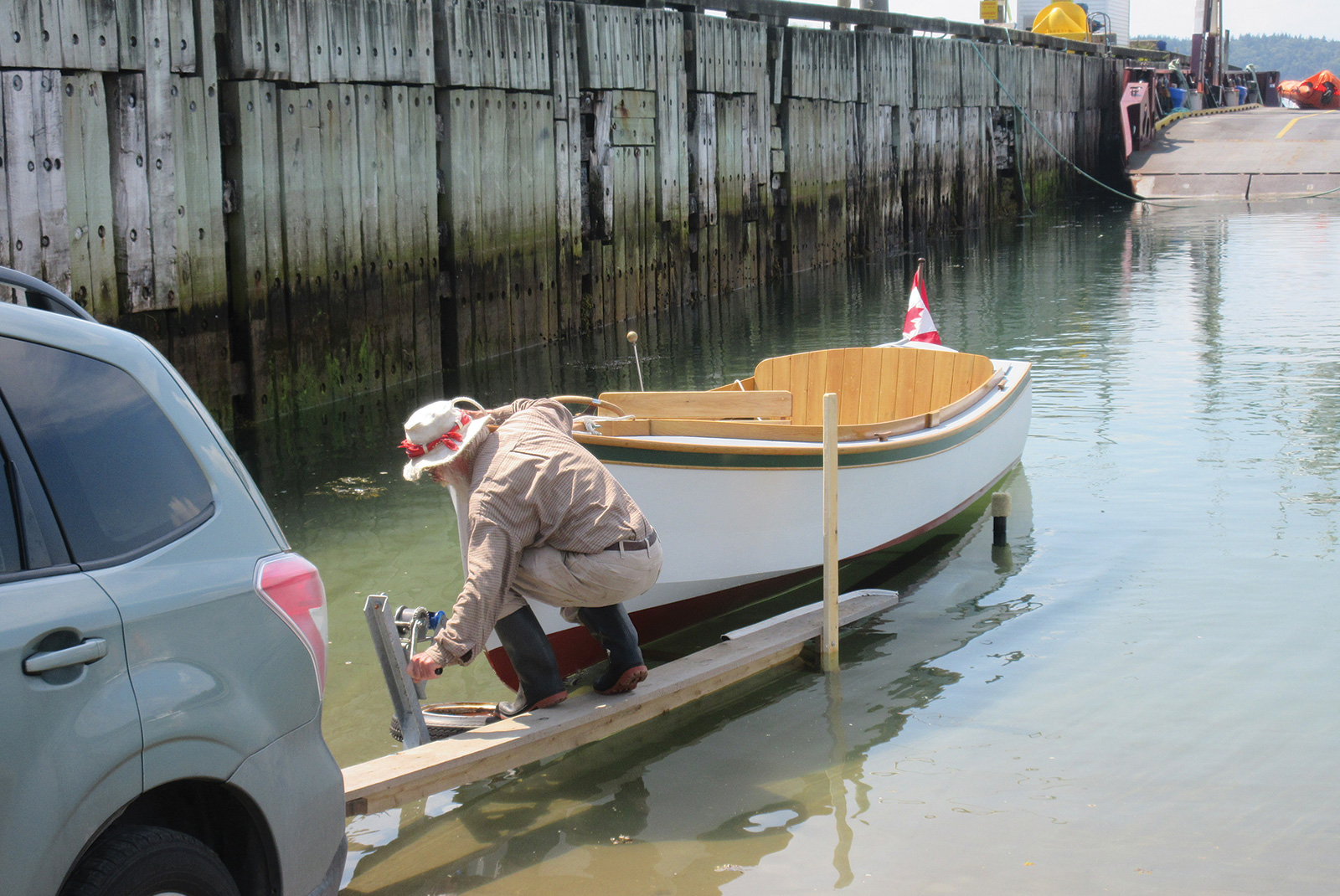
The author’s catwalk.Martha Bryan

The author’s catwalk helps him stay dry-footed and secure while launching or retrieving his 18′ launch.

My present boat, an 18′ launch, is the first boat I have owned that lives continually on a trailer and is launched and retrieved for each use. When I first used the trailer, I found it inconvenient to stand on the tongue underwater while releasing the winch strap, and difficult to balance on the trailer frame while climbing aboard the boat. During retrieval, it was even more awkward to step from the boat to the trailer to attach the winch strap.

My solution has been to add a catwalk to one side of the trailer. The attachment is meant not only to keep the boat centered on the trailer but also to make it easy to get in and out of the boat. It has been an unqualified success.

Braces are attached to the trailer’s metal frame.Harry Bryan

Braces attached to the trailer’s metal frame form the catwalk’s foundation.

I made the catwalk from an 8″-wide rough-sawn spruce board fully 1″ thick. To stiffen the piece, I fastened a 3½″-wide spruce board, also fully 1″ thick, on edge underneath the catwalk and extending for most of its length. (Pine would work as well, but if I had used pine I would have increased the stiffener’s width to 4″.) I took care to make no part of this structure extend outboard of the trailer’s wheels.

The horizontal cross members supporting each end of the catwalk are made from 1½″ × 3½″ hardwood clamped to the trailer’s frame with ⅜″ carriage bolts. The design for the brace supporting the catwalk’s after end emphasizes light weight and rigidity but also open airflow to avoid drag while going down the road. A 1″ × 2½″ post is incorporated into the after brace as a handhold for getting into or out of the boat.

Soft material—dinghy gunwale guard serves the purpose—covers the after inboard edge of the catwalk. That edge is where the hull nudges while getting the boat centered for haulout, so the padding prevents abrasion damage to the planking. I also rounded the exposed after corner of the catwalk plank, as visible in the photos.

Each trailer and boat setup is unique, so dimensions may need adjustment and the concept as shown may need modification to suit individual needs. I hope the installation shown here can serve as an inspiration, and my experience—together with the comments I have heard at launching ramps—indicate that others may find this solution useful.  Article ends.


Harry Bryan is a contributing editor to WoodenBoat.