
 Vincent Regenhardt
In 2017, SAGA, a Nordic Folkboat launched in 1951, capsized and nearly sank during a class regatta in Flensburg Fjord, on the border between Germany and Denmark.
On a fair but chilly Sunday in September 2017, Vincent Regenhardt piloted his Nordic Folkboat, SAGA, out of a marina and into the Flensburg Fjord, a 16-nautical-mile inlet straddling the border of Germany and Denmark, for a race. The wind had been building, but Vincent was fully confident in his boat’s seaworthiness, and he had been sailing SAGA all his life. “A Folkboat cannot capsize,” he told his crew.
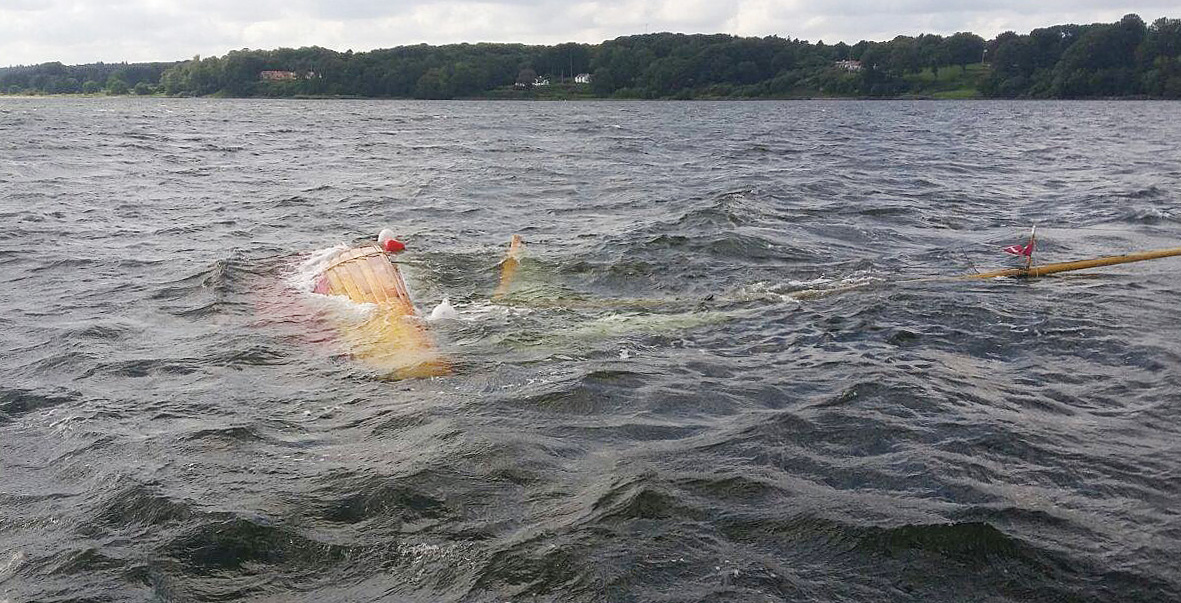
The three sailors were as exhilarated as always when SAGA heeled to the breeze as she sailed close-hauled at the start. On the day’s final leg, they were again close-hauled when she heeled alarmingly to port, putting the gunwale under water; in quick succession, before they knew what was happening, the cockpit flooded, she downflooded through the open companionway, and the mast and sails hit the water.
 Courtesy Of German Maritime Search And Rescue Service
After the 25′ boat was recovered by a German search and rescue boat and towed to shore for haulout, the cause of the incident was clear: corroded keelbolts had failed and her cast-iron ballast went to the bottom.
Vincent had struggled to prevent a full capsize, but he quickly realized that all he and his crew could do was stay clear. They were in the water but buoyed by their life vests. A sailing yacht close by came to their assistance, lashing fenders to SAGA’s masthead to prevent her from turning turtle. A rescue crew, responding to Mayday calls, took the crew to the Danish shore for transfer to a hospital to be checked for injury or hypothermia.
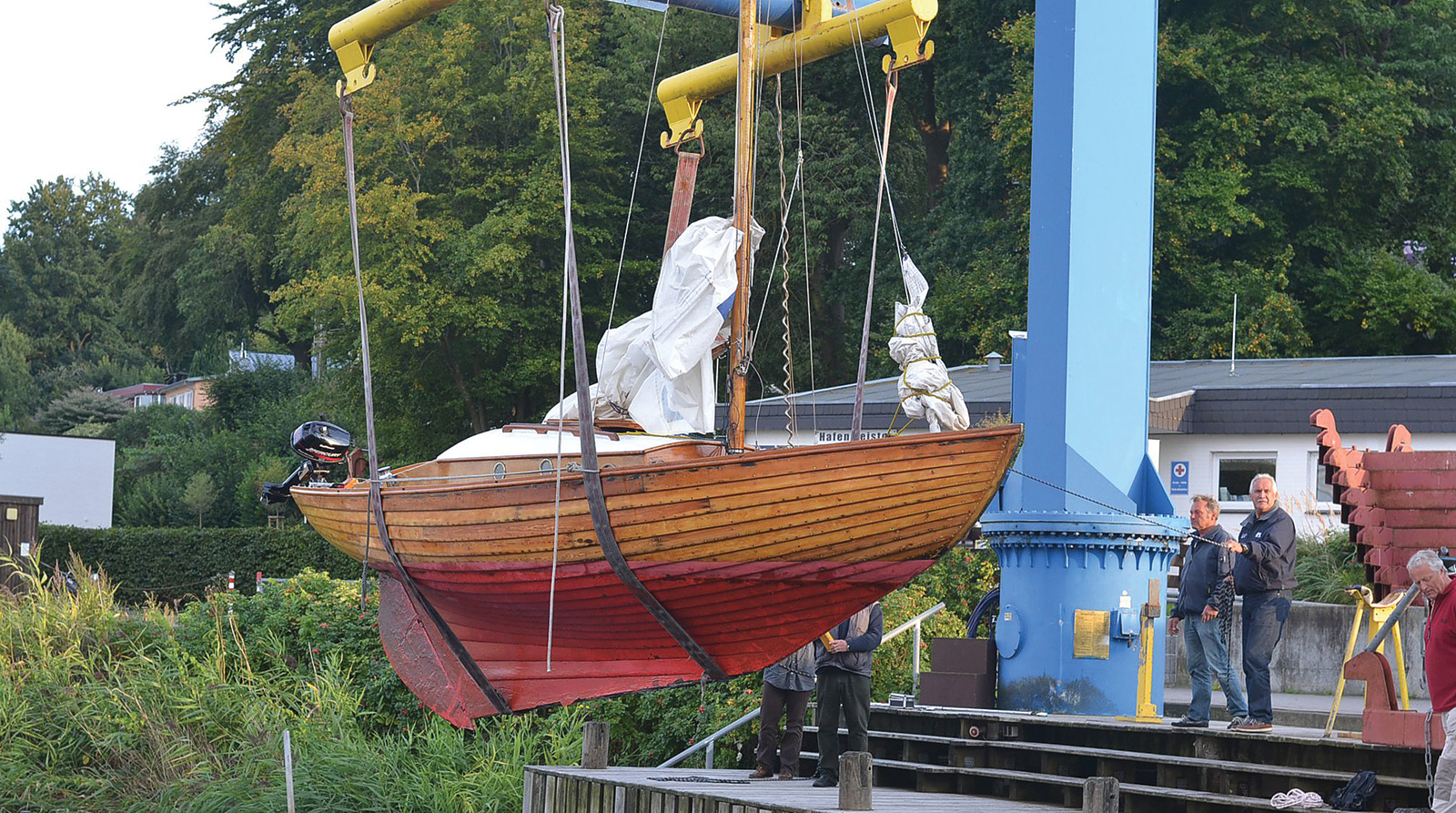
After they were discharged later, three fellow Folkboat racers from the regatta drove them back to the host marina, where they had a surprise for Vincent: there was SAGA, hauled out by a boat crane. The reason for her capsize was immediately obvious: SAGA’s one-ton cast-iron ballast keel was gone.
 Vincent Regenhardt/Nordic Folkboat International Association
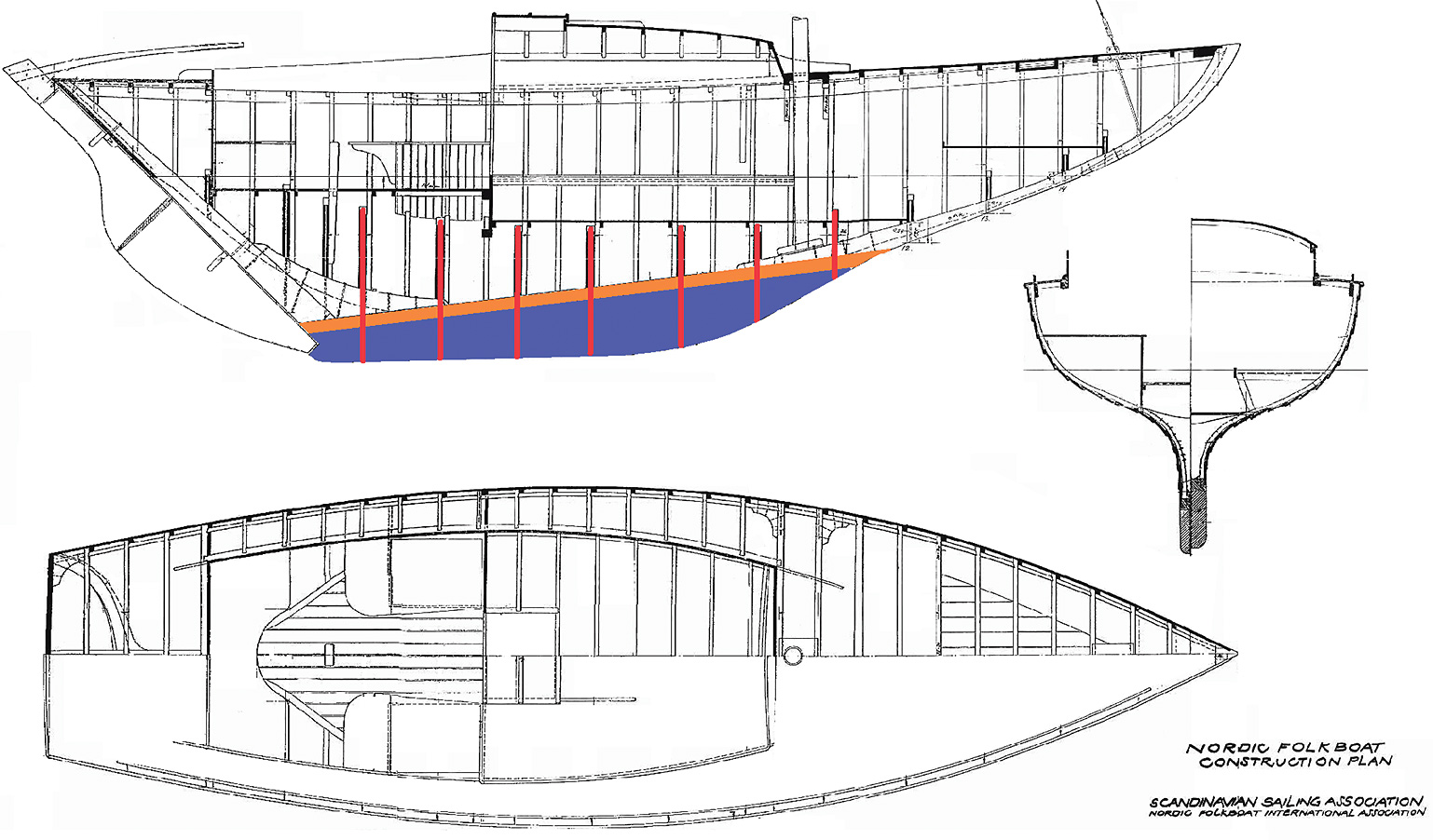
The Nordic Folkboat, designed as an economical racing sailboat in 1942, carries a fractional sloop rig supported by a 2,205-lb (1,000kg) cast-iron keel (shown in blue) held in place by seven galvanized-steel bolts (shown in red) through the oak timber keel and floor timbers.
SAGA was built in Denmark in 1951 to specifications that sprang from a 1942 Swedish design competition for an economical and seaworthy small yacht. The class has proven phenomenally successful ever since. The boats are full-keeled, with an overall length of 25′ (7.68m). Their simple fractional sloop rigs are balanced by cast-iron ballast keels of 2,205 lbs (1,000kg), equating to 53 percent of the boat’s displacement of 4,255 lbs (1,930kg). Like many Folkboats, SAGA is planked with larch over steam-bent oak frames; her topsides are bright-finished. She served some 24 years as a sail-training boat for the Danish navy before going into private ownership. She was refitted in 1992, and the Vincent family bought her in 1996.
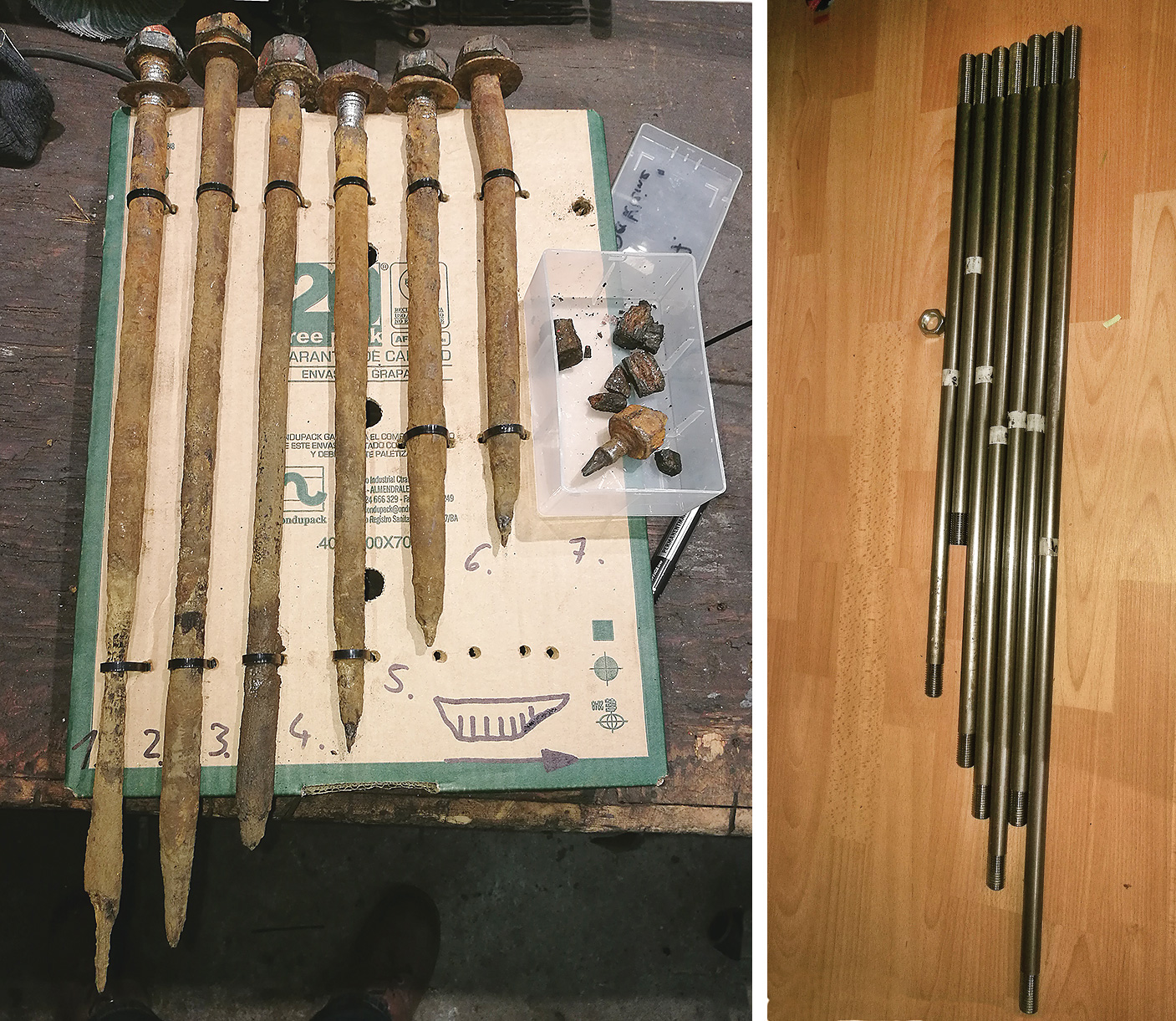
The capsize came just six months after Vincent’s father had handed him the responsibility for SAGA. Only a few weeks after the capsize, Vincent set up SAGA in his parents’ barn and started withdrawing the remaining pieces of SAGA’s keelbolts. He discovered that during almost 70 years of service, all seven keelbolts had severely deteriorated. They were originally ¾″ (19mm) in diameter, and in their outward appearance they still looked healthy—but they had corroded to thin needles.
SAGA’s capsize captured the attention of sailors all over northern Germany. Many owners began to worry about their own keelbolts; one even used a mobile X-ray machine, a type ordinarily used for horses, to have his checked.
 Michael Sauter
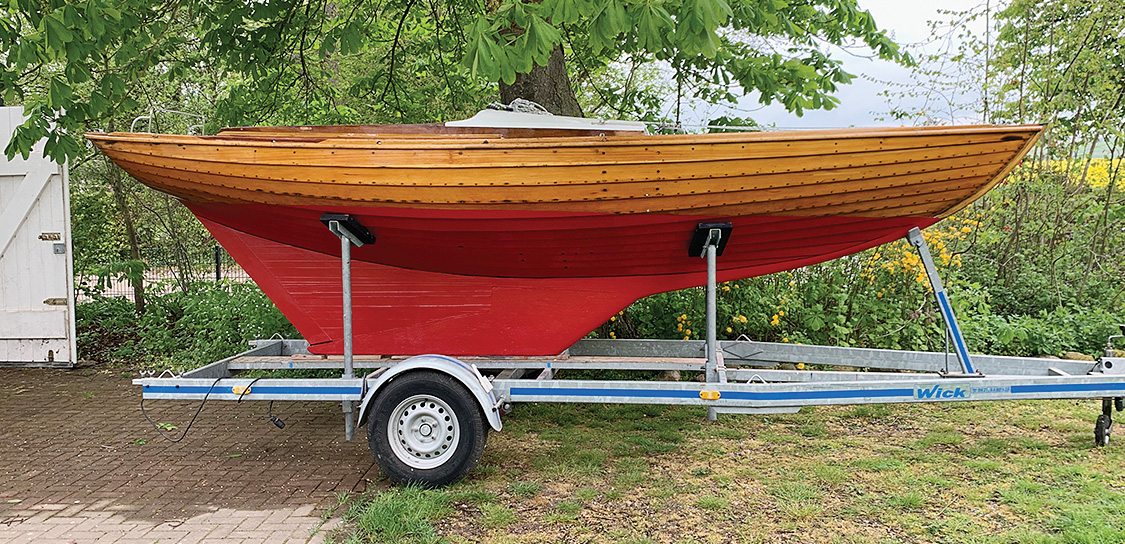
SAGA’s keelbolt failure caused many wooden-boat owners—including the author—to check their own keelbolts for degradation. The author was restoring his KDY15 of 1965 at the time and examined various metal alloy alternatives for his keelbolts.
My own restoration project underway at that time involved a boat built in 1965, meaning her keelbolts had been subject to corrosion for more than 50 years. Named TOKYO, the boat is a 19′ LOA (5.7m) larch-on-oak KDY15, built to a design sponsored by the Royal Danish Yacht Club as a daysailer class with 15m2 (161 sq ft) of sail area. She was donated to the Hellerup sailing club to celebrate their gold and bronze medals at the 1964 Olympic Games in Tokyo. The type resembles the Folkboat, even though it is from an older design and 6′6″ shorter, and it is known casually as the Folkboat Junior.
 Vincent Regenhardt
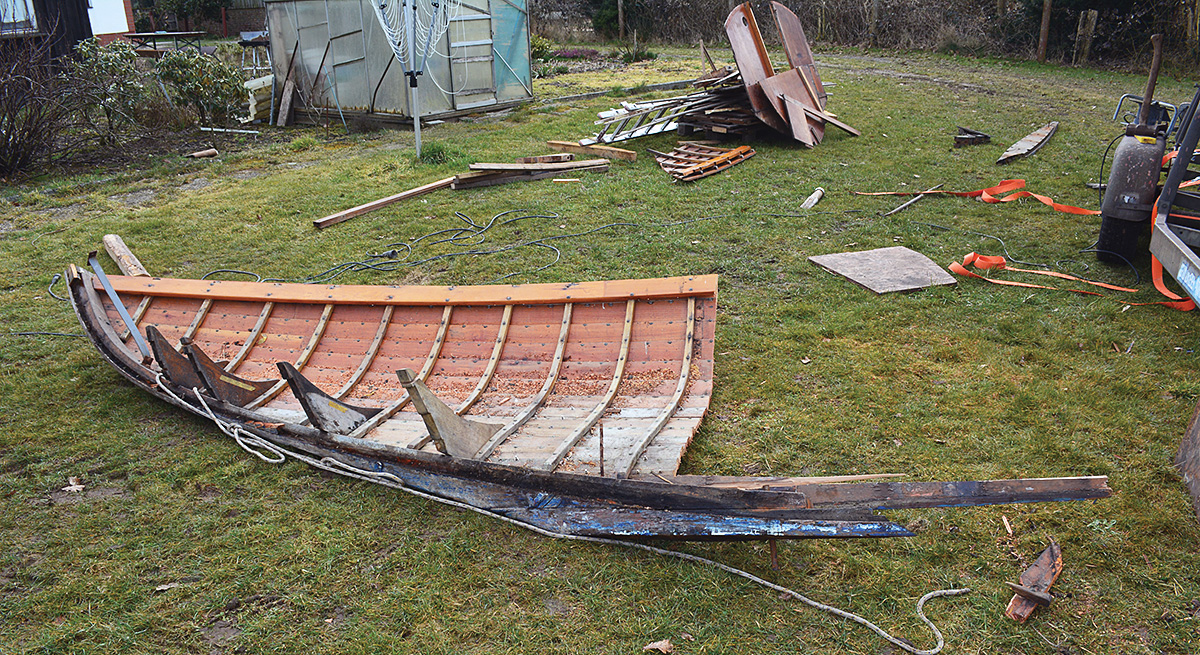
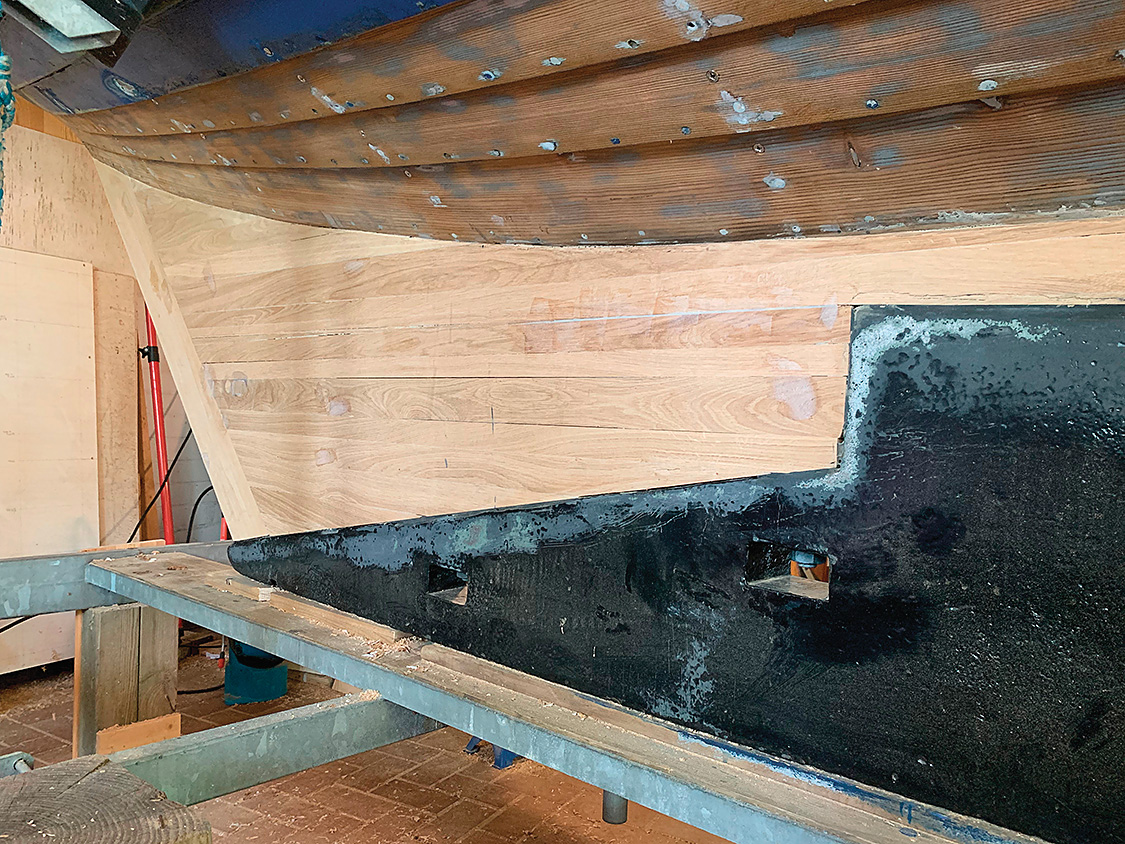
For SAGA’s restoration, Vincent Regenhardt bought a second Folkboat for “spare parts,” reusing its cast-iron ballast keel and also its stem timber and some other parts.
Vincent was committed to getting SAGA back on the water. He concluded that not only would he have to find a Folkboat keel somewhere but also found that he would have to replace rotten wood, including centerline timbers. He also had to deal with some cracked planks and partial frame replacements. Giving up was not an option: His solution was to buy a second vintage Folkboat for “spare parts.” He could reuse not only the cast-iron ballast keel but also the timber keel and the stem.
He also researched what type of metal to use for the replacement keelbolts. His experience led me down a similar path in my project, and I set out to analyze corrosion, what it might mean for my keelbolts, and what options I should consider for replacements.
The overview of galvanic corrosion in the accompanying article below lays out the concerns to be considered when choosing combinations of wood species, ballast-keel material, and keelbolt alloys. The bottom line is that the presence of noble-metal keelbolts in a less-noble ballast keel has the potential to create galvanic corrosion.
Reviewing the references by Nigel Warren, Thomas Larsson, and other resources—including a useful comprehensive overview by Rob Lehman on the website of his company, Fair Wind Fasteners in Newport, Rhode Island—left me with a list of potential keelbolt alloys:
- Galvanized mild steel. Galvanizing is the process of immersing mild steel in melted zinc or a zinc alloy to increase its corrosion resistance. It is an economical option, with all the drawbacks of corrosion risks discussed above and the caution of making regular inspections.
- Stainless steel. This broad term covers a wide range of alloys, and the term “stainless” does not mean that it cannot corrode. Stainless steel was developed in several countries in parallel. In Germany, the steel company Krupp filed the first patents for stainless steel in 1912. Even earlier, in 1908, the schooner-yacht GERMANIA was built for industrialist Gustav Krupp von Bohlen und Hallbach using stainless steel. It is called stainless, in simple terms, because a chemical reaction of chrome within the stainless steel and ambient oxygen establishes a thin, protective layer of chromium oxide. Chromium provides the corrosion resistance and nickel improves resistance to acids.
 Vincent Regenhardt (both)
Above left—Corrosion of SAGA’s keelbolts, potentially caused both by galvanic action from the use of dissimilar metals in her construction and also the acidity of her oak centerline timbers, ultimately led to their catastrophic failure after almost 70 years in service. The bolts corroded to a thin point corresponding to the interface between the timber keel and the ballast keel. Above right—SAGA’s owner, Vincent Regenhardt, elected to use a low-carbon stainless steel for his replacement keelbolts.
Comparing alloys calls for interpreting differing international standards. Here in Germany, we have two relevant categories of stainless-steel alloys: V2A and V4A, names that stem from the original formulations. Today, the alloys in these groups are assigned a German material number, and comparable alloys are known in the U.S. system, created by the American Iron and Steel Institute (AISI), by a different number. So a typical 18-percent chrome and 10-percent nickel alloy is known in North America as No. 304 and in Germany as material number 1.4301. An alloy originally in the V4A category, with the addition of molybdenum and titanium, is No. 316 TI and German material number 1.4571; for uses under the waterline, and especially in conjunction with oak, only an alloy of this quality or better should be considered.
Warren describes some unfortunate characteristics of stainless steel in detail: weld decay, which is a diminished corrosion resistance around a weld, can be overcome. Crevice corrosion and pitting corrosion, however, are serious issues. Stainless-steel alloys in the absence of oxygen—as when embedded in a boat’s structure—don’t create the corrosion-resistant electrochemical layer described above, and the result is a phenomenon known as crevice corrosion. This type of corrosion is easiest to understand if you think about a keelbolt going through a deadwood and a metal keel, where oxygen cannot circulate freely but salt water is still present, along with dirt. Without the protective surface layer, crevices develop and corrosion can get established. Pitting corrosion, on the other hand, can occur on an exposed surface: in short, if the surface oxide level breaks, an electric cell is being established within the single material, and the metal in the pit is being attacked with increased force. The alloy No. 304 (1.4301) is regarded in technical tables as subject to high “risk of punctual or crevice corrosion.” For alloy No. 316 TI (1.4571), that risk is still “medium.”
- Silicon-bronze. Silicon-bronze is a special copper alloy with the addition of some silicon and sometimes nickel. This alloy has a number of advantages, and it shows a very high resistance to corrosion from saltwater and acids. For boats with cast-lead keels, silicon-bronze bolts are recommended, according to Rob Lehman at Fair Wind Fasteners. But with a cast-iron keel—which many boats built in the first part of the 20th century had, including Nordic Folkboats—the use of silicon-bronze bolts would raise galvanic issues; in this case, the cast-iron keel would be the less-noble material and would thus be subject to galvanic corrosion.
- Monel. Named after Ambrose Monel, an American industrialist and military commander, this alloy is about two-thirds nickel, one-third copper, and some iron. On the galvanic scale, it falls between the two stainless-steel alloys mentioned here. It has high tensile strength, even stronger than steel, and is highly resistant to atmospheric, seawater, and acid corrosion. It is, however, expensive.
- Titanium. Extremely light and strong, titanium is the one material for which the risk of punctual or crevice corrosion is listed as “extremely low.” It tops the list of noble metals on the galvanic table. It might be a fine choice for high-end yacht restorations, but its very high price puts it out of range as a material to be considered for a Folkboat restoration.
Armed with an understanding of the choices, I consulted a selection of experts with this question: “For a Folkboat with an oak timber keel and a cast-iron ballast keel, what would be your recommendation for the keelbolt material?”
Larsson’s book recommends using 316 stainless-steel below the waterline and within oak. In general, he suggests avoiding mixing of metals due to the risk of galvanic corrosion, and he says that if material mix is unavoidable, the metals should be isolated as far as possible from each other.
Uwe Baykowski, a widely consulted northern German boatbuilder and surveyor, is also the author of a recent book about yacht maintenance and restoration. He recommends replacing keelbolts with silicon bronze wherever possible, otherwise at least stainless-steel 316 TI with added titanium. When I specifically asked Uwe about weighing the difference between stainless-steel and galvanized-steel keelbolts for a cast-iron keel, he reaffirmed his recommendation for stainless steel. He said that in his experience neither the quality of the base steel nor the quality of galvanization are reliably verifiable today.
I also contacted André Bauer, a northern German naval architect and the owner of an engineering office for ship and boat building. He recommended galvanized steel. His arguments centered on the concerns about galvanic currents created by the combination of stainless steel and cast iron. He also noted that major boatyards would favor using galvanized steel below the waterline.
Finally, Rob Lehman from Fair Wind Fasteners answered my question as follows: “Either (316 stainless steel or galvanized steel) would be a reasonable choice, but I would opt for galvanized keelbolts in that instance.” He reiterated the aforementioned concerns about crevice corrosion. “You won’t even necessarily be able to see it,” he said. “Galvanized steel is not subject to crevice corrosion, and with a bolt that is necessary for safety purposes, such as a keelbolt, I will always recommend the safer choice.”
 Michael Sauter (both)
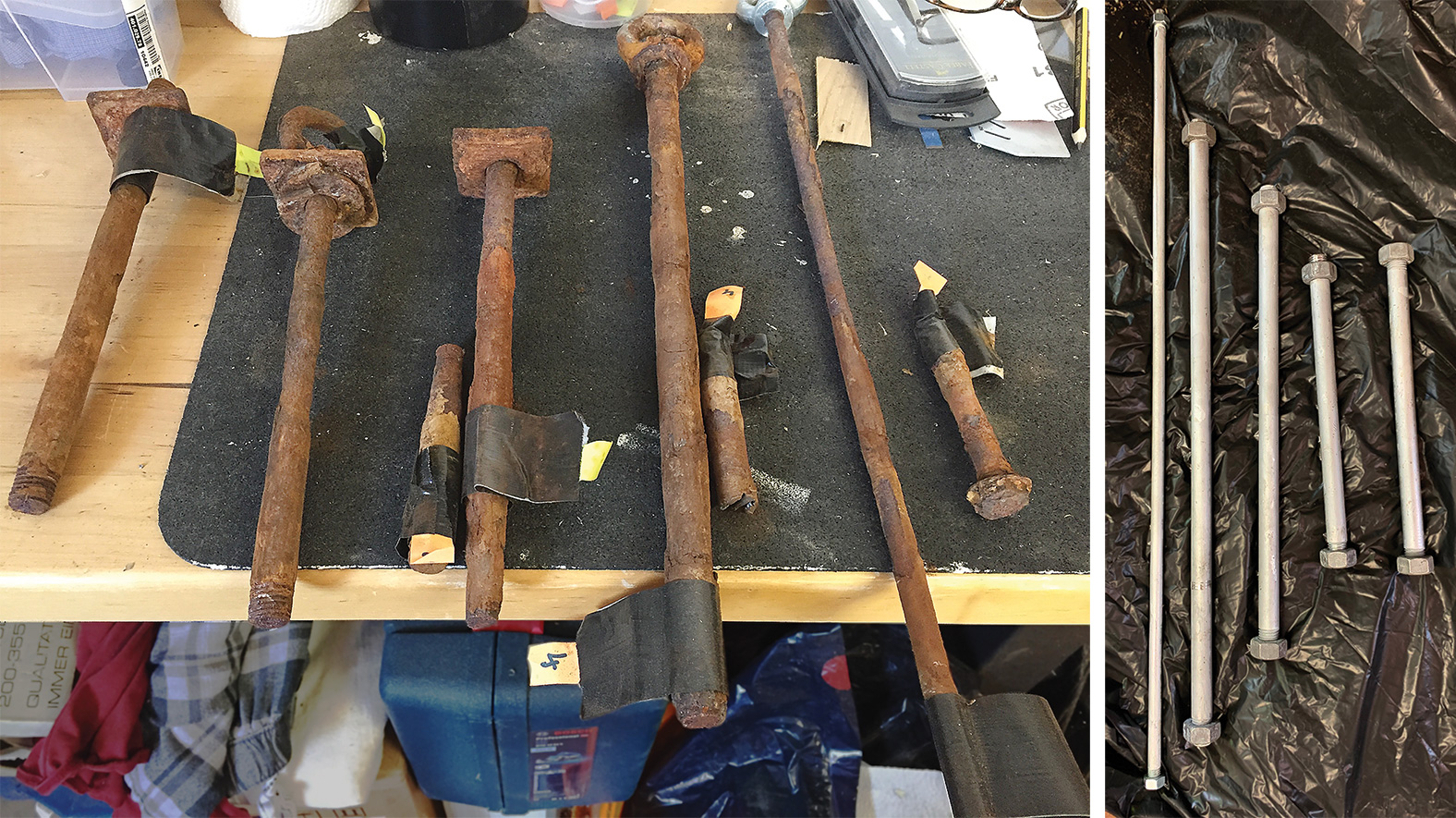
Left—The author decided that the lesson of SAGA’s ballast keel failure served an important lesson: he removed his boat’s keelbolts, which had been in service for almost 60 years, and found them to be somewhat corroded. Right—For replacement, the author settled on galvanized-steel keelbolts coated in epoxy to help isolate them galvanically.
I used galvanized steel for my restoration. Vincent, however, chose a different path. He was determined to use stainless steel from the beginning, and in a comprehensive social media video, he explained his reasoning. He did not choose the stainless-steel 316 TI alloy that is typically used in Germany (No. 1.4571). Instead, he chose No. 316 L (German No. 1.4404), a low-carbon version of the alloy commonly used internationally. His reasoning was simple: The main advantage of the former alloy is its resistance to very high temperatures, which was not relevant to boatbuilding. In workability and even in some corrosion categories, the latter has some advantages.
 Vincent Regenhardt
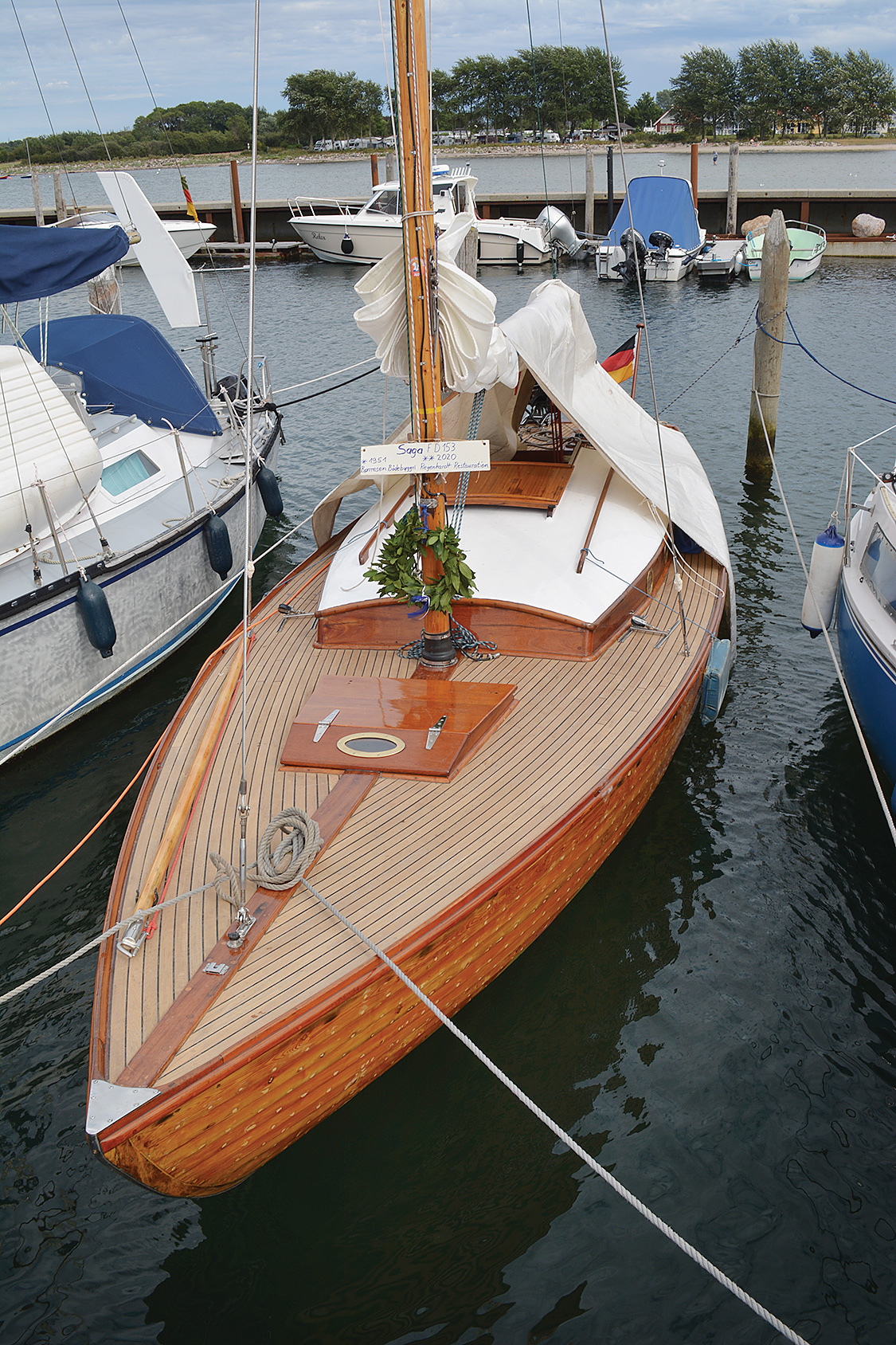
SAGA, successfully restored, returned to the Nordic Folkboat fleet in 2021.
In 2021, Vincent finally relaunched SAGA after thousands of hours of work and many late nights in the barn. Meanwhile, I was involved in my own work on TOKYO, for which I had decided pull the keelbolts and replace the deadwood. The boat has a 275kg (606-lb) cast-iron ballast keel with a large oak deadwood between it and the timber keel. I withdrew the five keelbolts, four of them with diameters of 20mm (¾″) and one with 12mm (about ½″). The bolts showed wear and tear after 57 years of service but still looked quite stable.
I followed André’s advice to use galvanized-steel bolts. Heeding Uwe’s warnings about reliability, I put considerable effort into identifying reputable sources for steel and a trustworthy company for galvanizing. The five keelbolts of the Folkboat Junior do not run through the whole iron keel but rest in pockets. I had a metalwork expert mill threads in both ends of the bolts, renewed the oak floor timbers, and used galvanized nuts on all but the two keelbolts that were fitted with lifting eyes. I also followed the Larsson and Warren advice on isolating different metals; I coated the keelbolts in epoxy before driving them in slightly oversized holes.
 Michael Sauter
The author’s KDY15, TOKYO, can sail confidently with her new oak deadwood and five new keelbolts for her cast-iron ballast keel.
It is worth mentioning that the orignal keelbolts in SAGA and TOKYO, of uncertain iron or steel alloys, lasted decades in service. In the case of SAGA, nearly 70 years passed before the heart-stopping disaster occurred. None of the effects of corrosion happen overnight. This discussion is not meant to reach the deepest details nor to be an exhaustive treatment of a complex science; instead, it shows the practical aspects to be considered when having the luxury to select woods and alloys for a restoration—as well as the judgments involved.
The questions also reveal contradictions: some woods resist the damage of nail sickness, but on the other hand they support the corrosion of bolts and rivets. Boats with cast-lead ballast keels pose fewer hazards, in terms of the choice of material for keelbolts, than those with cast-iron ones. With iron keels, tradeoffs must be made.
Clearly, galvanic corrosion can be dangerous. Warren describes examples in which disastrous effects were visible within weeks. Mixing of metals should be especially avoided wherever possible. Lots of electronics, a faulty AC electrical system on a neighboring boat in the marina, and missing or eroded sacrificial anodes especially create an unfortunate constellation of issues. 
Michael Sauter took up boatbuilding in retirement from his former life with a global consulting company. He spends most summers in the Penobscot Bay area of Maine, and he has taken several courses at WoodenBoat School.