
 Mike Smylie
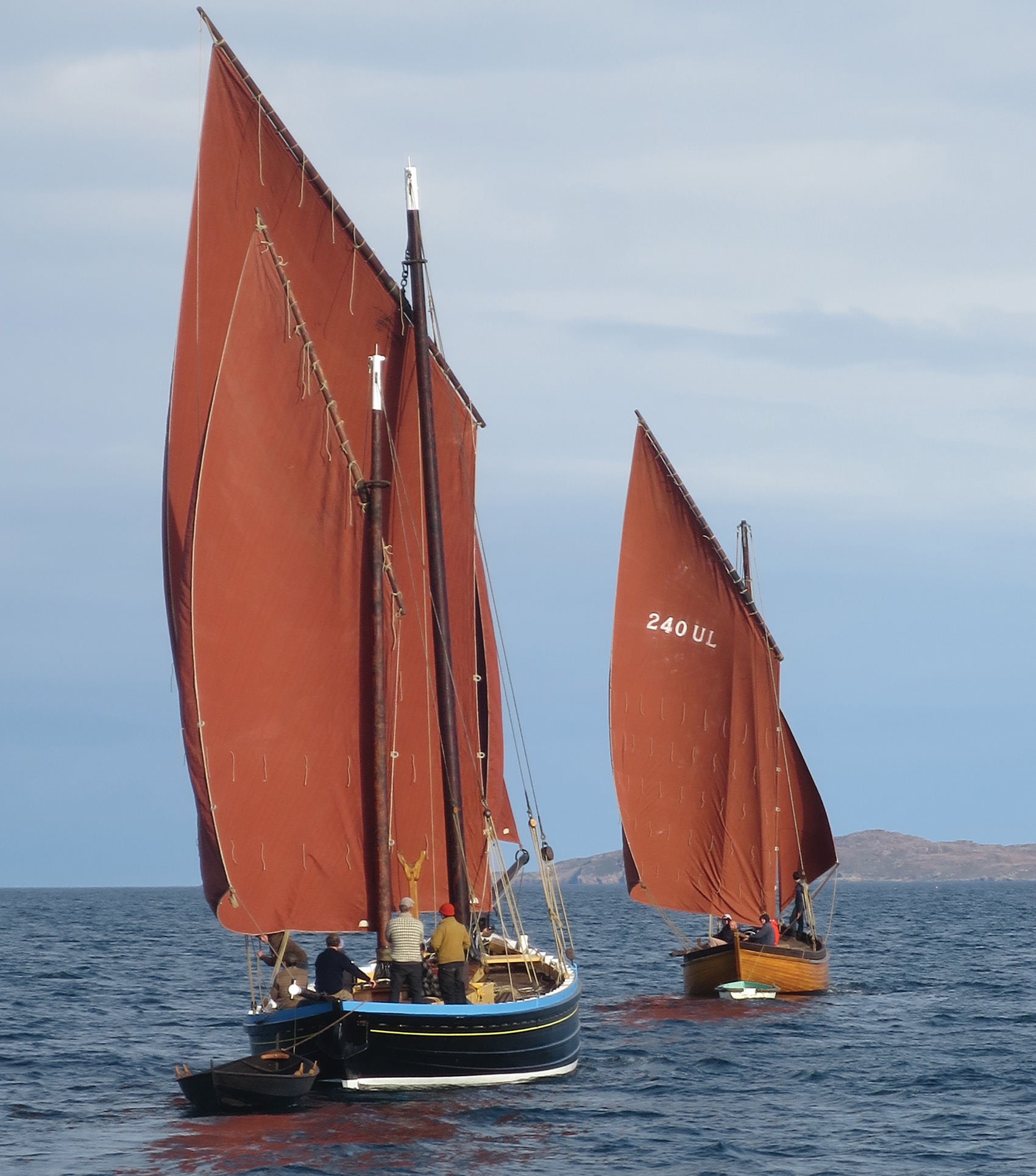
The 50′ Zulu ST. VINCENT of 1910 (left) and the 37′ Lochfyne skiff CLAN GORDON of 1911 (right) were relaunched in spring 2023 within a week of each other; within days, they joined for their first sail together out of Loch Broom in northwestern Scotland, bound for the Summer Isles.
Halfway down the hill on a walk to a small boatyard in Corry, near Ullapool on Loch Broom on the northwestern coast of Scotland, it’s the smell that hits you first—“boat soup,” as they call it: pine tar, linseed oil, and turpentine. The proper stuff for wood. On May 6, 2023, the scent seemed to hang off the trees and settle on each blade of grass. Like the aroma of oakum, it was pungent yet delightful. Then, as I turned the corner past salmon-farm buildings, suddenly the boat on the ways towered over the bunting, over everything. Two huge masts with two huge, dark-red lugsails hanging limp over a black hull spoke of tradition in every respect.
This was relaunching day for the 1910 herring fishing boat ST. VINCENT, 50′ from stem to transom, after her restoration by Dan Johnson and Tim Loftus and their team at Johnson & Loftus Boatyard. And even as she stood on the marine railway, another historic fishing boat with deep roots in the west of Scotland, CLAN GORDON of 1911, lay to a mooring just off Johnson & Loftus, where she had arrived under sail a couple of days before. She had been relaunched on April 29 after a full restoration at Isle Ewe Boats, Alasdair Grant’s boatyard on the island of that name in Loch Ewe, west of Loch Broom.
 Mike Smylie
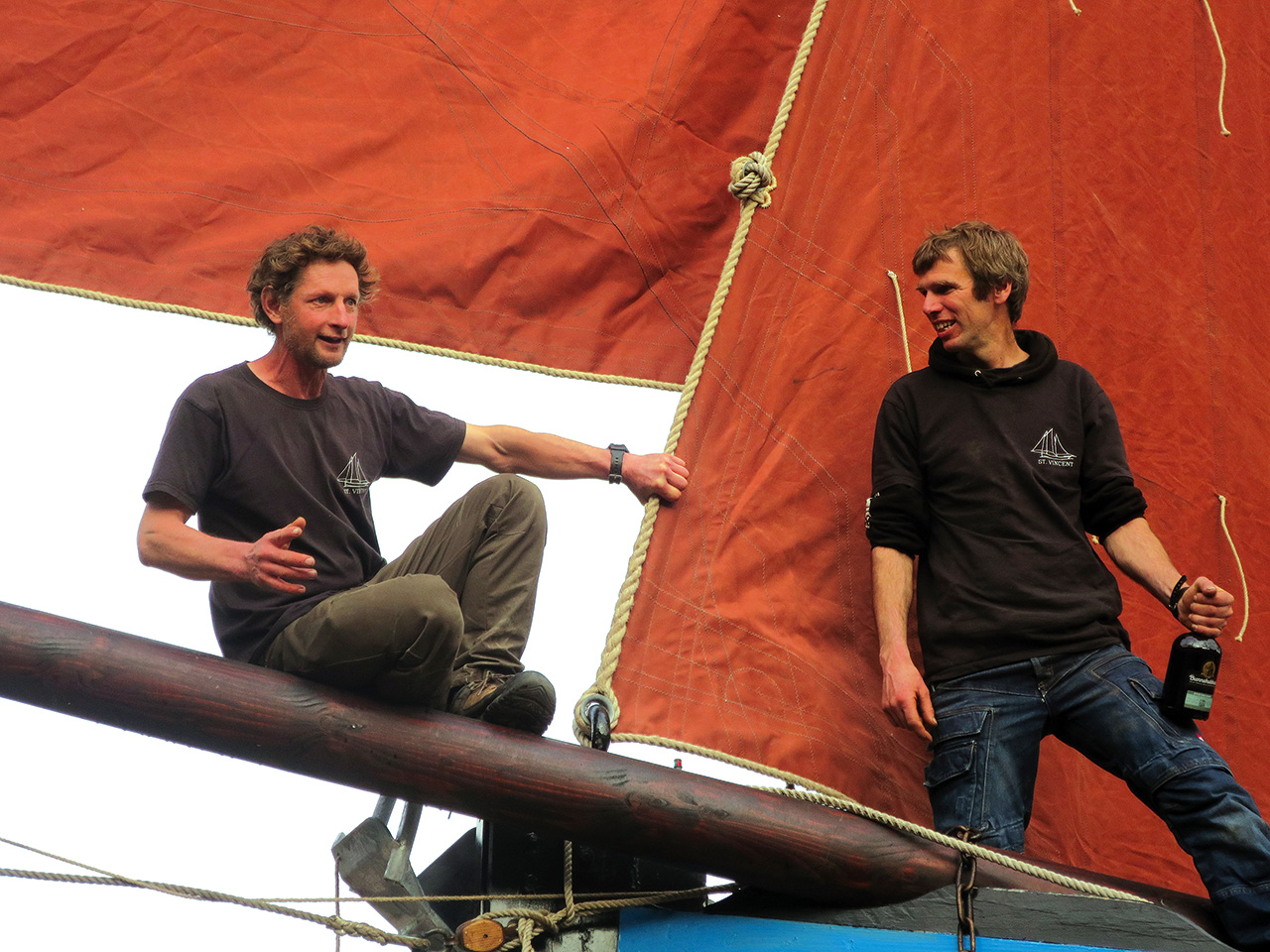
Boatbuilders Tim Loftus (left) and Dan Johnson (right) prepare to christen ST. VINCENT with a bit of whisky just before sending her down the ways.
On the railway, ST. VINCENT showed her deep but incredibly flat floors. She oozed history: a blue caprail, a thin yellow covestripe, a white boottop, a long boomkin, and a much longer bowsprit, and all around her that aroma of boat soup. She was sitting on a purpose-made cradle, and as the tide approached its zenith the crowd grew excited. Soon, thuds and the crash of braces as they were removed echoed as Dan and Tim and their team prepared to unleash the cradle.
The railway had been coated with hot tallow, which had cooled and solidified. After a quick speech and a dribble of alcohol over her stem, ST. VINCENT was sent down the incline. With a cry from the crowd and a rush of water, she was afloat, 113 years after her initial immersion. She joined CLAN GORDON, and that day the two boats together presented a sight that hadn’t been seen in a century.
Both ST. VINCENT and CLAN GORDON had been discovered and saved by James MacGregor, a naval architect who grew up on Loch Broom opposite Ullapool. MacGregor’s father was a fisherman, but James and one of his brothers, Gordon, left to pursue university studies. The third of the brothers, Rory, stayed to join their father in a life of fishing.
 Mike Smylie Collection
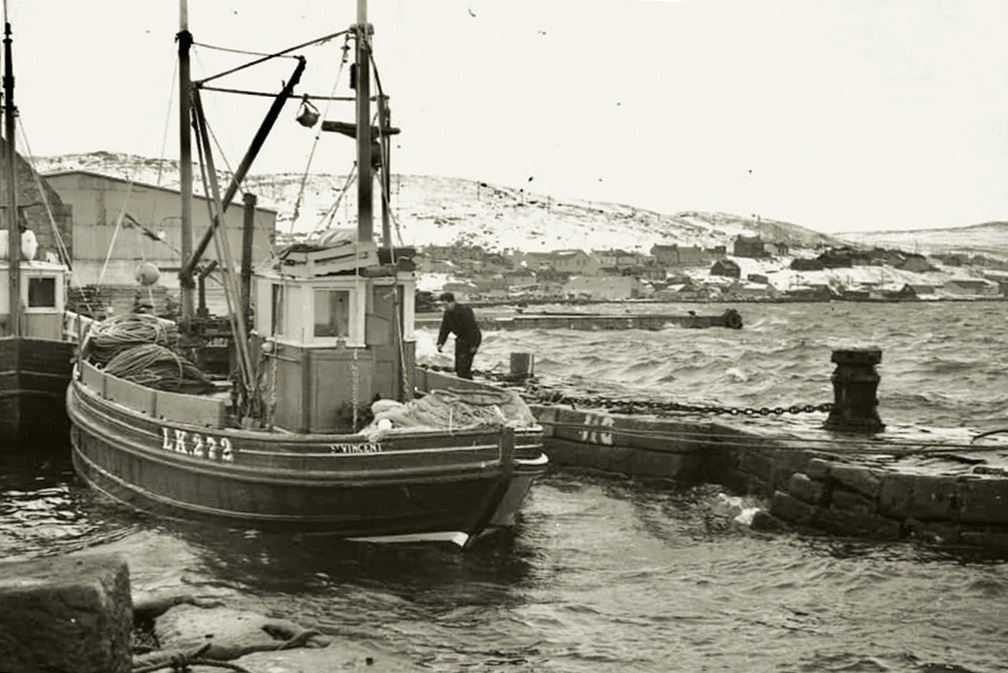
ST. VINCENT is shown here in Hay’s Dock in Lerwick, Shetland, in about 1960, long after her conversion from lug rig to diesel power.
ST. VINCENT was in a dilapidated state in North Shields on England’s east coast when James found her in 2007. Recognizing her vintage, he bought her and took her north to Arbroath, on Scotland’s North Sea coast, near where he lived. He removed her mismatched deckhouse, rerigged her as a two-masted east-coast lugger, restored her original name, and had her sailing again by 2010—but seldom had time to sail her. Over the next decade or so, her condition declined, and it became clear that ultimately a full restoration would be in order.
Meanwhile, in 2003, James and Gordon together bought CLAN GORDON and had her, also, restored at Arbroath. The following year, they sailed her to Ullapool. Several years later, she sank at her mooring there, after which she was hauled out. She, too, was due for a full restoration.
An unforeseen lifeline for the boats came in 2017 when the island of Tanera Mòr, the largest of the Summer Isles off Loch Broom, was purchased by Ian Wace, a wealthy financier and hedge-fund co-founder. Pursuing a vision for the island’s future, he passed it to a charitable trust and funded a thorough community restoration program (www.tanera.org). Part of his vision included restoring and repurposing the island’s historic herring-curing station, whose stone buildings date to 1788. That raised the prospect of a new role for ST. VINCENT and CLAN GORDON; in 2020, MacGregor donated both boats to the Tanera Mòr Project, through which Wace funded their restorations. Their presence on the island will honor the legacy of the link between the boats that fished for herring off this coast and the herring-curing stations built ashore on several islands off Loch Broom, Tanera Mòr among them.
 Tim Loftus
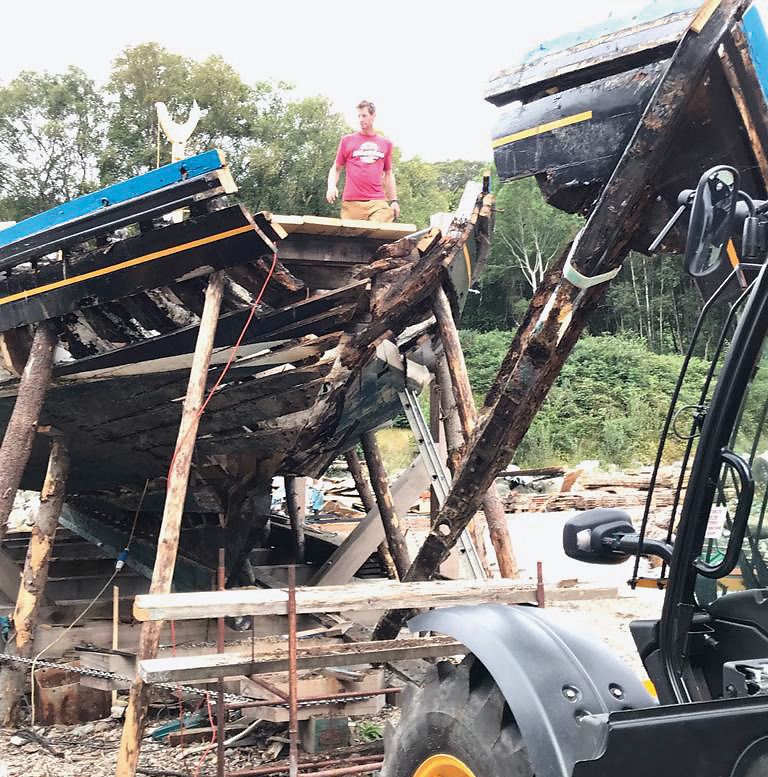
ST. VINCENT’s original sternpost was cut back at some point, so it was removed to make way for restoration to its original configuration.
ST. VINCENT is a type of herring boat called a Zulu. At 50′, she’s small as the Zulus go—the largest were up to 80′—but she’s large enough to have the characteristic steeply raked sternpost and plumb stem, and she conveys the magnitude of these hulls. Zulus (see WB No. 146) represented the pinnacle of Scottish coastal boatbuilding in the late 19th century, a time when the herring fishery was flourishing and fishermen demanded powerful rigs to speed their vessels to and from the fishing grounds.
In the 1870s, Scots fishermen chose the name Zulu for what was then a new type of boat developed for the herring fishery. Zulu warriors, who were widely admired for demonstrating exceptional courage in the 1879 Anglo-Zulu War in southern Africa, had earned the respect of British soldiers fighting against them. The war left many Scottish fishermen, as well as the general populace, distinctly angered by reports of their kinsmen being slaughtered in a conflict that was, in effect, just another expansion of English colonialism.
The Zulu fishboats gained a reputation for speed, and over the decades the fleet grew exponentially in number, and the boats in size, as the demand for herring exploded. They had crews of up to nine men. Yet, by 1906 the last of the large ones had seen their heyday. The smaller boats built later had short careers: the pronounced rake of their sternposts made them ill-suited to the internal-combustion engine, which fishermen quickly adopted after its introduction at the turn of the century.
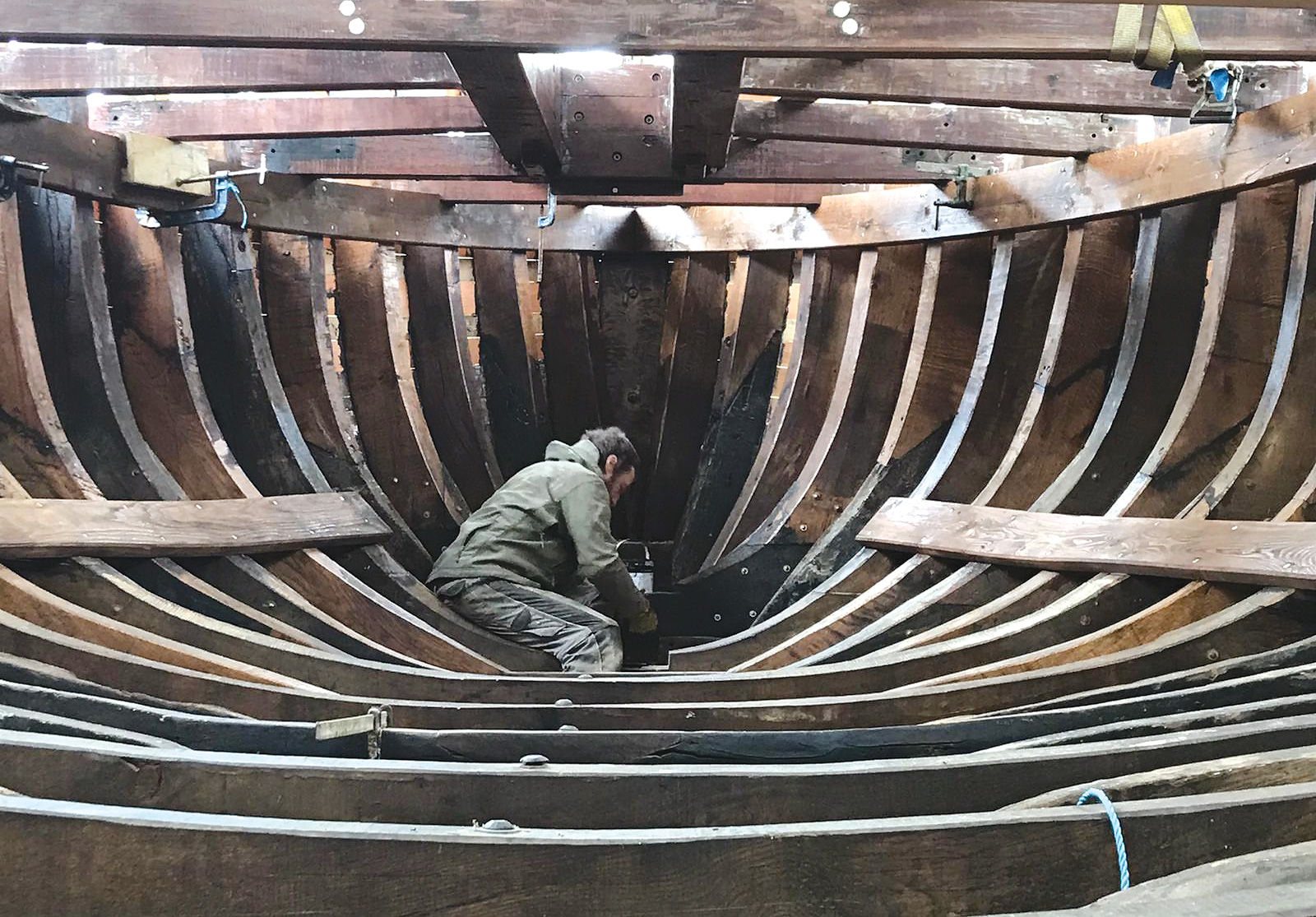 Tim Loftus
The boat was entirely reframed with robust new sawn futtocks of oak.
Today, ST. VINCENT is probably the largest of the Zulus in existence in Britain in any condition to sail. She was one of only a few comparatively small ones that appeared after the heyday of the Zulus, and she was probably one of the very last. One 80-footer, MUIRNEAG, was a rare survivor: she fished out of Stornoway into the 1950s, when she was finally broken up and much of her wood was recycled for fenceposts.
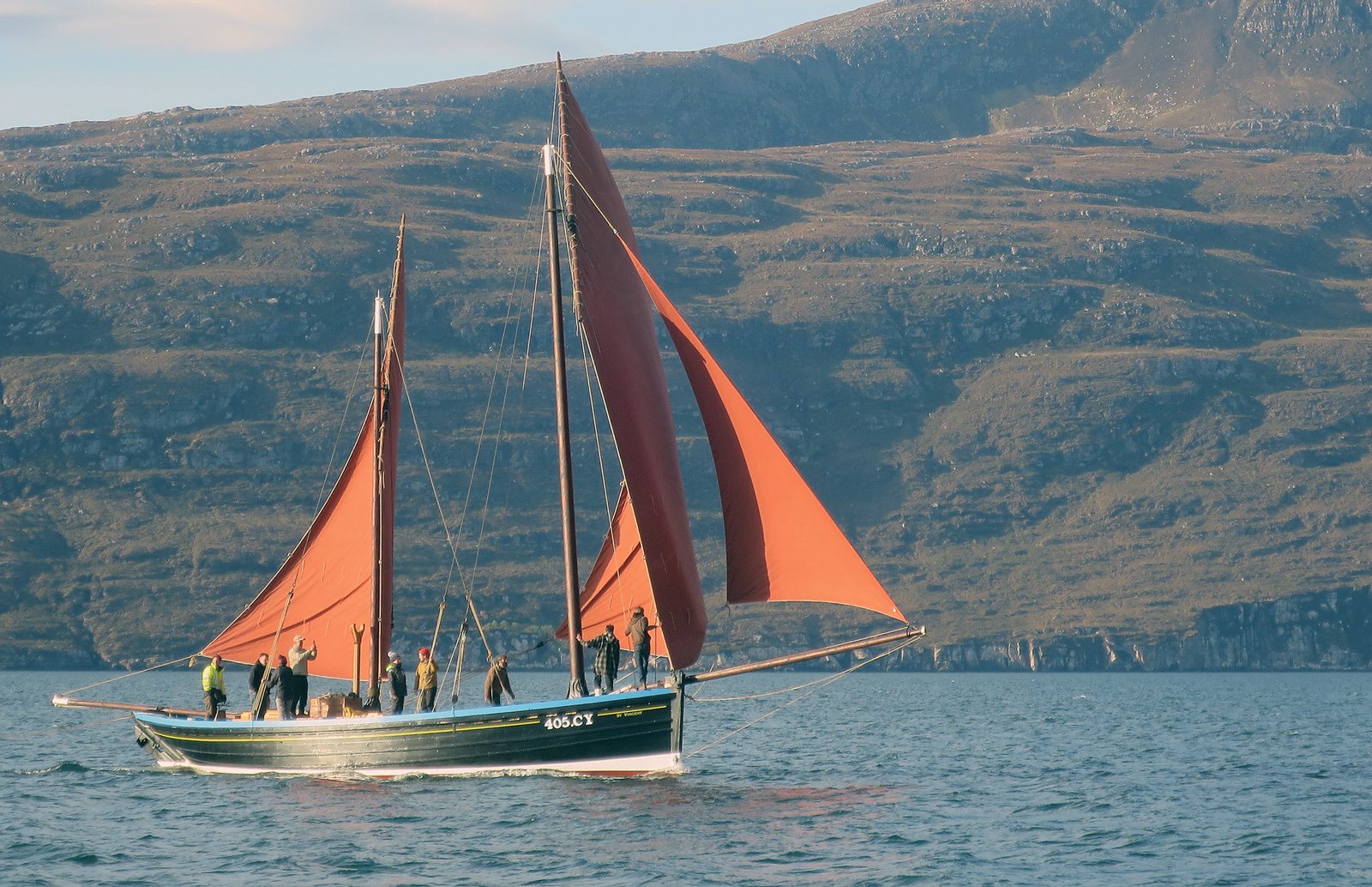 Mike Smylie
Zulus such as ST. VINCENT were developed during the herring boom of the late 19th century and carried ample rigs to get to the herring shoals and return quickly to curing stations with their catches. ST. VINCENT’s original home port was Eriskay in the Outer Hebrides; here, she sails out of Loch Broom not far from Ullapool.
ST. VINCENT was built by the W&G Stephens Boatyard of Banff, east of Inverness on Scotland’s east coast. Her construction was commissioned by two west-coast fishermen, Donald MacDonald and Alasdair MacAskill, both from Bun a’Mhuillin on the Outer Hebridean island of Eriskay, where she worked the drift-net fishery until the 1940s. She was converted for motor power at some point. She later was passed to a fisherman in Wick, in the far northeast of the Scottish mainland, where she was “modernized” with a wheelhouse and new Gardner 6LW engine. By 1955, she was working out of Cullivoe on the island of Yell in Shetland, and she subsequently went through a succession of owners ranging as far south as Lowestoft, England.
By very late in the 1980s, ST. VINCENT had moved to North Shields, near Newcastle upon Tyne, where she was converted for use as a pleasure boat, which included the addition of a huge deckhouse. She had been renamed NAUTILUS by the time James MacGregor found her there in 2007.
For the thorough restoration that Ian Wace had in mind after the Tanera Mòr Project trust received the boats from James in 2020, he approached Johnson & Loftus Boatbuilders, which Dan and Tim had founded in 2017.
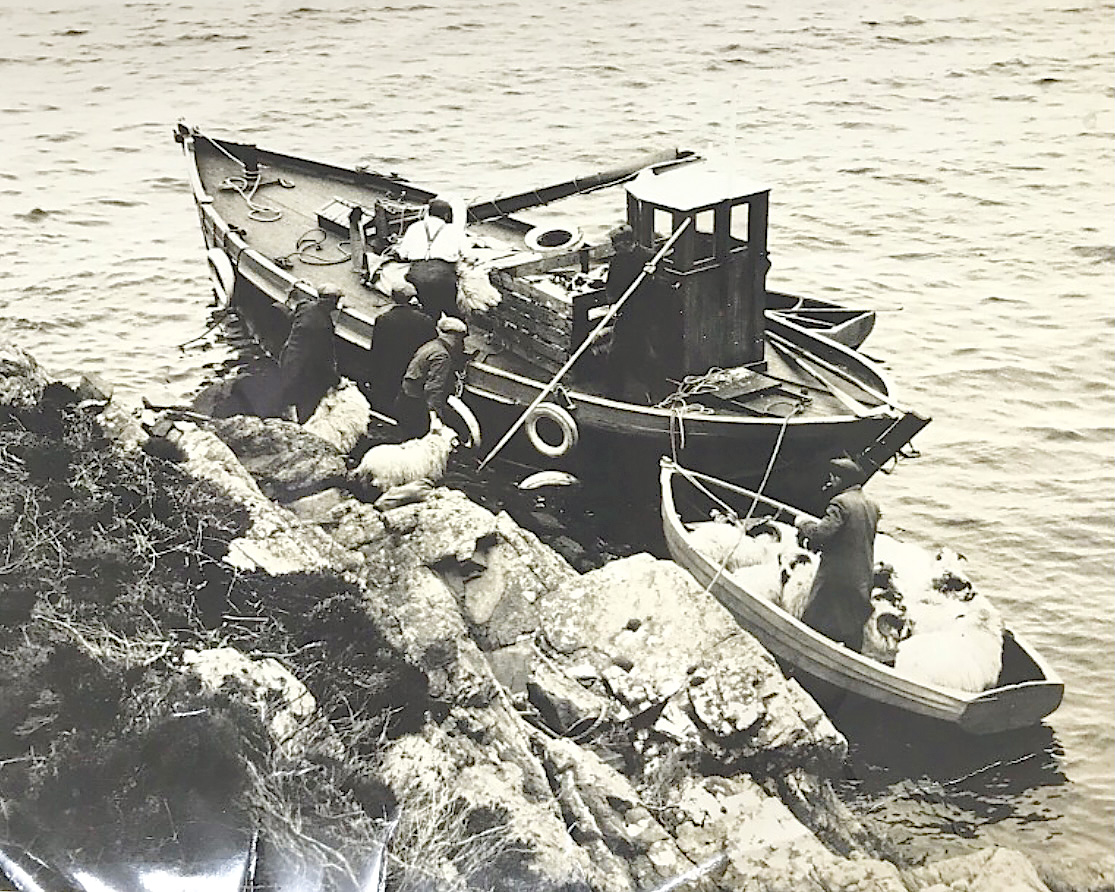 Mike Smylie Collection
CLAN GORDON was built for ring-net fishing under sail in tandem with a second boat; later she was converted to engine power. Like many fish boats, she served multiple purposes; here, circa 1960, she ferries sheep off the Isle of Raasay, east of Portree on the Isle of Skye.
Tim was a Cambridge-trained geologist, a successful mountaineer, and an ocean sailor before deciding he wanted to be a boatbuilder. He learned the trade at the International Boatbuilding Training College in Lowestoft, England (which has since closed). After graduating, he first worked for the Ullapool Boatbuilders Co-operative, then, in 2003, he went to Cockenzie, east of Edinburgh, to build a yacht of his own, THEMBI, a cruising cutter of Ed Burnett’s design. He next worked for the Underfall Yard in Bristol, in southwest England, before returning to Ullapool in 2011.
Dan had grown up in his father’s workshop, where he learned traditional timber-frame construction. He went on to earn a degree in furniture design and construction, after which he set up as a furnituremaker. He moved to Ullapool in 2006 to build an oceangoing boat of his own, the 34′ junk-rigged schooner HESTUR, designed by Jay Benford, and, like Tim, he sailed widely in the Atlantic.
Before they could start work on ST. VINCENT, they had to collect her from Arbroath. She wasn’t in the best of health; nevertheless, they sailed her without much trouble north up the coast, west in the Moray Firth to Inverness at the eastern end of the Caledonian Canal, through the canal, and then north to Corry for haulout.
“The keel was okay,” Tim told me. “It appeared to be the original beechwood keel, though it is possible that this had been renewed, and it was just the hog [timber] that was original. We weren’t totally sure. But the stem and sternpost are new, made of oak. The top bit of the sternpost was cut off when she was a yacht, which shortened her a couple of feet. So, she was a couple of feet longer when she left the yard than when she came in.” They replaced about 90 percent of the frames with new ones of oak. They also replaced the keelbolts using genuine wrought iron, a rarity these days. About 70 percent of the larch planking had to be replaced, along with the wales, which were oak. At times, up to five shipwrights were at work on the project.
I asked what they used for steam-bending. “That big red boiler by the boat,” Tim said, “and we used bags to steam the planks in. The oak strakes were about 6½″ × 5½″ and they took about four and a half hours to steam, after which they went in a treat. The deck and deckbeams were mostly new, except a few beams that James MacGregor had replaced. Those he renewed were, surprisingly, of purpleheart whilst for the ones we replaced we used oak.”
They also replaced the rudder. Long ago, when the boat was reconfigured for motor power, a skeg extension off the keel had been installed to form a propeller aperture. Because this restoration took her back to her original configuration—meaning without an engine—they reverted to the original rudder style, mounting it on the steeply raked sternpost. Instead of a tiller, the boat has worm-drive steering gear operated by a horizontally mounted wheel they’d inherited with the boat. You’d be hard-pressed to know it was not original. “We probably spent over a month, both of us, fabricating all the steel and forge work,” Tim said.
Belowdeck, they built four berths in the forecastle and installed a stove. Four more berths were installed aft of the fish hold. “The fitout inside was purposely basic,” Tim said, “but she will normally be crewed by six people, so it was vital to have enough places for them to get their heads down. The fish hold is bare, as it would have been. I think the intention is to have the boat as a community benefit, so that folk will be able to experience and learn how to sail the boat. For the moment, Dan and I will skipper her.”
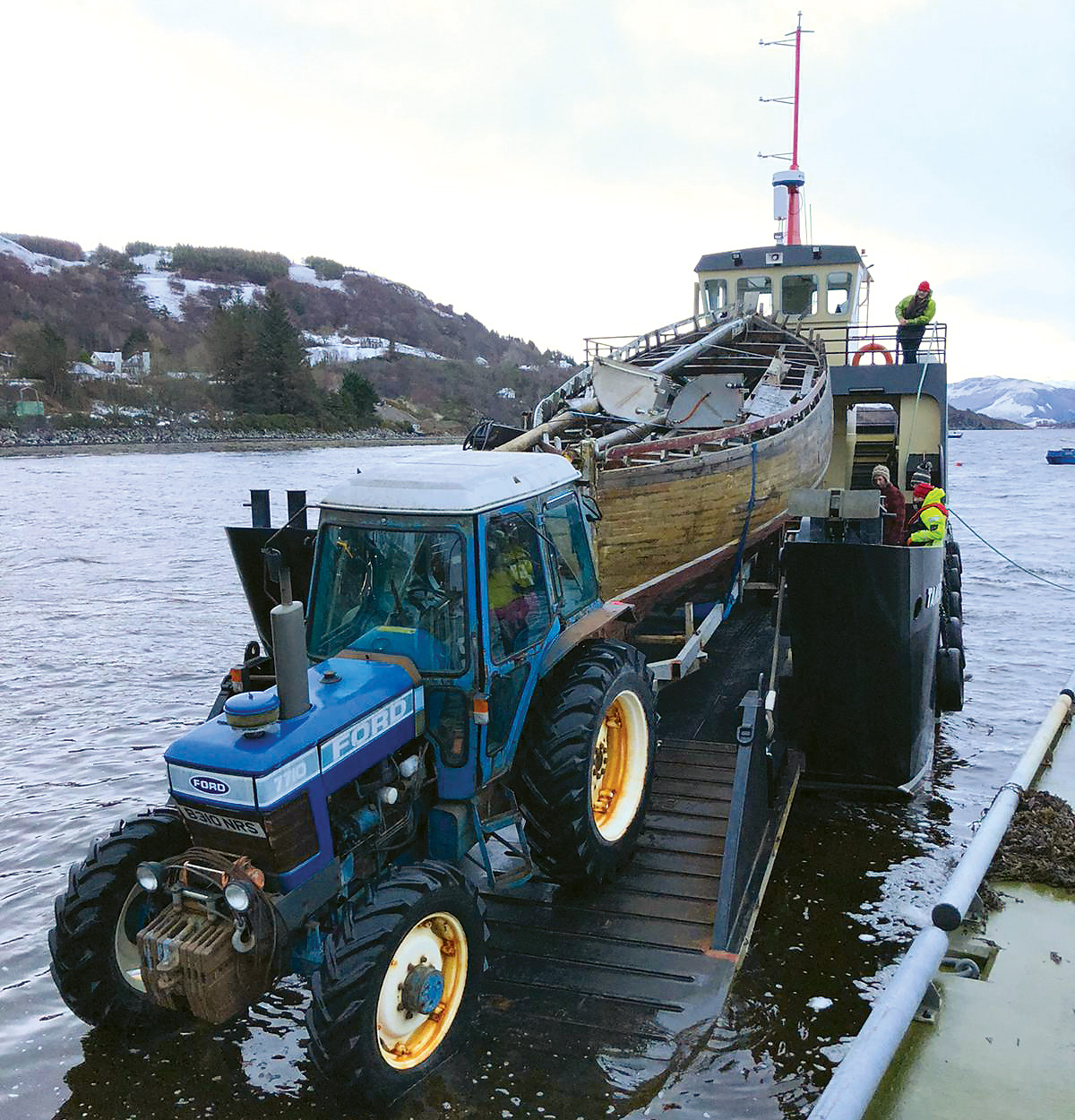 Tim Loftus
In 2020, the boat was loaded onto a landing craft at Ullapool for delivery to Isle Ewe Boats.
They also refurbished the rig, making new spars—a mainmast, bowsprit, and boomkin—to replace the existing ones, which had rot. The Douglas-fir for the spars came from Leckmelm Woods, within a mile of the yard. But they were able to retain the mizzenmast, which had already been replaced in about 2008. The wire rigging, which had been replaced in Arbroath, was still serviceable, but the running rigging all had to be replaced.
Meanwhile, CLAN GORDON was being restored by Alasdair Grant at his yard after being taken to Isle Ewe aboard a landing craft from Ullapool. Six generations of Alasdair’s family have fished and farmed as crofters on Isle Ewe, where he was born. He always knew he wanted to be a boatbuilder, so after leaving school, he went to the Boat Building Academy in Lyme Regis in southwestern England. Upon graduating, he worked in Falmouth, Cornwall, but returned to Scotland and eventually, in 2014, returned home to Isle Ewe to go out on his own, specializing in traditional construction.
 Alasdair Grant
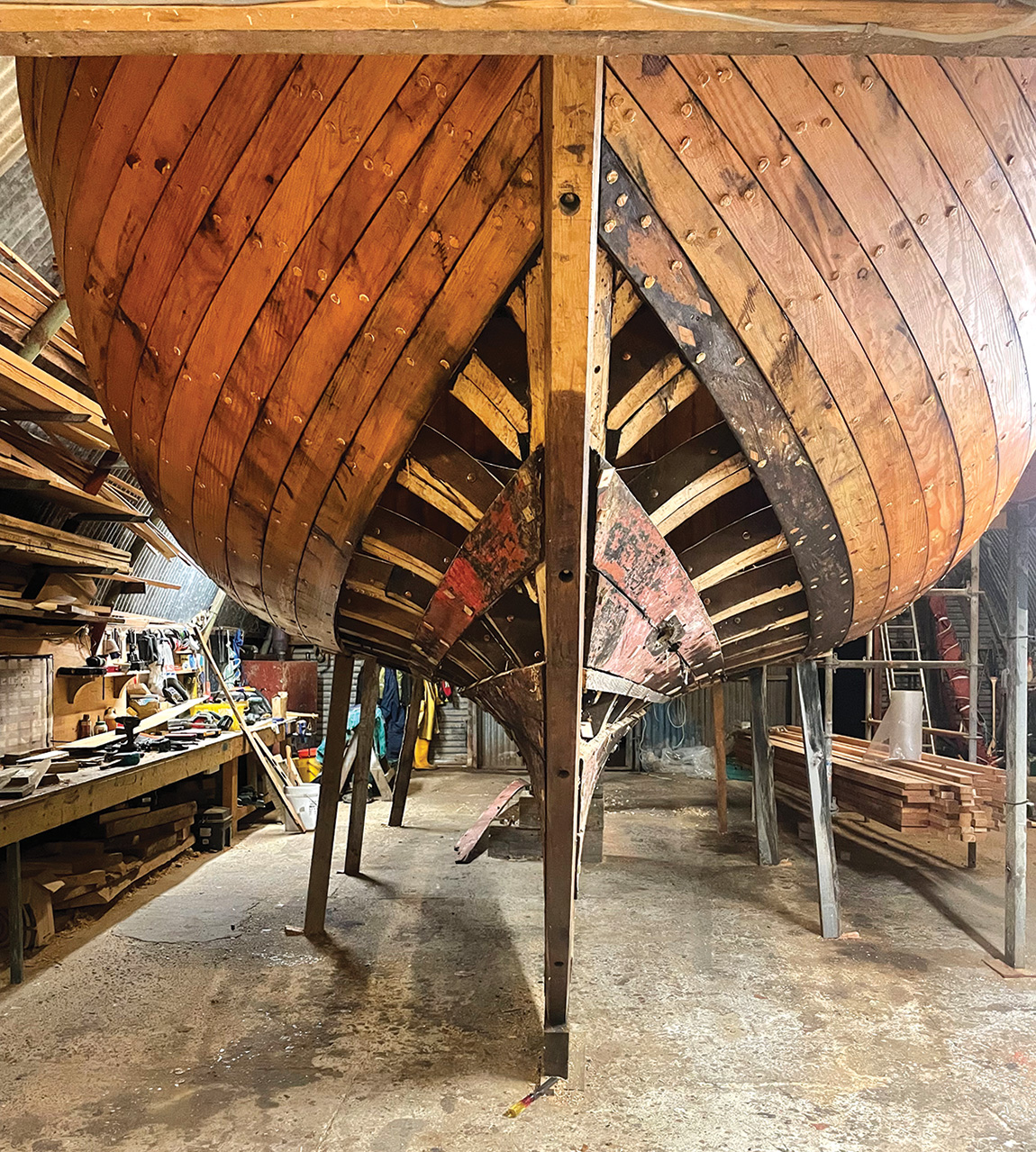
Alasdair Grant and his crew thoroughly rebuilt the hull.
CLAN GORDON, 37′ from stem to transom, is a 1911 Lochfyne skiff—the loch’s name has always been rendered as a single word in reference to these boats—typical of hundreds of skiffs that worked the herring fishery from ports ringing Loch Fyne, which extends north off the Firth of Clyde on Scotland’s west coast (see WB No. 218). Most of these boats were used for ring-net fishing, a trawling technique using two boats working a net in tandem. Fishermen at Tarbert, on Loch Fyne, first started using drift nets as seine nets in the 1830s. From that innovation came the trawl net, but its use was soon banned and remained so until 1867—causing much hardship in Tarbert. After 1867, the use of relatively small open boats called trawl skiffs was widespread. In 1882, Edward McGeachy brought two larger, half-decked skiffs, ALPHA and BETA, over to Campbeltown on the firth’s western shore from Girvan on the eastern shore. Numerous skiffs of the type were built over the next two decades by builders in communities ranging from Campbeltown, which is near the mouth of the Firth of Clyde, up the western shore of the firth to Carradale, Tarbert, Ardrishaig, and as far as Inveraray, which is near the head of the long, narrow Loch Fyne—and they became widely known as Lochfyne skiffs. Eventually, many other builders around the Clyde and outside of the firth, northward toward Oban, built them, too.
Lochfyne skiffs were larger versions of the earlier trawl skiffs. The new type allowed fishermen to sail farther afield in their constant search for herring shoals. Rigged with a single standing lugsail and jib, they were highly maneuverable, which made them well suited to working in pairs with a ring-net. New boats continued to be built into the 1920s, when engine power finally began to supersede sail.
CLAN GORDON’s builder was identified as one R. Munro, of Ardrishaig, a village on Loch Gilp, a small bay off the west side of Loch Fyne about midway in the north–south range of the western-shore boatbuilders. This boat, however, was built for an owner much farther north: Roderick Gordon of Loch Kishorn, northeast of the Isle of Skye. She was worked by the Gordon family for decades, mostly for herring fishing in the Minches, the islands in the strait between the Inner and Outer Hebrides. It appears she was fitted with a Kelvin 13.15-hp engine either before launching or just afterward. Not much else is known about her early history, although legend has it that her purchase price was paid for after just two nights of fishing in Loch Broom during the herring boom of World War I.
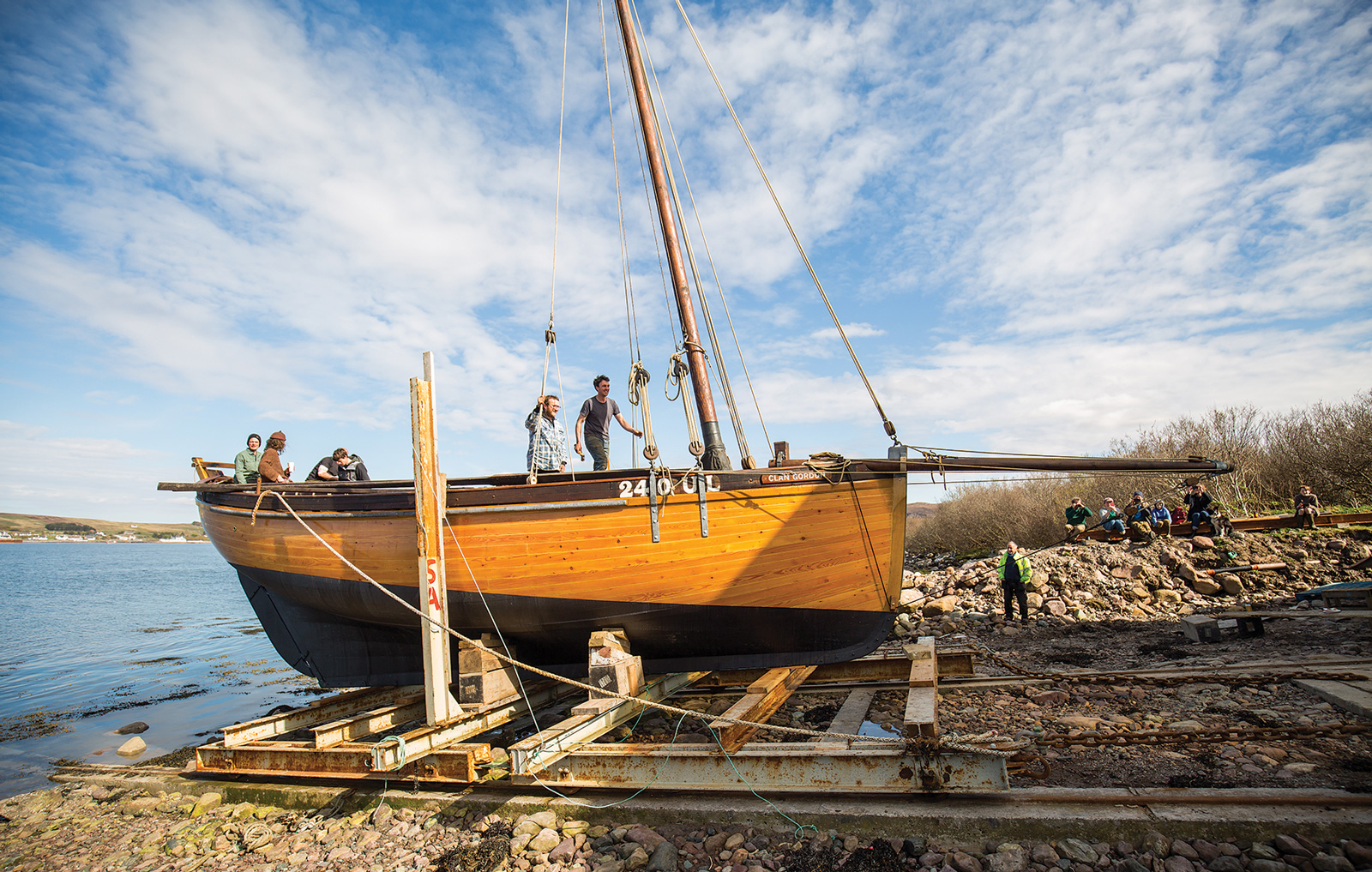 Amy Smith
CLAN GORDON was relaunched April 29, 2023, giving Alasdair Grant time to sail her to Loch Broom for ST. VINCENT’s launching, after which the boats sailed in company to their owner’s island of Tanera Mòr.
She was sold to another fisherman in 1946 after a death in the Gordon family. In 1958, she was acquired by the Northern Lighthouse Board and worked out of Portree on the Isle of Skye as a service vessel delivering lighthouse keepers and supplies to Rona Island, west of Skye. Charlie Macleod, one of her skippers, told me of the wee cockpit, aft of a spar crutch from which a pulley was suspended so that a canvas could be hoisted to chin height to provide the helmsman rudimentary protection from the elements. Later, a wheelhouse was added, and the early Kelvin was replaced with a Kelvin-Ricardo four-cylinder, 30.36-hp gasoline and paraffin engine.
Withdrawn from lighthouse service in December 1964 as her condition deteriorated, she was sold to a fisherman, then passed along to others in turn. By 1988, a fellow named Pip Hills found her back on the east coast, stored in a shed somewhere near Brechin, which is inland north of Arbroath. Hills heard about the boat in a pub conversation, and he had seen her afloat some years before at Tayport, opposite Dundee on the River Tay estuary. He tracked down the owner, who had a sort of fishing-tackle-cum-Nazi-memorabilia shop tucked away in the hills. It seems the fellow was living in the ruins of a castle on land he owned, amid gardens and grounds. He intended, as so many do, to bring the boat back to sailing condition, but he never got around to it. He wanted £800 (about $1,050 at today’s rates) for the boat, and Hills bought her for something less.
Once Hills got her to his Granton neighborhood of Edinburgh, he took off the deck, which was entirely rotten, replaced much of the framing and planking above the waterline, scarfed-in a new stem piece, replaced deckbeams and planks, and got the Kelvin J4, which was aboard her by then, working. He also rigged her with a standing-lug mainsail and a foresail, so for the first time in many years she was able to sail again.
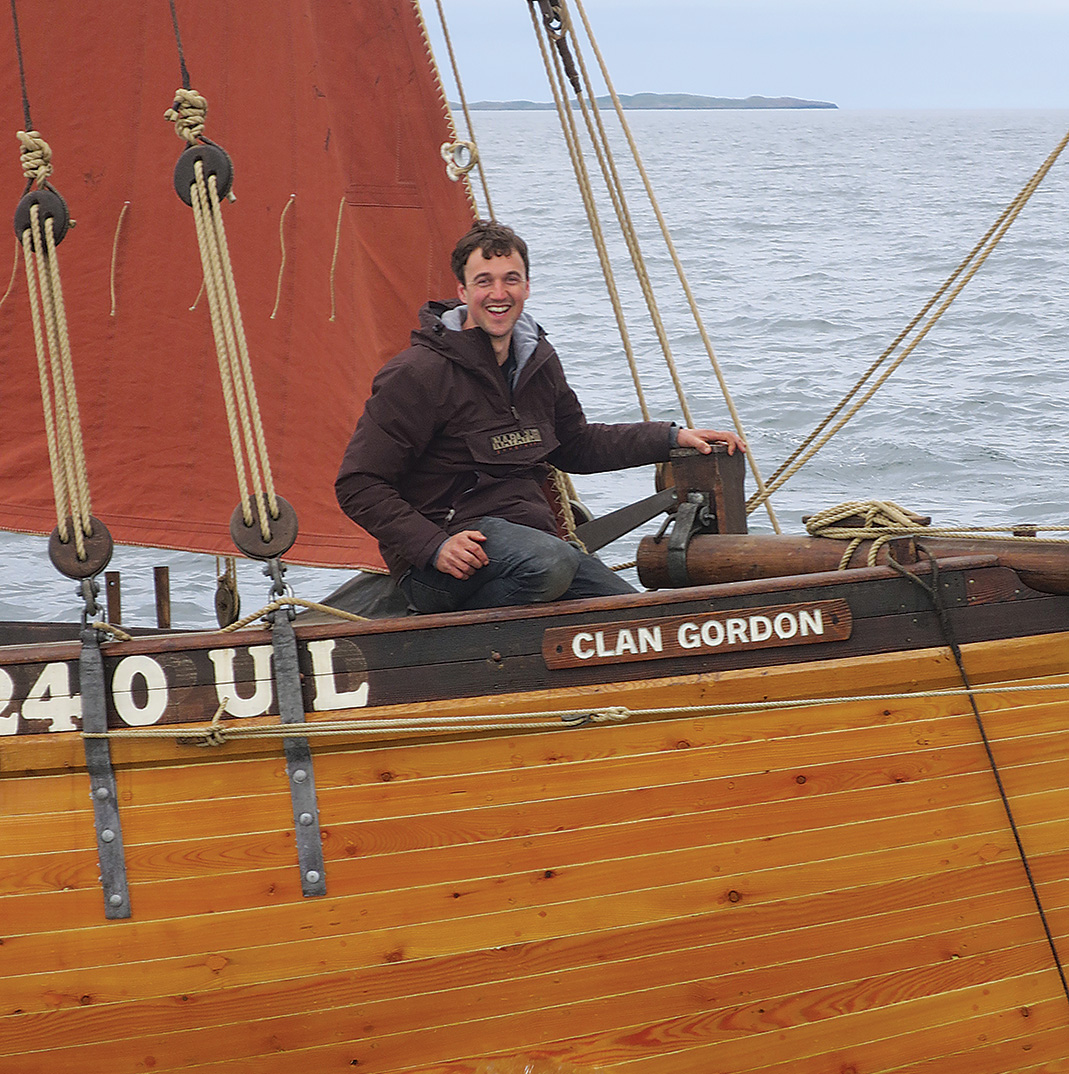 Mike Smylie
Alasdair Grant, a sixth-generation islander, opened his boatyard on Isle Ewe in 2014. His restoration of CLAN GORDON involved rebuilding much of the boat; the metal hardware, including new bowsprit fittings, was made in-house.
I spent a wonderful evening, back in 2002, sailing aboard the boat for a brief foray around the Firth of Forth. That was the year before Hill sold her to James and Gordon MacGregor. Consequently, the MacGregors fettled her a bit, bringing her into a condition to sail her to the west coast again. They sailed her to Ullapool, where they kept her moored. I used to feast my eyes upon her each time I was there. Then, tragically, she broke loose from her mooring in a gale and sank. They were able to have her raised, however; after they hauled her out, she sat in a parking lot in Ullapool for several years, looking forlorn with her deck missing and a gaping hole in her stern.
As with ST. VINCENT, some restoration had been completed on CLAN GORDON, most recently by Hills. She had been well looked after during her time afloat at Ullapool, but given the amount of rain up on the northwest coast, her time ashore had diminished her.
Alasdair and his team of shipwrights—there were two or three of them working at any one time—had to replace much of her hull. To begin with, he had to analyze the boat and order timber, all of which takes time. Eighteen months of continuous work followed, during which new oak was used to replace the keel, stem, and sternpost, although he did manage to retain the oak deadwood aft which, he says, had been protected by concrete trim ballast. “We picked our way through the frames, one by one, renewing much, but we were able to keep some of her floors and futtocks,” all of oak. “The keelbolts we made ourselves, from bronze bar.”
Although the topside planking had been replaced earlier by Hills, many of the planks were soft, so new larch was used in the restoration. However, most of the original pitch-pine planking below the waterline was retained, since Alasdair found it to be in remarkably good condition, considering the age of the boat. “Large portions of the pitch pine were rock hard,” he said. A new deck was laid with quarter-sawn Douglas-fir over new beam shelves and deckbeams of oak.
Much of the sound wood of the former topsides planks was repurposed for interior fittings such as bulkheads and the berths forward in the small cuddy cabin, whose layout remained as close to original as possible. The typical fishing crew of four were accommodated in one berth per side with pipe berths above them; the boy, it is always said, slept on the floor.
 Mike Smylie
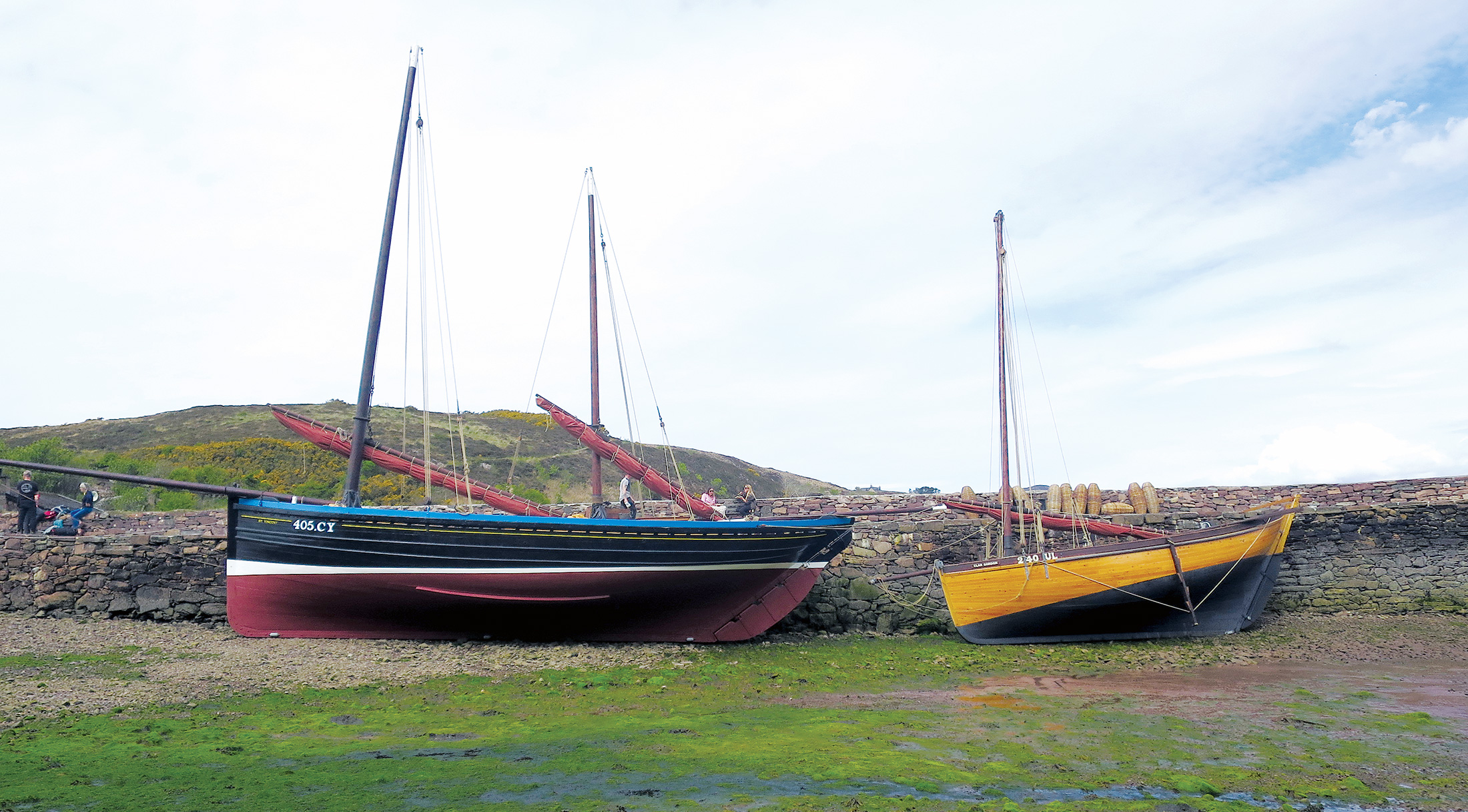
Zulus and Lochfyne skiffs both have long, straight keels with ample drag aft, but when the two boats dried out side-by-side at Tanera Mòr, their differences were clear: CLAN GORDON at right (rigged with beaching legs) has extreme drag, developed for working nets along the rocky shores of Loch Fyne. Her pronounced mast rake puts the maststep far forward, leaving the midships clear for working the net over the side.
Alisdair’s team made the mast and installed all the rigging. They also fabricated superb iron and steel fittings about the boat. From the keelbolts to the bowsprit hardware, everything was produced in the yard. The only outside work involved the sails, which were made by Steven Hall of Tollesbury, on England’s east coast, and the electrical-system work, which was done by Watt Marine of Ullapool. She now has a small solar panel to top up the battery for a bilge pump and lights.
The end result is simply wonderful, a true representative of its original 1911 presence. She is, as far as I know, the only Lochfyne skiff afloat, although she may soon be joined by two others, both of newer vintage, that are under restoration. Having owned a 1912 version for several years, I know how handy they are to sail, although mine was gaff-rigged. The Lochfyne skiffs were once described as Britain’s prettiest workboats, and CLAN GORDON certainly will uphold that reputation for years to come.
Watching her pounce on a brief flurry of wind and forge ahead, it’s easy to see why the ring-net fishermen developed these boats, which had to shoot their nets while working among confined nooks and crannies on the rocky coast of Loch Fyne and, to its south, Kilbrannan Sound, west of the Isle of Arran. With the cutaway forefoot, deep heel, and adaptable rig, these boats truly were deadly in their work. Having followed the fortunes of this vessel since first coming across her in 1991 and researching the history and provenance of all these skiffs, I can only add how happy I am, at last, to see a proper surviving example out moving through the waves.
True to his roots on the west coast, Alasdair has brought back to life a fine and splendid vessel, one that will thrill those who see her under full sail and one that really does, as was her new owner’s intention, represent a massive part of the fishing heritage of this wild and untamed west Scottish coast.
 Mike Smylie
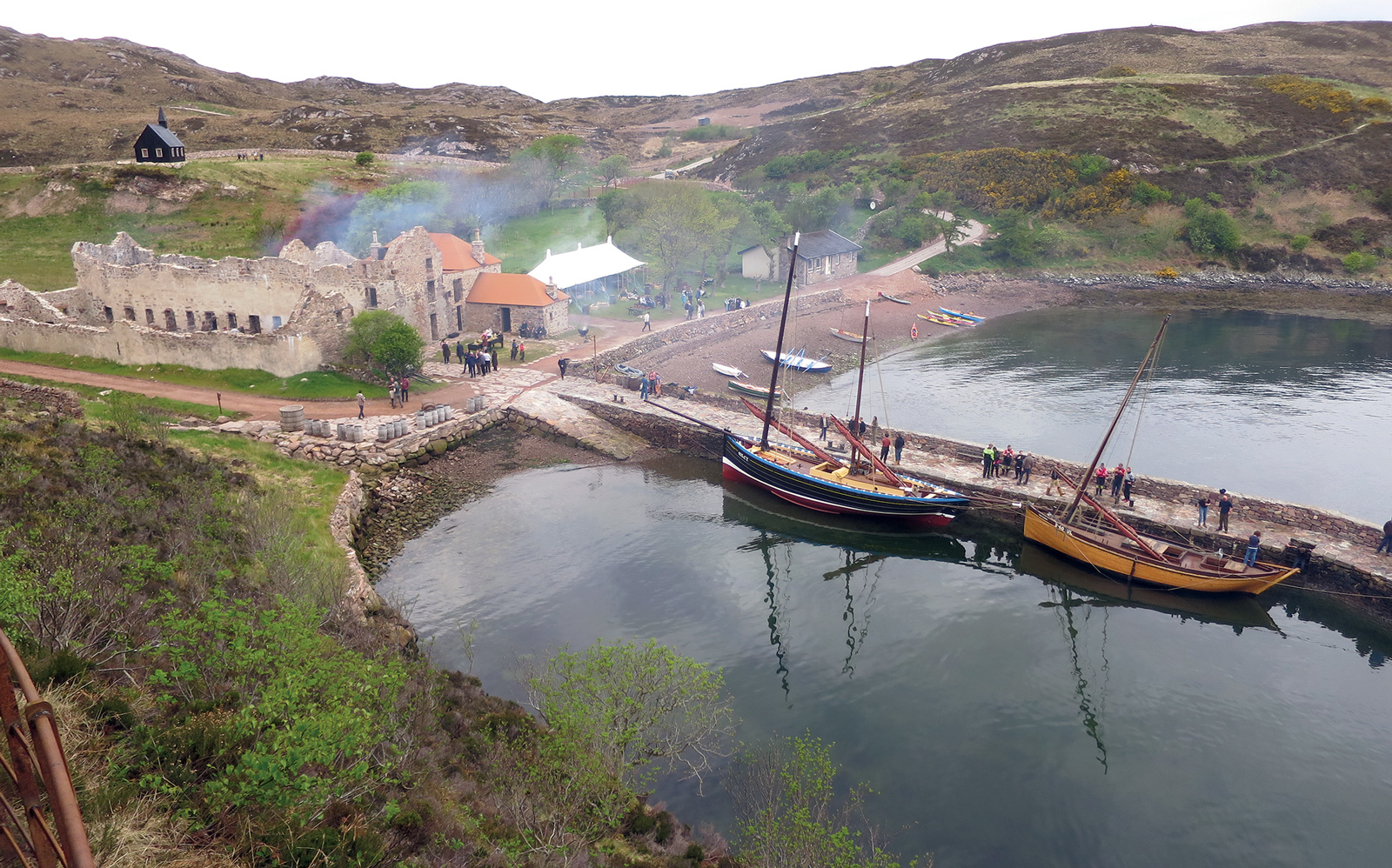
ST. VINCENT and CLAN GORDON have a future role in historical interpretation at Tanera Mòr, where they and the remains of the stone herring-curing buildings and quay built in 1788 will combine to tell the story of Scotland’s fisheries.
To see both boats proudly sailing in company from Ullapool northwest toward the island of Tanera Mòr a day after ST. VINCENT’s relaunching was simply breathtaking, a sight that had probably been lost to the west coast for a century. It almost brought a tear to my eye. We’d started out early, 5:30, in the windless morning. I was aboard an accompanying boat, the 1958 yawl HARVEST LILY, which Rory MacGregor formerly owned and which has also been recently restored by Johnson & Loftus Boatbuilders. She took both ST. VINCENT and CLAN GORDON in tow at first. But once we’d cleared Loch Broom, the towline was cast off and away they galloped, surging through the waves, in their determination to feel the water flowing beneath their keels—or so I’m romantic enough to like to think. But there’s no doubt that they were an eye-catching pair, a spectacle for all to see.
Later, moored in the small harbor on Tanera Mòr, in front of the old herring-curing house, we felt linked to a tradition that extends back almost 200 years. The boats soon returned to the boatyards, which continued to look after them for a year. In May 2024, I was aboard ST. VINCENT when she sailed in tandem with CLAN GORDON to Tanera Mòr once again, this time to stay.
Today, Tanera Mòr is a haven of retreat and peace, where, for now, invited visitors, most of them sent by charities Wace supports, can become absorbed in the spirit and tranquility of the island. “To continue supporting the charitable objectives into the future,” the trust’s website states, “Tanera will ultimately have a commercial aspect to underwrite the outreach and charitable aims already at the core of the project.”
It really is the most enchanting place, even when the wind blows. It is all the more so with the presence of these boats, which will serve as a historic connection to the region’s herring fishery. For Ullapool, fishing was simply the main—and for many, the only—employment back in the 18th and 19th centuries. These two boatyards, through their skill and hard work, have produced two down-to-earth, yet utterly, eye-wateringly, graceful craft. 

Mike Smylie is a historian of vernacular and working watercraft, concentrating on the boats, people, and traditions of the fishing industry. He has written many articles and some 30 books on the subject, including The Slopemasts: A History of the Lochfyne Skiffs (2008) and Herring: A History of the Silver Darlings (2004). In 1995, he co-founded 40+ Fishing Boat Association as fishing boat decommissionings decimated fleets, and he edits its biannual magazine, Fishing Boats. As “Kipperman,” he promotes herring via his Amazing Travelling Kipperhouse, to show “what a proper kipper is.”