
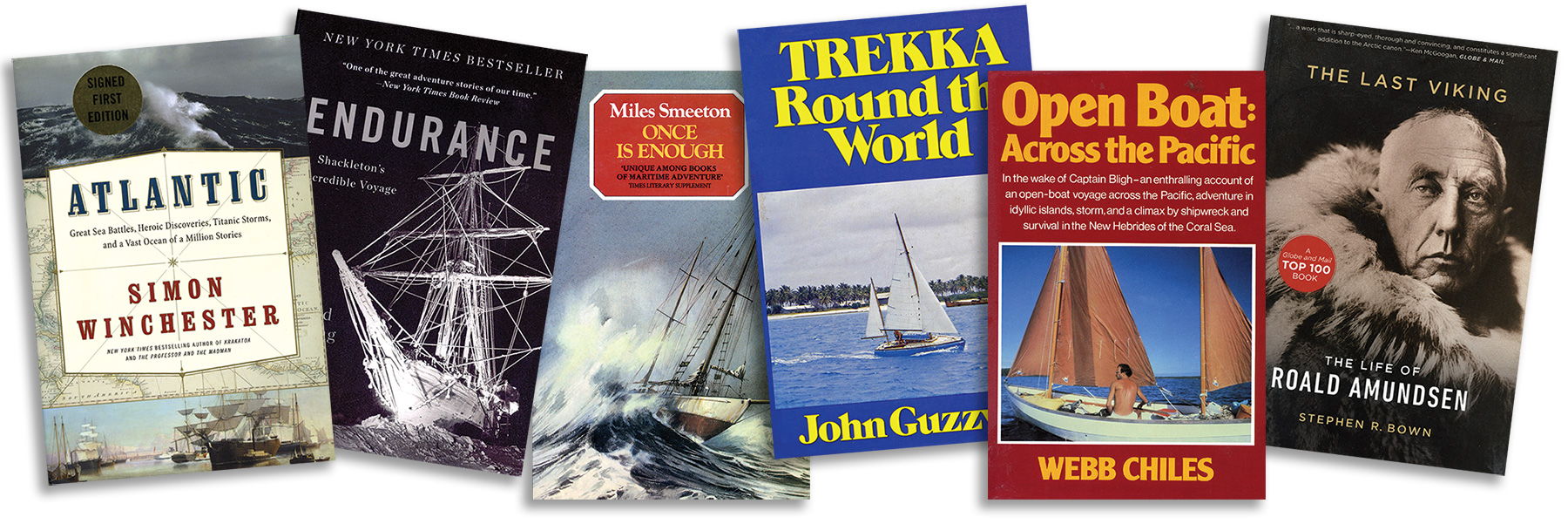
The best way, in my experience, to keep a summer cruise interesting and entertaining is to have a small library aboard. As part of my preparation, I fill a bag with books I want to read; it lives in a locker in the V-berth, and I can fish out a good book whenever I want. Most of my books for cruise reading come from a friend’s secondhand bookshop. After all, there’s no point in spending a lot of money on something that’s going to be passed among the crew or left in a marina’s laundry room. One of the real delights of a bag of books is that books don’t stress your boat’s systems. They draw zero amps and never depend on connectivity. You don’t need a library. For a two-week cruise, three to four books will do the trick. Here are six true sea stories for those quiet nights at anchor:
ENDURANCE: Shackleton’s Incredible Voyage
ENDURANCE: Shackleton’s Incredible Voyage, by Alfred Lansing. Basic Books/Perseus Book Group, 1959. 357 pp.
Alfred Lansing’s book recounts Ernest Shackleton’s last Antarctic voyage, which is the greatest sea story of the 20th century, if not the best sea story of all time.
At the start of the 20th century, there were few opportunities left for adventurers. Roald Amundsen had conquered the Northwest Passage and the South Pole, and Peary had made it to the North Pole. All that remained was the further exploration of Antarctica. Expeditions from half a dozen countries were being planned to traverse the globe’s southernmost land mass. One was led by the Anglo-Irishman Sir Ernest Shackleton.
Shackleton’s expedition set out in ENDURANCE from London on the Imperial Trans-Antarctic Expedition just as World War I was starting. The ship’s crew consisted of 27 men, including Shackleton, plus one stowaway. After crossing to Buenos Aires, where they acquired the stowaway, they continued on to the Grytviken whaling station on South Georgia Island. Whaling captains there tried to warn Shackleton off the adventure. Ignoring them, he proceeded south to the pack ice of the Weddell Sea. It was slow going as the ship approached the mainland of Antarctica. The expedition was to make an overland dash across the continent from the northeastern coast to McMurdo Sound on the Ross Sea.
Australian photographer Frank Hurley documented everything. He produced a remarkable archive of still and motion pictures that continues to hold the world breathless today.
Then the ship was crushed by the pack ice, forcing the crew to abandon her. Hurley photographed the ship’s final moments as she began her plunge to the sea floor, 10,000′ below. (The wreck wasn’t discovered until 2022.) With no way to call for help, Shackleton and his crew began a long trek toward a small group of islands where they stood a slim chance of being rescued by passing whalers. Shackleton had the foresight to haul the ship’s boats with them, and they were able eventually to sail to Elephant Island. Knowing rescue was up to them, Shackleton ordered one of the boats, the JAMES CAIRD, decked over and spartan accommodations prepared for six people. The boat, at 22′ long, wouldn’t be most mariners’ choice for a South Atlantic voyage. Cape Horn was closer to the castaways, but South Georgia was downwind, and with the easterly current the boat could make 60 nautical miles a day. On April 24, 1916, the six men set off in the double-ended ketch with 650 miles ahead of them; they reached South Georgia 17 days later, landing on the opposite side of the island from the whaling station. After waiting on the weather, three of the crew—Shackleton, Frank Worsley, and Thomas Crean—set off to cross the island. Upon their arrival at the whaling station, a rescue expedition was quickly mounted to bring the Elephant Island crew home.
If you read just one book this summer, ENDURANCE is a prime candidate to fill you with awe and admiration.
The Last Viking: The Life of Roald Amundsen
The Last Viking: The Life of Roald Amundsen, by Stephen R. Brown. Douglas & McIntyre, 2012, 356 pp.
Before rock-and-roll, Arctic explorers were the heartthrobs of the daily press. The names Shackleton and Scott were as well-known as McCartney and Hendrix. But the Mick Jagger of those times was the Norwegian explorer Roald Amundsen.
Stephen Brown’s biography is the story of a man who accomplished incredible feats, often succeeding where countless others failed. Born in 1872, Amundsen grew up in Oslo knowing exactly what he was destined to do: become a famous explorer. The Arctic would be his stage. Devouring tales of Sir John Franklin’s early voyages seeking the Northwest Passage, Amundsen trained for the rigors of exploration by undertaking ski expeditions, some nearly fatal, across Norway in the dead of winter.
Amundsen knew personal charm couldn’t produce the funds necessary for exploration, so he painted his ambitions as a scientific quest. Approaching the German Marine Observatory in Hamburg, he announced that he wanted to record the most accurate observations of the Magnetic North Pole available. This got him a three-month tutorial on magnetic science.
The next step was to acquire a vessel, and this is where he began his less-than-stellar career as a man who sometimes did not honor his debts and lied about his plans. GJØA was a 29-year-old, 47-ton, single-masted fishing smack he could afford. After buying the ship, he lacked the money to pay for the expedition, so he solicited loans. When repayment wasn’t forthcoming, his creditors confronted him on the wharf in Oslo demanding their money or his vessel. In the middle of the night, he left his backers standing on the wharf and sailed for the Arctic. Two years later he returned as a Norwegian national hero for being the first to sail through the Northwest Passage. All was forgiven.
Biographer Brown’s story is balanced between the great things Amundsen accomplished and his peccadillos. To mount his later Antarctic expedition, he outright lied to his crew, telling them they were sailing for the Arctic when they were really heading for Antarctica. Over the years, Amundsen continued to dodge and weave through various schemes (see WB No. 270) until, in an uncharacteristically altruistic gesture, he set off in his Latham biplane to search for the Italian airship ITALIA that had gone missing near Spitsbergen. The last anyone saw of Amundsen was on June 18, 1928, when he took off to join the search for the Italians.
The Last Viking is a story of incredible adventure—often heroic and sometimes audacious in its chicanery.
TREKKA Round the World
Trekka Round the World, by John Guzzwell. John de Graff Inc., 1963. 199 pp.
Many polite people shake their heads and silently ask themselves “What kind of madman heads off into the world’s worst seas in a 20′ boat?” The less-than-polite folks ask that question out loud. John Guzzwell, however, wasn’t mad. He knew exactly what he was doing when he teamed up with the designer Laurent Giles to design the boat that Guzzwell built purposely for a voyage around the world. He described that experience in his classic book of small-boat courage and seamanship, Trekka Round the World.
Guzzwell was descended from a long line of Grimsby, England, fishermen, and thus came by his sea legs honestly. As a boy, he sailed with his parents in their custom yacht OUR BOY to South Africa. During World War II, young John spent a good portion of his youth in a German internment camp. After that, the world called, but he couldn’t find personal peace until he emigrated to Victoria, British Columbia. On the B.C. coast, he dreamed of building his own yacht, as his father had, and he took inspiration from Capt. John Voss’s circumnavigation, which started in British Columbia, in the First Nations canoe TILIKUM. Guzzwell built TREKKA in the spare room of a fish-and-chips shop in downtown Victoria. The little yawl slipped quietly out of Victoria Harbour in late September 1955, heading for Honolulu. She coasted down to San Francisco, where Guzzwell met Miles and Beryl Smeeton, who would become his great friends. After leaving California, TREKKA raised land, Mauna Kea, on November 3, and for the next four years Guzzwell continued his adventures, sailing south of the Cape of Good Hope in TREKKA and around Cape Horn in the Smeeton’s boat, TZU HANG. It took Guzzwell four years to circumnavigate, and his adventures rivaled those of Joshua Slocum. TREKKA Round the World is a pleasant read with an evening’s glass in the warmth of a cabin lamp.
Open Boat: Across the Pacific
Open Boat: Across the Pacific, by Web Chiles. W.W. Norton and Co., 1982. 204 pp.
Not all adventurers lead well-funded, well-equipped expeditions, but they are still worth reading about because they show us the best of ourselves. Webb Chiles is one of those quiet guys who just goes out and does great stuff without a lot of who-haw. His story, Open Boat: Across the Pacific, deserves a place in the bag.
Chiles left San Diego in November 1978 in an open 18′ Drascombe Lugger and began by rowing directly into a gale that nearly ended his voyage before it truly got started. He capsized but continued on, crossing 7,000 miles of the Pacific Ocean before fetching up on Emae in the New Hebrides. In his longest stretch at sea, he crossed south beyond the Equator on a four-and-a-half-week leg that ended after 3,000 miles in Nuka Hiva in the Marquesas. After that, it was island-hopping in shorter stretches until he was finally shipwrecked. Inspired by Capt. William Bligh’s voyage in the aftermath of the BOUNTY mutiny, Chiles endured pitchpoling, capsizing, shrieking gales, and flat calms. He got to explore the islands of the South Pacific in ways most of us will never experience. In the end, nature had its way, and he was shipwrecked in the sparsely populated New Hebrides. An excellent writer, Chiles tells a story that is as evocative as it is incredible.
Once Is Enough
Once Is Enough, by Miles Smeeton. Granada Publishing, 1959. 208 pp.
John Guzzwell’s story continued amid his voyage in TREKKA. He embarked on a trip around Cape Horn as mate with Miles and Beryl Smeeton in their 46′ canoe-sterned ketch TZU HANG. Leaving TREKKA temporarily in New Zealand, Guzzwell set off with the Smeetons for Sydney, Australia, down the coast to Bass Strait, and then into the Southern Ocean. It was not the trip the three voyagers were expecting.
Miles Smeeton describes a relatively good passage below New Zealand to a point west of Cape Horn, when the gods of misery took umbrage and battered TZU HANG unmercifully until one sub-Antarctic breaker caught up with them, pitchpoling the yacht.
As TZU HANG righted herself, the three were amazed to be alive. Beryl was swept overboard after her safety harnesses lifeline snapped. She was nearly lost. She made an Olympic sprint with a broken arm through the icy seas until Miles and John could get her back aboard—just as the next wave struck. TZU HANG was dismasted, and the tumble scoured the deckhouses and skylights clean away. One of the deckbeams in the cabin was fractured. However, they were still breathing, and they began the arduous struggle of making the yacht seaworthy. Nailing locker doors over the gaping holes in the deck, John put his carpentry to work fabricating jury-rigged masts from spare lumber and recovered spars. Despite her injury, Beryl took over sailmaking and Miles spliced new shrouds and fabricated a chimney from tin cans so they could get a fire going in the cabin to dry them out and make it warm enough for the glue to set in the new masts. Like a story by Jack London, the shipwrecked sailors raised their new main and mizzen, then shaped a course for the coast of South America. The Horn was no longer their goal; survival was.
TZU HANG, as the book’s forward points out, was the first boat to have suffered such punishment rounding the Horn and survived to tell the tale. Smeeton knows how to put a story together and build suspense. The raw terror of the pitchpoling and remarkable strength in surviving the event earn Once Is Enough a place in the book bag.
Atlantic
Atlantic, by Simon Winchester. Harper Collins, 2010. 475 pp.
Oceans are coquettish in the ways they reveal their secrets, hiding them behind screens of oily calms or howling gales. It takes an excellent writer and experienced sailor to discover and bring them to life, which Simon Winchester does in Atlantic, his biography of the Atlantic Ocean.
Throughout his life, the author has had a personal relationship with the Atlantic Ocean, and it is reflected in the story. Atlantic becomes a real portrait, as if of a living being. Winchester is no mere reporter, although he spent much of his career in the trade. He is a storyteller who uses verifiable facts to engage his reader; he is immune to the prevailing fear of adjectives, so his descriptions are as lush as they are evocative. Reading him is like listening to great music when you have the ear for it.
Tracking humanity’s relationship with our planet’s second largest body of water, the reader travels through history, cultural nuances, and fascinating tales. There are Viking settlements, fake maps, storms, discoveries, battles, pirates, and revolutions seasoned with old English poetry and Viking sagas. Although Winchester is detailed, Atlantic is not boring; he includes the human color so necessary to make this a good tale. One might recognize the author’s name from a number of other bestsellers, including The Professor and the Madman, The Meaning of Everything, Outposts, and The Map That Changed Everything. 
Bruce Kemp is a regular contributor to WoodenBoat