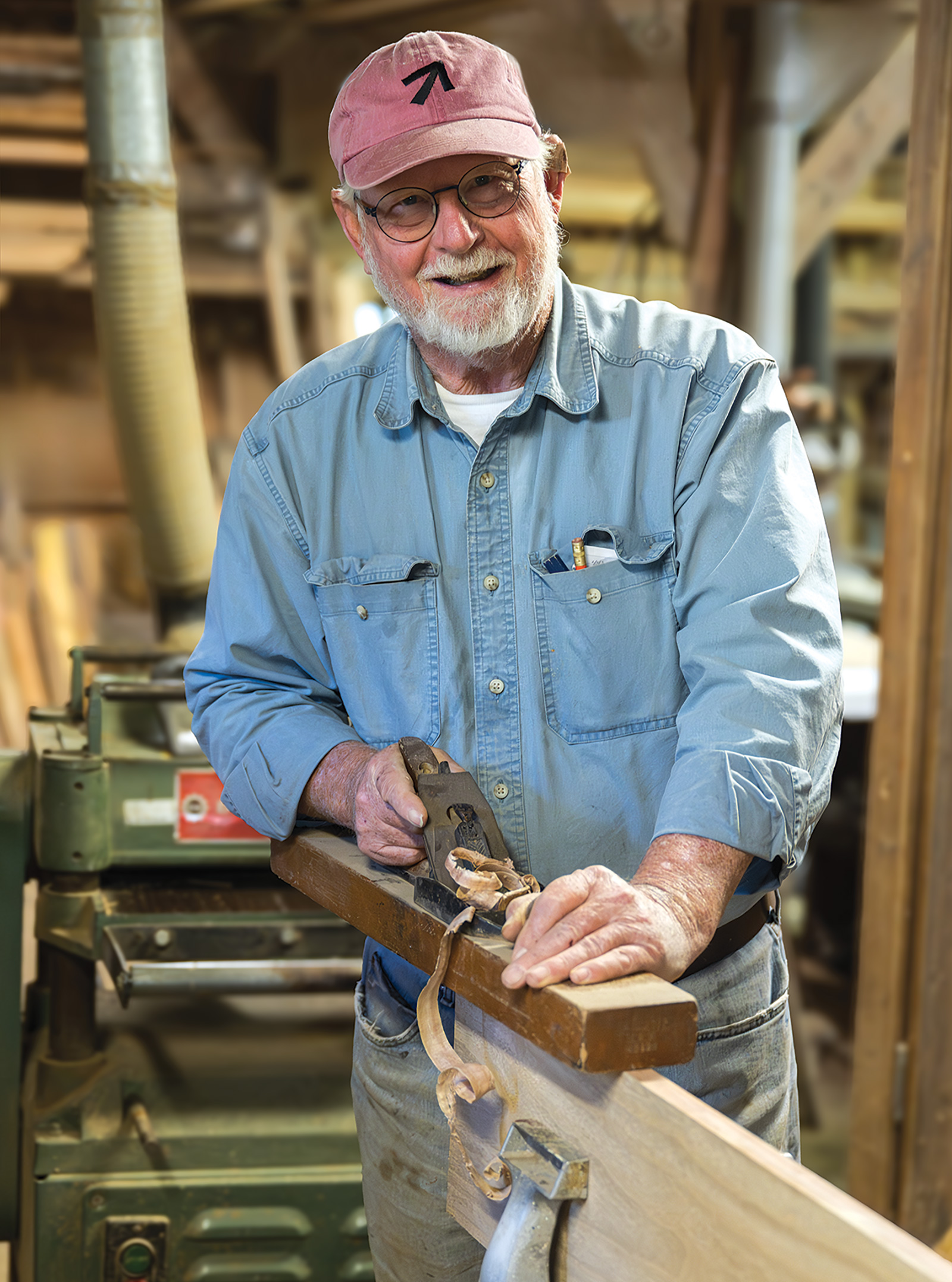
John SwainJay Fleming

In the mid-1960s, John Swain apprenticed at Applegarth’s Boatyard in Oxford on Maryland’s Eastern Shore and has specialized in Chesapeake Bay watercraft ever since. Today, he has his own shop near Chestertown.

At 7:30 on a September morning, boatbuilder John Swain takes a break from projects at his boatshop to show me his world. He often starts such visits on the wharf at the foot of Cannon Street in the historic colonial port of Chestertown, Maryland, on the Eastern Shore of Chesapeake Bay. On this day, a sultry wind is blowing down the Chester River when Swain and I arrive at the Chestertown waterfront. Sometimes Swain is a bit paternalistic about the classic watercraft tied up at the wharf here. To be sure. This is not his job; there’s a crew of professional sailors and custodians to tend to the boats. But Swain has built or rebuilt them all. They are a bit like his children—never fully out of mind.

At the inner pier, there’s the replica of an 18th-century ship’s cutter and a pair of traditional Chesapeake deadrise work skiffs. Farther out on the wharf lie the 123-year-old skipjack oyster dredge ELSWORTH and the buyboat ANNIE D., built in 1957.

After assuring himself that all is well with these boats, Swain’s eyes turn to the vessel tied at the end of the wharf, looking like a ghost ship from Master and Commander. SULTANA is the 53′ LOD reproduction of an 18th-century square-topsail schooner. She’s the flagship for the SULTANA Education Foundation, and she is Swain’s masterwork.

SULTANA’s builder is fit and able-looking at age 79. He has a ruddy, welcoming face framed by a silver beard, wire-rimmed glasses, and a red ball cap. Both his shirt and pants are denim. This morning, they have not yet gained a patina of sawdust. It will come later today in the shipyard up Cannon Street where he and his helpers constructed SULTANA 25 years ago, or at his own shop next to the house he and his wife, Melinda Bookwalter, built in the woods.

A Stout and Storied Ship

SULTANA is a teaching ship, and she is scheduled to sail in a few hours with her professional crew, visiting fourth graders, and their teachers. When Swain climbs aboard the schooner, one of the crew is already here. She greets him with a smile that says she is pleased that SULTANA’s godfather has come to check on their girl this morning. Then she heads below to make up gunpowder charges for the ship’s signal cannons. The student crews love hearing the pop of the half-pounders almost as much as they relish hoisting sails and sorting through the crabs and fish they pull up after towing an otter trawl.

As the captain and the rest of his crew arrive, they share warm and familiar greetings with Swain. To them he is not a visitor. He is honorary crew.

“John is the gentlest human being I have ever met,” says Drew McMullen, president of the SULTANA Education Foundation, which operates the classic colonial schooner.

Clearly, the ship’s crew agree. They are unperturbed by Swain as he moves from bow to stern, casually lifting hatches and floorboards, showing the bilges to his visitor.

“Dry and tight,” he smiles after his survey.

“She’s an absolute tank,” McMullen says.

The idea of building SULTANA germinated over years in the 1990s. During a gig associated with the construction of the state of Delaware’s official tall ship, KALMAR NYCKEL, launched in 1997, where he was teaching disadvantaged youth to build Six-Hour Canoes, Swain discovered the joy, validation, and life-lessons that emerged from shared boatbuilding projects. While visiting The Netherlands on holiday, he had come across a community effort, involving young people, to construct a replica of the three-masted, square-rigged ship BATAVIA, started in 1985 and launched in 1995.

“I thought that was pretty neat,” Swain said.

“If John isn’t working on boats, he’s thinking about boats or reading about boats,” Bookwalter says.

Inevitably, his reading took him to Howard I. Chapelle’s The History of American Sailing Ships, and in it he discovered drawings of the original SULTANA. She was Boston-built in 1767, one of several American schooners purchased by the British Navy to enforce the tea taxes on the American colonies in the years preceding the American Revolution.

“I knew it when I saw her. She was the one,” Swain says.

She has a sparred length of 97′, but with an LOD of only 53′, a beam of 17′, and a draft of 8′, SULTANA is a manageable size to build, operate, maintain, and fund, despite embodying all the historical trappings and romance of a square-topsail, colonial schooner. Swain dreamed of her being an American version of BATAVIA, built largely by a community and volunteers.

At the time he was rebuilding the Echo Hill Outdoor School’s historic skipjack ELSWORTH, and in 1997 he shared his dream of building a reproduction of SULTANA as a school ship with McMullen, who was working for Echo Hill at the time.

Crew of four professionals.Lucien Niemeyer

Swain led a crew of four professionals and a hundred volunteers in the ship’s three-year construction.

“I loved the idea from the very moment John shared his dream,” McMullen says.

He and Swain are deliberate men, history enthusiasts, and lovers of traditional boats, so they took their time poring over their research into the original ship’s construction and history, current U.S. Coast Guard regulations for passenger-carrying vessels, and the practices of successful community organizations that operated tall ships. What emerged was the nonprofit SULTANA Education Foundation, with a mission to “provide transformative educational experiences.” By 1998, the foundation had enthusiastic community support, funding, and donated space from Chestertown to build a shipyard. Then Swain, four professional shipwrights, and a legion of volunteers laid the keel for the new SULTANA. They launched her two years and five months later.

“We had a few hoops to jump through with Coast Guard inspectors who were skeptical of the trunnel fastenings we were using just like the original builders,” Swain recalls. “But we made up some sample trunnel-fastened planks, gave the inspectors sledgehammers, and asked them to see if they could break the planks apart. Not a chance.”

The Coast Guard approved. Since her launching in 2001, SULTANA has carried more than 100,000 students to investigate the natural and human history of Chesapeake Bay while exploring matters of ecological sustainability.

SULTANA at 25

SULTANA is a replica of a merchant schooner.Jay Fleming

SULTANA, launched in 2001 as a replica of a merchant schooner built in Boston, Massachusetts, in 1767, is arguably Swain’s greatest achievement.

Launched in 2001, the SULTANA Education Foundation’s schooner SULTANA (see WB No. 165) is a full-scale reproduction of a Boston-built merchant vessel that served for four years as the smallest schooner ever commissioned in the British Royal Navy. In 2004 and again in 2007, the replica and her associated foundation were the recipients of the Walter Cronkite Award for Excellence in Maritime Education from the National Maritime Historical Society.

The foundation (www.sultanaeducation.org) works with schools to develop in-depth citizen-science programs in which students conduct long-term investigations of local waterways. Throughout the course of their investigations, students participate in a variety of classroom lessons and field experiences that address current issues facing local waterways, produce tangible water-quality data, and culminate in the implementation of student-led projects.

Since her launching, SULTANA has carried more than 4,500 students on Chesapeake Bay each year for the foundation’s hands-on programs. Current surveys of the ship show she remains in virtually like-new condition due to the care of the people who built her and the crews who maintain and sail her.

Daysailer based on crab skiffs.Marc Castelli (both)

With a thorough foundation in traditional Chesapeake Bay boat types, Swain early in his career designed and built small boats inspired by them, including this daysailer based on crab skiffs.

The Campus

After his visit to SULTANA, Swain leads me a few blocks up Cannon Street to what has become the SULTANA Educational Foundation’s campus, which includes the shipyard where Swain and helpers built SULTANA and the Holt Education Center, which the U.S. Green Building Council has certified as “LEED Platinum,” its highest rating for sustainability. It is a repurposed, 11,000-sq-ft, historic building with a geography classroom, a wet lab, a project shop, and a student-focused Native American exhibit.

At the center, Swain checks in with McMullen, who has been helping to guide the foundation since its inception. This morning, McMullen is at his desk preparing for one of the many events sponsored by the foundation. The upcoming SULTANA Downrigging Festival draws about a score of tall ships and as many as 10,000 guests to the Chestertown wharves at the beginning of each November for a community party. It not only includes tours and sails aboard the historic vessels but also traditional watercraft exhibits, small-boat racing, a long lineup of bluegrass and traditional musicians, and an array of food vendors.

Passing through the Holt center’s classroom and labs for youth programs reminds Swain how different schools were for him when he was growing up in Clayton, Delaware, and later Buffalo, New York. Traditional elementary school was, to say the least, challenging for a student like Swain, who says he had a hyperactive imagination. He was always yearning to build things, especially boats, rather than log long hours glued to a desk. One of his classroom daydreams was to build a boat out of a wooden barrel. “I learned the hard way that a barrel will not hold together, or float, once you remove the metal rings,” he laughs.

Construction of a shallop commemorating Capt. John Smith’s 1607 founding of Jamestown.Michael Wootton

In 2007, Swain led the construction of a shallop commemorating Capt. John Smith’s 1607 founding of Jamestown (left). The original boat was quickly assembled, leading to a theory that it was built in halves (right).

For Swain, the best part of his schooling was an architecture class in which the instructor let him deviate from the usual curriculum involving buildings and instead design and construct a model sailboat. “I made it out of fiberglass,” Swain remembers. “What was I thinking?”

After a brief interlude in community college, he decided it was a waste of his time and his father’s money. He was 20 years old, and he wanted to learn how to build boats, so he found a job at Applegarth’s Boatyard in
Oxford, Maryland, about 50 miles from Chestertown. For a year-and-a-half he apprenticed with master skipjack builder Curtis Applegarth, a fourth-generation builder.

Swain soon moved on to Dickerson Boatbuilders in nearby Trappe, where he not only learned complex joinery but also was tasked with building detailed scale models of Bill Dickerson’s boats. The modeling refined his attention to detail, and it unleashed his artistic and design impulses. There was something in Swain that loved tried-and-true designs and construction traditions. But he simultaneously sought ways to improve on them.

The shallop replica.Chris Cerino

The replica retraced Smith’s explorations of the bay.

After just three years of working at the Dickerson yard, he opened his own boatshop in an old canning factory in Drawbridge, Maryland. His first commission was a classic Chesapeake deadrise powerboat. It would be the first of more than 65 Swain-built boats. Applegarth, who died in 1986, had imprinted upon Swain the love for traditional bay craft such as deadrise workboats, skipjacks, bugeyes, and log canoes. It wasn’t long before he designed his own Swain Song Skipjack daysailers. They were his take on the small skipjacks once used by Bay watermen as crab scrapes.

Swain has brought to life a string of recreational skipjacks, three-sail bateaux, and plywood bugeyes based on Chapelle’s research. He has rebuilt oyster buyboats and made spars for working skipjacks as well as several of the Chesapeake’s famous log-canoe racing ketches. Then there are Swain’s variations on traditional Chesapeake open boats. He built the reproduction of the shallop that Capt. John Smith used to explore Chesapeake Bay in 1608. In 2008, her modern crew spent 120 days rowing and sailing the shallop around the bay, stopping at towns along the way, to re-create Smith’s voyage of discovery and to celebrate the 400th anniversary of the voyage.

“You might say I have traditional boats on the brain. That’s what I have been attracted to,” he says.

But Swain has taken work where he could find it, and not all of it has involved bay watercraft. His résumé includes motoryachts, tug-trawlers, a yard tug, and the restoration of a Q-class racing sloop. Just for fun, he guided a friend’s nine-year-old children in constructing two skiffs, which then inspired them to build miniature hydroplanes for Cocktail Class racing (see WB No. 213).

The Shipyard

The Echo Hill Outdoor School’s 1901 skipjack ELSWORTHJay Fleming (left), Marc Castelli (right)

Swain has had long-term commitments to many boats, among them the Echo Hill Outdoor School’s 1901 skipjack ELSWORTH, which he restored in 1996 (left) and which he still works on today (right).

It’s midmorning when Swain takes me farther up Cannon Street beyond the Holt center. There is a wood-framed building, painted red, with a sign reading SWAIN & McMULLEN SHIPYARD. This place is full of memories for Swain. He and his fellow shipwrights lofted, patterned, and built SULTANA here. A shed roof covers huge tools, among them a shipsaw. Nearby there’s a well-used forklift tractor, which he calls “Lurch,” used for dragging timber around, and a wooden staging pad where Swain and his minions learned the tricks of 18th-century shipbuilding as they framed, planked, and decked SULTANA.

“It wasn’t like building a skipjack,” he says.

An inveterate collector of books on boats and seafaring, he turned to his library, which includes a complete collection of WoodenBoat, for insights. He read books about 18th-century ships and their construction, including Karl Marquardt’s story of HMS ENDEAVOUR and books about traditional wooden ship building in New England such as The American-Built Clipper Ship, 1850–1856, by William Crowthers. Little by little, he and his crew figured out how and why those Boston craftsmen 250 years ago built ships, the original SULTANA among them, using trunnels and side-by-side double-sawn frames, with futtocks measuring 8″ in breadth and with only 8″ bays between frame pairs.

He shakes his head and laughs quietly to himself as he remembers how he learned to steam and bend 2½″-thick white-oak planks like noodles to form SULTANA’s bow. Planking SULTANA’s bow reminds him of the tight curves of three cutters he built for customers, following Thomas Gilmer’s Blue Moon design. “I paid Tom for the plans each time, even though I already had a set of plans from the first boat,” Swain says. “It just seemed like the right thing to do.” No doubt, but Swain’s sense of fair play got him into a financial mess.

“I was bankrupt and getting divorced in 1978,” he says. But then two angels came to his rescue. An admirer of his work asked Swain to build him a 38′, Al Mason–designed sailing yacht, which allowed him to pay off his debts and set up a new shop. Shortly after finishing the Mason, Swain met Melinda Bookwalter, a spunky social worker with a practical eye for life and finance. She had previously bought property in the forest near the head of the Chester River. It was there that they would design and build their house (and Swain’s boatshop) out of wood that had been intended for the planking of a scow schooner. Bookwalter became both his wife and the chief financial officer of Swain Boat Builders LLC.

Timber, Driving, and Dreaming

After brunch at his favorite cafe, Swain decides it’s time to take a drive, and I join him. He likes to venture out of town in his 14-year-old Subaru to see how the trees are doing. When he thinks of trees, he pictures the stands of Osage orange trees (Maclura pomifera) on the edges of corn and soybean fields.

Intent on constructing SULTANA as authentically as possible, but with locally sourced timber, Swain initially found himself daunted by the lack of local white oak big enough for the ship’s heavy structural timbers—until he realized that Osage orange, abundantly available on the Eastern Shore, had strength and rot-resistance properties similar to those of white oak.

“Many of the trees had been planted as living fences,” Swain says.

Over the years, they had outgrown their usefulness, and the farmers were glad to have them culled. When Swain went to select trees, he carried three 6′- to 8′-long patterns of the primary curves he needed for frame futtocks. Eventually, he and his crew harvested 250 trees for SULTANA. They milled the logs into 4″-thick flitches and dried them at the shipyard. Because Osage orange trees are full of twists and turns, SULTANA’s builders could use the natural crooks to make the futtocks, floors, and knees in the ship, giving them added strength.

Driving around these back roads on the Eastern Shore surveying the trees, Swain often daydreams. “It’s a habit of mine,” he admits. “I have built a lot of boats in my head while driving these country roads.”

Today, he is daydreaming about big schooners. At one point, he turns down a lane that leads to a boatyard. He wants to check on how a friend, Capt. Ed Farley, is coming along with his restoration of the 122-year-old Delaware Bay oyster schooner KATHRYN M. LEE. At the boatyard, Swain finds the 85′ schooner on jackstands, fully reframed and replanked with her bulkheads and deckbeams in place. A shrink-wrapped cover protects her from foul weather, but it looks as if no one has been working here for some time. “She’s an amazing and historic boat. I sure hope Ed gets her done,” Swain says, ever hopeful.

Then we head back to the Subaru to continue the drive, and he entertains dreams of other schooners. One of them is a 45′ three-master that he constructed and sold to a minister on Martha’s Vineyard, Massachusetts. Another is the E.E. MOORE, which Swain built for his own use and named after his grandfather. He built her in his mind while on back roads searching for timber for SULTANA. Then, slowly, he got some extra money and built her in wood.

The MOORE is a 36′ Strait of Juan de Fuca sharpie schooner based on drawings of a boat that Chapelle documented. But in typical Swain fashion, he imagined improvements on the traditional design and wedded a Chesapeake-style “patent stern” and masts on tabernacles to his version of the West Coast workboat. He and fellow carpenters Nick Biles and Dominic Dragotta took nine years building the MOORE between their other projects, finally launching the schooner in 2012. Over the past decade, Swain and his wife went adventuring in their schooner to Tangier Island, Virginia, on the lower Chesapeake, where the Swain Memorial Church is named after his great-grandfather. At one point, he and Dragotta circumnavigated the Delmarva Peninsula in the MOORE. On another voyage, they spent five weeks traveling up the East Coast, Hudson River, and Erie Canal, sometimes accompanied by Bookwalter. It was the longest vacation of Swain’s life.

In spring 2024, Swain and Bookwalter sold the MOORE, feeling that it was time to pass her on to a younger sailor with the energy to enjoy all those strings a schooner has to pull.

“We’re not without boats,” Swain says. “Somebody gave us the hull for an unfinished fantail trawler. I’m going to make her a cruising boat.”

The sharpie schooner E.E. MOORE.Jay Fleming

Swain launched the sharpie schooner E.E. MOORE in 2012 for his own use, and cruised often with his wife, Melinda Bookwalter.

House and Shop

It’s late afternoon when Swain and I get back to his home and shop. The house is loaded with whimsical peaks and angles and large windows opening into the forest. The interior walls are lined with shelves of nautical books and decorated with lines drawings and paintings of traditional watercraft. Boat models are everywhere. The shop is a barn surrounded by a half-dozen boat projects in various stages of completion.

It’s almost suppertime, and Bookwalter is preparing pork tenderloin with local sweet potatoes and green beans. But Swain and I have time to head out into his shop and contemplate the projects he has underway. He goes to a shelf over a workbench and pulls out three very large slicks. His favorite has a blade fashioned from a leaf spring that belonged to a military half-track vehicle and a handle made by one of his idols, the legendary Chesapeake boatbuilder “Mister Jim” Richardson of Cambridge, Maryland. The Chesapeake Bay Maritime Museum has a buyboat in its collection named the MISTER JIM in honor of Richardson. Not surprisingly, there is currently a 46′ buyboat being built by Jim Drake and his wife, Brooke, in Mount Airy, Maryland, named the JOHN SWAIN.

The sharpie schooner E.E. MOORE in Annapolis, Maryland.Marc Castelli

The sharpie schooner E.E. MOORE was sold in 2024 and today lies in Annapolis, Maryland.

If someone told Swain that at this point in his career he has completed a body of work that is every bit as impressive and historically significant as Richardson’s, he would shrug it off and simply say, “I try to build stuff that lasts.”

“John’s so modest,” McMullen says. “But I sincerely doubt there is another traditional boatbuilder in America with his patience, craftsmanship, intuition, and people skills.”

McMullen says Swain was a master at matching the right person with the right job during the SULTANA project. “We had a happy yard,” Swain says. That’s how he likes to remember building SULTANA.

But his mind doesn’t linger too long on the past. He’s looking forward, eager to spend tomorrow back in his shop and to find some neat way to use Richardson’s slick. There is always another boat to finish. Maybe he will start on the deck of a little skipjack stored under a tarp in the yard, or work on the interior of the 28′ Ralph Winslow–designed sloop in the main bay of the shop. Then again, he really wants to finish off that fantail trawler hull on the trailer next to the house so that he and Bookwalter can go cruising again. They have yet to cruise the Low Country of the Carolinas.  Article ends.

Randall Peffer is a regular contributor to WoodenBoat.