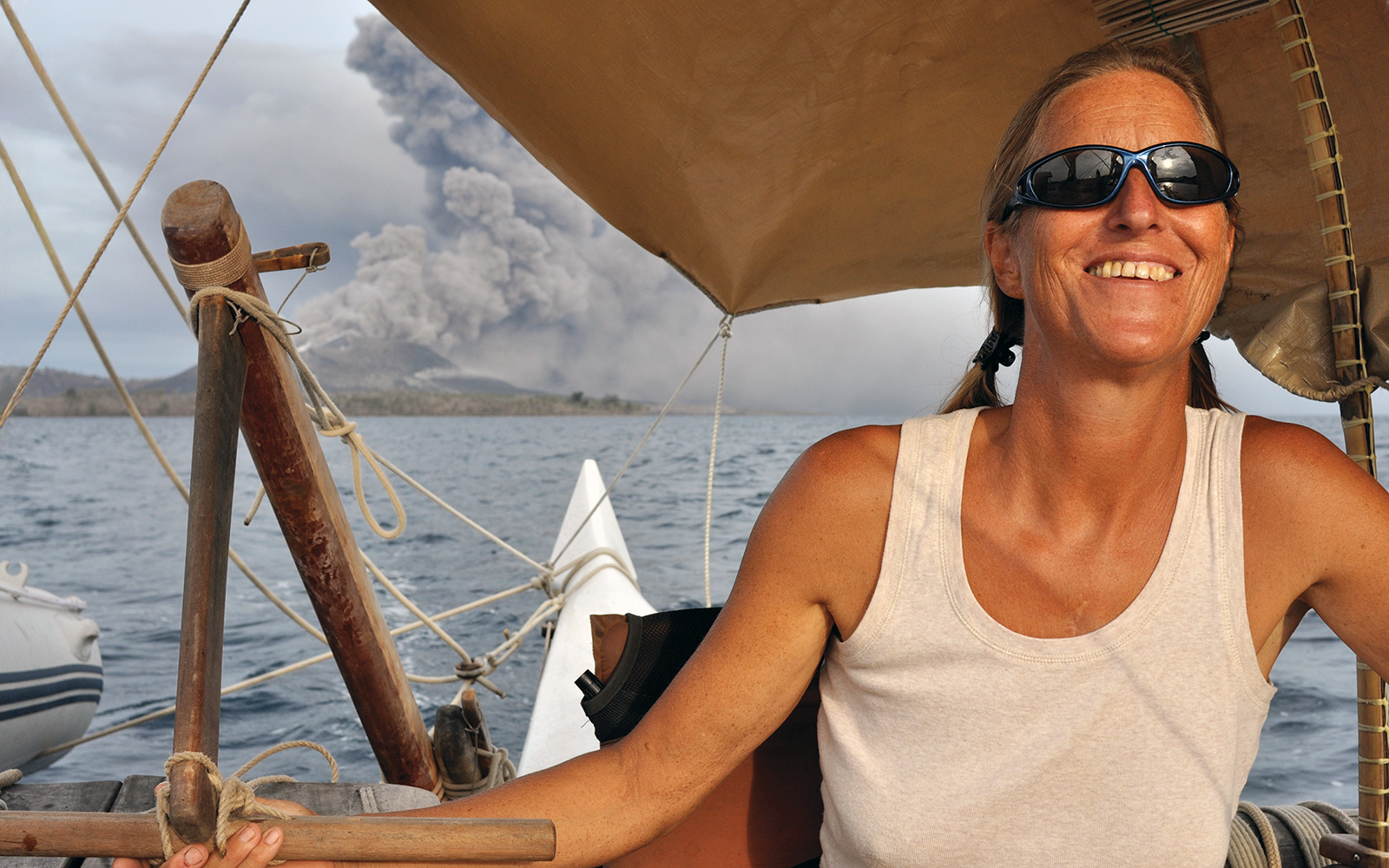
Matt FletcherHanneke Boon, a collaborator with the multihull designer James Wharram, is a lifetime designer, boatbuilder, and seafarer. In this photograph, she is at the helm of LAPITA ANUTA approaching Raboul, Papua New Guinea, in 2009 as the Tavurvur Cone ash plume rises behind her.
The water taxi speeds off from the dock in Olhão on the south coast of Portugal at mid-tide, around 3:30 p.m., its oversized outboard engines propelling us east along the Algarve toward Armona Island. It’s a warm spring day. My two teenaged boys cling to the after rail as spray lifts over the wake while I shield my one-year-old daughter from the sun, strapped tight against my chest in her carrier. My husband, Rémy, wedges our groceries between his legs, visibly relieved to be out of the car after two long days driving across multiple climates from southwest France.
Our host, Hanneke Boon, beams beneath her linen sunhat.
As the powerboat taxi throttles back, a huge Polynesian-inspired catamaran slides into view: red-painted hulls, carved wooden stemheads rising like punctuation marks at each end, and two pale wooden masts reaching into a blue sky brushed with thin cloud. The boat sits lightly, almost expectantly, on the water.
Julius BrightonHanneke took an active role in building SPIRIT OF GAIA, 63′ LOA, the largest James Wharram design ever built.
Hanneke stands, slips her phone into a weathered tan waist pack, and reaches for a line. The taxi comes alongside the port hull of SPIRIT OF GAIA, Hanneke’s Pahi 63 catamaran, as it bobs gently in the ripple of wake. We step aboard, following Hanneke’s lead, hauling bags to the amidships deck.
She slips into boat mode, kicking off her trousers without ceremony, down to her underwear, and begins opening the cabins. I perch the baby on a towel and appoint her brothers on watch. Rémy and I trail after Hanneke like eager apprentices as she moves methodically around the deck, checking fittings and lashings after the boat’s winter at anchor. She pauses at the starboard tiller, frowns, and mutters about a slight problem: a line connecting the steering system seems to have failed. Without breaking rhythm, she rigs a temporary fix, hands moving quickly and with assurance, then continues her inspection.
By five o’clock she seems satisfied. We’re instructed to settle into deck chairs beneath an awning she’s just tied overhead. Our complete inability to assist—not one useful knot between us—is now fully evident. Hanneke doesn’t appear to mind. She lowers herself into a chair, lifts our daughter onto her lap, and grins.
The boat swings gently to its anchor. The boys leap from the dark brown stemheads into the cold lagoon, letting the current carry them between the hulls before scrambling up the stern ramp and racing forward for another jump. I sit back and let the scene settle: the warmth, the movement, the ease with which Hanneke inhabits both authority and welcome.
SPIRIT OF GAIA was conceived as an oceangoing catamaran capable of extended long-range offshore work, specifically dolphin research, without the constraints imposed by heavier, more rigid multihull construction. Built over five years in Cornwall in South West England and launched in 1992, the design was based on ancient Polynesian voyaging craft. Hanneke was one of several open-minded women who sailed and lived with the catamaran designer James Wharram, who died in 2021 at age 93. Hanneke alone became a very close design partner for James, and she carries on his legacy.
Hanneke built SPIRIT OF GAIA with James in their backyard with the assistance of eager volunteers. The hull lines and basic structure were established early, but rather than fully resolving every detail in advance, they made many decisions on site, informed by hands-on boatbuilding experience and long-term sailing knowledge. The boat was built almost entirely from renewable wood species, primarily Douglas-fir, both in plywood and solid wood. The hull and deck were sheathed in fiberglass set in epoxy for durability. Structural weight was kept low by carefully choosing materials and by eliminating unnecessary fittings and furniture.
Angie RichardWhen the author and her family visited SPIRIT OF GAIA in Portugal, the boat became a playground for her sons.
A defining concept of GAIA’s layout is “flexispace.” Each hull is organized around simple structures that serve multiple purposes: bulkheads, seating, bunks, shelving, and storage. In construction, this minimized material needs, and thus overall weight, while increasing adaptability and ease of maintenance. Structural crossbeams, known as amas, were built as curved plywood-web I-beams rather than solid laminations or box sections, allowing controlled flexing under load and avoiding hidden voids where rot could develop. In ancient Polynesian fashion, the amas were lashed to the hulls rather than rigidly attached, permitting movement under torsional stress to avoid concentrated structural loads. Metal hardware was minimized; the chainplates, for example, are of hardwood, with hand-carved deadeyes. Hanneke, as one of the chief builders, was closely involved from start to finish. She also drew the plans, shaped fittings and interior details, and provided continuity as volunteers came and went.
Over the following week, GAIA opens herself to us, and so does Hanneke. We pore over drawings, photo albums, and decades of boatbuilding stories. We are taught knots and how to maintain the outboard motor. We perfect the art of chucking a lashed bucket down an intentional deck-to-ocean hatch to collect salt water for washing dishes. We share meals on the amidships deck, explore the surrounding mudflats at low tide, and become comfortable with the minimalist way of life enabled by a boat such as GAIA.
We’ve come here to learn about Wharram Designs as we prepare to build their Narai Mk IV design, an oceangoing catamaran. Our project is intended as a research, storytelling, and citizen-science platform for a circumnavigation with our French-based nonprofit, the Floating Stories Lab. Hanneke listens carefully, asks precise questions, and answers with calm confidence shaped by a lifetime at sea.
When the water taxi finally returns three days later to take us back to land, it feels less like a departure than an initiation.
Hanneke was born in Amsterdam in 1953 and grew up with boats as the axis of family life. They were small, practical craft sailed on inland Dutch waters, simple boats designed for weekend camping afloat. Along with her two sisters, she absorbed sailing by proximity rather than instruction. At that age, there was no mythology to it, only repetition.
James Wharram DesignsHanneke and the author’s husband, Rémy, examine plans and photographs in SPIRIT OF GAIA’s chartroom in contemplation of their own 41’ Wharram catamaran.
She often describes those early boats as deliberately simple. A bucket served as a toilet. Cooking happened on a single gas burner. The three girls slept under the foredeck or on the cockpit sole, with bedding of thin mattresses and sleeping bags. Comfort wasn’t eliminated so much as redefined. Land-based camping followed the same logic: carry little, know how to use what you have, and trust that competence is a form of safety.
Her father, Nico Boon, encouraged this approach. He was drawn to designs of light-displacement boats and plywood lapstrake construction, valuing elegance over mass. In 1963, he became the first buyer of a Waarschip 600, a pioneering lightweight 20′ glued-lapstrake sloop developed as a plywood kit boat in The Netherlands. Hanneke still recalls that decision as formative, not only for the boat itself, but for the
philosophy it carried.
When Hanneke was 14, a camping holiday in England altered the course of her life. Nico had heard about a British sailor who had crossed the Atlantic west to east on a hand-built wooden catamaran, the first multihull sailor to make this notorious crossing successfully. They found that man, James Wharram, in North Wales. The meeting resulted in the purchase of a set of plans for a 22′ catamaran, the construction of which became a family project when they returned home.
Back in The Netherlands, Hanneke’s family became deeply involved in the early multihull scene. Hanneke helped with the practical work of building their Wharram catamaran and, alongside her parents, took part in the grassroots efforts of a multihull club, for which her father was a founding member. This included producing a newsletter by hand, collating and stapling the mimeographed pages. At the same time, her father became Wharram’s agent in The Netherlands.
After high school, Hanneke stood at a crossroads. Talented in art, mathematics, and science, she chose art school, calling it later “the easier option.” Two years in, she received an invitation that rendered the decision temporary at best: to join James for a transatlantic passage in TEHINI. She was 20. She went.
That crossing marked the beginning of her adult life and her working life, a partnership with James that merged sailing, drawing, building, and analysis, and one that would continue for more than five decades.
James Wharram DesignsLeft—James, with crew Jutta, left, and Ruth, right, sailed TANGAROA across the Atlantic Ocean in 1955. Right—After meeting James in Wales, Hanneke worked with her father and younger sister at home in The Netherlands to build the 22′ HINA for the family, completing the boat in 1968.
James often described himself as an experimental nautical archaeologist. The term wasn’t metaphorical. He believed that traditional watercraft carried knowledge embedded through use rather than theory and that modern design could be informed by careful study rather than romantic imitation. Hanneke shared that conviction. Together, and with a wider circle of female collaborators beginning with Ruth Merseburger and Jutta Schultze-Rhonhof, who sailed with James on his pioneering catamaran voyages, they pursued designs intended not simply to float but also to support a way of living at sea grounded in functional, seaworthy minimalism.
Hanneke makes it clear that simplicity is not casual. It requires discipline.
James Wharram DesignsAt 20, Hanneke joined Wharram in Amsterdam for TEHINI’s 1971 transatlantic passage.
Her contribution to Wharram Designs is most visible, and perhaps most underestimated, in the plans themselves. Since the 1970s, she has drawn most of the construction plans for Wharram Designs by hand, in three-dimensional perspectives. A Yachting World feature recently observed that they are “the best way to imagine yourself aboard a Wharram,” adding that without Hanneke the design office “would not be what it is.”
The drawings, works of art in their own right, are not meant to be merely decorative. They are translations of design ideas into solid wood and of theory into practice, informed by thousands of miles sailed and countless boats built by amateurs working in sheds, back yards, and tidal boatyards. Hanneke understands how builders think because she has always been one herself.
In recent years, her work has shifted subtly. She no longer pushes to expand the design catalog’s range. Instead, she concentrates on consolidating the work: revising plans, improving clarity, digitizing drawings so they can be reproduced accurately long into the future. It is quieter work, but no less demanding. It reflects a long view concerned with continuity.
A month after leaving GAIA, Rémy and I head north .toward Lorient, Brittany, scouting places to live, schools ..for our children, and potential boatyards. Later, at the 2024 Fêtes maritimes de Douarnenez (Douarnenez Maritime Festival in Brittany), Hanneke joins us. As usual, we camp (this time, with a toddler and no teenagers), and we also bring a spare tent for Hanneke. She had sailed from Falmouth to Brest aboard a traditional wooden monohull before taking a bus south to meet us.
At 72, and despite multiple heart surgeries, Hanneke moves with an ease that feels earned rather than defiant. Freed from years of caring for James through Alzheimer’s before his death in 2021, she carries a renewed appetite for movement. She travels light—a backpack, a long teal waterproof coat, a smart phone—and crosses oceans because she still wants to.
Angie RichardHanneke keeps up relations with builders, so en route to an arranged sailing she also visited Benoît Castel and his Hitia 17, SARDINHA.
Before the festival, we take her to meet the French artist Benji Flao, who has invited her to sail aboard LOULOUTE, his refitted Tiki 28 built in the Wharram yard in 1990. On the way to meeting Benji, we detour to the coast to visit Benoît Castel, a Wharram owner-builder preparing his Hitia 17, SARDINHA, for the summer. As we approach on this postcard-perfect Breton summer’s day, Hanneke greets him warmly, then immediately begins inspecting the boat: stepping back, crouching, sighting along hull lines, running her fingers along rudder lashings. Benoît watches, proud and nervous. Her reputation in the Wharram world is well known.
She tells us, giggling excitedly at the memory recall, about how back in 1981 she and James took their Hitia 14 prototype (Wharram’s first stitch-and-glue design) on the roof of a car on a long European tour, ending up on a Breton naturist beach. The story lands lightly but also emphasizes the continuity of Wharram Designs.
At Billie Marine Boatyard in Hennebont, near Lorient, Benji prepares LOULOUTE for relaunching. Hanneke joins in without ceremony, helping tie the forward nets to the aluminum amas as a fine drizzle begins to fall. We retreat to the yard office with small cups of espresso. Inside, Hanneke falls into conversation with Pascal Petit, a veteran boatbuilder she last met years earlier in La Rochelle; he would become a Wharram agent in France.
When the rain clears, we follow the tractor down to the riverbank. LOULOUTE slides off the trailer and floats free on Le Blavet. The following day, Hanneke sets sail with Benji and his children toward Audierne and, finally, Douarnenez, where the boat will be beached in the heart of the maritime festival.
As we drive toward our rendezvous at the festival, my WhatsApp lights up with messages from Hanneke’s voyage: videos of dolphins dancing at the bows, steady progress reports—“60 nautical miles in 13 hours. Lots of motoring, but also 4½ hours of sailing while there was wind”—and joyful reflections on her return to Audierne, where GAIA once rafted up alongside the historic Breton langoustine vessel CAP SIZUN in October 1992.
Watching these small coastal miles accumulate on my phone screen, it’s easy to forget how often Hanneke’s sailing has unfolded at a very different scale.
Years ago, during a period of enforced stillness following heart surgery, Hanneke’s attention turned not to harbors or festivals but to long-
distance migration routes and the boats that made them possible. The question was not whether Pacific peoples had crossed open oceans but how, and what kinds of craft could do so repeatedly, reliably, and without external support?
The “Lapita Voyage” emerged from this line of inquiry. Conceived as both an experimental sailing project and a practical intervention, it was rooted in a specific historical and technical problem: the mysterious decline and eventual disappearance of seaworthy voyaging canoes on the Polynesian outlier islands of Tikopia and Anuta, and with them, independent interisland transport. Drawing on museum records, anthropological studies, and direct measurement of the Tikopian Vaka Tapu, or sacred canoe, preserved in Auckland, New Zealand, Hanneke and James focused on a distinctive V-shaped hull form unique in Polynesia for its ability to sail efficiently to windward. Hanneke carried out detailed measurements and drawings of the canoe in 1995, work that directly informed the new designs.
Working with a small group of collaborators, they developed two catamarans based on these Tikopian and Anutan hull proportions. The boats were designed to be simple, lightly built, and capable of long ocean passages under sail and paddle alone. Construction combined traditional form with modern materials: strip-planked wooden hulls over a plywood backbone and bulkheads, the planking sheathed with fiberglass cloth set in epoxy for durability—a pragmatic response to the scarcity of large dugout logs. The rig was the traditional Polynesian crabclaw, chosen for its power, efficiency, and suitability for hand-sewn sails and local repair. Wherever possible, spars, paddles, crossbeams, and fittings were conceived to be made, and later replaced, using locally available materials.
In 2008–09, the two canoes sailed approximately 4,000 nautical miles from the Philippines eastward through Melanesia to Tikopia and Anuta, following the same route taken by the early Lapita migrations. Hanneke skippered LAPITA ANUTA; James, by then 80 years old, sailed as honorary admiral. The voyage was not framed as re-enactment but as experimental nautical archaeology: a way of testing hull shape, rig, and handling under real ocean conditions while returning working vessels to the communities whose designs had inspired them. On arrival, the canoes were given to the islanders with the intention of restoring the heritage of interisland voyaging capacity and renewing sailing knowledge through use rather than preservation alone.
When Hanneke speaks about the Lapita Voyage now, she places it within a longer continuum. Boats, she and James long argued, predate the wheel; fiber, rope, and watercraft shaped human movement long before roads or engines. In this sense, the Lapita Voyage was not a departure from modern life but an applied investigation into technologies that once supported self-sufficient societies and might still do so again.
Angie RichardBefore the maritime festival in Douarnenez, France, Hanneke joined Benji Flao aboard his LOULOUTE, a Wharram Tiki 28.
A year after the Douarnenez festival and her journey aboard LOULOUTE, Hanneke travels back to Brittany
in May 2025, ferrying over from Cornwall to join me and the team behind Women & the Wind (see review, page 104), a feature documentary film I co-produced about three remarkable women crossing the North Atlantic in a 50-year-old Wharram Narai Mk I, MARA NOKA, captained by solo sailor Kiana Weltzien. Hanneke joins the film’s tour across Brittany, contributing to question-and-answer sessions and quietly observing the unfolding of a renewed interest in Wharram boats, particularly among young sailors encountering these designs as living possibilities.
Later that year, we meet again at the Port Townsend Wooden Boat Festival in Washington. Hanneke presents a talk titled “My Life with Wharram Catamarans” to more than a hundred people, tracing her story through photographs, voyages, and the slow evolution of design thinking. Over the course of the weekend, she sells out of books and Wharram T-shirts, fields questions late into the afternoons, and reconnects with people she hasn’t seen for decades.
It becomes clear that Wharram Designs is experiencing yet another revival rooted not in nostalgia but in relevance. The continuity of the family business, now run by Hanneke with support from Jamie, her son with James, owes much to her steady presence: drawing, answering, traveling, and showing up with that familiar, welcoming smile.
James Wharram DesignsHanneke was a lifetime associate of James Wharram, who died in 2021. Here, they are discussing changes to the prototype of the Mana, a design adapted for CNC kit construction.
Back in Portugal later in 2025, SPIRIT OF GAIA was resting through the winter in sheltered waters while Hanneke returned home to Cornwall. The coming year, 2026, was already taking form.
In spring, Hanneke will rejoin GAIA with a small group of volunteers to carry out maintenance and preparation. From there, weather dictating schedule, GAIA will sail north with a mixed crew of old friends and new hands, making her way along the Atlantic coast to Brittany and on toward Cornwall, where Hanneke hopes the boat will be present to mark GAIA’s 34th birthday in May.
From Cornwall, they will turn south again. In July, she will return to Audierne for a Wharram Hui, co-hosted by our Floating Stories Lab Association, before continuing to Douarnenez for this year’s iteration of the Fêtes Maritimes, where GAIA will be on exhibit.
After that, a change will come. SPIRIT OF GAIA will be passed on to a new family, who will take her to share custodianship and sail her as she was meant to be sailed. Hanneke will join when she wishes.
Alongside this transition afloat, Hanneke’s work ashore continues to widen. She was recently made a Fellow of the British Royal Geographical Society, an acknowledgment that places her lifelong engagement with sailing, design, and human migration within a broader intellectual landscape. Invitations to speak now arrive from around the world. At these engagements, she shares stories of voyages made, design thinking honed over decades, and the quiet decisions that allow people to live well at sea.
James Wharram DesignsWith vast experience in building and sailing catamarans, Hanneke over the years became a close design collaborator with James and continues to refine the design catalog.
When at home in Cornwall, she continues the daily work few people see: answering questions from thousands of Wharram builders and would-be builders across time zones, digitizing drawings, refining plan sets so they remain clear and accurate for the next generation. It is slow, attentive labor, rooted in the belief that boats, like knowledge, endure best when they are shared.
For us, Hanneke has become like family, both guide and mentor. She is a lead advisor and member of the Floating Stories Lab and sits on our Wooden Boatopia Council alongside prominent wooden boatbuilders committed to making a positive difference in the industry.
When I think back to that first afternoon aboard GAIA—Hanneke in her deck chair, our daughter on her lap, the stories and knowledge flowing freely from her lips—what stays with me is not authority, but wisdom and ease. A matriarch in her prime, carrying forward the legacy of Wharram Designs, continuing to inspire modern Sea People, and keeping the knowledge of ancient Polynesian seafarers alive. ![]()
Angie Richard is an award-winning writer, director, and producer of eco-adventure, climate-impact, and natural-history documentaries. She is the cofounder and president of the Floating Stories Lab Association (www.floatingstorieslab.org) hand-building a 41′ Polynesian-inspired wooden catamaran as a research and storytelling vessel. Angie leads citizen science initiatives exploring the impact of end-of-life boats on marine ecosystems. She lives with her family in Finistère, Brittany, France. For information about James Wharram Designs, see www.wharram.com and People of the Sea (Lodestar Books, First Edition 2020, Second Edition, 2021).