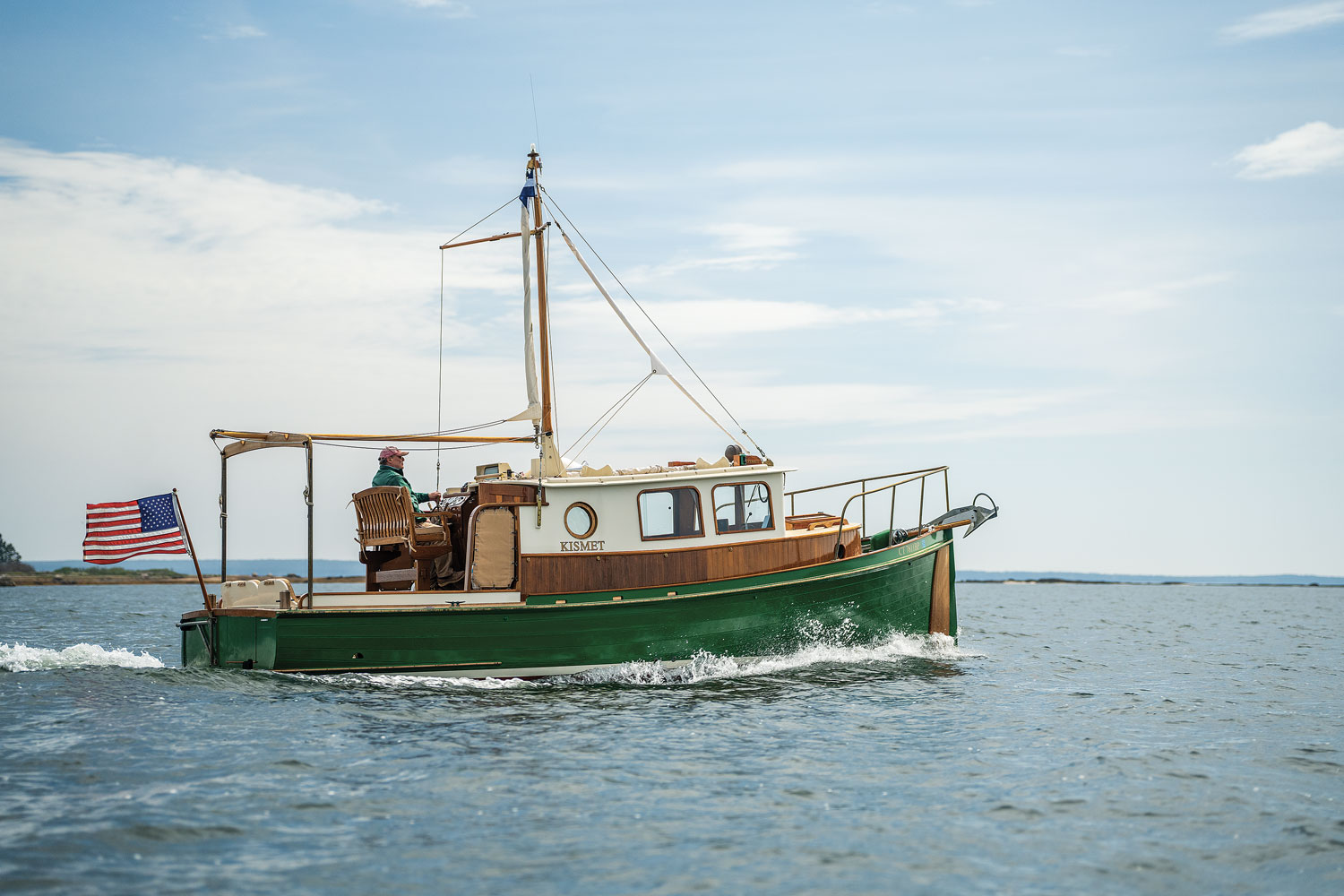
Truman ForbesKISMET, a 27′ power cruiser built to Bill Garden’s Pollywog design, has recently emerged from an extensive refit.
More than 30 years ago, in WB No. 119, I wrote a review of a design called Pollywog. That piece was illustrated entirely with designer Bill Garden’s evocative drawings. I subsequently became Bill’s agent for selling the package of drawings for this boat, and probably sold close to 50 sets. KISMET is one of several Pollywogs that have since been built, and her recent relaunching, after a major refit, provides an opportunity to finally show photos of this fine design.
Bill drew the plans for his lawyer friend Laurie “Loophole” Armstrong, who built BLACK DAVE from them in 1995. Another friend of Bill’s, a retired boatbuilder named George Fryatt, jumped right in and also built a couple of these boats—one of them for himself (also launched in 1995), which found its way to Maine in 2005. Others were also built from the plans that I sold.
Fryatt’s boat was shipped east from Vancouver around 2005 for Dale Turic, and I first came across her 10 years later, when Jim and Lolly Mitchell bought the boat and renamed her KISMET. In 2019, she went briefly to Bruce Fowler, who made the two-month voyage from Brooklin, Maine, down the coast, up the Hudson, through the Erie Canal and returned home via Lake Champlain and the Hudson. “A one-adventure boat,” he called her. Bob and Suzie Yaro purchased her afterward, in 2022, and immediately had her moved to Brion Rieff ’s Brooklin shop for repair and refit.
The Yaros’ idea was to modify her for comfortable afternoon runs near their Connecticut home and perhaps take a few short cruises. The refurbishing took longer (two and a half years) and went deeper than originally planned and consisted of frame repairs as well as many alterations. Launching was in early spring this year, and after trials in Brooklin, she headed west with Bob at the wheel and his friend Peter as crew. In five days at 5 knots, they made Noank, Connecticut, which will be her home port for the summer. She was on display at the 2025 WoodenBoat Show at Mystic Seaport, just upriver from Noank.
Reports from Bob Yaro that I’ve received so far are glowing.
KISMET now has a 2′-longer cabin than original, accommodating an enclosed toilet room, a larger galley, and a shower. She also was fitted with hot and cold running water, heating and air conditioning, a toaster oven, a surplus never-used Isuzu diesel identical to the 70-hp one she arrived with, a lift-out pair of fuel filters for easy element-changing access, pushbutton anchor handling, a kayak-carrying setup, roller-furling mainsail and jib, a sturdy gallows frame for the boom and awning, a transom gate and stern seat (with propane underneath), and all kinds of new wiring and electronics. Drawers, shelves, and lockers were added throughout the cabin for an abundance of additional stowage. There’s also a new bronze bow pulpit.
I lost track of Bill Garden’s drawings after the flurry of sales diminished, and they didn’t turn up until after Brion had lengthened KISMET’s cabin. Coincidentally, Bill Garden had shown a lengthened cabin and weather-cloth extension as an unpublished option. It was a most happy discovery, once the plans came to light, that what Brion and Bob had created almost exactly matched what Bill Garden had drawn.
You should be able to purchase drawings from Mystic Seaport Museum, or I can still furnish them in a pinch.
Truman ForbesA Dutch door
Brion Rieff looks out through KISMET’s Dutch door. He and his staff, especially Mike Moros, Michelle Ross, and Rick Jaeckal, carried out KISMET’s refurbishing, including moving the door and its adjoining bulkhead aft a couple of feet. The two-piece door, shown on Bill Garden’s original drawings, makes a convenient way for the folks inside the cabin to talk with those outside, including the helmsman when he or she is using the outside steering station.
Truman ForbesA peek inside
Looking into the after part of the cabin through the Dutch door shows a good-sized opening porthole over the galley. There’s a duplicate port opposite on the port side for the enclosed toilet room, or head. Both ports, which were obtained from a marine salvage company, were added to the extended portion of the cabin. They are handsome additions in keeping with the boat’s overall aesthetic. The bell is seen here in its stowed location; there’s a mounting socket outside for actual use.
Truman ForbesLooking forward
There’s an inside steering station where the helmsman can not only steer but has the same shift, throttle, chartplotter, and navigation and engine instruments as the outside helm station. Here is where you want to be when the weather gets bad or when you want to take a more active part in the conversation. The seating area has been enlarged for more comfort. The V-berth shows through the doorway.
Truman ForbesKISMET cabin overview
While designed primarily for two people who’d sleep forward in the V-berth, the boat can accommodate two more by converting the dinette into a double berth—the details of which appear on the following page. The galley, which has always been on the starboard side, was enlarged and made more useable by the cabin’s added length. There’s now a propane-fueled cookstove along with a more ample countertop. The enclosed toilet space is just out of sight to the right of the photo. Under the new teak-and-holly sole lies a hot-air cabin heater.
Truman ForbesConvertible dinette
By pulling out four hidden supports, as Brion is doing here, and topping them with a dedicated extender plank that’s stored in the overhead, you get a wider berth that can sleep two people comfortably. Here, the table has not yet been lowered to bridge the gap between the dinette seats, but after it is dropped down and all the cushions are in place, you have a genuine double berth. The cabin is a bit crowded then, but it surely gives that second couple a good place to sleep together or gives the extra crewmember his or her own berth.
Truman ForbesA composting toilet
Creating a fully enclosed toilet room was a primary reason for extending the cabin. But once any new space is available, it soon fills. For example, there’s a shower with hot and cold running water and the primary electric panel (well protected from spray). Just outside the bifold door, a toaster oven lies against the aft bulkhead. It all feels cozy rather than cramped.
Truman ForbesStowage
Shelves, drawers, lockers! They’re everywhere in this small cabin. And it’s just what’s needed to avoid cluttering up this small space where cooking, eating, steering, and lounging may all take place simultaneously. There are so many places to store food, dishes, and other cruising gear that one needs a good memory or a roadmap to find what’s needed when the time comes. Painting the hidden stowage spaces white instead of staining and varnishing them will make them easier to clean, and finding stuff that’s hiding in plain sight will be simplified, too.
Truman ForbesStarboard bow
Additions to the boat’s already handsome profile include a bow pulpit, a 2‘ extension to the cabin (identifiable by the round porthole aft), and a full set of roller-furling steadying sails. Vertical teak staving—common in the Pacific Northwest—protects the bow from a swinging anchor. A gallows frame for the boom and awning replaced the original boom crutch and makes a secure hand grab. KISMET still floats on her lines because as much weight was removed as added. To clear the foredeck, the jibstay was moved from the stemhead to the trunk cabin.
Truman ForbesOutside steering section
This steering station was original but was enhanced by the two-person teak porch bench purchased by Bob Yaro and adapted by Brion for use aboard KISMET. When you’re standing up, your feet are on the engine box, which runs all the way out to the hull; it’s a step up from the cockpit sole and from there, you can see ahead over the cabin roof. Engine instruments are housed in a panel custom made by the shop to harmonize with its surroundings. There’s a level flat cut into the cabin rooftop for loose items such as the skipper’s coffee cup or phone.
Truman ForbesSwim platform
This is how you get aboard. Simply bring the dinghy alongside and take the easy step onto the platform. It’s a small step up, and once you’re there, you enter the cockpit by swinging up the hinged section of the afterdeck and opening the hinged door in the transom. Then you walk right in, without having to climb. Gravity holds the deck, and a hook takes care of holding the door. It’s a bit to deal with, so when anchored, chances are that the door will remain open much of the time.
Truman ForbesBow pulpit
Brion fabricated a new bow pulpit, which will make the foredeck safer while dealing with the anchor, dock lines, and cleaning chores. Rather than use customary stainless steel, he went for the more traditional bronze, which, in time, will take on a lovely patina. Polishing isn’t appropriate; Mother Nature does just fine. As you can see from this and other photos, the shape of the rail and the stanchions that support it echo the boat’s sheer and stem profile, enhancing rather than diminishing the overall appearance.
Truman ForbesBoarding from a kayak or dinghy
Bob Yaro is an avid paddler and plans to carry a kayak on the cabintop and board it from the swim platform. To make this easy and safe, he and Brion devised a swingout bronze davit—not for the kayak, but for the paddler. The kayak will be lying athwartships against the swim platform and to get in or out of it the davit is there, swung out over the kayak, to assist. You grab it with your hands and lift your body in or out, without having to depend on the kayak’s marginal stability. The davit also aids those stepping out of a dinghy.
Truman ForbesSkylight and handrails
KISMET has attracted caring owners ever since she was built 30 years ago, so with the exception of broken frames at the turn of the bilge that Brion sistered, she lasted pretty well. Her original skylight and hand grabs, for example, were still in good condition, so like the rest of the boat, required only refinishing. Hand grabs here on the trunk cabin and especially along the top edges of the main cabin, while nice to look at, are also vital to hold onto while passing between the bow and stern.
Truman ForbesThe view from above
Foredeck, cabins, and cockpit—and the space they consume—show here. At the bow, the anchor is at the ready and can be operated remotely by the power windlass. On top of the main cabin are a couple of opening ventilation hatches and chocks for a kayak. The cockpit length, of course, had to be sacrificed by the same amount that the cabin was lengthened, but there’s still a decent amount of space for the helmsman and partner in the settee atop the engine box (with its hinged covers). Under the full-width settee across the stern are a couple of propane tanks.
Truman ForbesSteadying sails
KISMET’s steadying sails are small, but Bob Yaro says they do indeed dampen the boat’s roll in a beam sea; he also estimates that if the wind is blowing they add half a knot to the boat’s 5-knot cruising speed. Both the jib and mainsail are on roller furlers, so they are easy to set and douse. The mast pivots forward on a tabernacle for passing under bridges or hauling over the road.
Truman ForbesView from the starboard quarter
This view shows the overall setup: Beginning from aft, there’s the swim platform, kayak-boarding davit, and transom door, followed by the gallows frame, self-bailing cockpit, and outside steering station. We also see here the main cabin with the mast stepped atop, the furled mainsail and jib, and the new bow pulpit. Missing is the kayak itself, which at a sacrifice in visibility will lie in custom chocks on the starboard side of the cabintop. ![]()
Maynard Bray is WoodenBoat’s technical editor.
Be sure to watch the video, WoodenBoat Legends: KISMET, showcasing KISMET’s features and details.