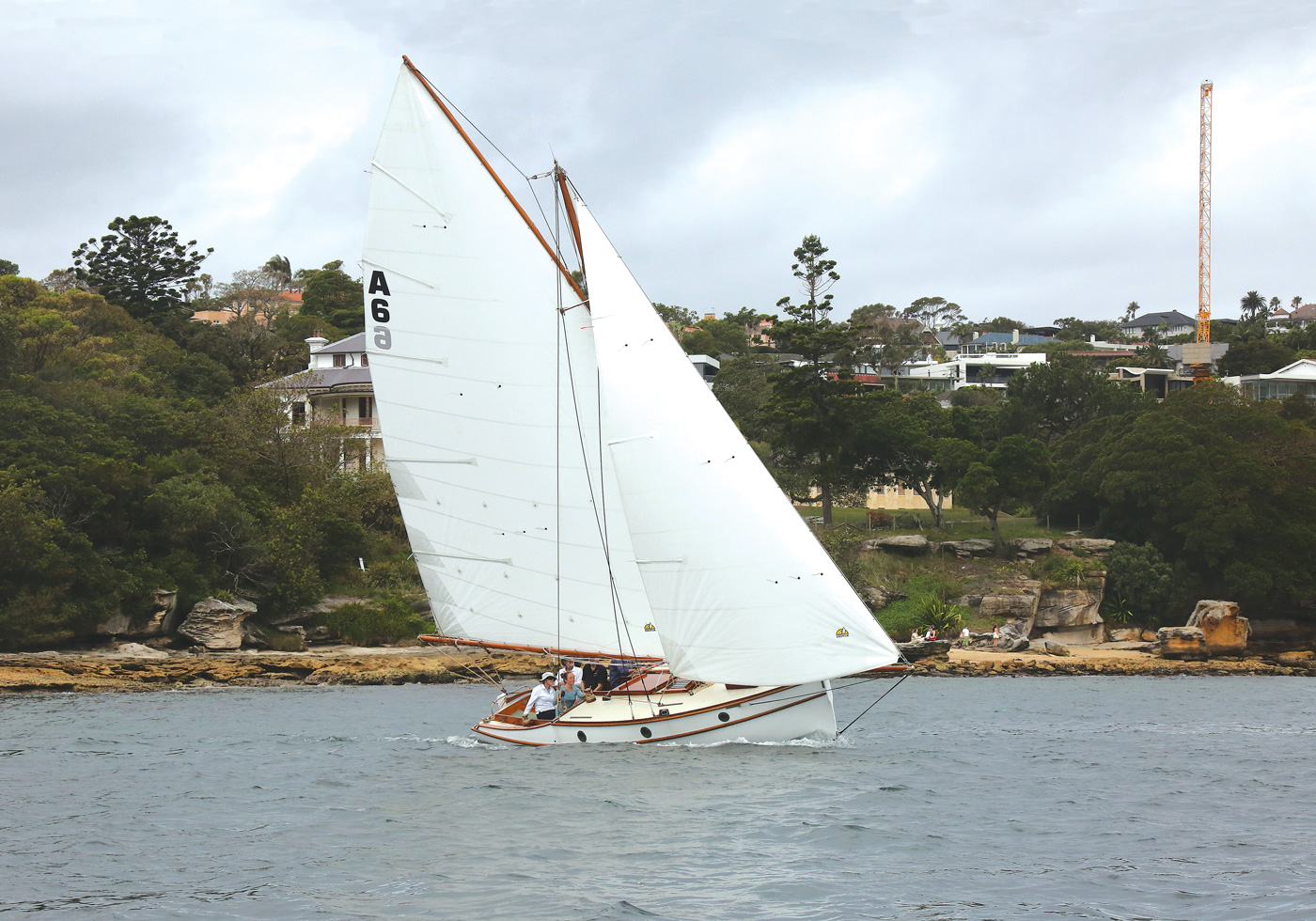
VOLUNTEER sailing in Australia’s Sydney Harbour.Nigel Sharp

VOLUNTEER is the latest member of the Ranger-class fleet on Australia’s Sydney Harbour. She is gaff rigged, as are her sisterships, but with a slightly different standing-rigging arrangement: most Rangers have swept-back spreaders with aft-leading upper shrouds and forward-leading lower shrouds. “That is just wrong for gaff rigs,” said her owner-builder, Ian Smith, who insists that lowers must lead aft to offset the forward force of the gaff jaws. “Aft uppers might give a tight forestay, but we have running backstays for that.”

With its large cockpit and distinctive raised deck, the Ranger-class sloop is the archetypal daysailer of Sydney Harbour, Australia. The original RANGER, which was 24′ LOA and lug-rigged, was designed by Cliff Gale and built for him by Billy Fisher in a Sydney suburb in 1933. The Ranger class came about when four sisterships were built between then and 1953. Three more followed in this century, albeit all of them with some variations. While the original RANGER was lug rigged, gaff soon predominated, although one of them was once converted to Bermudan; she turned out to be slower than her sisters.

Ian Smith started planning a major project about 10 years before he retired as a professional boatbuilder in 2013. Although for many years he didn’t like the raised-deck styling of the Ranger class, he grew accustomed to their “unusual looks” and now thinks they are beautiful. In 2002, with the help of his then business partner Simon Sadubin, Ian took the lines off an original Ranger and built a suitable shed over his driveway. He began work on the boat, in earnest, in 2014 and launched the new boat, VOLUNTEER, in December 2024.

Since she was launched, VOLUNTEER has sailed in races run by the Sydney Amateur Sailing Club. She has been competitive, having beaten each of her sisters at least once, while they have each beaten her at least once. “Our main problem is that for the first few races we had no spinnaker, so in the spinnaker races the other boats get away from us downwind,” Ian said. “We are struggling now to learn how to handle modern spinnaker setups with beaked poles, topping lifts, and so on, as my foredeck crew have mostly been from historical 18-footers, where there is no topping lift and we just keep adding pole sections.”

Ian and his wife, Tricia, plan to cruise VOLUNTEER. They will spend nights aboard in Sydney Harbour, sometimes rafting up with other boats; and they may occasionally go out of the harbor and up the coast to Pittwater—an afternoon’s sail—but they are unlikely to go any farther.

VOLUNTEER's cockpit.Nigel Sharp

COCKPIT: VOLUNTEER has a bridge deck, as do all Rangers, but her cockpit seats are cambered, while those of her sisterships are flat and level. Ian used Queensland maple—which was difficult to find—for all the cockpit brightwork as well as for the lazarette hatch and caprails.

The Tiller made from an offcut of the deadwood stock.Nigel Sharp

TILLER: The spotted-gum tiller, made from an offcut of the deadwood stock, is shaped to go over the aft cockpit coaming and under the mainsheet horse, and its forward end is carved in a style common to all the Rangers.

Lewmar size 24 bronze self-tailing winches.Nigel Sharp

WINCHES: The spinnaker sheets are managed by a pair of Lewmar size 24 bronze self-tailing winches; another pair of size 40s each side of the companionway are used to tend the headsail sheets.

A 15-hp Yanmar 2YM engine.Nigel Sharp

ENGINE: Although most other Rangers have Nanni diesels, Ian chose a 15-hp Yanmar 2YM. He has had Yanmars on several previous boats and values their relative quietness. Diesel fuel is carried in a 40-liter (10.6-gallon) stainless-steel tank.

Mainsheet block is mounted on the cockpit sole.Nigel Sharp

MAINSHEET BLOCK: The mainsheet block is mounted on the cockpit sole; it is effectively a combined snatch block and cleat. Ian had a similar one on his Sydney Harbour 18-footer, BRITANNIA, although for safety reasons, given her vast mainsail, hers didn’t incorporate a cleat.

Flag cleats made from spotted gum.Nigel Sharp

FLAG CLEATS: Ian made flag cleats from spotted gum and lashed them to the Dyneema shrouds with tarred nylon twine.

The forehatch.Nigel Sharp

FOREHATCH: VOLUNTEER’s forehatch, like those of several other Rangers, isn’t hinged but can be lifted off its frame. It has a permanently open narrow slot that is normally on the aft side, but the hatch can be rotated 180 degrees so that the slot can scoop fresh air into the cabin when the boat is lying head-to-wind while on a mooring or at anchor.

The interior cabin.Nigel Sharp

CABIN: Ian kept VOLUNTEER’s interior simple; it is essentially the same as one of his previous boats, comprising two berths forward, a seating area, and no head. This is “a very practical Sydney Harbour style,” he said. The bulkheads are made of nicely contrasting light-colored Queensland maple and dark Australian red cedar. While most of the other Rangers have simple skylights, VOLUNTEER’s cabin space is illuminated and ventilated by a handsome butterfly hatch.

Cutouts in the flat Queensland maple panels providing ventilation.Nigel Sharp

LOCKER CUTOUTS: The cutouts in the flat Queensland maple panels of the locker doors provide ventilation—and a distinctive touch.

Structural components made from various wood species'Nigel Sharp

A VARIETY OF WOODS: Various wood species make up the structural components: the lighter colored deckbeams are laminated celery-top pine, which grows only in Tasmania; the dark ones are of solid spotted gum; the beam shelf is celery-top pine; the stringers and frames are also spotted gum; and the hanging knees are tea tree, or Melaleuca quinquenervia. The latter is a common roadside tree around Sydney—in fact there is one outside Ian’s house, which is itself called Melaleuca. The portholes are from the Australian company Briggs Marine.

The portable refrigerator.Nigel Sharp

REFRIGERATION: VOLUNTEER has a 12-volt “esky”—Australian vernacular for a portable refrigerator. Ian has deliberately kept the boat’s electrical system basic; it has navigation lights, internal lights, engine starting, fuel gauge, bilge pump, and a socket for the esky. Solar panels are planned.

Castings for spinnaker pole’s end fittings, mainsheet horse, and stemhead fitting.Nigel Sharp (All)

CASTINGS: Ian carved the casting patterns for the spinnaker pole’s end fittings (bottom left), chainplates, and gooseneck. The patterns for the mainsheet horse (top) and stemhead fitting (bottom right) were made by Marcus Cranny, who built his own Ranger, AZURE, in 2018.

The frames, rivet fastenings, and ample floors.Nigel Sharp

STRUCTURAL WOOD: VOLUNTEER’s closely spaced frames, rivet fastenings, and ample floors combine for a durable and rugged hull. Most of the Rangers have more floor timbers than would be typical for a hull of this size, to prevent the garboards from loosening; VOLUNTEER is no different. She has a spotted-gum keel, a blackbutt stem and sternpost, spotted-gum frames, and Huon pine carvel planking.

VOLUNTEER’s deck.Nigel Sharp

DECK: VOLUNTEER’s raised deck is planked in western red cedar topped with plywood and a sheathing of Dynel cloth set in epoxy.

Article ends.


Nigel Sharp spent 35 years in the British boatbuilding industry before leaving in 2010 to work as a freelance marine writer and photographer. For more of his work, see www.nigelsharp.co.uk.