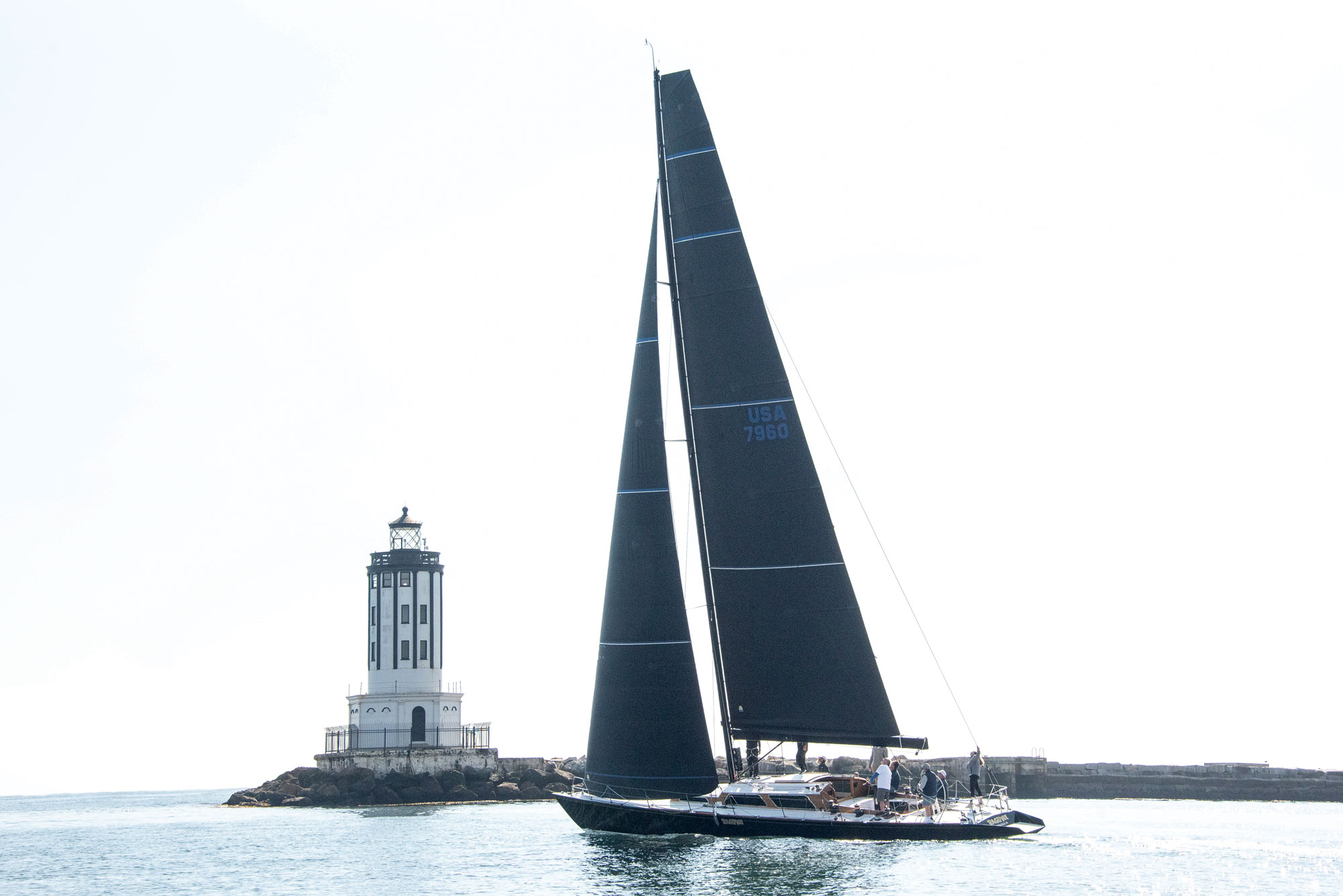
Steven JostMore than 50 years after she was launched, the groundbreaking sloop RAGTIME (originally INFIDEL) has emerged from a comprehensive refit and is still winning races.
In the 1960s, her rivals called her the “Black Box” and a “plywood New Zealand freak boat.” The 1967 Sydney–Hobart Race Committee banned her as unfit for ocean racing. But as INFIDEL (her original name), she won the Keelboat Fleet Championship in New Zealand that year, beating the long-dominant RANGER (see WB No. 222).
Then a pair of new American owners took the big, sloop-rigged sailing canoe to California and renamed her RAGTIME. Already a decade old, she surfed 2,225 miles from Los Angeles to Honolulu in the 1973 Transpacific Yacht Race (Transpac), and out-dueled the reigning champion, the maxi WINDWARD PASSAGE, for line honors. She did it again in 1975. “RAGTIME was a new breed. She turned a lot of heads,” remembers Mark Johnson, who owned and skippered WINDWARD PASSAGE in those years.
Bob Steel, a veteran West Coast racer who has sailed aboard RAGTIME since the 1970s, says that amid the fiberglass and aluminum revolution in racing sailboats in the 1960s and ’70s, RAGTIME and WINDWARD PASSAGE proved the enduring viability of wooden boats on the grand-prix circuit. “She’s still turning heads and winning races over a half century later,” Steel says. In early 2025, RAGTIME emerged from a nearly three-year refit.
“She was born to race,” says her ninth and current owner, Tina Roberts. “And that’s what she’s doing and will do.”
Recently, Roberts has entered RAGTIME in every challenge she can find in Southern California, including the Newport-to-Ensenada International Yacht Race and a 50th-anniversary rematch with the fully restored and race-ready WINDWARD PASSAGE. It’s all about tuning up RAGTIME for her 16th Transpac during the summer of 2025 and grand-prix racing to follow.
Steven JostTina Roberts, RAGTIME’s owner, had a string of business successes—and outdoor adventures—before taking on stewardship of RAGTIME. Upon completion of the refit in late 2024, she immediately began campaigning the yacht.
Design and Construction
INFIDEL, when launched, was no ordinary boat. The New Zealand–based designer John Spencer had honed his design and construction skills by building lightweight plywood sailing dinghies such as the Firebug-, Firefly-, and Cherub-class boats in Auckland. When the New Zealand industrialist Sir Tom Clarke asked Spencer to design something for big-boat coastwise and around-the-buoys competition, Spencer knew exactly what to create to fly over the water: a long, low, narrow, hard-chined, light-displacement hull inspired by his class racers.
For fore-and-aft and framing timber, Spencer used local kauri (a protected species today) for its strength and rot-resistance. He planked the boat with two layers of 3⁄8″-thick Fetcher kauri marine plywood (a highly respected New Zealand product), glued and screwed. The deck sheathing, 5⁄8″ thick in total, consisted of one layer of 3⁄8″ plywood and another of 1⁄4″.
Steven JostIn 2022, RAGTIME moved to Diversified Composites in Long Beach, California, for the most intensive refit of her life. The project included the addition of a deeper keel and a taller mast.
The keel and rudder were deep blades. The deckhouse was a flight of fancy for a modern ocean racer, which usually has a flush deck or a modest, low-profile cabin trunk. Spencer, gave INFIDEL a house built of varnished kauri with Art Deco angles and curves, large portlights, and decorative stainless-steel trim. Down below, the boat was (and is) little more than tiers of berths. As built, INFIDEL had no auxiliary power.
Sir Tom’s new boat was 61′ 8″ long with a displacement of only 24,000 lbs, about half as much as her rivals of the era. She was wet but capable to windward. Off the wind with a spinnaker, she could plane all day long, exceeding 25 knots. Course records fell almost every time she raced in Australia and New Zealand. Old-guard yachtsmen hated everything about her and couldn’t figure out how to handicap her. The Royal Yacht Squadron in Sydney cooked up a new rule about required hull thickness to exclude her from the Sydney–Hobart Race. It didn’t matter. Everybody in sailing circles knew her name.
Steven JostThe interior layout, refrigeration, and galley fixtures were tired—as was the finish down below.
A Southern California Inspiration
It was John Hall, in partnership with a business associate, who purchased INFIDEL, brought her to California, and re-named her RAGTIME. They also installed an engine to help her navigate the narrow channel leading in and out of her new home in the harbor at Newport Beach. In 1971, RAGTIME was sold to a Long Beach syndicate of Bill Dalessi, Barney Flam, Mort Haskell, Stan Miller, Chuck Kober, and Jack Queen. With two-time Congressional Cup winner Dick Deaver as the sailmaker and sailing master, RAGTIME was first to finish in every race she sailed, including a series of downwind charges to Mexican ports of call. In 1973, RAGTIME edged out WINDWARD PASSAGE off Diamond Head, Oahu, by 4 minutes and 31 seconds to win the Barn Door trophy in the Transpac.
In 1975, RAGTIME, by then owned by Bill White and Bill Pasquini, won line honors in the Transpac again and became the first monohull to finish first in the Newport-to-Ensenada International Yacht Race. Gary Weisman, who later became the president of North Sails, was aboard RAGS, as she was nicknamed, for this race. He was only 24 at the time, and recalls the thrill vividly, 50 years later:
There was one night near the end when we had strong winds. The boat had about an 8′ tiller back then. We were in this squall, just going with it at 15 knots or so. It was raining hard. We needed two guys lined up on one side of the tiller pulling, one guy on the other side, and me standing behind them watching the kite calling out course corrections, “up, up, up, down, down” to keep us from rounding down and losing the rig. It was hairball…. The next day we still had strong winds. We were heading down the Molokai Channel toward the finish at Diamond Head and this 50′ catamaran came out to greet us. RAGTIME caught a big gust and we blew by the catamaran going about 10 knots faster.
Steven JostThe hull work included a thorough inspection for rot and then sheathing in two layers of carbon fiber set in epoxy.
Meanwhile, a group of surfer-sailors from the Santa Cruz area of the central California coast were taking notice of the plywood rocket that trailed a rooster tail when sailing off the wind. Bill Lee, George Olson, and Carl Shumacher thought maybe they could design and build something similar, a big surfboard with sails, in fiberglass, to rival this wooden boat. Although the idea of extremely light-displacement boats has been around since the advent of Polynesian sailing canoes or earlier, the Santa Cruz gang now had a name for the stepchildren of RAGTIME: “sleds” or “ULDBs”—ultra-light displacement boats. One of them, Bill Lee’s MERLIN, set a Transpac elapsed-time record in 1977 that stood for 20 years. RAGTIME, an old lady by raceboat standards at age 14, finished third against MERLIN.
Steven JostThe interior refurbishing began with defining new spaces for sleeping and cooking, and white-painted surfaces with bright-finished accents.
Donation Boat
In the late 1970s, Jim Phelps of Long Beach bought RAGTIME with partners Dick Daniels and Eldon Hickman and had modifications in mind. Their upgrades included replacing the tiller with wheel steering and installing a taller rig. RAGTIME scored consecutive first- and second-place finishes in the Newport-to-Ensenada race before her owners donated their 25-year old racing legend to the University of California, Irvine.
RAGTIME was chartered from the university for two Transpacs in the early 1980s. She did not end up in the winner’s circle, despite having aboard Congressional Cup winner Dennis Durgan, who was Dennis Conner’s tactician during FREEDOM’s 1980 AMERICA’s Cup victory. Durgan sailed one Transpac as the skipper and another, later, as the owner. Under Durgan’s ownership, RAGTIME proved she could still fly. With Dick Deaver steering, she entered another Newport-to-Ensenada race and finished first in her class by five seconds over a contemporary ULDB.
RAGTIME racing had its lighter moments, too. Dave “Halfdeck” Johnson, the long-time captain of WINDWARD PASSAGE, and his brother, Dougall, remember being aboard the boat for the ’83 race from Newport Beach to Cabo San Lucas, Mexico. After blasting 900 miles down the coast from Southern California to Baja at speeds as fast as 27 knots, RAGTIME was becalmed about 150 miles from the finish. While waiting for the wind to return, the Johnson brothers set up a hot tub in the roller-furler’s well at the bow and hosted the Pig Mania Intergalactic Championships. Pig Mania is a classic game of chance that uses small plastic pigs in lieu of dice; small fortunes were won and lost as RAGTIME drifted. Strong spirits might have been involved. Ocean racing was put on a temporary hold.
Steven JostRAGTIME’s new cockpit is wider and longer than the original, the mainsheet traveler is farther aft, and control lines run belowdeck for improved cockpit management. A new carbon-fiber pedestal supports the original wheel.
The Farrah Years
In 1985 Pat Farrah, co-founder of Home Depot, bought RAGTIME. “Everyone wanted to sail on her. She’s a magical boat,” he says. “Our first race was Los Angeles to Ensenada, Mexico. We had a raw crew, but it was a great crew, and we won that race in a 30-year-old plywood boat.”
Farrah embarked on his first Transpac race with RAGTIME the same year, and again in 1987. “We just raced the pants off her,” Farrah says. “On one Transpac we had 40-knot winds off our beam and 12′ seas. For 10 minutes, we did a sustained 32 knots. We had the whole crew back on the transom for the weight, you know, to keep her from taking a nosedive. Pure magic.”
But to Farrah’s mind, RAGTIME was “starting to go downhill” after all those years of racing. “I decided it was time to save her for the next generation,” he says. We put her on the hard for a $1.4 million top-to-bottom overhaul.” With the help of boatbuilder Dennis Choate of Long Beach—and others—RAGTIME got upgrades such as a “sugar scoop” transom that extended her length to 65′; a deeper keel with a lead bulb; and a taller, 70′ mast. Her original framing and plywood hull remained healthy. During these years, Farrah commissioned a respected yachting artist, the late Gary Miltimore, to paint a now-iconic risqué “RAGTIME girl” mural inside the boat. Following the restoration, Farrah and Mike Elias of Long Beach sailed RAGTIME in the 1989 Transpac, marking Farrah’s third deepwater campaign with the yacht.
In 1991, Farrah’s son, Mike, sailed RAGTIME in another Transpac before the family sold her to Scott Zimmer, who sailed her out of the Balboa Yacht Club in Newport Beach. Zimmer raced RAGTIME locally as well as in the 1997 Transpac. By that point in her life, RAGTIME was a legend on the California yachting scene, and it seemed as if she could go on forever.
Steven JostThe new mainsail measures 1,029 sq ft, which is 309 sq ft larger than the previous one. The new 2,594-sq-ft spinnaker adds power for the long ocean passages that made RAGTIME famous.
A Man with a Vision
Four years later, RAGTIME again entered the Transpac, this time with Patricia Steele and Owen Minney chartering her from Zimmer.
By 2003, many people in the high-stakes raceboat world of Southern California (now dominated by the likes of Roy Disney’s various super-maxis named PYWACKET) were starting to wonder if RAGTIME had run her last race. The boat was tired and put up for auction. But Newport Harbor entrepreneur Chris Welsh and three friends (Jon Richards, Alan Peterson, and Scott Zimmer) decided she still had some life in her. They won the boat with a bid of $125,000.
Welsh and company raced RAGTIME in the 2005 Transpac. While she didn’t bring home any trophies, the experience and the boat inspired Welsh. He took over sole ownership and hired the naval architect Allen Andrews to design a new rudder, a bulb keel, carbon-fiber spars, and sails. In 2007, Welsh raced the faster and lighter RAGTIME in the Transpac. The race posed a considerable learning curve for Welsh and his crew as they experimented with sails and tactics to keep the boat sailing to new and swifter polars (predicated boat speeds at various wind strengths and angles). When they had her in the groove, RAGTIME, now age 43, could soar.
Emboldened and thrilled, Welsh entered RAGTIME in the Los Angeles-to-Tahiti Race, despite having no professional navigator. The old sled had a blown engine, a broken mainsail batten, and a leaking keel seal, but she finished seven days ahead of expectations. She set a new course record: 14 days, 16 hours, 24 minutes, and 23 seconds.
After the race, and with RAGTIME already more than halfway across the Pacific, Welsh continued sailing her southwest to New Zealand. There, he briefly renamed her INFIDEL and won the IRC division in the Royal Akarana Yacht Club’s Fusion White Island Race. Then he sailed her to Australia for the 2008 Sydney–Hobart Race, from which she had been excluded in 1967 as being too fragile for blue-water racing. How sweet it was. She finished first in the IRC 2 class and 18th overall. John Jourdane, a veteran navigator of 23 Transpac races (and 66 trips between the West Coast and Hawaii) was aboard RAGTIME for this event. “She has always been one of my favorite boats,” he says, “So far ahead of her time. So fast and easy to steer once the owners replaced the tiller with a wheel.”
“You can steer her with two fingers,” says her current owner, Tina Roberts.
Steven JostTina Roberts enjoys a post-refit sail aboard RAGTIME in autumn 2024.
Jourdane adds that if anyone still had any question about her fitness for ocean racing, she proved her mettle in her Sydney–Hobart run. Not only did she win her class, but at the start of the Bass Strait crossing she doubled back (sometimes in 60-knot winds and despite a blown-out No. 3 jib) to assist in the rescue of the crew off the sinking Farr 52 GEORGIA.
RAGTIME returned to the United States for the 2009 Transpac Race, her 15th. She also raced in the legendary St. Francis Yacht Club’s Rolex Big Boat Series in San Francisco. At about that time, Welsh met Tina Roberts, and together the couple began planning new ocean ventures. In 2011, Welsh entered RAGTIME in the Double-Handed Guadalupe Island Race with Mark Ivey and finished first. After the race, an exhilarated Welsh remarked, “Double-handing RAGTIME is like wrestling an alligator.”
Steven JostThe structural work included the installation of three new ring frames to stiffen the bow.
After eight years of intense campaigning, Welsh needed a break. He purchased CHEYENNE (ex-PLAYSTATION, the 2001 Atlantic-crossing record-holder) and the DEEP CHALLENGER submersible from the estate of the explorer Steve Fossett, who died in 2007. Then Welsh partnered with the entrepreneur Richard Branson to create a new start-up, Virgin Oceanic, aiming to explore the ocean’s depths.
Steven JostReconfiguration of the galley included adding a refrigerator and stove that are removable for day racing.
But even with new boats and new ventures, Welsh did not neglect RAGTIME. In 2013 he moved her from Southern California to San Francisco Bay, where she competed in events such as the Bridge-to-Bridge Race and Three Bridge Fiasco. Then in 2014 she returned to the Southern California regatta circuit. Still racing with chops at age 50, she was more than a larger-than-life presence on the water. She was a miracle.
In 2018, Welsh put RAGTIME on the hard while partnering with Roberts to purchase and develop Deep Flight, a company known for its winged submersibles, operating in the Maldives, Philippines, and Japan. Then the Covid-19 pandemic hit, and life stood still.
Steven JostStructural upgrades to accommodate the increased sail area included reinforcing the afterdeck around the backstay chainplates and stiffening the transom.
A Lady’s Lady
On March 15, 2021, Welsh died of a heart attack at age 58. Grieving but undaunted, Roberts took on the stewardship of RAGTIME to further his vision for a thoroughly modern RAGTIME.
“Taking the helm wasn’t something I planned on. It was the only choice. The boat is a historic treasure,” Roberts says. “I asked [the naval architect] Alan Andrews to help honor Chris and bring his dreams for RAGS to life. Alan said, ‘I’ll only do it, if you do it.’”
Committed to honoring Welsh’s legacy and continuing his dreams for the yacht, Roberts moved her boat to Dennis Choate’s Southern California boatyard for 27 months of what Roberts calls “the most intense refit of her life” (see sidebar, RAGTIME 2.0). According to her professional captain, Ernie Richau, her polars are now very similar to a contemporary TP70 sled.
Steven JostThe 80-hp engine is a marinized Mercedes Smart Car turbo diesel, which burns less than 2 gallons per hour and weighs 250 lbs.
The world of bluewater maxi-racing was all new to Roberts before she met Welsh. But she had boats and wind-in-your-face adventuring in her DNA. Some of her earliest memories are of growing up during the 1970s in Idaho and Washington, charging up and down the Snake River in her father’s powerboats and lake sailing with her grandparents. She felt the call of the wild blue yonder while flying in light aircraft as a young girl with her flight-instructor dad.
Inevitably, Roberts discovered motorcycles. After earning a degree in marketing at Pacific Lutheran University in Tacoma, Washington, and working her way up (during her 20s) from meat cutter to CEO of a meat-packing company, she thought, “I’ve got to do something before life gets away from me.” She quit work and took off on a 650cc Suzuki for a solo romp down the West Coast of the United States and Central America to Panama (and back) with stops to surf at legendary breaks such as Pavones in Costa Rica.
Steven JostThe refurbished cabin has a new galley layout, four new berths, and a new navigation desk.
By the time she met Chris Welsh in 2009, she had already run and sold multiple companies, including a bakery in San Francisco’s Castro district and a specialty foods distributor (“I took a liking to lamb!”). When she showed up for a blind date with Welsh at San Francisco’s St. Francis Yacht Club on her Suzuki, Welsh was, by all accounts, dazzled by her free spirit.
Of course, he showed her RAGTIME. But it was not until a race some weeks after they began dating that she realized this was no ordinary boat: “It was light air. None of the other boats in the race were moving, but RAGTIME was gliding toward the finish line. I was hooked.” A strong believer in destiny, Roberts sensed the universe was calling to her with this man and this boat. “I can’t wait to sail her in the Transpac this summer. It was Chris’s dream, and now it’s mine,” she says. “We mixed Chris’s ashes into the new steering pedestal. He will always be at the helm.”
Roberts relaunched RAGTIME in Long Beach in fall 2024 with significant press coverage, and by early February she had the boat on the racecourse. In her first important competition, the Newport-to-Ensenada race, Roberts proved that RAGTIME still has the magic. Sailing in the vanguard of the fleet down the coast to Mexico, she moved up from 11th position with 20 miles to go, to finish a close 7th, leaving more than 120 other racers in her wake. Then, a week later, Roberts took on WINDWARD PASSAGE in the Newport Harbor Yacht Club’s Opening Day Race. It was an 11-mile pursuit race, and RAGTIME showed her prowess in light air. She finished third, just two minutes behind the leader, in a fleet of more than 40 boats, and bested WINDWARD PASSAGE, which placed 10th, by about 9 minutes. These races would be among the first of a string of strong showings in preparation for the 2025 Transpac in July; RAGTIME started that race, but was forced to drop out due to a medical emergency nearly 500 miles offshore.
“It’s like RAGS has intuition,” Roberts says. “She knows how to sail. She gets up on a chine and she just goes. Like, let the water music begin.”
For six decades of crews and admirers, it has always been thus.
Steven JostRAGTIME spent the spring and early summer preparing for the 2025 Transpac, which started in early July. She was forced to drop out due to a medical emergency 500 miles offshore. In an exemplary display of air-sea rescue, a crewmember was lifted from the yacht 500 miles offshore.
RAGTIME 2.0
“This 2022–25 refit has been about preserving history while embracing new innovations that will inspire the next wave of adventurers,” says Tina Roberts, RAGTIME’s current owner. “I’m a junkie for speed, so that’s what we are trying to do, to make her fly…. There have been significant upgrades with a focus on performance, but RAGTIME is still RAGTIME.”
The yacht still has her original 61-year-old kauri framing and Fletcher kauri plywood planking and deck. The iconic and seductive painting of “RAGTIME Girl” still smiles at her crew below.
The renowned Southern California boatbuilder Dennis Choate and his team at Diversified Composites have overseen the structural enhancements involved in the refit, which reduced her gross displacement by more than 2,000 lbs. The naval architect Alan Andrews has guided the yacht’s performance upgrades. Jimmy Slaughter, a professional sailor and expert rigger with Performance Yacht Rigging in San Diego, has provided racing intelligence and consultation, overseeing all upgrades in the refit and testing.
Key upgrades include:
• Two layers of carbon-fiber skin on RAGTIME’s original plywood hull.
• A new rig using a modern, lightweight , 75′ carbon-fiber mast and boom, originally made for the TP52 SILVER SURFER.
• Longer spreaders and new carbon-fiber standing rigging.
• Machined custom stainless-steel chainplates with headless eight-bolt installation.
• A new square-top mainsail that is 309 sq ft larger than the previous one, increasing its area from 720 sq ft to 1,029 sq ft. This main and a suite of new jibs are all molded using a blend of carbon-fiber and Technora cloth by Doyle Sails New Zealand.
• A new spinnaker of 2,594 sq ft.
• A 250-lb marinized Mercedes Smart Car CDI OM660 turbo diesel engine.
• Redesigned deck elements, including a new, wide cockpit, a relocated mainsheet track, and a carbon-fiber steering pedestal.
• Eight new Harken Pro-series carbon-fiber winches, replacing 12 Barients.
• A B&G Hercules H5000 navigation system.
• Kelp cutters on the keel and rudder.
• More than 2,000 lbs reduction in gross displacement. ![]()
Randall Peffer is a regular contributor to WoodenBoat
RAGTIME Particulars
LOA: 65′ (originally 61′ 8″)
Beam: 11′
Draft: 11′
Displacement: 22,000 lbs (originally 24,000 lbs)
Original mainsail: 720 sq ft
Mainsail: 1,029 sq ft (originally 720 sq ft)
Spinnaker: 2,594 sq ft (originally 2,500 sq ft)
Designer/Builder: John Spencer
Place Built: Auckland, New Zealand
Year Launched: 1964