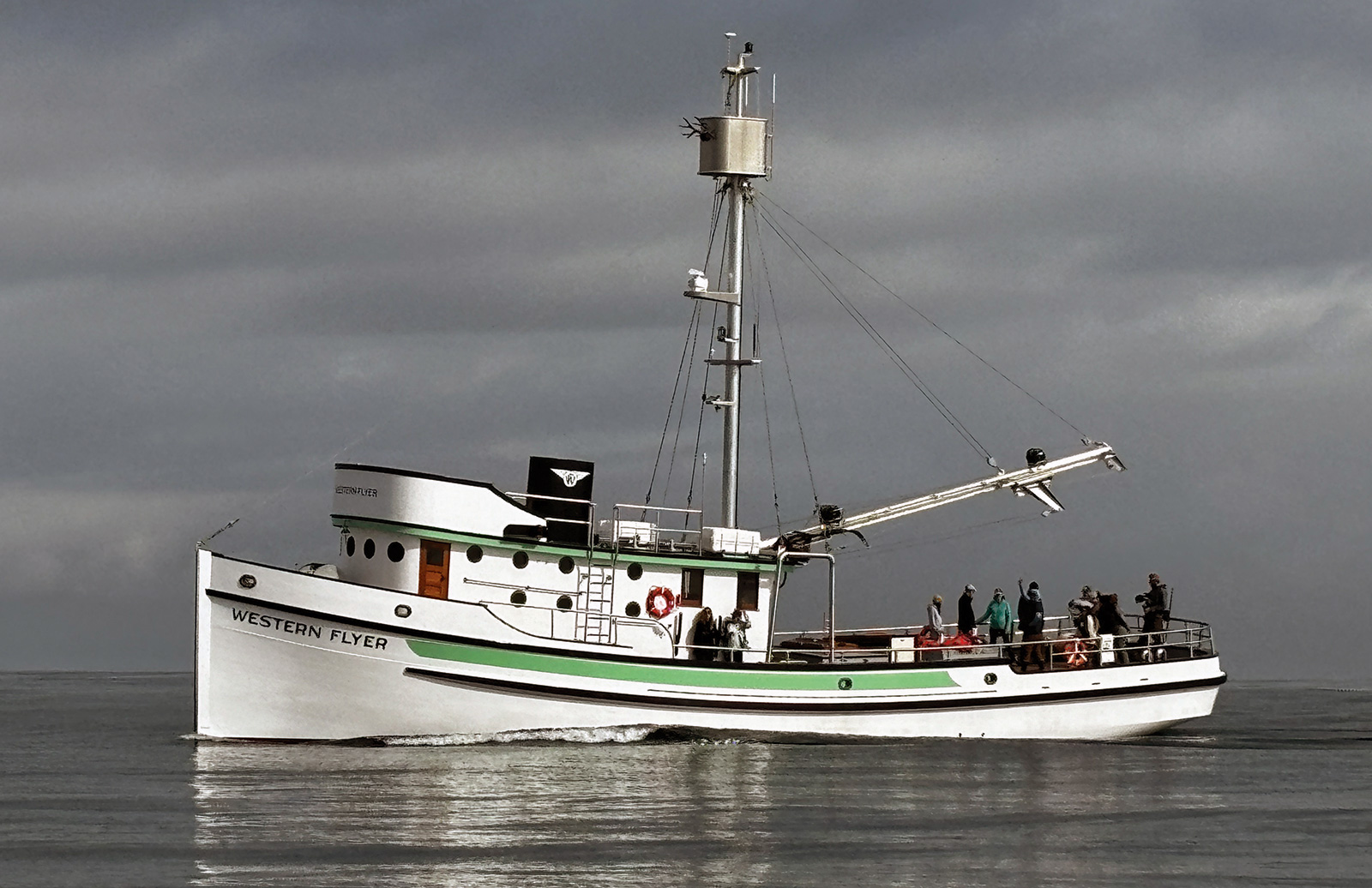
WESTERN FLYER makes a run out of Moss Landing, California.

WESTERN FLYER makes a run out of Moss Landing, California, the day after her triumphant return to Monterey. After a nine-year, $7-million restoration, the 77′ former purse seiner that once carried John Steinbeck and his friend Ed Ricketts to the Sea of Cortez will return to research work under the auspices of the WESTERN FLYER Foundation.

In 2019, I walked into the Port Townsend (Washington) Shipwrights Co-op to interview co-owner Tim Lee. I found myself standing next to the bow of a large wooden fishing vessel, and glancing at her, I turned and noticed a length of white tape on the weathered stem, with the words “WESTERN FLYER” hand-written on it.

“Is this…?”

“That’s it,” Tim said. She was the very boat that the author John Steinbeck and the biologist Ed Ricketts chartered for their legendary voyage to the Sea of Cortez in 1940.

I touched the plumb stem that had cut through the long Pacific swells and probed the harbors and estuaries of the sea between Baja California and the mainland of Mexico. In the waters that the undersea explorer Jacques Cousteau later called “the aquarium of the world,” Steinbeck and Ricketts studied the rich biology and documented their findings in a book published in 1941, republished as The Log from the Sea of Cortez in 1951. But the scientific voyage was a mere six-week interlude in WESTERN FLYER’s life of commercial fishing. She had had hundreds of crew members who were unknown, unremarked upon, mostly forgotten.

Built in 1937 by Western Boat Building Company in Tacoma, Washington, WESTERN FLYER was a relatively new sardine seiner working out of Monterey, California, when Steinbeck chartered her. She and her captain returned to fishing after the research voyage.

Sold and resold, and renamed GEMINI in 1970, she was used as far north as Alaska in a variety of fisheries. She hit a reef and sank off Ketchikan in 1971 but was raised and repaired. By the early 2000s, most wooden-hulled fish boats were long gone, including her sister ships, and the aging WESTERN FLYER appeared ready to follow. After sinking (twice) in Swinomish Channel near Anacortes, Washington, she was raised in January 2013 after six months on the bottom and taken to Port Townsend (see Currents, WB No. 243). It was there that John Gregg, who had been inspired early in life by the Steinbeck and Ricketts adventure, stepped in and bought the hulk for restoration as a full-time research and education vessel, based in Monterey, that would trade on her earlier fame.

Gregg established the WESTERN FLYER Foundation and raised money and interest for what became an eight-year project to restore the boat. The Shipwrights Co-op rebuilt the hull under the leadership of Chris Chase. Tim Lee and his crew got down to the dirty business of replacing frames, centerline structure (with the exception of that stem), and planking. Today, little of the original hull remains, but above deck the wheelhouse and cabin retain almost all the wood that went into them in 1937. With the boat rebuilt and painted white and green, as she was when first launched, her original name was restored. After relaunching, she was towed to Snow & Company in the Ballard neighborhood of Seattle, to be repowered.

Capt. Paul Tate took WESTERN FLYER south on her maiden voyage, arriving at Moss Landing on Monterey Bay on October 7, 2023, after a rough passage. On November 4, he took the boat the last 15 miles home to Monterey, with flags flying and her deck crowded with supporters. Among the crowd waiting to greet her was Joe Petrich, a boatbuilder and designer whose family founded and owned Western Boat Building. “My family built it,” he said as Capt. Tate maneuvered the 77′ boat to her berth. “It’s very moving to see it, knowing my father might have bent some of the original planks…. I didn’t realize what the boat meant to people until I was down in Monterey on vacation with my family sometime in the ’80s and I saw a picture of it… They said it was the most famous boat in Monterey.”

When I saw WESTERN FLYER in Port Townsend, the hair rose on the back of my neck. I’d read almost every book Steinbeck wrote. He immortalized the Monterey waterfront in Cannery Row of 1945, and in the late 1970s I lived a similar lifestyle at Moss Landing. The night of her arrival in Monterey, I stayed aboard and slept in one of the original bunks. When Capt. Tate went ashore for a bit the next morning, I found myself briefly with the boat all to myself and took my time to explore it in detail. Later, Capt. Tate told me that work to install the research equipment was continuing: “We hope to be back down to the Sea of Cortez by spring of 2025,” he said, 85 years after her famous voyage. I’ve crossed paths with WESTERN FLYER three times since her reconstruction began, and I hope the next time I’ll see her with her decks crowded with students following the example of Steinbeck and Ricketts.

Fittings for a new purpose.Fittings for a new purpose

For the Port Townsend Shipwrights Co-op in Port Townsend, Washington, the WESTERN FLYER’s restoration project was a labor of love. While the intention was to relaunch her as she was when she first touched the water in 1937, some modifications were made. For example, the new skylight and companionway provide light and access to the laboratory occupying the space that once held the catch of sardines and squid.

A tradition of luck.A tradition of luck

In his book The Log from the Sea of Cortez, Steinbeck mentions “deer horns” on the mast of the WESTERN FLYER and many other boats. The tradition came from Sicily, he was told. The antlers bring good luck, though no one knows why. Regardless, they seem to have worked well for WESTERN FLYER.

Nod to original wood.Nod to original wood

Artisans at Ventana Surfboards and Supplies in Santa Cruz, California, crafted a turtle from wood taken from WESTERN FLYER and inlaid it in the boat’s deck. Steinbeck wrote of the boat’s crew killing a turtle during the 1940 voyage. As he told it, the turtle died a long, hard death: even with the head chopped off, it kept moving, and the heart beat for hours afterward. Efforts to cook the meat failed, as did an attempt to save the shell. Regretfully, they threw it all back into the sea, and their remorse echoes through Steinbeck’s book.

A blend of new and old.
A blend of new and old

The round portlights and surrounding woodwork of the wheelhouse are all original, but the wheel is not. The original wheel installed by Western Boatbuilding in 1937 came up for auction during the reconstruction, but John Gregg, the founder of WESTERN FLYER Foundation, chose not to bid on it, instead using a classic eight-spoke wheel built by John Hastie & Co. Ltd., in Greenock, Scotland. In 2022, Gregg had the boat towed to Snow & Company in Seattle, Washington, where their crew installed the power train and all-new systems, including the wheel, a hydraulic steering system, autopilot, jog lever, and all the Furuno electronics and system monitors.

Where conversations flowed.Where conversations flowed

Aside from a plywood-and-epoxy roof and restored finishes on the table and woodwork, the galley has changed little in 87 years. The Shipwright’s Co-op crew carefully removed the cabin and set it down on a support structure exactly shaped to the sheer and dimensions of the boat’s deck. While one team replaced almost every piece of wood in the hull, the cabin team carefully removed all the wood, cleaned it, and put it back in place, resulting in a cabin made almost completely of the same materials that once resonated with the voices of Steinbeck, Ricketts, and the rest of the most famous WESTERN FLYER crew.

A startling find.A startling find

On a fascinating turn of luck, project manager Chris Chase found an Olympic diesel stove that exactly matches one known to have been used in Steinbeck’s day. Chase found the replacement in a Montgomery Ward department store in Portland, Oregon, in mint condition and still stored on its original shipping pallet, along with the owner’s manual. The starboard side of the galley, while full of original wood, has equipment unheard of in 1937. The sink and faucets provide pressurized hot and cold running water. The Vitrigo model-DW combined refrigerator and freezer runs on 120v AC power, as does the hot-water heater.

Companionway access below.Companionway access below

The biggest transformation in WESTERN FLYER’s restoration came belowdecks, not only in hull reconstruction but in repurposing the boat from commercial fishing to research. For most of the boat’s life, the crew climbed down into the hold by removing the hatch cover and descending a vertical ladder; researchers now can access the lab safely and easily via a companionway.

Ample laboratory work space.Ample laboratory work space

During their six-week cruise to the Sea of Cortez, Steinbeck and Ricketts conducted their sampling and specimen-preservation work on an improvised table on deck as well as sometimes taking over the galley. With the fishhold rebuilt as a laboratory, researchers on WESTERN FLYER can operate in safety and relative comfort deeper in the hull, where the roll of the long, narrow hull will be a little less snappy. Chris Chase built the 3′× 10′ mahogany table, which is topped by a paper-and-resin material called Richlite.

A fishhold no longer.A fishhold no longer

Looking forward in the laboratory, a watertight door provides access to the engineroom to starboard. A Seabird flow-through seawater sensor is mounted on the port side of the bulkhead. A Headhunter Sting Ray saltwater pressure system provides seawater for science work on deck as well as for the fire suppression system. WESTERN FLYER’s original registration number and tonnage are carved into a principal deckbeam. A young craftsman, Lachlan Carlson, built the skylight and other fittings.

New steam-bent frames.
New steam-bent frames

When rebuilding WESTERN FLYER, Chase could not find white oak in the size and quality needed for 62 pairs of steam-bent frames that needed to be replaced. Such wood was abundant during the early-20th-century boatbuilding boom in the Pacific Northwest but scarce by the early 21st century. Chase found substitute wood on the campus of Berea College in central Kentucky, where he harvested 14 white oaks, using horses to twitch the logs out. The logs yielded 150, 18′× 4″×3″ frame blanks, which were shipped to Port Townsend and kept in a humid container until they could be steamed and bent into place.

Hybrid power.Hybrid power

The Transfluid hybrid electric system is sandwiched between the engine and the 6:1 Twin Disc reduction gear. The engine can run power through the Transfluid gear to the Twin Disc gear or the Transfluid gear can grab the shaft and run it off two 50kW electric motors drawing on six Transfluid lithium-iron-phosphate batteries, which weigh a total of 3,000 lbs. When the diesel engine is running, the electric motors can be used to recharge the batteries. The idea behind the electric system is that it will enable the vessel to stay on station for as long as six hours, using the almost silent electric motors.

Up-to-date diesel engine.Up-to-date diesel engine

WESTERN FLYER’s original 160-hp six-cylinder Atlas engine was long gone when the vessel arrived at Snow & Company in Seattle for repowering. Chase said it had been replaced with a Caterpillar engine in about 1951 and other engines later. “We took a Detroit 12-71 out, and from what we know, that was one of four 12-71s that had been in the boat since the 1960s,” Chase said. The new engine is a John Deere 6135 AFM85, turbocharged in-line six-cylinder delivering 425 hp; a Bollard Marathon 28kW genset is seen here on the right.

Watertight decks.Watertight decks

As boat design transitioned from the Age of Sail to steam to diesel, many boats retained the long, narrow form of sailing vessels: WESTERN FLYER is such a boat, at 77′ LOA with a beam of 20 and draft of 8′2″. With a length-to-beam ratio of close to 4:1, she could be propelled easily with comparatively little horsepower. In the reconstruction, the deck and cabin roof were built of plywood sheathed with fiberglass cloth set in epoxy, which will prevent leaks that could damage computers and sensitive equipment. The deck has two layers of sheathing topped by 1″-thick planks of Douglas-fir.

On the Bay.On the Bay

A dream realized and a blast from the past, WESTERN FLYER runs on Monterey Bay 87 years after joining the fishing fleet there. But where the heavy boom of the old purse seiner once held a big Puretic power block for hauling in its net, the boom will be used to launch and recover an ROV that will be used to explore and sample the bottom at great depths. WESTERN FLYER will no longer pursue fish but instead be a fisher of data and information, continuing Steinbeck and Rickett’s mission of understanding the ocean and the life it holds.  Article ends.

In his youth, Paul Molyneaux read just about everything Steinbeck had written. Paul lived and worked in Moss Landing, California, in the late 1970s, going fishing aboard wooden boats and experiencing the Cannery Row lifestyle, some of which is documented in his book, The Doryman’s Reflection.