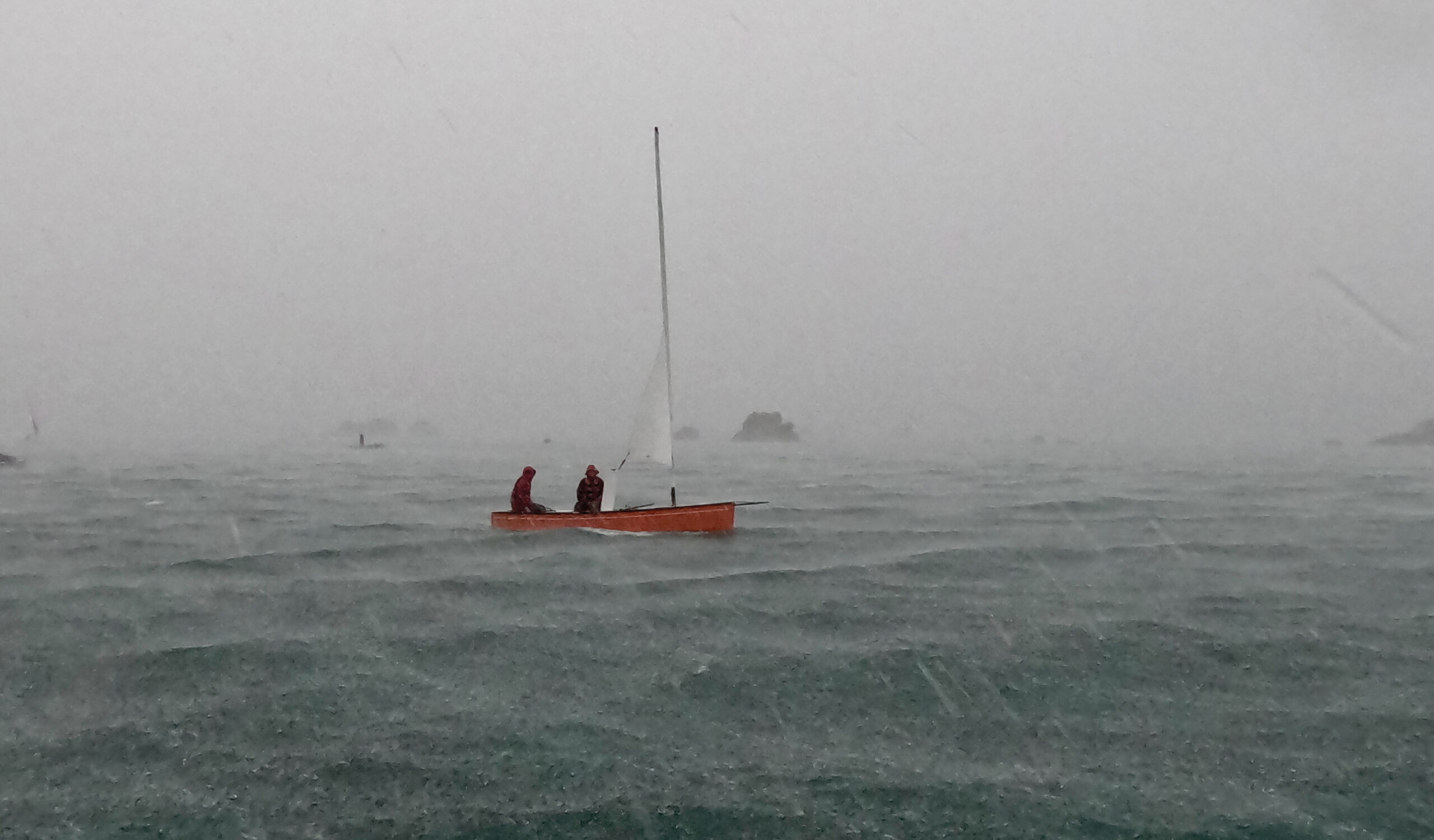
The Gilles Montaubin–designed SPRINT’O creeps along under greatly reduced sail during a sudden squall on the Challenge Navigeur Léger’s approach to Île de Batz on the north coast of Brittany.
My cameras tell the story: At 9:43 a.m. on June 12, 2025, my faithful old Nikon D800 records several shots of various small boats being rowed in early-morning sunshine across a glassy calm sea. Ahead of them are multiple lines of craggy black rocks, and in the distance an island with a tall, elegant lighthouse at one end. It’s an idyllic scene, apart from the huge mountain of black clouds piling up on the horizon behind the fleet.
By 9:47 a.m., the sky darkens and the water turns inky black. A few wisps of wind ruffle the surface of the sea. Although the fleet is running ahead of the clouds, the coming storm is clearly catching up with them. The boats in my photos are reduced to silhouettes against a silvery sea, with a strip of light on the distant horizon.
By 9:52 a.m., the wind begins, and with it the rain. The breeze comes slowly at first, then quickly gathers pace. Most of the boats are now reefed, with sails eased right out.

Most of Montaubin’s boats are fitted with mainsails that can be roller-furled around the mast, which allows sail area to be reduced very quickly.
At 9:54 a.m., the squall hits the fleet. It’s astonishingly powerful, with easily over 30 knots of wind. Everyone drops their sails or reduces to the smallest reef possible. We are quickly soaked to the skin—especially those dressed for summer sailing. I stow my Nikon and take out the waterproof GoPro camera I brought along for just such an eventuality.
At 9:55 a.m., my GoPro shows an image that looks like a tropical typhoon: a gray-green sea covered with lines of white spume. The wind is so strong that rather than making waves, it flattens the surface of the water. It should be terrifying, but it’s actually mesmerizingly beautiful. Even under bare poles, we are being driven along at a speed of 2 knots. The boats around us seem to be coping remarkably well, too.
By 9:58 a.m., visibility is down to less than a mile. The lines of rocks above the water are gray shadows, and any rocks under the water are invisible.
By 10:15 a.m., it has calmed down enough for me to bring my regular camera out again. The fleet looks a bit bedraggled, but all the boats in my viewfinder are right-side up and seem to have people aboard, which is reassuring.
At 10:39 a.m., I photograph the fleet coming into a small harbor and anchoring in a group in the middle of a pool. Everyone is wet but still high from the rush of adrenaline. It feels as if we’ve survived a potentially perilous situation. The memory of those dramatic 30 minutes will stay with everyone for a very long time.
“Sailing Light”
That squall came during the third day of the 2025 Challenge Naviguer Léger (CNL, literally “sailing-light challenge”), which took place last June off the north coast of Brittany, France. The event is an annual invitation-only raid that has a reputation for being one of the most challenging sail-and-oar events in the European boating calendar. It’s invitation-only because instead of being an officially organized event, it’s more a gathering of friends, which neatly avoids the legal obligations associated with organizing a regatta. As a result, there’s no event website, no event listing—just an email list you can get added to if you know whom to ask.
Gilles Montaubin, the French small-craft designer renowned for his minimalist aesthetic, is the event’s co-founder and is usually the instigator of these emails. His instructions for the 2025 gathering state clearly that all participants are required to “naviguer en autonomie complète,” that is, be completely self-sufficient for the duration of the raid. Furthermore, “full responsibility remains with the skipper” for the safety of the boat and the people aboard. The only advantage listed of sailing in a group is “being able to provide assistance if necessary.”
Each year, the group votes on where to go next, and Gilles draws up a proposed itinerary. There are no reserved moorings, no organized races, no formal dinner, no ceremonies. Everyone just turns up at a certain place at a certain time and gets on with

Montaubin took the helm of his own boat, DIOGÈNE, for the 2025 four-day event, which he cofounded and which is closely aligned with his aesthetic of lightweight, nimble, and fast small boats. The twin asymmetrical daggerboards are held in position with a simple through-pin.

The four-day west-to-east Challenge Navigeur Lèger 2025 involved following the rocky shoreline of Finistère, France, in sail-and-oars boats. Facing contrary winds, some returned to L’Aber Wrac’h rather than carrying on to the final destination, Trébeurden.
In 2025, that certain place and time were L’Aber Wrac’h on June 9. The destination was the village of Trébeurden, 50 miles to the east, passing the port of Roscoff on the way. It’s a beautiful coast, full of craggy inlets, glorious sandy beaches, and lots and lots of rocks. The French call them cailloux, meaning pebbles, as if to diminish their power—but don’t be fooled; they are scattered across the coast in seeming thousands, each one capable of tearing a hole in the bottom of a boat. Not surprisingly, the region of Finistère, where we were sailing, contains hundreds of shipwrecks as well as the highest concentration of lighthouses in the world.
Simplicity and Performance
I duly turned up at L’Aber Wrac’h at the appointed hour with a rucksack containing food for four days (most of it precooked) along with a tent, a mattress, a sleeping bag, and my two cameras. My host was none other than Gilles himself on his latest creation: the 17′ (5.2m) design he calls the Walabi 3. I had briefly met the famously self-effacing designer at the Blekinge Archipelago Raid in Sweden in 2005 (see WB No. 187), when his 18′4″ (5.5m) PETITE ELISA proved nigh unbeatable, winning five out of seven legs, usually by a large margin. With her flat bottom and hard-chined hull, PETITE ELISA had a modern, almost brutal, look. She was clearly designed for efficiency rather than traditional good looks. I was immediately intrigued and vowed to find out more one day.
Twenty years later, I finally got the chance to try out the latest manifestation of Gilles’s thinking. At 17′, the Walabi 3 is slightly shorter than her predecessor and, at 264 lbs (120kg) unladen, considerably lighter. She has storage space forward rather than a cuddy and twin daggerboards rather than a centerboard. Gilles increased the angle of the chines in the later boat, giving the topsides a subtle increase in flare. The fitout for Gilles’s boat is minimal and basic, almost thrifty. He has used his 50 years of experience in yacht design to pare the boat back to its essence, without sacrificing anything in performance. Not for nothing has he named his boat DIOGÈNE, the French spelling of Diogenes, the Greek philosopher famous for his ascetic way of life and his cynicism.
It turned out that two other boats built to the Walabi 3 design were taking part in the CNL, both owned by dentists who had previously sailed a wooden-hulled Wayfarer dinghy together before deciding to build their own boats. SPRINT’O and FLOKI were both fitted out to higher specifications than Gilles’s own boat—one of them even had a Mylar sail—suggesting that dentists like their boats as shiny as their teeth. As FLOKI’s owner, Franck Virol, put it, “Dentists are good at fixing things.”

Stéphane Blanc and crew approach the Île Vierge lighthouse aboard SPRINT’O, which he built to Montaubin’s Walabi 3 design; she is one of three such boats that sailed in the challenge in Finistère in 2025.
The rest of the fleet consisted of an eclectic mix of boats. The CNL’s relative lack of rules seems to encourage experimentation and pushing the boundaries of what is possible for camp-cruising within a supportive framework. As well as the three Walabi 3s, there was another Montaubin design taking part, the less racy Petit Gabriel, plus four traditional sailing dinghies designed by François Vivier, two sailing canoes, a plywood one-design dinghy, a Goat Island Skiff, a converted Hobie Cat, a 1960s long-keeled wooden gaffer, and a 1970s fiberglass cabin cruiser. A fifth Montaubin-designed boat, the distinctive-looking pocket cruiser, PETIT LOUP, shadowed the fleet and acted as unofficial safety boat.

In contrast to Montaubin’s spare design approach, other boats in the five-day challenge were more closely aligned with traditional designs and rigs, such as the François Vivier–designed Silmaril TRUK2, seen here approaching Brignogan-Plages at the end of the first day.
The Start of an Adventure
It was a gray day with a light southwesterly blowing when we set off from L’Aber Wrac’h, timing our departure to make the most of the east-going current. Straightaway, we were among the cailloux, with ominous, low-lying rocks appearing at every turn. Before long, we passed the Île de Vierge, with its stunning 108′-tall lighthouse, said to be the tallest stone lighthouse in Europe and the tallest lighthouse of its type in the world.
DIOGÈNE had made a slow start, possibly because the crew needed to get to know each other, possibly because she didn’t like the lack of wind. One person who was having no such trouble was Emmanuel Conrath in his François Vivier–designed Grand Silmaril VITA BREVIS (see WB No. 304). Sailing light, with his large, black genoa hoisted on the end of a long bowsprit, Emmanuel was running rings around the rest of the fleet.
As we passed the Île de Vierge, Gilles called out to Emmanuel, and they agreed to take the outer route, giving the bulk of the cailloux a wide berth. Minutes later, we saw Emmanuel and most of the other traditional boats heading inshore, following the scenic coastal route past Le Curnic.
“It’s always like this,” Gilles said. “We agree one thing, and the next moment everyone does something completely different. Everyone follows their own course on the CNL.”
Along with the three other Montaubin-designed boats, we took the direct, offshore route and benefited not only from shorter distance but also the full effect of the current’s eastward set. The wind died just in time for lunch and, after a quick snack, Gilles got the oars out. A sliding seat was fitted atop a storage box in the cockpit, and a panel in the cockpit sole flipped over to reveal a wooden footrest. DIOGÈNE was soon under way again, and as I kept a wary eye out for cailloux, Gilles told me about the boat’s origins.
The Sum of Influences
Gilles grew up sailing with his father on the Marais Pointevin, an area of marshland on the west coast of France crisscrossed by an enormous network of canals and rivers. He studied sociology at university, but after gaining a doctorate in 1972 he decided to quit academia and instead set himself up as a boat designer and builder. He was particularly interested in multihulls. He established his company, MER (the French word for sea but also an acronym for Multicoques Economiques Réalisations), to build one-off plywood and composite multihulls, the first company in France to do so. Along the way, he designed a 24′7″ (7.5m)
trailerable catamaran that he sailed with his family to Corsica and Sardinia, followed by a 39′4″ (12m) catamaran that he sailed from La Rochelle to Greece. His biggest design was the 44′3″ (13.5m) trimaran TRILES, launched in 1988.
But Gilles had always been interested in the shape of the traditional flatiron skiff, called a platte (i.e. flat) of Marais Pointevin. These were heavily built wooden boats used to transport people and cattle from one side of the river to the other by rowing or poling. He decided to build a flat-bottomed dinghy inspired by the Pointevin workboats but using modern materials. He launched his first flat-bottomed dinghy in 1988. That boat was lug-rigged, and he followed it with a two-masted misainier vendéen (Vendée lugger) in 1992. Then he had a realization: “‘Why am I copying old boats?’ I thought. ‘I want to build something modern. I want to inspire young people to go sailing!’”
He had long experimented with rigs, among them a loose-footed cat-ketch and even a “biplane” catamaran with a wishbone sail on each hull. His next boat would be flat-bottomed like the traditional platte but with a modern rig. His Petit Jean design of 1998, with hard-chined hull and unstayed cat-yawl rig, was the first in what would be a long line of flat-bottomed dinghies that proved to be perfectly adapted to the growing raid scene in France and elsewhere.

PETIT GABRIEL is a Montaubin Émerillon 17 design similar to “raid” boats but fitted with a small cuddy with a lift-up coach roof.
Adaptable Boats—and Crews
Aboard DIOGÈNE, we were once again dodging the cailloux as the wind picked up. Gilles had a chart showing the position of every rock, but it was hard to keep track of exactly where we were. Several times, rocks appeared unexpectedly a few feet away from us, emerging from the swell like creatures from the deep. The fleet was scattered over a wide area, and despite his emphasis on autonomy, Gilles was counting the boats repeatedly to make sure no one had been left behind. By the time we reached our first stop, the Montaubin-designed boats were well ahead of the rest of the fleet, closely followed by Emmanuel in his speedy VITA BREVIS. Yet by the time we dragged DIOGÈNE onto the perfect sandy beach at Brignogan-Plages, most of the fleet appeared very quickly and it seemed we weren’t so far ahead after all.
Last in was the perfect miniature gaffer AMER-ZO. “I was looking for a bigger boat,” her owner, Patrick Menneteau, told me, “but I saw AMER-ZO on the beach and admired her greatly. A passer-by saw me and said, ‘That boat’s for sale, and her owner is over there.’ Fifteen minutes later, I’d bought her. She’s turned out to be a really good boat. I’ve made a few improvements, such as adding bilge keels to keep her upright when the tide goes out; they are shaped like shark fins to make them more efficient.”
Sleeping arrangements for the first night were predictably varied and personal. Some crews had purpose-made tents, some had normal camping tents adapted for nautical use, and others pitched tents on the beach, as I did. Gilles, as you’d expect from his minimalist aesthetic, had a simple but highly efficient awning that fitted over DIOGÈNE’s boom. One of the main reasons for having twin daggerboards now became apparent, as it freed up space in the cockpit for a large sleeping area. Gilles usually carries a four-part mattress for the purpose but left it behind this time to make space for my bags.

Ashore, the varied accommodations included an improvised tent made from a boat cover.

For the Walabi 3 FLOKI, a land tent was adapted to cover the cockpit.

Montaubin’s DIOGÈNE has a neatly fitted awning for camping ashore or afloat.
Montaubin’s DIOGÈNE has a neatly fitted awning for camping ashore or afloat.Like any gathering of sailors, evenings were an excuse for socializing and sharing drinks and nibbles. I took the opportunity to meet some of the wide range of sailors, in addition to the dentists there was an IT consultant, a sculptor, two retired teachers, a retired Air France pilot, a geographer, and a mathematician. Perhaps inevitably, the traditionalists grouped around Emmanuel while the modernists tended to gravitate toward Gilles. Yet, when it came to carrying a boat out of the water or perhaps testing a new brand of whiskey, everyone pulled together.
“I feel like I’m in The Truman Show,” said Marco Dessandro, a sculptor born in Belgium to Italian parents. “Wherever I go, the same people turn up!” He had already attended events in Holland and Île d’Yeux, France, and was fast becoming a regular fixture on the camp-cruising scene proliferating across Europe.

To avoid strong winds, the fleet hauled out on the beach on the Île de Sieck. The boats included three Silmaril variations (second, third, and fourth from the left) and three Walabi 3s (right).
Marco got interested in boats while making site-specific sculptures in Japan and elsewhere. He wanted to create floating sculptures that people could sit in, so he made various vessels out of paper, plastic, and birch, effectively rediscovering the concept of a “boat.” Eventually, he focused on a series of riveted aluminum canoes of his own design. Unfortunately, the rivets leaked and the boats took on water, so he was eventually persuaded to build himself a proper boat: a Michael Storer–designed Viola, a 14′ sailing canoe. His low-lying boat with its long lug rig looked rather marginal for open-sea sailing, yet Marco was invariably one of the first boats home.
A Spirit of Experimentation
The next day, with strong easterlies in the forecast for the afternoon, we set off early to make the most of the morning’s gentle conditions. This time,
we stayed close to shore to keep out of the west-going current and big waves, and once again the modern boats led the fleet.
“You must be pleased to see your boats consistently in the lead,” I ventured, but Gilles merely remarked, “I don’t really notice.”
“But you would notice if they were at the back of the fleet,” I persisted.
“Yes, you are probably right,” he answered with a wry smile.
Gilles’s first modern sail-and-oar design, the 20′ (6.1m) PETIT JEAN, marked a turning point in his creative development. The boat proved an instant success, winning the Douro River Raid in Portugal that had been organized by fellow Frenchman Charles-Henri Le Moing in 1997. The 19′4″ (5.9m) LILI followed in 2001 and duly won the Great Glen Raid in Scotland, also organized by Charles-Henri.
Both designs were open boats rigged as cat-ketches, with loose-footed mainsails and leg-o’-mutton mizzens. Gilles had already hit on the ingenious idea of reefing or furling the mainsail by wrapping a line around the base of the mast to roll the sail around the entire spar, inspired by jib roller-furling. By the time he built LILI, he had also switched to carbon-fiber spars after a brief flirtation with bamboo.
Gilles followed up on the success of LILI with the 16′8″ (5.5m) WABI, which won Raid Finland, and PETITE ELISA, essentially a scaled-up version of LILI fitted with a small cuddy and a single mast. PETITE ELISA went on to win the 2005 Blekinge Archipelago Raid in Sweden.
A whole string of designs, variations on the theme of flat-bottomed adventure boats, has followed. Typically, Gilles builds a boat for his own use, tests it for a year or two, and then sells it. If you catch him at the right moment, he might sell you the plans to build your own (see chantiermer.wordpress.com), but that doesn’t seem to be his priority. His main motivation is intellectual curiosity and a spirit of experimentation.
Gilles’s broad concept of hard-chined, minimalist hulls has been scaled up to cruisers of various sizes, most of them two-masted. The larger boats are usually fitted with his trademark features of masts set up for roller-furling and curved coach-roof profiles. The biggest to date is the 31′5″ (9.6m) PHYTHÉAS, built in plywood (as most of them are) by Louis-Marc Loublet.
Reading the Conditions
In Brittany, the three Walabi 3s were battling it out at the head of the fleet. The wind had picked up, the sun was shining, and all was well in our little world. SPRINT’O had passed us and was headed out to sea, while FLOKI had set her genoa and was trying to overtake us to leeward. Gilles looked skeptical. “The genoa adds speed,” he said, “but it means they can’t point as high as we can.” And, sure enough, moments later Franck lowered the genoa and FLOKI got back on track.
The Walabi 3 design has twin asymmetrical daggerboards, which give extra lift when sailing to windward. The windward board must be lowered and the leeward one raised during every tack; both boards are left down only when short-tacking. Off the wind, the leeward board is half-lowered and held in position by pushing a pin through the appropriate hole. After two days as the chief board raiser and dropper, I found the process slightly tiresome—but nearly all Gilles’s boats have this feature, so I must be in the minority.
The original sailing plan, according to Gilles’s itinerary, was to anchor off the Île de Sieck for lunch and then carry on to the Île de Batz for the night. But, with a strong northeasterly on the nose, Gilles and Emmanuel (the de facto event leaders) decided to set up camp on a small, sheltered beach on the Île de Sieck. There was only one problem: As the fleet slowly came together, it became clear that one boat was missing. Dutch sailor Koos Winnips, in his home-built sailing canoe WOLF—surely the most vulnerable boat in the whole fleet—hadn’t heard about the change of plan announced on the VHF and had continued all the way to the Île de Batz.

The 15′11″ Artemis sailing canoe WOLF was designed by Axel Schmid and built in Holland by her owner, Koos Winnips, who added the outriggers, or amas, for extra safety at sea.
There was an anxious hour or so as VHF contact was lost, but Koos eventually confirmed his whereabouts on the phone. The incident confirmed that although the CNLorganizers might like to give off an air of nonchalance, their genuine concern when someone strays from the fold suggests they care more than they let on.
“I like sailing in a group,” said Stéphane Blanc, owner of SPRINT’O, who took part in his first CNL on a wooden-hulled Wayfarer dinghy in 2015. “There’s a sense of community, and you learn a lot from others. I wouldn’t do this on my own. We passed 1m [about 3′4″] away from a caillou today. It’s good to know there are others there who can help if things go wrong.”
It was another night on the beach and another pouch of spicy lentil stew for me; by this time, I was already envying Gilles his freeze-dried penne all’arrabbiata. One sailor who shall remain nameless had forgotten to bring a tent, so he improvised with a boat cover spread over two oars, a tiller, and a boom crutch, with the edges held down by rocks. He had a good night’s sleep and was still smiling the following day, which is all anyone could ask for.

The challenge’s unofficial safety boat, the 21′7″ PETIT LOUP, is an example of a Montaubin design intended for cruising comfort; she was built by her owner, the professional boatbuilder Louis-Marc Loubet.
Scattered But United
The next day, for various logistical reasons, I hitched a ride on the unofficial support boat, PETIT LOUP, the cat-ketch that was built by her owner, Louis-Marc Loubet. He has built several Montaubin designs at his yard at La Tremblade on the west coast of France and came out of retirement to build SPRINT’O for Stéphane Blanc. His own boat was, of course, immaculate—not just that, but it also has a slickness to it that feels very modern. It might be built out of wood, but you would never know it, for all the clean white surfaces and neatly rounded corners.
My transfer turned out to be a lucky choice: this was June 9, the day of the fierce storm. When it hit, I was sitting pretty in PETIT LOUP’s cockpit, cameras at the ready. The boat’s roller-furling mainsail came into its own. Indeed, while the boats with traditional rigs struggled to control their sails in the sudden gusts, all the modern ones quietly rolled their sails away or left a tiny corner unfurled to maintain steerage.
As the wind diminished and the boats regrouped, it seemed miraculous that there was no damage and no one was hurt. But then, that’s what the CNL is all about: creating safe boats and capable sailors able to withstand whatever nature throws at them. The boats may be small, but they are well designed and well built.
After the storm, the crews gathered at the Île de Batz to lick their wounds. Koos, the lost Dutchman, was reunited with the group and seemed none the worse for his adventure. If anything, he was lucky to have missed that morning’s wind drama.
My time was up, and I caught a ferry from Batz to Roscoff and then back to England; the rest of the gang carried on to Primel-Trégastel, near Plougasnou. I learned that the next day, the wind shifted to the southeast and, instead of carrying on to Trébeurden as planned, most of the skippers decided to make the most of a favorable wind to head back to L’Aber Wrac’h; they covered 44 miles in 11 hours. Four sailors who carried on to Trébeurden stayed the night and then caught taxis back to L’Aber Wrac’h to retrieve their cars and trailers for the road trip home.
The CNL was over for another year, but the same sailors will be reunited in other sail-and-oar events across Europe. Meanwhile, Gilles will no doubt go back to his drawing board and draw an even better raid boat. The search for perfection never ends. ![]()
Nic Compton is a regular contributor to WoodenBoat.