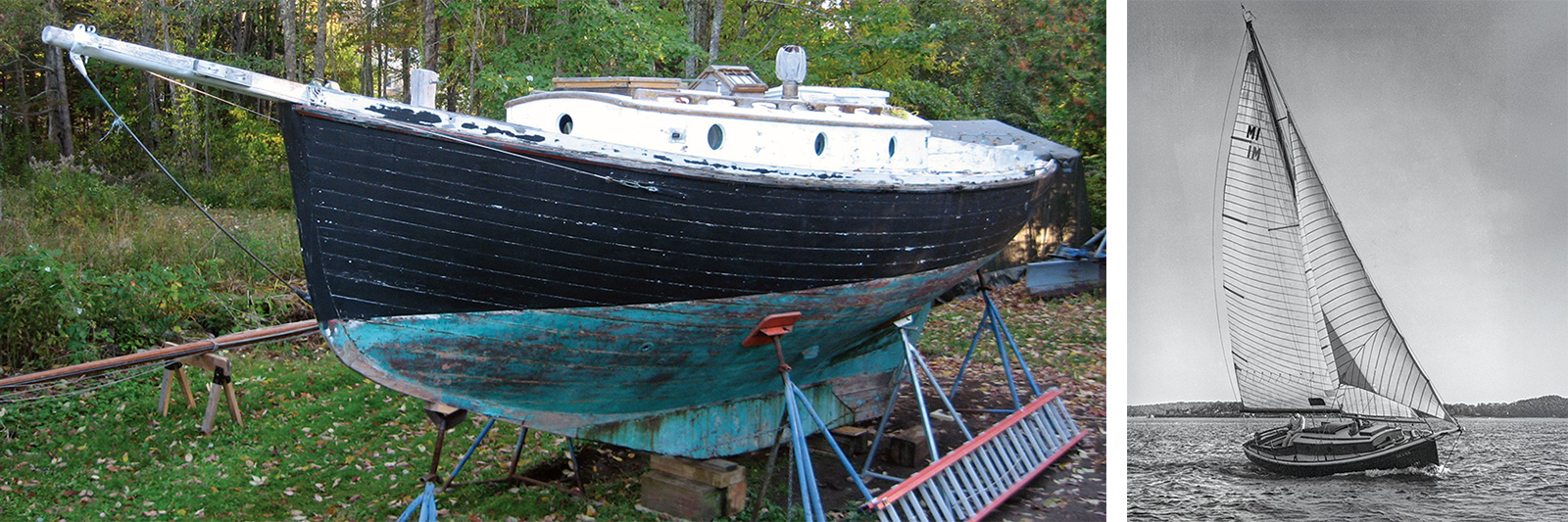
DAYBREAKCourtesy of Drew Scott (left) Mystic Seaport Museum/Richards, East Greenwich, RI (right)

Above left—DAYBREAK’s status is little changed from 2014, when this photograph was taken. The boat is now sheltered in a custom bow shed. Above right—The boat carries 386 sq ft of sail in her cutter rig.

Particulars

  • LOA:  27′
  • LWL:  23′6″
  • Beam:  8′2″
  • Draft:  4′9″
  • Sail area:  386 sq ft
  • Power:  18-hp Yanmar diesel
  • Official No.:  590503
  • Designed by:  Robert Townsend
  • Built by:  Franklin G. Post & Son Inc., Mystic, Connecticut, 1950

DAYBREAK is the ninth of the standardized cutters called Mystic Islanders built in Mystic, Connecticut, by Post & Son on speculation in the optimistic years following World War II. Back then, you could buy one fully outfitted, including sails for $6,700 and, at the builder’s urging, “Make the Post-war Era a Post-boat Era.”

Its design was a stretched and improved version of REALITY, which her designer, Robert Townsend, had owned and sailed extensively. Unfortunately, all I know of Townsend is that he lived in the same town as the builder and demonstrated great skill in conceiving and drafting the Mystic Islanders.

These are robust, short-ended sailing craft with generous freeboard. For their 27′ length, they were mighty roomy, with full headroom for occupants no taller than 5′9″ and configured for either three or four berths. As Post’s advertisements claimed, they look “Seagoin’” with their plumb bows, snug rigs, long and well-proportioned trunk cabins, footwell cockpits, outboard rudders, and low bulwarks.

DAYBREAK's interior.Maynard Bray

The interior, set up for four berths, is large for a 27′ hull, with reasonable headroom.

This version sleeps four on two settee berths in the main cabin and a V-berth for two more forward. The galley (complete with a woodstove) is amidships. The toilet is underneath the port V-berth, and a slim pipe supports the deck-stepped mast. The engine lies entirely under the self-bailing cockpit.

Mystic Islanders were well-built, with white-oak backbones and frames, cedar planking fastened with bronze screws, and plywood decks. But their 3,800-lb cast-iron ballast keels were attached to the hull with galvanized steel bolts, and that’s this boat’s Achilles’ heel. Her keelbolts need replacing, which can become a formidable project and has discouraged her recent owners from even attempting it. Renewing rusty keelbolts can be really tough or only plain tough, but it’s never easy. The good news, however, is that the rest of the boat looks good and appears perfectly usable, assuming that the checks in the oak deadwood close up when the timber swells.

So, with luck regarding the keelbolt replacements, cleaning and painting should get a new owner a usable boat. The engine and sails are nearly new, and she’s otherwise complete.

Mystic Seaport Museum is just upriver from DAYBREAK’s birthplace, so it’s not surprising that the museum has the builder’s archives in its collections. Copies of all the builder’s paperwork relating to this boat would be included in the sale. The slogan imprinted on the yard’s stationery, “Buy Health and Happiness with a Post Boat,” could apply just as much now as it did 75 years ago.

It’s been 25 years since DAYBREAK was afloat, but during her time ashore she’s been well sheltered. She’s now under a custom-built bow shed in Castine, Maine.  Article ends.


Maynard Bray is WoodenBoat’s technical editor.

To inspect DAYBREAK or obtain more information, contact owner Drew Scott at drew@hylanandbrown.com.