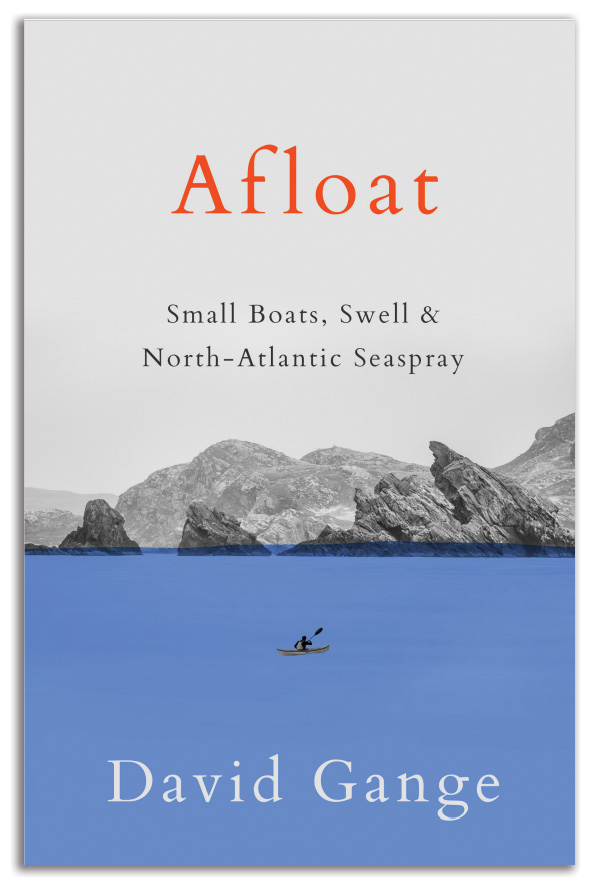
Afloat: Small Boats, Swell and Seaspray, by David Gange.
William Collins (An imprint of Harper Collins),
www.harpercollins.com. 304 pp., illus, $30.
For more than a century, the literature of small wooden boats has been continually enriched by book-length studies documenting shapes, construction details, and uses of specific local and indigenous watercraft. These tomes include Edwin Tappan Adney and Howard I. Chapelle’s Bark and Skin Boats of North America; George Dyson’s Baidarka; a series of books by Bernard and Christian Faeroyvik and, later, Arne Emil Christensen on Nordic watercraft; C.R.G. Worcester’s The Junks and Sampans of the Yangtze; and, more recently, Douglas Brooks’s studies of Japanese watercraft and Nova Scotia dories. And, of course, Chapelle’s American Small Sailing Craft is the seminal documentary study of historic American types, while John Gardner’s books on building classic small craft continued this effort, with an emphasis on guiding amateur construction. All of these works relied on field work and painstaking measurement to record ingenious but ephemeral small wooden boats.
David Gange’s new book, Afloat: Small Boats, Swell & North Atlantic Seaspray, offers something different: It is a lyrical and deeply human perspective on the role and lasting impact of overlooked small boats in several remote coastal communities—and, by inference, the role of small craft in all coastal communities. Gange writes of his subject boats: “Where decked, sailed vessels were often commercially owned … tiny undecked boats were possessed by individual families. This is part of the reason they evade historical attention. History books tell the tale of sail and steam. They tend to centre on ships that moved between big ports and towns. This makes it a surprise to some that, wherever we have statistics, small rowed and paddled boats vastly outnumber sailboats.”
All images from Afloat, by David GangeLeft—The local boat that author David Gange used to explore the Sapmi region. Right—A Bay punt in Newfoundland.
Gange’s original mission was to travel for 12 continuous months over the year 2020. Equipped with a small folding boat, he would visit eight communities ringing the North Atlantic basin, absorbing, through conversation and hands-on experience, the historical and ongoing significance of local boat types. His aim was not the precise documentation of watercraft, with measured drawings and tight technical description, but rather ethnography recorded through oral tradition. The Covid-19 pandemic, with its travel restrictions, altered that original plan; the project ultimately became a series of discrete trips between January 2022 and October 2024.
The places visited were: Connemara in Western Ireland; Scotland’s Isle of Lewis; the Sápmi region spanning the very northernmost portions of Norway, Sweden, Finland, and Russia; the Faroe Islands; Greenland; Newfoundland; Maine and Massachusetts; and Barbados. The resulting book is molded around cultural immersion, outings in local watercraft, and long, ambitious passages in Gange’s own boat.
“I don’t for a moment,” Gange writes, “believe in the assessments that inland writers, from the eighteenth century to the present, have made of these regions. Visitors from cities depicted them as backward, naturally prone to poverty and famine, and in need of outside intervention to ‘catch up’ and modernise.” He writes in his introductory chapter, “The Lives and Love of Little Boats,” that in fact “every place featured in this book experienced a revival of interest in its traditions since the 1970s.… Boatbuilding is now a feature of indigenous activism around the world, at a time when the resurgence of indigenous knowledge and practice is the most important intellectual movement of our era.” He goes on to describe festivals built around small boats in each of his topic destinations. Culture, indeed, is at the heart of this study, with just a brief interlude chapter describing the various boatbuilding methods encountered.
Everywhere around North America, he writes, it is poets more than historians or archaeologists who have reclaimed marginalized histories. Everywhere, understanding of the world of the maritime north means reconceptualizing voids as creative spaces and feeling our way to what might have been and what still could be. To this point, Gange recollects his visit to Mount Desert Island, Maine, and his encounter with the legacy of Ralph Stanley, the noted builder of lobsterboats and Friendship sloops. “Stanley’s,” he writes, “was the name that cropped up everywhere.” He then relays a widely held notion that the first boat Stanley built was a motorized lobsterboat. But this overlooked the fact that, as a 1940s-era schoolboy, he had built a 15′ rowing dory. “This tendency to forget the rowing boats was something I came across frequently: it was possible to find records of the sailboats a builder had made—the sloops and ketches—but it was only in conversation with local people that lists of the smaller, rowed boats poured forth.” The oral tradition, it seems, is alive and well in Downeast Maine.
Gange’s path after his visit to Mount Desert led him to WoodenBoat School, which shares its campus with this magazine. I didn’t meet him during his visit, but while here he did accurately absorb the magazine and school’s combined origin story under the hand of founder Jon Wilson. He recounts these in a glowingly flattering impression of the place that was not unlike mine after my first few days here. I am convinced that such surface-level views of a community, while lacking the nuance of true knowing, offer powerful glimpses of character that are often buried by the routines of decades of residency. (I’m reminded of friends in Washington, D.C., who never make time to visit the Smithsonian.)
After his visit to the WoodenBoat campus, Gange proceeded, over two days, to Belfast via Eggemoggin Reach and across the top of Penobscot Bay—an arduous journey under oar or paddle. “To the Penobscot Nation,” he writes, “these tidal headwaters are sacred. Fresh water gathered from vast swathes of forest flows into salt tides and brings burgeoning life from both directions.” The native bark canoes, he writes, “permitted an intensely mobile way of life within the river’s vast watershed.” Such canoes, he notes, were abundant when European explorers and fishermen first arrived on these shores. However, the secrecy and illiteracy of the Europeans masked the sophistication and location of the Penobscot Nation—and the vital role of small boats, once again.
The Bark and Skin Boats of North America—the Adney and Chapelle book—enjoys special mention. Gange calls it out as a seminal ethnographic work that gave rise to the concept of cultural reconnection through boats, as mentioned above. He also cites the sequel to that book, The Bark and Skin Boats of Northern Eurasia, calling it “fiercely ambitious,” and a work “that took in the canoe histories of every Arctic region from Scandinavia via Siberia to the Bering Strait: 10,000 kilometers of tundra and boreal forest that were once opened up to human access by technologies of birchbark and sealskin.” The text drives home the fact that, in the Arctic more even than elsewhere, distinctions between Europe, Asia, and the Americas make no sense: “The ceaseless traffic of little boats bound all the north’s cold-water worlds together long before Columbus,” he writes—a connection now eclipsed by political division, preserved only through oral tradition, and especially vibrant as it relates to small boats.
Gange notes a resonant methodology in the works of the English cartographer-historian-writer Tim Robinson, whose artistic efforts over the course of a half century brought the past to light in Connemara. Robinson, Gange writes, argued “that recovering the past of Connemara wasn’t compatible with the enlightenment idea of illuminating the past or constructing an authoritative narrative.” Instead, he said, his tales “mark some points of attachment of the historical web from which one can grope back along the strands into the darkness. The long memory of oral culture, which doesn’t work in narratives of cause and effect, and doesn’t always think with linear time, is where the meanings of the sea reside.” The small boats we experience in this book pierce the darkness. ![]()
Matthew P. Murphy is editor of WoodenBoat.
