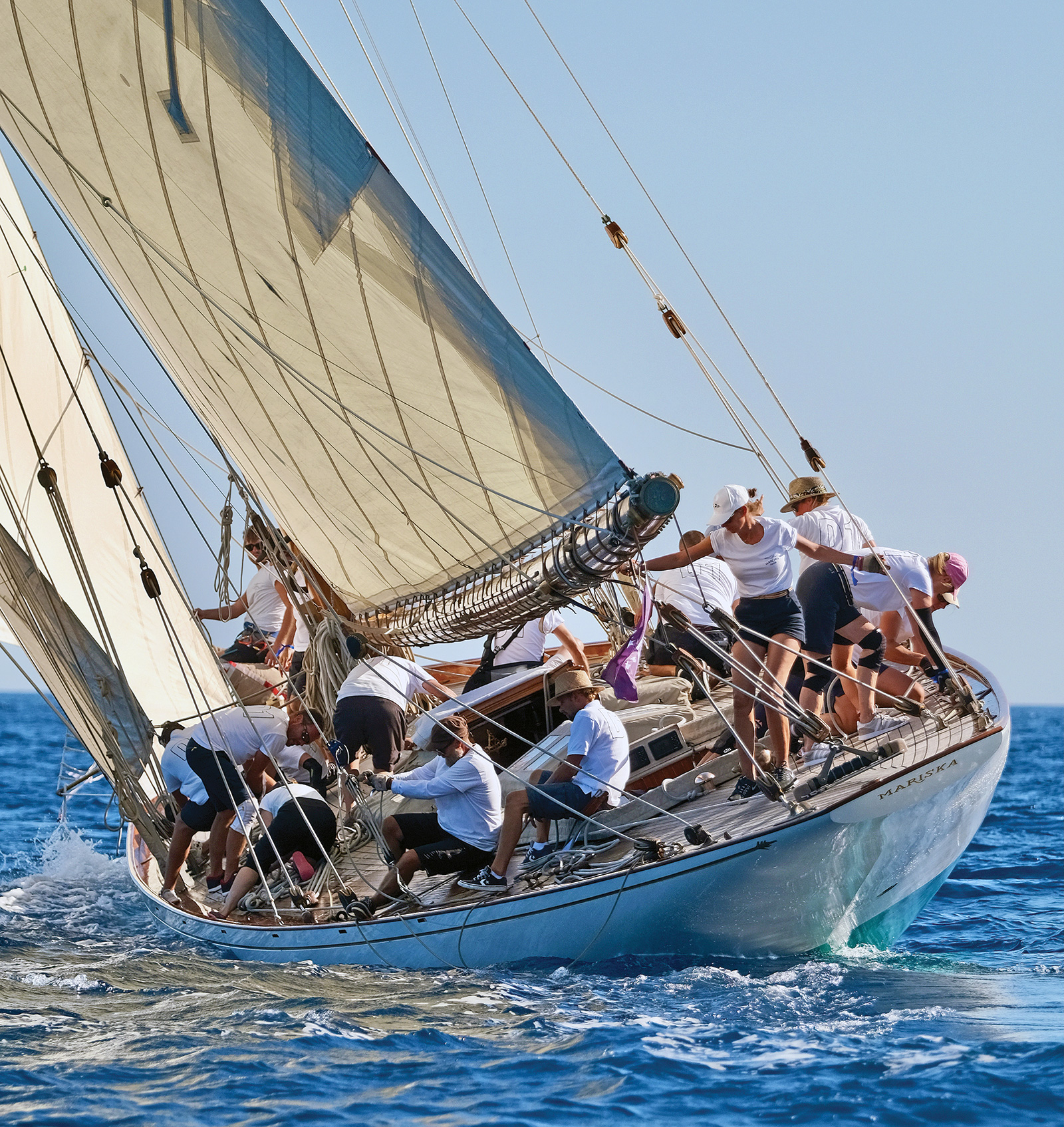
In ideal conditions at Régates Royales in Cannes, France, MARISKA’s crew handled sail the same way her original crew did after her launching in 1908 for the then-new 15-Meter class. Her original deck and rig configurations were restored in a project completed in 2007.
Particulars
- LOD: 77′
- LWL: 48′7″
- Beam: 13′7″
- Draft: 8′9″
- Displacement: 35 tons
- Sparred length: 90′5″
- Sail area (upwind): 3,767 sq ft
(downwind): 6,458 sq ft
MARISKA was built to race. Launched in 1908, she was designed by William Fife III for the then-new International Rule’s 15-Meter class, the second of the type that Fife designed and the first to be built at the William Fife & Son yard in Fairlie, Scotland. She was composite-built, meaning she had wooden planking over steel frames. In her initial three seasons, her first owner, Arthur K. Stothert, raced her no fewer than 133 times, often placing first or second.
MARISKA has reclaimed her competitive heritage in recent classic-yacht-racing events, where she is once again in her element. I joined her during a race in 20 knots of wind at Régates Royales in Cannes, France, where she is a regular competitor. As that afternoon’s sail came to an end, Manon Bajart, the yacht’s co-captain and caretaker, said, “That was a great afternoon!” I could not have agreed more.
As with any long-lived yacht, she has had her ups and downs. During World War I, only eight years after her launching, her keel was melted down to be used for ammunition. In 1923, a Swedish owner, Carl Matthiessen, vice president of the Royal Swedish Yacht Club, bought her and campaigned her intensively for 20 years. Later, Olle Grafström, a jazz musician and painter, bought her, and his restoration altered the original deck layout by replacing an original skylight with a sliding hatch, which brought in air and light and allowed the installation of a piano in the saloon. She sank twice in the early 2000s due to a lack of maintenance. Over the years, her rig was converted to a gaff yawl, next a marconi yawl, and then a Bermudan ketch before returning to her original gaff-cutter configuration in 2007.
The return of the original rig was part of a massive two-year restoration during which her Swiss owners decided to keep as much of the original fabric as possible. The as-launched deck layout was restored, with the mahogany interior rebuilt. In September 2009, MARISKA made her return to racing at Les Voiles de Saint-Tropez, and in following years she was a constant presence at all classic-yacht-racing events in the Mediterranean.
Her latest adventure began in 2020, when another change of ownership took her to Slovenia, where she underwent her latest refit and was reimagined for charters for the first time in her history. She participated in seven regattas in the 2023 Mediterranean season. Among her honors in 2024 was the Comité International de la Méditerranée Classic Yacht Trophy for her class, marking yet another milestone in her long life of sailing and racing.
On Deck
The skylight in the foreground admits light and air to the owners’ cabin; another skylight visible just abaft the mast is over the saloon. The companionway, too, has skylights to port over the galley and to starboard over the head.
Sheet Blocks
Rigging details aboard MARISKA are faithful to her original period of 15-Meter racing; a good example is this fiddle block for the jibsheet, which gives the trimmers multipart purchase in the absence of modern winches. “MARISKA 1908” is stamped on the bronze cover plates retaining the two sheave pins, and the block’s anti-chafe leather is neatly stitched in place in the traditional manner.
Hoisting the Mainsail
Raising the mainsail is an all-hands-on-deck experience. All sail-handling aboard MARISKA is done manually, and hoisting the 195-sq-meter (2,099-sq-ft) sail up the 19.8m (65′) Douglas-fir lower mast requires a lot of exertion.
The Saloon
Varnished mahogany woodwork and raised-panel construction accentuate the comfortable and accommodating main saloon. Mahogany predominates in the staterooms and the galley as well.
The Galley
The galley is situated on the port side, adjacent to the companionway. Brass hinges and handles complement the varnished mahogany woodwork. The refrigerator, at left, is neatly incorporated into the cupboards. The stove is small but sufficient. The entire space has ample light from the skylight alongside the companionway deckhouse.
A Suite for Owners
The interior restoration was inspired by Fife’s original plans. Here, the owners’ stateroom has two berths and a settee. Going forward from the cabin are a guest stateroom to starboard, the galley to port, the saloon spanning the width of the hull, and the crew’s quarters all the way forward.
A Well-Run Crew
“A great afternoon!” Capt. Bajart said after a thrilling day of racing at Régates Royales, with 20 knots of wind. Racing in such conditions with all-manual line handling and crews numbering between 20 and 22 calls for tight coordination and keeping a close eye on mainsail and topsail trim.
Classic Touches
At the end of the boom, a beautiful cast-bronze nameplate harks back to an age of refined racing for classic yachts such as MARISKA.
The Tiller
During a 2007–09 restoration, MARISKA’s rudder profile was altered to make her a little easier to steer, but she retains her original tiller steering. The wooden tiller remains a pure work of art and craftmanship, with leather details and ropework.
A Knife at Hand
A sailor always has a knife aboard in case of emergency, and on MARISKA a sharp rigger’s knife is kept in a leather sheath lashed to the tiller near the rudderstock fitting. Many of the crew carry their own knives for safety and practical reasons, but it is wise to have one in a known location, always at hand. The bronze rudderpost fitting is inscribed with the builder’s name and year of launching.
Race Mode
MARISKA was built for racing, and she did so very successfully; however, like all racing yachts, she was superseded by advances in technology. Her changing fate led to two sinkings in the early 2000s, but after restoration she returned to racing in 2009 on the burgeoning Mediterranean classic-yacht-racing circuit. At Régates Royales, she was once again in race mode. ![]()
Thomas Madsen, based in Sweden, is a photographer and writer with a passion for classic yachts.


