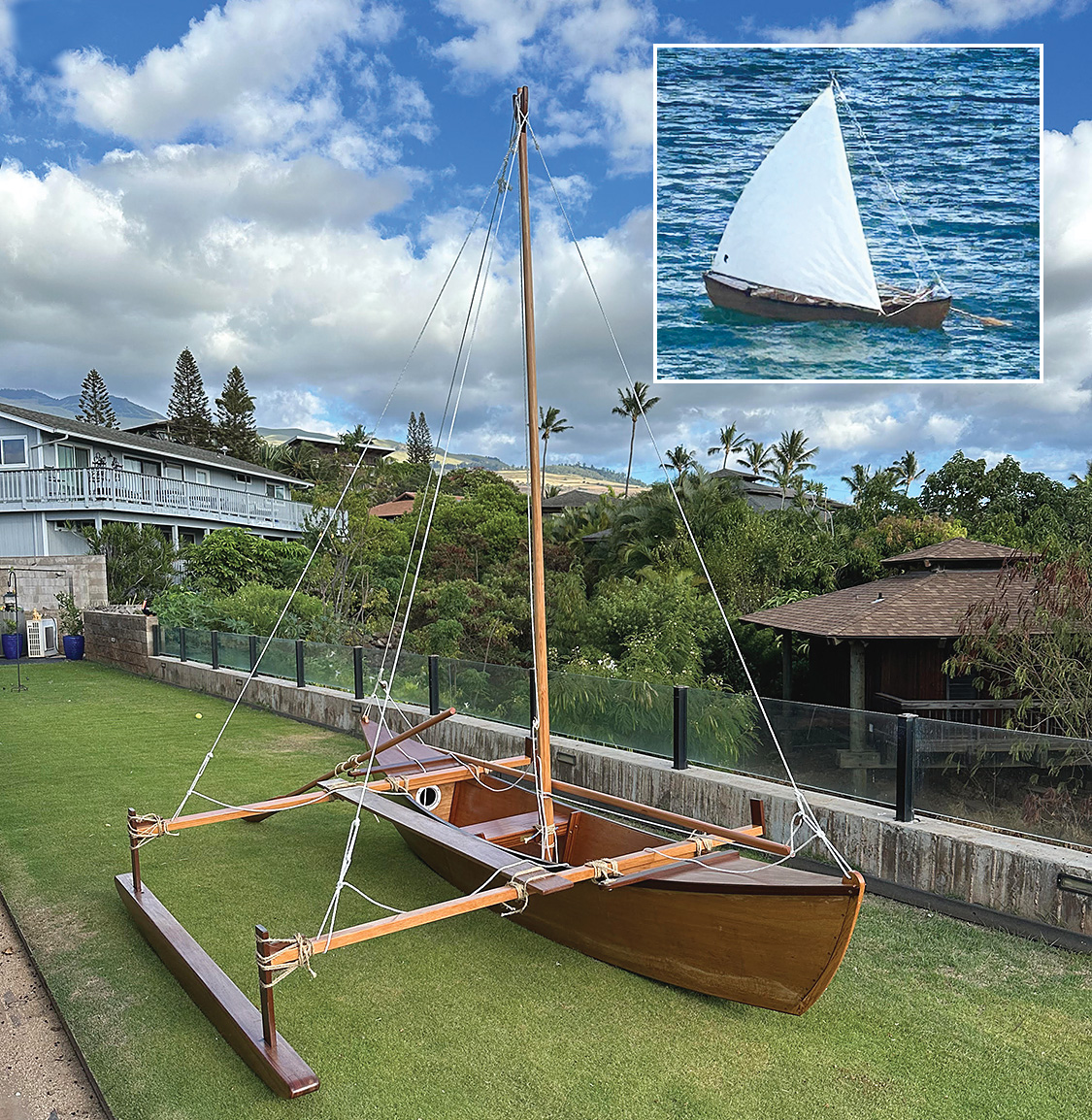
KUPUNA

KUPUNA

Photos by Andrew Kydd

KUPUNA was built in Hawaii by Andy Kydd at Kihei, Maui. The hull is 12′9″ LOA with a slender 2′ beam, and the outrigger gives her an overall span of approximately 8′. Built of marine plywood and sapele to Andrew’s own design, she was inspired by the outrigger sailing canoes of Gary Dierking. KUPUNA (which means ancestor) was launched without a rig in August 2022. In the summer of 2023, Andy designed and built the rig, which he describes as “shunting proa style—to come about you let go of the tack, which becomes the clew, and haul in on the clew to convert it to the tack.” Andy has had fun learning to work the rig and reports that the canoe sails well downwind and on a reach, but will not make headway to windward. He plans to make adjustments next spring and will be fitting a removable leeboard.
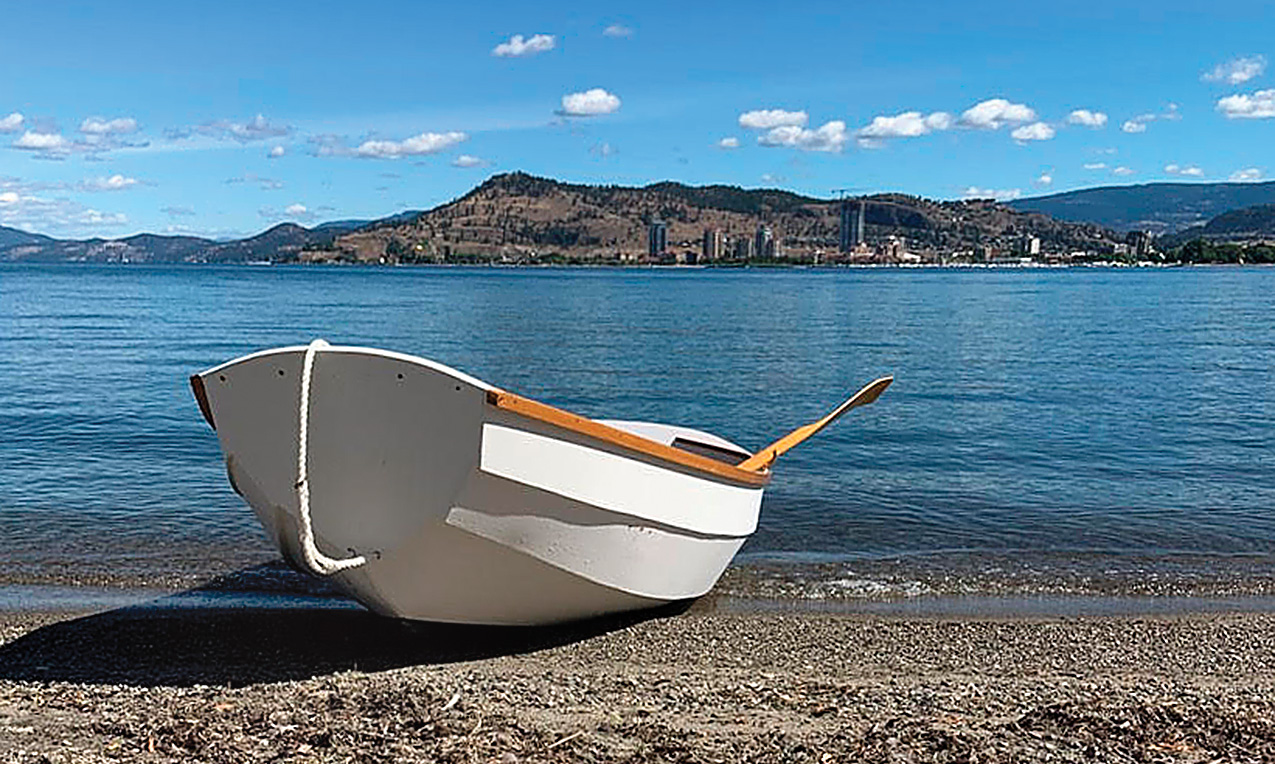

KITTY

KITTY

Photo by Bob Runnalls

Bob Runnalls of Kelowna, British Columbia, built his 9′6″ Nutshell pram, KITTY, during the Covid-19 pandemic. With no prior boatbuilding experience and “very little carpentry of any sort,” he found the construction challenging but was helped by the detailed Joel White plans. KITTY’s hull is ½″-thick marine-grade mahogany plywood on a laminated Douglas-fir ’midships frame and stem. The breasthook and quarter knees are ¾″ Douglas-fir. Since launching the boat on Okanagan Lake, Bob has been rowing KITTY and says she is “very stable even in rough waters.” He plans to build a sailing rig and has already made the daggerboard and its trunk.


JUNE BUG

JUNE BUG

Photo by Dean Keddy-Hector

Dean Keddy-Hector of Driftwood, Texas, launched JUNE BUG, a 16′10″ × 5′4″ Iain Oughtred–designed Tirrik, in June 2022. Dean used okoume plywood for the hull and a mix of solid wood elsewhere—mahogany for the stems, bald cypress for the floors, white oak for the mast partners and breasthooks, Osage orange (also known as Bois d’arc in Texas) for the knees, and Douglas-fir for the spars. She was named JUNE BUG, says Dean, both for the month of her launching and in honor of the many “hapless June bugs who (unfortunately) sacrificed their little lives while I was epoxy-coating the hull.” The Keddy-Hectors are using JUNE BUG on Canyon Lake between Austin and San Antonio, as well as on Lake Cascade in western Idaho.


STAR FERRY

STAR FERRY

Photo by Jim Cobbs

Jim Cobbs built STAR FERRY, a cedar-strip-planked Adirondack Guideboat from a Newfound Woodworks kit in his Greenwich, Connecticut, basement. No one believed Jim would get her up the stairs when the boat was finished, but to his relief he proved them wrong. Jim had used a guideboat for a few days at the Ausable Club in St. Huberts, New York, and was impressed by its performance. He thought the type would make a good boat for hauling people and beach gear from the town of Nantucket, out to Coatue on the northeast tip of the island. STAR FERRY is 16′2″ long with a beam of just 3′2″. She weighs 70 lbs, has a loaded displacement of 480 lbs, and a loaded draft of 5½″. She was finished in February 2023, launched in the spring, and will be homeported
on Nantucket.


SS LEECH

SS LEECH

Photos by Calvin Dame (above), Mary Diane Baker (below)

In July 2022, Calvin Dame of Brattleboro, Vermont, launched the SS LEECH, a Phil Bolger–designed Shoebox Punt. At just 5′6″ × 3′3″, the design appealed to Calvin as a good way to introduce his grandchildren “to the delights of boating—with ample flotation. It is as unsinkable as a Boston Whaler, but easily rowed, and is a hit with the three- and six-year-olds.”

SS LEECH (her name is a nod to the farm pond where she was launched), was built of two sheets of 6mm marine-grade meranti plywood with “simple dimensional lumber for the rest.” Calvin’s wife, Mary Diane Baker, decorated the hull. Everyone in the family likes to caution that SS LEECH is “not as fast as she looks.” She “cruises” on the Forest Echo Farm pond in Mount Holly, Vermont, as well as the West River and Retreat Meadows in Brattleboro.


KORU

KORU

Photos by Casey Wilkinson

KORU, a Didi 23 designed by Dudley Dix, was built by Casey Wilkinson of Bainbridge Island, Washington, as a display boat for his boatbuilding business and for personal use with his family. She is built of 9mm marine plywood with fiberglass sheathing and carries a fractional rig on a 29′ mast. At 23′ LOA with a beam of 8′1″, KORU has accommodations for four, but Casey says that with a lifting keel and minimum draft of just 20″ she is easy to trailer and can be launched from most ramps. KORU was launched in October 2022 and will be used for cruising and racing around Puget Sound.


Inspired by H.H. “Dynamite” Payson’s Cartopper.

Inspired by H.H. “Dynamite” Payson’s Cartopper.

Photo by Marty Elder

Inspired by H.H. “Dynamite” Payson’s 11′6″ Cartopper but wanting something larger, Marty Elder of Birmingham, Alabama, expanded the Cartopper’s dimensions by a third to produce a boat measuring 15′ LOA with a 5′ beam. For the stitch-and-glue hull, Marty used high-grade exterior plywood sheathed with fiberglass and epoxy on a premium-grade-pine frame. He installed a 6.5-hp Yanmar diesel engine; at 2,600 rpm, he says, it comfortably pushes the boat at 4.5 knots. Marty launched the boat in March 2023 on Lay Lake south of Birmingham and has been using her on the inland lakes of Alabama. He is planning a trip to the Choctawatchee Bay on the Gulf Coast.


VANNBJØRN

VANNBJØRN

Photos by Mia Bernacki

David Bernacki, a first-time builder from Clyo, Georgia, built this skin-on-frame David Gentry–designed Shenandoah Whitehall in January through March 2023. The frames were cut from okoume plywood, and the cedar for the stringers was sourced from a big-box lumber store. David used local cypress for the skeg, transom, and quarter knees, while the white-oak breasthook was fashioned from a piece of wood given to him by a co-worker, and the swamp-oak floorboards came from a tree that had been blown down on David’s property during Hurricane Matthew. The boat’s skin is 12-oz ballistic nylon, and the silicon-bronze fastenings were repurposed from David’s father-in-law’s Chris-Craft, which was being refastened. VANNBJØRN (Norwegian for water bear) is, says David, “amazingly light, fast, and tracks like a dream.” David will be using VANNBJØRN on the Savannah River and Clark’s Hill Lake near Augusta, Georgia.


JALLII

JALLII

Photo by Ken Baughman

Ken Baughman of Falmouth, Massachusetts, built JALLII, a 15′×6′8″ skiff, to his own design. The hull is based on a shortened version of the Tolman Alaskan Skiff (see WB Nos. 280–284), and the interior is Ken’s interpretation of the Chesapeake Light Craft Peeler. The stitch-and-glue hull is built of AC plywood with a layer of 4-oz fiberglass throughout. Ken says the boat has a “10′ workboat finish: it looks great from 10′ away,” and he has it set up for fly-fishing. JALLII was launched in April 2023, and Ken is using her in Woods Hole, Massachusetts, as well as on local lakes and ponds.


DREAMS WON’T WAIT

DREAMS WON’T WAIT

Photo by Heidi Drehobl

For some 25 years, Drew Fairaizi of Hampton, New Hampshire, had been planning to build a sailboat. Since his college days, he has taken shop classes in woodworking, metal casting, sculpting, fiberglass, painting, electrics, and electronics, and he also took a boatbuilding course at WoodenBoat School. Before buying a house on the coast of New Hampshire, he measured the garage to be sure it would be suitable for a boatbuilding shop.

Now, at last, his dreams have come true. Drew started building DREAMS WON’T WAIT, a Chesapeake Light Craft PocketShip, in November 2021 and launched her at Milton Three Ponds on the border of Maine and New Hampshire in May 2023. On the day of the launching, Drew says, the wind was gusting 24 knots and the 18′6″-LOA gaff sloop handled it well with a double-reefed mainsail.


JOANIE

JOANIE

Photos by Louise Green left), Andrew Green (right)

Over the winter of 2020–21, Andrew Green of Pewaukee, Wisconsin, built JOANIE, a Skunk Island Skiff designed by Kees Prins for the Wooden Boat Foundation in Port Townsend, Washington. She was launched in August 2022. A self-taught boatbuilder working in his basement shop, Andrew built the hull of ⅜″ marine plywood sheathed with 4-oz ’glass cloth and epoxy. He used clear pine for the chines, frames, gunwales, transom, and thwarts. The foredeck was constructed of cedar strips, while the centerboard and rudder are lead-ballasted western red cedar. JOANIE is 12′ LOA with a 4′ beam, and Andrew plans to sail her singlehanded or with his three grandchildren from his homeport of Pewaukee.


16′ flat-bottomed skiff

16′ Flat-bottomed Skiff

Photos by Chris Elliott

Chris Elliott’s father built this 16′ flat-bottomed skiff in 1984. He used it for fishing, but after he died, says Chris, it fell into disrepair. The boat had been stored upside down outside, and the caprail and sheerstrakes were in bad shape. Chris cut away the top 3″ of the sheerline, leaving the bow high to improve her profile. He found the frames and planking in reasonable shape but replaced the caprail with mahogany left over from his recent restoration of the 1952 Celebrity, PANSY (see Relaunchings, WB No. 292) and built a new transom of white cedar. The skiff was relaunched in April 2023 and will live at a dock in Queen Anne Creek in Edenton, North Carolina. There, Chris says, it will “resume backwater fishing duties for another generation.”


CLAN GORDON

CLAN GORDON

Photo by Mike Smylie

CLAN GORDON (at left) was built in 1911 in Ardrishaig, Scotland. At 38′ LOA she is typical of the hundreds of Lochfyne skiffs that fished for herring off the west coast of Scotland in the late 1800s and early 1900s. The skiffs, rigged with one standing lugsail and a jib, worked in pairs with ring nets (see WB No. 218). Little is known of CLAN GORDON’s early history, but she was still fishing well into the 1940s and ended her commercial life working for the Northern Lighthouse Board as tender to the Rona lighthouse. She was converted to a yacht on the east coast of Scotland in the 1960s.

CLAN GORDON was restored by Alasdair Grant and his crew at Isle Ewe Boats in Achnasheen, Scotland. The project, which lasted almost three years, included replacing the stem, sternpost, and keel; reframing in native oak; replanking in local Scottish larch; and a return to her original layout and lug rig. CLAN GORDON was relaunched in May 2023 at Achnasheen and will be used as a community benefit.


BUTTERCUP

BUTTERCUP

Photos by Charlie Flanagan, Inset: Bruce Mack

On Halloween 2021, Charlie Flanagan of Annapolis, Maryland, was visited by a friend carrying a long, shabby wooden pole on the roof rack of his car. When asked about it, the friend said, “This is part of your next boat project. If you want one.” It was the mast from Beetle Cat No. 1560, built by the Concordia Co. in 1973. Charlie accepted the challenge.

The boat had been stored upside down in a backyard and, on removing the floorboards, Charlie exposed a trash-can-load of squirrel droppings and a collection of rotten frames. He bought several new frames from the Beetle Cat Boat Co. in Wareham, Massachusetts, and bent many more on his own, reframing and refastening the boat from the stern to the maststep while preserving as much original wood as possible. Charlie also replaced the coamings, repaired the foredeck, recanvased the deck, repaired the floorboards, and fashioned a new half-round rubrail for the sheerline. After 10 months of weekend work, Charlie relaunched the boat in Annapolis in August 2022.

Soon after the launching, the boat was sailed by 91-year-old Doug Borden, who had raced Beetle Cats on Narragansett Bay in the 1940s. Doug’s son, Jeremy, gave Charlie the original bronze naming letters from his father’s Beetle Cat and, in her honor, Charlie’s restored Beetle Cat was painted yellow and christened BUTTERCUP. She sails on the South River in Annapolis.


These pages, along with the Boat Launchings section of www.­woodenboat.com, are dedicated to sharing recently launched wooden boats built or restored by our readers. If you’ve launched a boat within the past year, please email us at launchings@woodenboat.com, or write us at Launchings, WoodenBoat, P.O. Box 78, Brooklin, ME 04616.

Please include the following information:

  1. The boat’s length and beam;
  2. The name of its design class or type;
  3. The names of the designer, builder, owner, and photographer;
  4. Your mailing address along with an email address or phone number;
  5. The port or place of intended use;
  6. Date of launching; and
  7. A few sentences describing the construction or restoration. Send no more than five photographs (jpg images at 300 dpi) and enclose a SASE if you want anything returned.

Hints for taking good photos of your boat

  1. Set your camera for high-resolution images. We prefer jpg format, at 300 dpi minimum.
  2. Stow fenders and extraneous gear out of the camera’s view. Ensure the deck is clean and uncluttered.
  3. Take your photographs in mid-angle sunlight for best results. Mid-morning or mid-afternoon usually work well.
  4. Keep the horizon level and the background simple and scenic so your boat stands out from its surroundings.
  5. Take some pictures of the boat underway and some at rest. Often a vertical format works well for sailboats. Shoot a lot of images, then send us your five favorites.

We enjoy learning of your work—it affirms the vitality of the wooden boat community. We receive so many submissions that there is not room in the magazine for all of them to be published. Launchings not printed in the magazine can be seen at www.woodenboat.com/boat-launchings. Article ends.