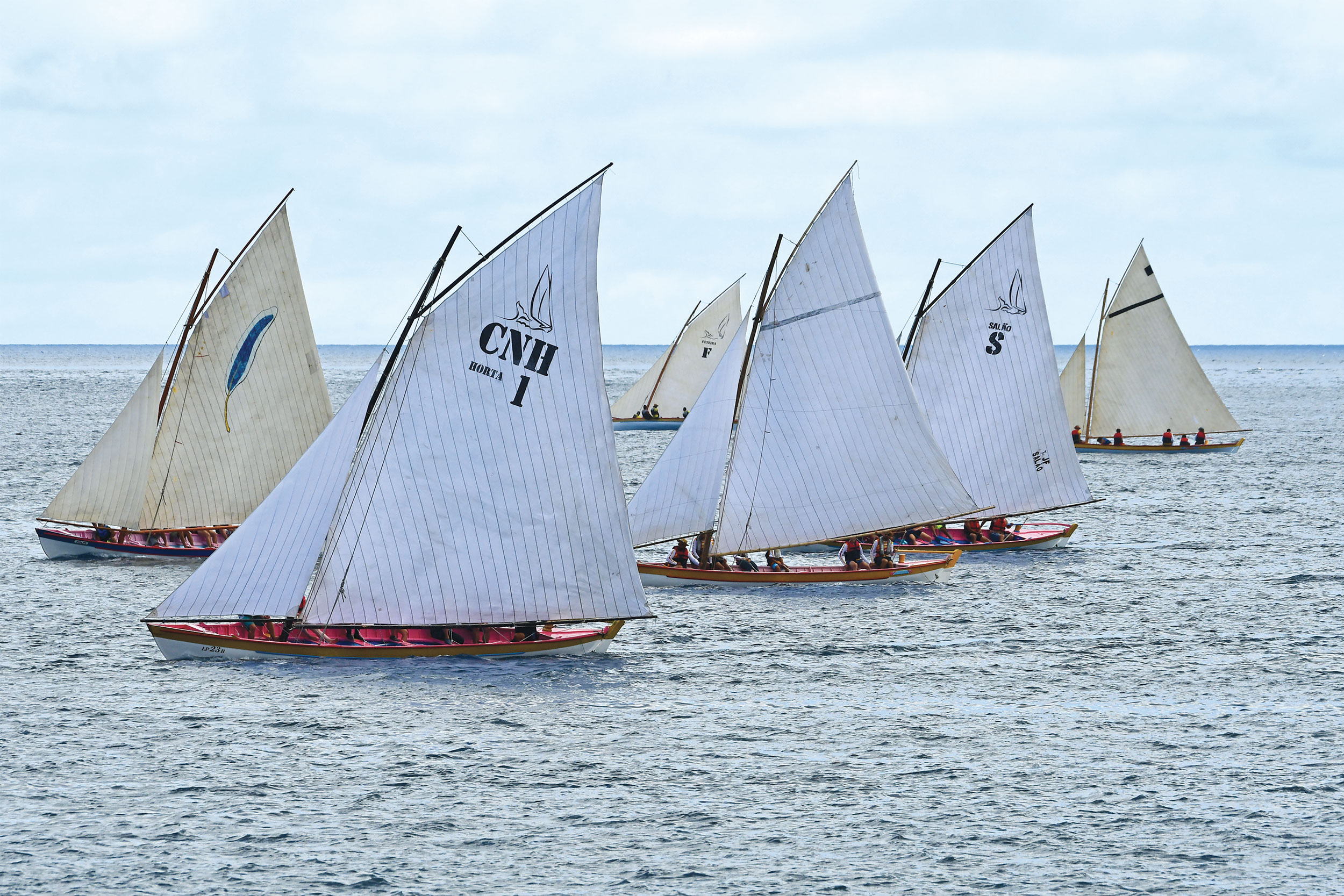
JOSÉ MACEDOAzorean whaleboats celebrate the maritime heritage of the Portuguese islands, and racing under sail or oars is common during events such as Sea Week 2025, which was held August 9 in Horta, Faial Island.
The scene was still common in the very early 20th century: 1905 photographs show the MORNING STAR, a brig employed as a whaler, docked at New Bedford, Massachusetts, after two years at sea. Its small fleet of double-ended whaleboats, normally on deck or slung from davits along the ship’s sides, were brought dockside and tied together, presumably for maintenance after hard use at sea. Barrels of whale oil, still valuable as a high-quality lubricant despite competition from land-based petroleum, were lowered to the pier to await transport to a refiner nearby. Tourists visited the ship; some bought scrimshaw and other souvenirs from the Portuguese crew; others snapped pictures with their Kodak box cameras.
A century and a quarter later, the faded pictures give us a glimpse of various technologies—sailing a square-rigged ship to pursue whales on distant seas, building wooden whaleboats, and manning these boats at sea in one of the world’s most dangerous fisheries—that made 19th- and early-20th-century whaling profitable enough to persist until the whales were nearly gone.
Author's CollectionAmerican whaleships, and the boats they carried, were common in the Azores. Many of them came from New Bedford, Massachusetts, where the author’s grandfather took this photograph in the early 20th century. The American type inspired Azorean boatbuilders.
This traditional whale fishery and its associated technologies died out around much of the world during the 20th century as more efficient methods—fossil-fuel-driven steam power, exploding harpoons, and the like—made it possible to kill more whales in less time with less risk to the humans who sought them, all while the demand for whale oil decreased.
An exception was the Azores, the Portuguese archipelago in the eastern North Atlantic whose surrounding waters were home to the sperm whales long favored by the New Bedford ships. As the rest of the whaling world was mechanizing in the 20th century, communities in the Azores continued whaling the old way, from small boats like those tied alongside the MORNING STAR and other sailing vessels at the New Bedford docks in 1905.
Azorean Maritime Heritage SocietyThe Azores’ connection with New Bedford’s Azorean-American community continues, and one way of celebrating the heritage is through rowing races, here with an all-female crew. The International Azorean Whaleboat Regatta is held every two years, alternating between the American port and the Azores.
It doesn’t take much imagination to understand the enormous risks inherent in this sort of fishery: walking bow-to-stern along the length of one of the Azores-style whaleboats in the New Bedford Whaling Museum, you’ll pass iron-tipped harpoons too heavy to throw more than a few feet from a lurching station where a harpooneer would brace himself while lunging in the direction of a huge whale’s back. Then, the first of several tubs containing hundreds of feet of coiled line that, once the whale was “on,” would whip out in pursuit of the attached harpoon. That line could snag anything or anyone in the way: all the gear, arms, legs, seats, and oars of half-a-dozen men at rowing stations along this 40′ boat’s length. Next comes another tub or two of coiled and rapidly unwinding harpoon line. Protruding from the short afterdeck is the loggerhead, a sturdy post around which two wraps of harpoon line passed, sometimes at a speed that could cause the rope and post to catch fire. Aft of the loggerhead is the oarlock for the stern sweep, which was continually manned by the boat’s skipper—Azorean whalemen, unlike some of their American counterparts in similar boats, didn’t change places once the harpoon was set. Two pieces of emergency gear are close by. The first is a sharp axe, used to cut the line during the “Nantucket sleigh ride” as the enraged whale tore ahead with the risk of sounding, which could tow the boat and its crew under. And next to the loggerhead is a bucket used for pouring water over an overheated line and loggerhead.
David PlattAfter BELA VISTA, João Tavares has continued building whaleboats in the Azores both for use and for museum exhibition.
If ever a small boat needed to be sturdily built and designed for its purpose and manned by the right crew, this was it. Whaling of this sort was thought up by Europeans, notably Basque whalers, and later the method was adopted, and perfected, by Americans from New England who brought the innovation of launching double-ended boats from ships to catch whales and bring them back to ship for rendering. The older technology of shore-based whaling persisted in the Azores for decades after the New Englanders departed. Lookouts ashore kept watch, and boats in sheds were ready for launching if prey was sighted. No longer needing to fit on a ship’s deck or between its davits, the Azorean whaleboats grew longer. Crews became adept at launching from shore and often set sail to reach the passing whales. Once powerboats became available early in the 20th century, whaleboats could even be towed part of the way out.
Benjamin MendlowitzJoão Tavares’s construction of BELA VISTA with two American apprentices in 1999 helped rekindle whaleboat appreciation. The boat now sails in New Bedford under the auspices of the Azorean Maritime Heritage Society.
Azorean whalers killed their last whale in 1986, after Portugal—by then a member of the European Union—joined most of the world in protecting whales, some species of which were extinct or nearing extinction. But interest in the Azores’ traditional fishery, including keeping alive some of its traditions and skills, never quite disappeared.
One idea aimed at preserving elements of the Azorean whaling tradition was to document the construction of a traditional whaleboat while memories of the type survived. In 1999, Bruce Halabisky, a writer, boatbuilder, and educator approached the Azorean boatbuilder João Tavares about apprenticing with him on a whaleboat construction on Faial, one of the Azores’ westernmost islands. Halabisky and another apprentice, Adam Stone, traveled from Maine to work with Tavares to build a new 40′ whaleboat, BELA VISTA. Halabisky wrote about the project for WoodenBoat (see WB No. 146) and worked with the experiential educator Lance Lee to publish Twice Round the Loggerhead: The Culture of Whaling in the Azores (Mystic Seaport Museum, 1999).
Pedro SilvaRowing and sailing regattas have proliferated since 2000, with competitions off Pico, São Jorge, Faial, and São Miguel islands celebrating the whaleboats’ heritage. Here, boats gather for an early 2010s regatta at Calheta de Nesquim on the south coast of Pico.
The job took months, and after the resulting boat was launched, rowed, and sailed off Horta, the largest city on Faial, the project’s American sponsor had her shipped to the United States. BELA VISTA and other traditional whaleboats built since then have been rowed and sailed under the auspices of the New Bedford Whaling Museum and the local Azorean community.
Pedro SilvaRowing competitions such as this one during Semana dos Baleeiros 2023 at Lajes do Pico are especially hard-fought matches among teams from numerous clubs, with divisions for men and women alike.
An Azorean whaleboat, Halabisky learned, is a creature of several traditions, stemming originally from the double-ended boats carried worldwide aboard whalers from New Bedford, Nantucket, and other American ports during the 19th century. Azorean boats tend to be longer than their ship-based forebears, but they are otherwise familiar in their details: hull shapes developed from half models; timbers sawn from local trees for keel and stems; light pine planking with battened seams fitted over temporary molds (though lacking the lapstrake upper two planks typical of the American-built whaleboats); sawn frames sourced locally to shapes taken by bending copper rods to the curves of hull; copper rivets fastening the planking to the frames; interior ceiling; and finally seats for six or seven rowers. Their fittings included the maststep and hinged partners, notched thwarts for the helmsman and harpooneer, a loggerhead aft to control the running harpoon line, racks for harpoons, tubs for line, and the like. A colorful paint job would make the boat visible and identifiable in the hazardous conditions its crew could expect to encounter offshore.
David PlattSeveral islands have museums devoted to whaling. The Museu dos Baleeiros on the island of Pico includes a Tavares-built whaleboat left partially unplanked on one side to show structural details.
The first of these adapted copies of American boats was built, probably on Faial, in the 1890s. Several dozen more would be built on various islands in the Azores through the 1940s. (One of the New Bedford Whaling Museum’s exhibited boats was built in the United States, shipped to the Azores for use there, then shipped back.) By the time Halabisky and Stone arrived in Horta in the late 1990s, none had been built for half a century.
Tradition can be important in an island community. Memories can be long, particularly recollections of an occupation as unusual, exciting, skilled, and profitable as pursuing huge whales in small boats. What had begun with the arrival of the New Bedford whalers in the 1850s gradually became part of the islands’ own culture. Boat design and construction, along with specialized seamanship skills needed to survive in this unusual fishery, flourished and evolved as the fishery’s needs changed over the years. Today, the whales that frequent the Azores’ waters are no longer hunted for their oil, ivory, bones, or other parts that once became lubricants, fertilizer, food, and other products.
David PlattThe same museum has a historic boat completely outfitted as it would have been for whaling, which ceased in the Azores in the 1980s.
Interest in these animals and the one-time fishery persists. Since the construction of BELA VISTA in the 1990s, at least 30 more traditional whaleboats have been built in the Azores. Today, men and women row and race them as participants in island clubs. The boats are an integral part of an effort to pass along the skills that once brought men racing down steps to launch their boats and set off under oars in pursuit of whales spotted from a tower ashore.
Museums on various Azorean islands reflect this enthusiasm. Pico alone has 36 historic sites, some restored and open to the public, that are connected to the island’s whaling history. There are lookout towers, boathouses, and factories, many complete with interpretive signs in English as well as Portuguese to educate visitors about the intricacies of shore-based whaling as it was practiced here for 180 years. On Faial, an entire factory where whole whales were reduced to oil and other products serves as an interpretive center. Peter’s, a Horta waterfront café frequented by transatlantic sailors, houses a scrimshaw museum. Several museums exhibit whole whaleboats and their gear, including one Tavares-built boat in Lajes on Pico left unfinished to reveal construction details.
A great way to begin appreciating these whaleboats and the Azores’ peculiar fishery is to go to the movies. Not the 1956 Moby Dick film with Gregory Peck, perhaps, but any of the other films screened by various museums in the Azores or New Bedford. The short film shown at the start of a museum tour on Faial, for example, begins with footage of a whale-spotter in one of the island’s stone towers.
“The whole process of the Azorean coastal whaling starts in the lookout,” the visitor learns from a helpful English sign introducing things. “In these little huts, spotters scanned the ocean surface from the shoreline all the way to the horizon, searching for the characteristic spouts or other signs of whales. When they spotted a whale, a firework was immediately launched alerting the sailors in the nearby town to lower their boats and prepare for the hunt.”
Pedro SilvaTop left—The most recent whaleboat built in the Azores was commissioned by Filipe Fernandes (seated), who worked on the project with boatbuilder João Tavares (standing). Top right—In 1999, BELA VISTA was the first whaleboat launched in half a century. Since then, about 30 have been built, most of them by Tavares in his boatshop on Pico. Bottom left—The boats retain authenticity, including the heavy chock and roller forward through which the long line was paid out after a whale was harpooned. Bottom right—Fernandes’s NOSSA SENHORA DE FATIMA (Our Lady of Fatima) was launched August 5, 2025.
By this time, presumably on the edge of their seats, viewers in the museum are treated to scenes, likely re-enacted for the cameras, of men dropping their shoreside occupations and running down streets and stairways to boathouses along shore. One man leaps out of a barbershop chair, is face covered with shaving cream. Meanwhile, others have pulled boats out of their sheds and have begun heaving them toward shore.
Such films form a central part of the exhibits on Pico, where whaling was important starting in about 1890 as New Bedford whalers bypassed the islands to venture to other parts of the world and a vineyard blight decimated the local wine industry. Whaling continued until the 1980s. Whether on Faial or Pico, the cinematic formula is about the same: after the opening scenes, actual footage shows whales being harpooned from whaleboats just like those being built on the Azores today. In the museum films, the whalers row, sail, or are towed out to hunt their quarry and tow their catch back to a processing plant ashore. A couple of the films then focus on flensing, or cutting blubber into strips to be boiled down for their oil. The Faial movie includes informative footage on other aspects of sperm-whale processing, such as getting oil out of the “cask” or head chamber where the most valuable lubricant is concentrated.
Even better than the movies is the actual construction. My weeklong visit to four of the Azores’ nine islands in May 2025 coincided with the final stages of Tavares’s construction of yet another new whaleboat. Three decades after building BELA VISTA with Halabisky and Stone, he is considered a legendary craftsman. The new boat nearly filled Tavares’s roomy shop in Ribeiras, a village on the island of Pico, which for 90 years was a center of shore-based whaling. The boat was being built for Filipe Fernandes, a Pico resident who in addition to a career as a government economist has been active for most of his life in the movement to preserve, row, and sail whaleboats and to celebrate them and teach others about their heritage.
“Pico is an island where watersports are not generally popular,” Fernandes explained in an email after our visit to Tavares’s shop. “Possibly a heavy past where lives were lost at sea and dramatic goodbyes to family members migrating and whose date of return, if ever, was uncertain, may have contributed to a perception that the sea is not a place to play, but rather a place for more serious affairs. However, the whaleboat is far more than just a boat: it is a living symbol of the islands’ heritage, resilience, and a tool where brave men risked their lives. For [the] demanding task of whale hunting, these boats are not seen as toys and are really a part of the community itself.
Pedro SilvaA resurgence that no one would have predicted 30 years ago has assured that whaleboats will not soon disappear from the Azores. This boat is MARIA ARMANDA, which in 1987 caught the last whale to be hunted off the islands’ shores. Seen here off Lajes do Pico during the first “whaleboat summit” in 2023, she was reconstructed in the early 2000s but still retains some material from the whaling era.
“The whaling saga,” Fernandes said, “touched the population in such a way that the stories and fascinations passed down generation after generation, making them an incredible exception to an otherwise relative disinterest in rowing and sailing on its own. Whaleboats in Pico are not for an elite, they are the nautical expression of the community as a whole, crewed by even the most unlikely people.”
A modern-day Azorean whaleboat is built from various hardwoods and softwoods, some local, some imported. Yellow acacia is used for stems, frames, cleats, and the “clumsy cleat” against which the harpooneer braced his thigh for the harpoon strike. The keel, thwarts, ceiling, and rails are of pine. The hull planking is of casquina vermelha, a relative of redwood, and 6,000 copper rivets fasten them to the frames. The loggerhead is of “cedro,” or cedar. The fittings are of bronze or stainless steel. Tavares uses modern techniques, and his tools include a bandsaw, power sanders, and drills; he uses epoxies where appropriate, for example in laminating knees when grown crooks aren’t available.
The whaleboats that Tavares and others build today, like their forebears going back to shipboard boats from New Bedford or Nantucket, are adaptations of earlier boats. Where New Bedford boats were usually 28′ to 30′ long, Azorean boats, free from the constraints of being hauled aboard ships, were larger; today, all are about 40′ long. For the most part, they are not museum pieces or reproductions; within certain rules they reflect the changing needs of their builders and users. Instead of remaining afloat, modern boats are carried or dragged to shore from boathouses, so they are built more lightly than their predecessors to save weight. Beam and freeboard are proportional to their greater length. They typically have crews of seven. The centerboards that were a feature of earlier boats that sailed out from shore disappeared once the boats could be towed by powerboats. “American boats were more straight-sided,” Fernandes said. Azorean boats have lighter gunwales than their American counterparts; modern-day boats built in the Azorean style on both sides of the Atlantic tend to use carvel planking instead of batten-seam more often than used to be the case. The sails are traditionally of canvas, but the use of Dacron is under consideration.
Tavares is known for building boats that are fast under oars or sail. That’s important these days in the Azores, where whaleboat club racing has given these adaptations of traditional boats a new life. “Races have happened as far back as 1891, but only occasionally and exclusively with whalers,” Fernandes said. Non-whalers began participating in the 1960s. In the 1990s, with growing public interest, the regional government began purchasing whaleboats and towboats and granted them to clubs and institutions, “at which point every island ended up with functional boats.”
A new life for the whaleboats had begun.
Today, rowing championships involve men and women—“Women started rowing in 1992,” Fernandes said. Pico Island also has a sailing championship and an annual Mastery Race involving launching, rowing, and sailing. “Regattas are held nearly every weekend from late June to end of August and take place at every harbor where there are whaleboats,” Fernandes said. Fernandes himself has been a member of Clube Náutico das Lajes do Pico since 2002. The boat that Tavares built for him will be his alone, which is somewhat unusual, but Fernandes is thinking of it as a teaching tool.
“I am [building] my boat so that I can share the incredible experience of sailing it,” he said. “One other thing I might do with my boat is training, and actually I already have a group from the United States who will be coming next April for an immersive week in and around whaleboats and their culture.” The boat, named NOSSA SENHOA DE FÁTIMA, was launched in spring 2025.
David Sayres, the author of Bradt Azores, a well-regarded guidebook, sums up these boats’ reputation with only a slight reservation: “perhaps one of the most perfectly evolved vessels on the seas.” ![]()

David D. Platt, formerly the editor of Working Waterfront, published by the Island Institute of Rockland, Maine, is an occasional contributor to WoodenBoat.