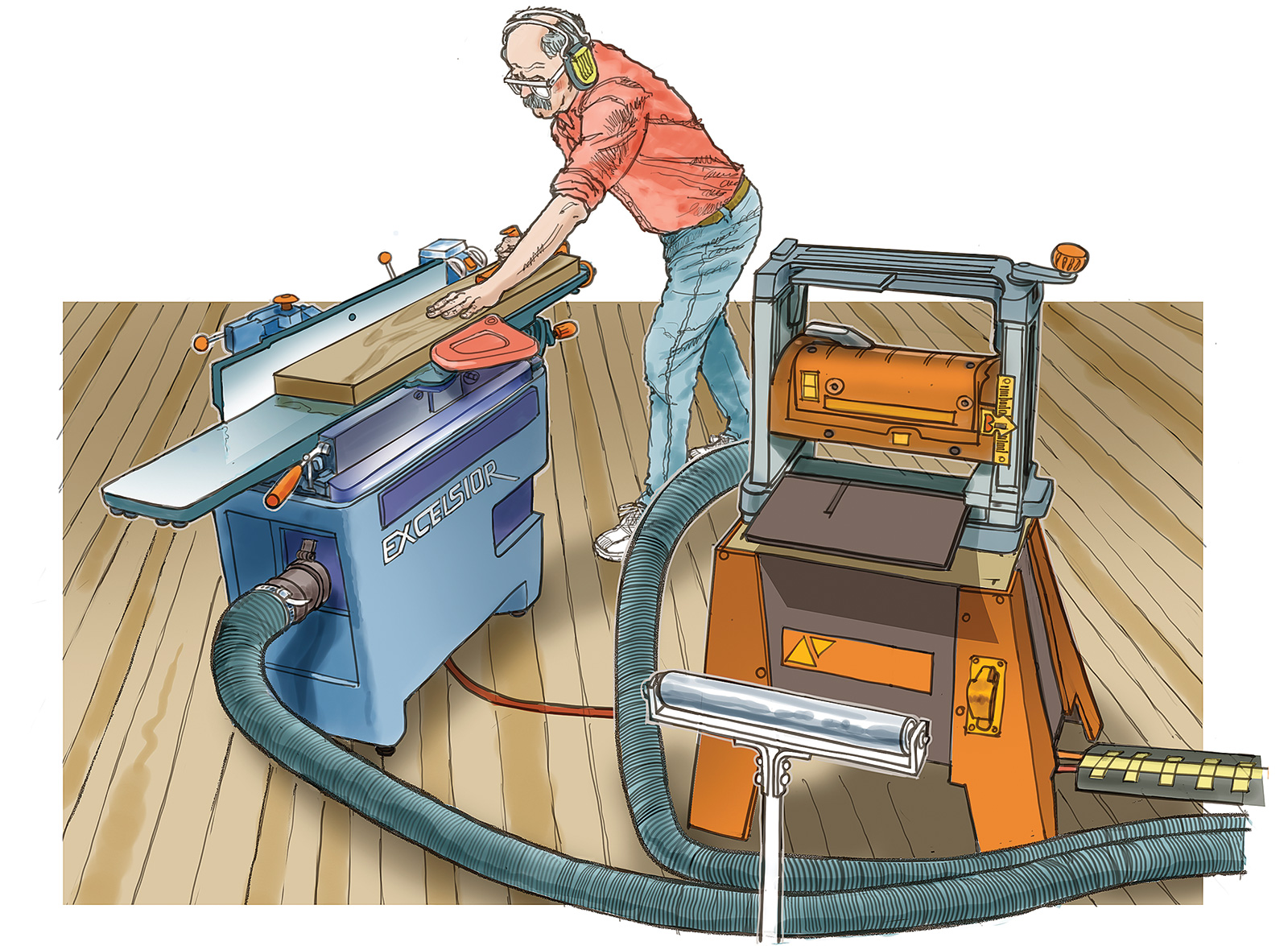
The jointer and the planer are powerful tools that turn rough, approximately dimensioned wood from the sawmill into finely tuned stock, ready to become components of a boat. There are some similarities between the two machines. Both have spinning cutters that shave wood surfaces, but they’re not the same machine in different boxes. This is a superficial illusion. Their cutters are no more redundant than a ripsaw and a crosscut saw: they achieve different results. Though their work can overlap in some ways, and occasionally they can substitute for one another, they’re partners in precision.
Both tools are technical marvels that replace hours and days of fantastically accurate hand skills of riving, adzing, chiseling, and—think mountains of shavings!—planing. Be grateful. The jointer straightens the edge of a board or flattens its face. When dressing a board’s edge, it matches the spinning cutter with a precisely angled fence—typically 90 degrees, but not always—to create a precisely milled edge. The planer, on the other hand, is a thicknessing tool designed to dress a plane parallel to its mate on the other side of the board, and bring the board to a desired thickness.
These are prodigiously dangerous machines that maim the careless worker. Recall our tablesaw precautions in the previous issue: keep your fingers out of harm’s way and use a thoughtful set of commercial and shop-made pushers, not a convenient stick or two. Also, these beasts are louder than the tablesaw and can damage what hearing you have left after the rock concerts of your teens; always use ear protection. Flying chips hurt your eyes; wear safety goggles or clear face shields. Wood dust can be toxic and fine airborne particles are always unkind to your lungs: use masks or respirators.
CUTTERS
Many jointers and planers use familiar straight blades of hardened alloys, sharpened to extraordinary edges and painstakingly aligned along a horizontal base angle so that each pass of a blade repeats exactly the blades that follow it. Sharpening and aligning these blades is an arcane mystery too complex to detail here; do your homework and use the proper tools to accomplish the work. Some newer and pricier cutters are spiral-set so that many small cutters overlap in the rotation to carve a flat surface. The individual cutters are square and have the advantage of being repositioned 90 degrees to expose a fresh cutting edge, rather than sharpened if an edge dulls or is damaged; this offers four times the cutting life of a blade.
JOINTER
The jointer’s cutter works below the stock. The infeed table may be adjusted to take a deep or shallow cut. Always work in multiple shallow passes, and do not hurry the action. The importance of stock moving through the jointer is that one reference face is riding closely against the fence, usually at a right angle but occasionally it can be set at a desired angle other than 90 degrees. The stock is held against the fence and pushed through to the outfeed table using pushers, not hands.
PLANER
The planer’s cutter acts from above, shaving a parallel plane to the reference plane on the planer’s bed. It can be adjusted to take a shallow or deep cut; like the jointer, several shallow cuts are preferable to deep cuts, and cleaner. The planer’s stock is usually moved through the operation by powered rollers adjacent to the cutter; some planers have two gear speeds for the stock feed. Both the jointer and the planer have ducts for a dust and chip extraction. Recall, from your experience with hand planes, that grain orientation matters; for smooth faces, both jointer and planer should not be cutting into grain that will cause the cutter to lift and tear the grain.
Basic Parts of the Jointer and Planer
MAKE A GOOD START
Using the jointer to produce a faired length of stock at exact right angles—or at desired angles—begins by mating the reference face of the stock snugly to the jointer fence. That reference face is the basis for all angles and it must be true—a flat surface throughout. This is almost always a broad-faced plane; a narrow-edged plane has too small a bearing surface upon the fence to keep consistent orientation. For small cross-sectional stock, the tablesaw will maintain the angles better than the jointer. Normally you will use the board’s face reference plane to produce precisely angled edges, taking down the stock width to the desired dimension. Then the planer, acting parallel to the reference face, will shave the stock down to proper thickness.
SURFACE CARE
Anything that hinders or misaligns the straight course of stock through jointer or planer will affect accuracy. The beds of the machines are ground flat and polished. Brush and wipe dirt and chips from the surfaces. Patches of rust, resin, dirt, or corrosion can affect the tool’s operation. Be a prudent steward of your tools: scour even minor discoloration away with steel wool and prevent recurrence by using a rust inhibitor on the bed surfaces. There are good commercial products to keep your tools rust-free, but you should avoid silicone-based ones, which will cause “fish eyes” in varnish or paint.
Occasionally wood is still too lively. Long after the sawyer’s big blade has cut the tree’s trunk, your bit of timber may have internal stresses that respond to ambient conditions in ways that can be inconvenient for precise work. Nearly every balk of timber displays its own wild character to some degree. Luckily, the jointer and planer—and occasionally their cousin the tablesaw—can restore truth to your wood’s dimensions. These are troublesome adjustments because the horizontal angles of the timber (green squares, below left) and vertical angles (green right angles) may register as correct according to a try-square or carpenter’s square. Timber aberrations can be broadly categorized:
Bow is a curve from end to end, lifting the long axis of the face grain. You want stock that lies flat on all four sides. A few separate, gradual jointer passes to the ends of your stock with the concave side down will flatten the surface along the length of the stock, giving you a base reference plane that will carry it through the planer’s bed faithfully, allowing you to reduce the thickness of your stock to desired dimension.
Cup is a side-to-side lift across the short axis of the face grain. Once again, work the stock with its concave side down, using the jointer to flatten the lower reference plane until it is completely milled so it will mate the planer’s bed for a faithfully parallel top and bottom plane at the desired thickness.
Crook is a horizontal curve of the long axis. You might strike a line along the convex side of the curve and use a bandsaw to create a reference length that the jointer can dress into a reference plane. If the crooked stock has a flat plane, you might also apply the jointer to the concave ends in a few passes, lengthening the milled ends until they meet in a complete reference plane.
Twist is a radial turn across the long axis and will require individual attention to both ends, flipping the stock and milling a lengthening reference plane, end to end, until you achieve a consistent reference plane.
Inequity in thickness from side to side might be cured with the planer if the stock is wide enough to firmly establish the reference plane on the planer’s bed; multiple passes will broaden the milled width until the board’s top is completely flat and parallel to the opposite face. A tablesaw can also fix this by ripping with the “true” reference plane against the saw’s fence.
End-to-end inequity is a judgment call. To correct it, the thickest end must be fed into the planer first; feeding in the narrow end first risks jamming the tool as the board’s increasing thickness passes under the cutter. ![]()


