
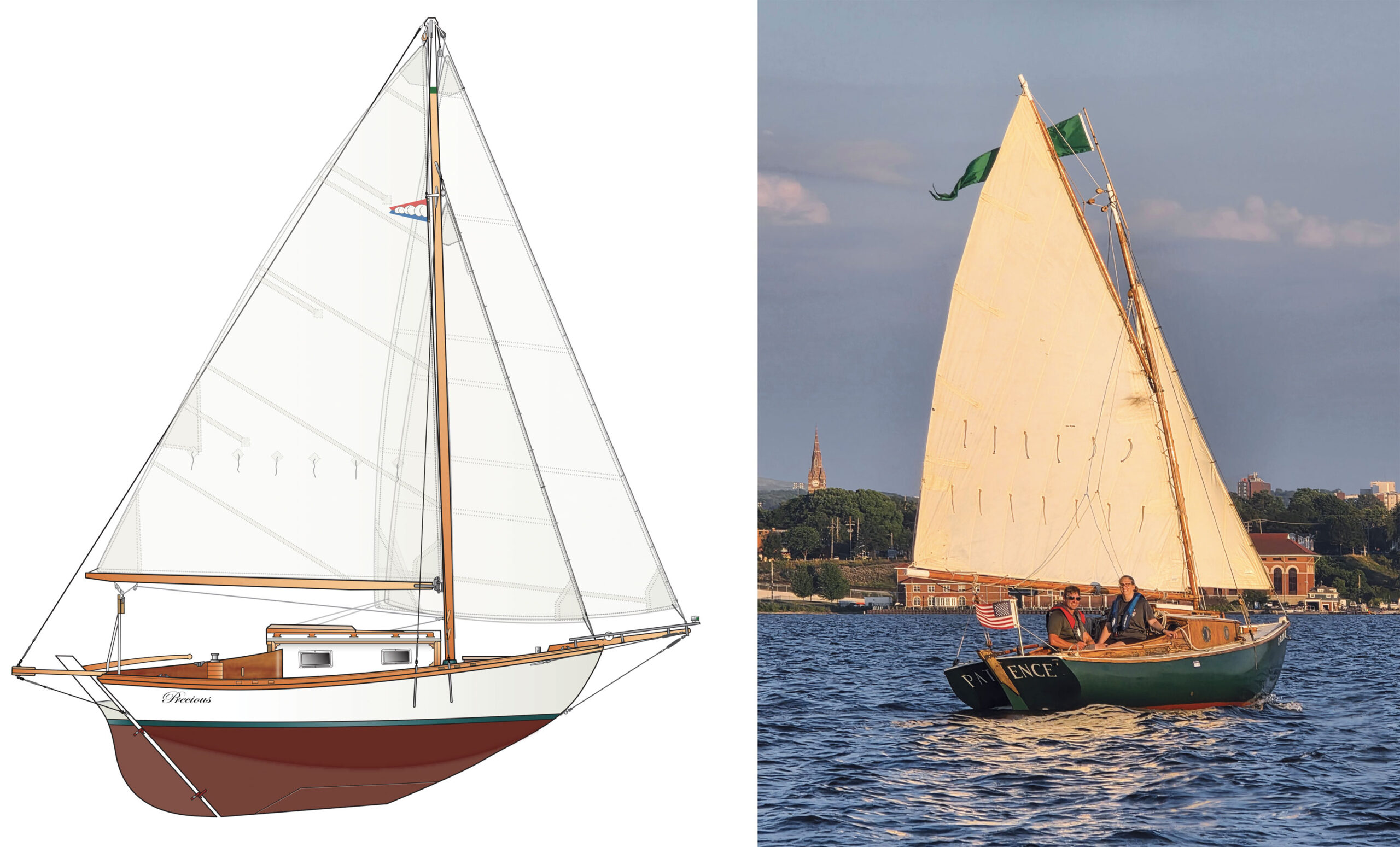
 Irwin Schuster (left) and Matt Jonas (right)
Left – PRECIOUS, shown in an illustration by Irwin Schuster as built and rigged in the 1970s by Sam Radding in San Diego, California, is an 18′ LOA strip-planked Picaroon II designed by Sam Rabl. The design, which Rabl included in his 1947 book Boatbuilding in Your Own Backyard, was a round-bottomed version of the earlier 18′ LOA hard-chined sloop that Rabl had built for his own use and named PICAROON, which gave the name to the design. Right – In 2016, Matt Jonas bought his Picaroon II, PATIENCE, for sailing on Lake Erie. He describes the boat as stable and commodious, “a great little boat.”
A story that made the rounds some 90 years ago told of a young man who built a sailboat and had an adventure. As things developed, he and a pal got a lot more than they bargained for. They set out from Mobile, Alabama, aiming for Key West, Florida, but ran into a bad northerly storm that in two days blew them almost to the coast of Yucatan, Mexico. Bruised but determined, they headed back toward Florida and hit yet more foul weather. Finally, 23 days after they first set out, having consumed all their ham sandwiches and then half a potato per day each, and with a much-diminished supply of water, the lads made it to Florida. They landed first at Fort Myers and eventually reached Key West.
The sparse details of this voyage and what happened next are contradictory. One version, published in the Miami New Times many years later, said the sailor “at the age of 19…built himself a sailboat and singlehandedly found his way from the Atlantic coast of the U.S. to the Bahamas.” Another says the young man and his buddy sailed from Fort Myers to Nuevitas, Cuba, where they “luxuriated” on a beach while the Cuban navy conducted a vain search for them. Yet another version, written by the young man himself to his mother on March 22, 1935, reported that in three days, he and “Ernie” would be sailing to Havana from Key West. There are kernels of truth somewhere in all this, because a membership card survives that identifies one of the adventurers—the writer Ernest Hemingway’s younger brother, Leicester “Hank” Hemingway—as a member of Havana’s then-notable El Miramar Yacht Club.
Whatever the absence of precise details regarding Hank Hemingway’s adventure, there is no doubt about his boat. He’d built it with the help of his friend and named it HAWKSHAW after a then-popular comic-strip detective, but the design had been dubbed “Picaroon” (petty pirate) by its creator, Samuel Supplee Rabl—and he was a most unusual man.
Although it is doubtless true that Sam Rabl (1895–1962) is less recognized these days than other yacht designers of his times, he occupied a very special niche in an era when disposable income was, for a time, particularly scarce. Many were those who dreamed of little cruises in their own sailboats, fishing or messing about in motorboats. But many, also, simply could not afford to buy one. Of such dreamers, Rabl would write: “He has no dreams of grandeur, cares not a whit for spit or polish, and has no desire to show his jet tailpipes to the rest of his brethren. His yachting uniform probably consists of the pair of faded dungarees that he wore in the engineroom of ‘Big Mo’ [the battleship USS MISSOURI] when she entered Tokyo Bay and he strikes out the watch bells on the bottom of a dishpan.”
Rabl was talking about the blue-collar working man who carried a lunch box to the job and nonetheless nurtured dreams of owning a boat and discovering, as Rabl envisioned, “the golden ripple on a sun-danced inlet where water-kissed breezes gently call, ‘come hither.’” If such a vision was ever to be realized, though, chances were that the dreamer would have to build the boat himself out of readily available, affordable materials. That was exactly the clientele to which Rabl devoted an important part of his life. He aimed to help make the visions of cash-strapped dreamers a reality.
Nobody understood what Rabl was all about better than the boat designer and engineer Weston Farmer (1903–1981), who was a kindred spirit and a longtime friend, although the two men never met in person. Farmer summed Rabl up like this: “In Sam Rabl’s day…every red-blooded American boy dreamed of building his own light airplane, or ham radio, or salty tabloid cruiser…. No man of the past 50 years knew this better than Sam Rabl, the Baltimore naval architect whose genius lay in designing tabloid cruisers simple enough to build for a very few dollars—a lot of boat for the buck.”
While Farmer’s assessment was entirely accurate, there was much more to Rabl. In 1956, Richard Stacks, a reporter and photographer for The Baltimore Sun, visited Rabl to research an article titled, “How to Get a Big Ship in a Small-Necked Bottle.” Of Rabl, Stacks wrote: “Mr. Rabl is a naval architect by profession, a model builder, and a student of military history by hobby.” A further hobby that Stacks didn’t mention, but that Farmer did, was Rabl’s ambition to write romantic adventure novels. As Farmer noted, “Sam wrote novel after novel in the hope of a bestseller but only succeeded in getting published his Mobtown Clipper—love for a ship and a lady, which wasn’t a very big bag as a book.”
 Boatbuilding in Your Own Backyard
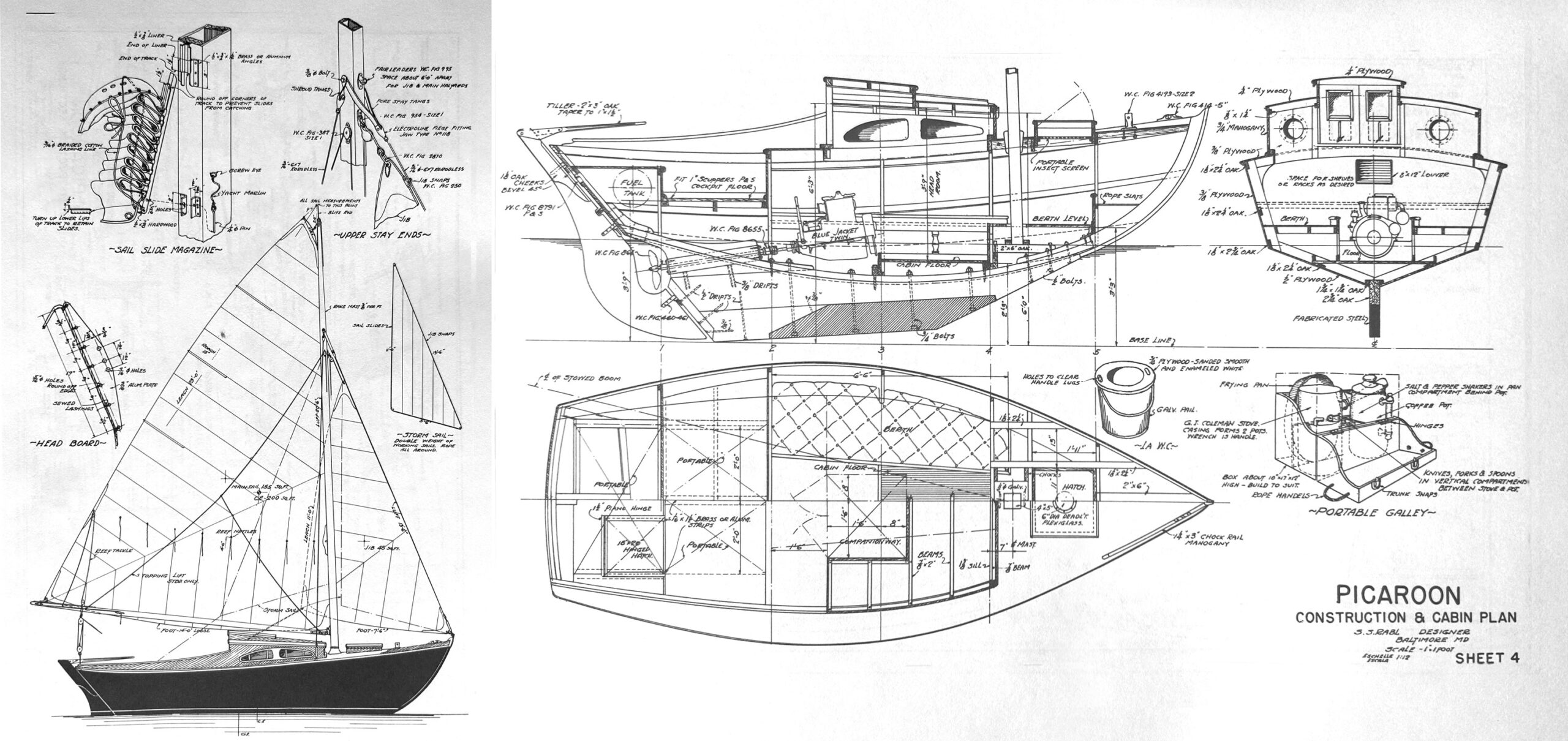
Left—As presented in Rabl’s book, Picaroon had a simple sloop rig, with singlehanding in mind. Below—Rabl wanted a stout boat with inboard power, two 6′ berths, and a custom portable galley box.
Rabl came to his profession more-or-less predictably. His Austrian-born father, Franz, arrived in the United States at age 16 in 1874, anglicized his name to Frank, and became a mechanical and electrical engineer. Four years after Sam’s birth in Hoosick, New York, Frank moved the family to Baltimore, where he joined the U.S. Army Corps of Engineers. Based at Fort Howard—with its stout walls and heavy artillery known as “the bulldog at Baltimore’s gate”—the elder Rabl oversaw fortifications on Chesapeake Bay. “Sam Rabl,” wrote Weston Farmer, “grew up in this environment, and it is little wonder that he should take up shipbuilding and graduate to naval architecture…. He graduated from the Baltimore Polytechnic Institute [then among the country’s leading engineering-oriented high schools] and took further work in engineering at Maryland Institute Annex.”
Sam Rabl’s career was both varied and very interesting. The earliest documentation regarding his work life lists him at age 21 in 1916 as a draftsman, but he also learned about shipbuilding from the ground up. During World War I, he worked as a shipfitter at the Union Shipyard in Baltimore. At Union, he met Philip L. Rhodes, then a young MIT graduate and future well-known yacht designer, who became a lifelong friend and a frequent guest at the Rabl home, where Sam’s mother prepared dinner.
Rabl’s subsequent jobs included stints at a machine shop and a drydock company; by the early 1930s, his varied skillset secured him a place at the Glenn L. Martin Company, which had constructed a new airplane-building plant in Middle River, northeast of Baltimore. There, Rabl worked on the design of the four-engine Martin M-130 flying boat, three of which were built for Pan American Airways. Beginning in 1935, these 130′-wingspan aircraft became famous as the Pan Am Clippers.
In 1936, Rabl joined the Bethlehem Sparrows Point Shipbuilding Company, where he would remain for 24 years and become chief draftsman. At the outbreak of World War II, the government recognized the immediate need to train shipbuilders, and Baltimore’s Johns Hopkins University developed various curricula. The Sparrows Point shipyard was a major participant in this effort, and The Baltimore Sun reported that “Samuel Rabl, a naval architect and author of several naval architecture books, is teaching the naval architecture course which includes design mathematics of naval architecture, launch ways, and stabilizing calculations.” A key textbook was Rabl’s own Practical Principles of Naval Architecture. Intended for ship’s officers, students, draftsmen, and shipyard workers, the book’s jacket copy noted Rabl’s characteristic practicality. It read, “Here’s a book you can USE.”
All this activity during the between-wars years represented Rabl’s day jobs. He married Margaret L. Napfel in May 1920, and the couple took over the Rabl family house at 6 N. East Avenue, a lookalike Baltimore rowhouse that Rhodes could identify only by the shape of a particular tree out front. Here, Rabl spent his free time building model boats, ships, and artillery pieces and writing articles for a variety of boating and do-it-yourself magazines.
He also became well-acquainted with all the local working craft of Chesapeake Bay. “On no other body of water will one find such a diversity of craft,” Rabl wrote in a 1925 article in Motor Boat. He came to know many of the men building the boats, from “Uncle Gabe,” a clever old African-American skiff builder, to the men at yards turning out log canoes, oyster tongers, tote boats, pungies, bugeyes, skipjacks, and the sturdy little one-lunger-powered push boats that attended them.
Articles such as “Work Boats of the Chesapeake Bay,” illustrated by Morris Rosenfeld’s photographs and Rabl’s own drawings, became an important aspect of his work. Of course, Rabl could also produce the lines drawings and construction drawings of the small boats he began designing, together with illustrations of the finished product. These designs, intended for the amateur builder, became an important avocation that soon gained Rabl a widespread reputation as a man who understood what made a good, practical boat that could be put together by those ready to take the plunge.
Rabl was very encouraging to hopefuls who bought plans for his boats but were apprehensive of their ability to actually build one. “If you have the intellect to build a boat in the first place, this same attribute will give you the know-how later. Where there’s a will, so help me, there are at least three ways: the right way, the wrong way, and the way you do it. The other nine hundred and ninety-seven don’t count.”
According to Rabl himself, he started seriously thinking about having a little cruising boat around 1918 when Motor Boat began publishing articles about “small auxiliaries” that readers could build. Among the authors were William “Billy” Atkin, Jack Hanna (designer of the Tahiti ketch), and others. Rabl said that his inspiration to have a boat of his own occurred “when the old itching to hold a stick and pull a sheet in a whole-sail breeze came over my complex with the advent of the bluebirds….” The design that Rabl would name Picaroon—after the name he gave the first of the type, which he had built for his own use—was initially sketched out on tracing paper. After refinement, plans were handed off to boatbuilders at Geo. T. Johnson & Sons in Cambridge, Maryland, who received the commission to build the prototype.
 Boatbuilding in Your Own Backyard
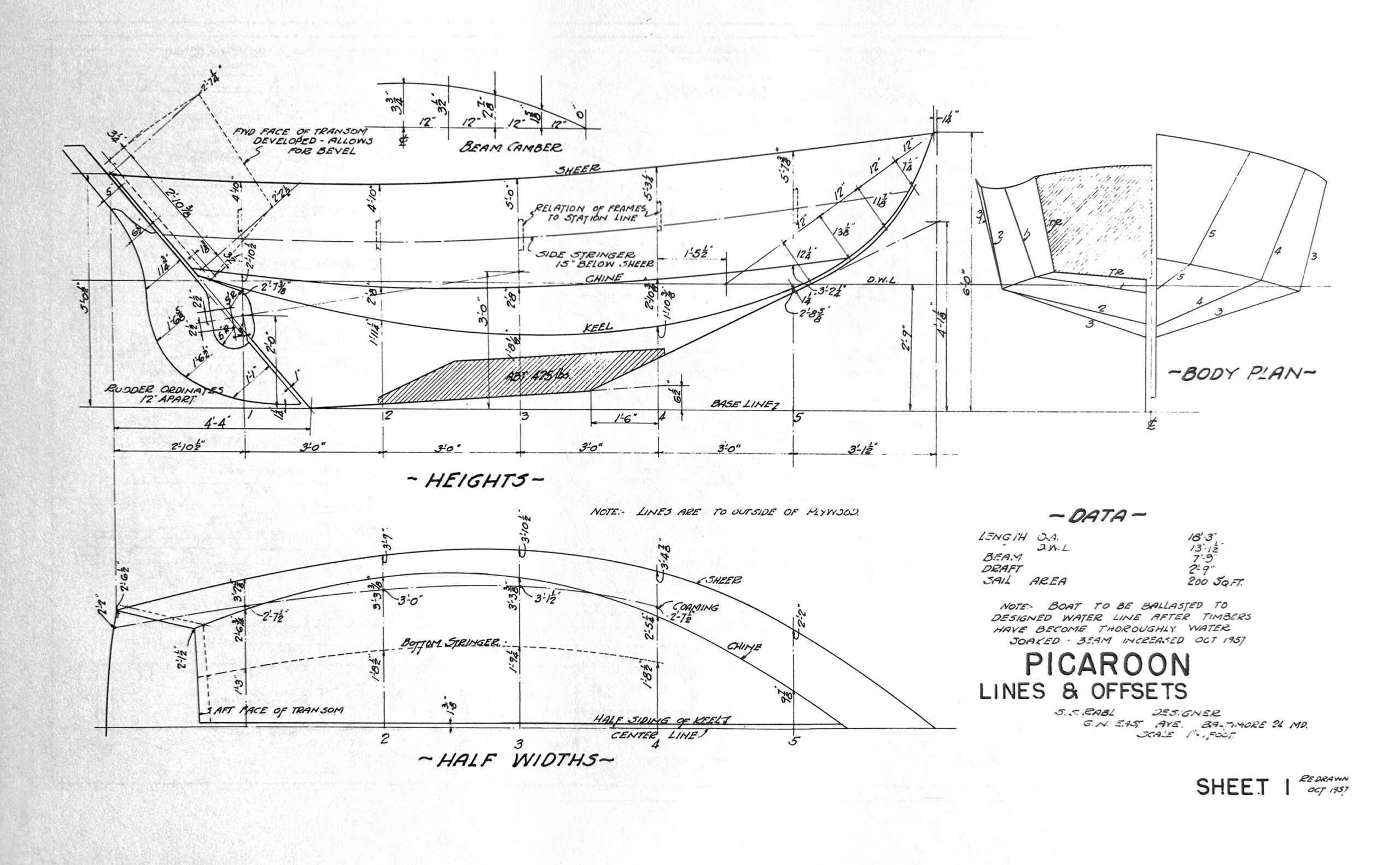
Picaroon’s hard-chined hull simplified construction for amateur builders. Rabl also designed ships and aircraft, and that work, which involved sheet-metal panel development, prepared him well for adapting his hulls to plywood planking.
When pondering Picaroon from a vantage point a century removed from the boat’s conception, it’s important to keep in mind that, in addition to the requirement for a cruising boat that could be singlehanded, Rabl had four primary goals in mind: (1) rugged construction that would yield a safe boat even in punishing seas; (2) a “fisherman” level of finish that would “eliminate the labor of upkeep and cost”; (3) a 6′ berth to port and another to starboard, even though Rabl himself was 5′ 5″; and (4) a foredeck long enough to give “ample room for handling lines [and for] handline fishing.”
Neither light-air performance nor speed were among Rabl’s requirements. In fact, he wrote that “she is [gaff] rigged as a knockabout sloop [though with a tiny topsail] with the sails running fifty-fifty in combination with the motor.” Rabl viewed the installation of a 4-hp Kermath as “the most interesting part of the little ship’s equipment.” What he meant by this, apparently, was that the exhaust was plumbed to both sides so that “one side would be out of water at an angle of heel and motor and sail were used together.” In other words, a Picaroon could function as an 18′ motorsailer. This seems like a wise idea, because not only was the boat heavy but also the shaft, mounted off-center, drove a comparatively large, drag-inducing 16″ × 14″ propeller.
Picaroon’s dimensions, particularly her beam, tell the rest of the story. “In this locality,” Rabl noted, “where the beamy Cape cat is only an occasional visitor, Picaroon’s beam to the natives’ eyes always seems excessive, but from this feature she derives her great sail-carrying ability. At some date in the near future, the reef points will be cut off the sails as unnecessary appendages.”
Rabl had no illusions when he presented Picaroon in Motor Boat. He predicted the design would appeal “to the rising generation of adventurous young Americans who spend their weekends afloat. As a family cruiser, her use is taboo unless that family consist of a two-fisted cave man and his adventurous young mate.”
Eight years after Rabl’s Picaroon article was published, he reported that 14 examples had been built. Some years later, Farmer noted of “Pic” that “she was built in every part of the world—Paramaribo [Suriname], New York, Singapore, New Orleans, Duluth—everywhere.” Oddly enough, a hundred years on, today’s generation with its interest in tiny houses and minimalist living—and anyone intrigued by camp-cruising or the peculiar romance attendant to small sailboats—might find a Picaroon, perhaps with an electric drive system, as appealing as did those of Rabl’s time.
Of course, whatever a boat’s pedigree or dimensions might suggest, only experience aboard reveals how well a given design meets the expectations of her skipper. In his follow-up article regarding Picaroon published in the September 25, 1926, Motor Boat, Rabl summed up his little ship: “I might say that without a single exception in my experience, she is the biggest boat for her length that I have ever seen or dreamed of and for singlehanded work she is what I consider the ultimate.”
Equally interesting were Rabl’s comments on the little yacht’s sailing performance, because he called the boat “the slickest-handling piece of woodwork that I have ever steered.” Perhaps most surprising is Rabl’s assertion that the boat was perfectly maneuverable in light air and could “thread her way under sail alone through the most crowded fleet and has done it time and again.” Although one suspects the power of that little topsail was significant, Rabl dispensed with it and the gaff mainsail when he updated the sail plan.
What appears to have been most important to Rabl, however, and perhaps because he knew his market would likely be inexperienced sailors, was safety. After six years of sailing PICAROON, Rabl wrote, “We could tell tales on end…of how she weathered many a storm and through actual performance earned an envious title for any boat, ‘seaworthy.’” Hank Hemingway’s experience was further proof.
If Rabl had one caution for cash-strapped boat dreamers seriously considering a Picaroon, it had to do with cost, warning that although the boat was just 18′ long, she would not be much less expensive than a 24-footer by the time she was rigged and finished out with all her many details completed. Rabl estimated that although the hull might be built for around $200, the finished, fully rigged boat with its detailed cockpit, cabin structure and interior, if constructed by a professional builder, would run some $900, which is about $16,000 in today’s money. But it would likely cost several times as much now.
As originally designed, Picaroon was built “Chesapeake style”—what Rabl called “an à la Maryland job”—with a cross-planked V-bottom of cypress and hard chines. “No caulking is used in the bottom seams,” Rabl noted of this “twartwise” (in Maryland-speak) bottom, “as these are laid up a sixteenth-of-an-inch open and allowed to swell tight. A mixture of red lead and tallow is puttied in the seams before the boat goes over to render them tight, and as the planks swell this is forced out without buckling the planks. Do not use planks over eight inches wide…”
Inevitably, Rabl tinkered with his initial design and learned that the original was hard to improve upon. A follow-up version in 1927 labeled “Peggy” was intended for a long-shaft outboard and had a bottom with much steeper deadrise that, according to Weston Farmer, was her undoing because she couldn’t carry her sail as the breeze increased. In 1932, when Farmer began editing the short-lived Mechanical Package magazine, he published what he called Rabl’s “sequel to his famous ‘Picaroon.’”
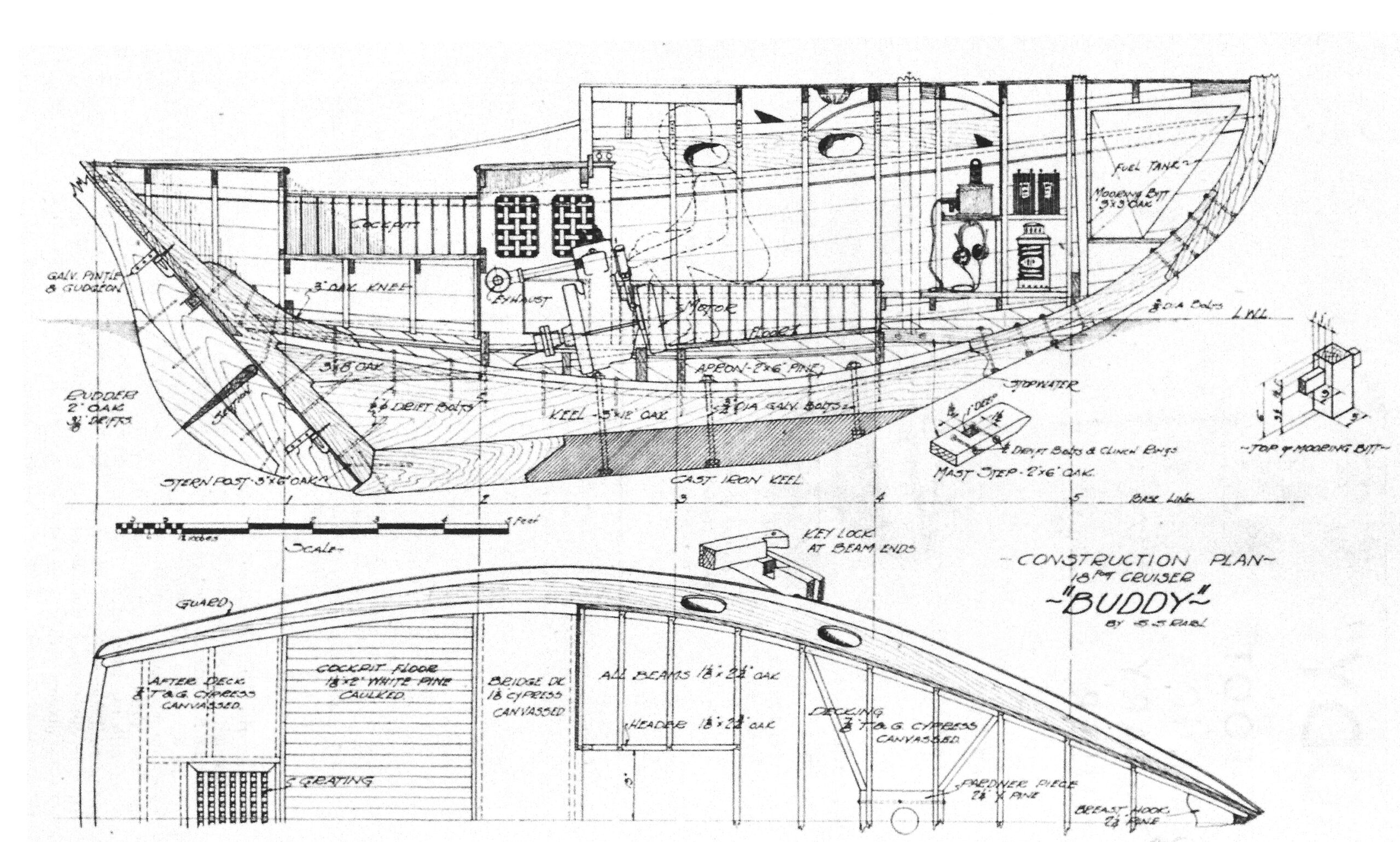
For Buddy, Rabl replaced the trunk cabin with a raised deck that greatly improved headroom. The higher topsides gave the hull enough tumblehome to minimize a potentially too-high, boxy look but, of course, increased windage, something that Rabl and others of his time always tried to minimize, with good reason. Unlike Rabl’s own Picaroon, with its gaff rig, Buddy had a marconi mainsail like the rig Rabl designed for “Pic” when the design was published. There was a tiny 9″ “gaff” at the mainsail’s head—presumably to both reduce the mast’s height while permitting the sail shape desired—a self-tending jib, and a storm jib. Like Picaroon, Buddy had the traditional cross-planked bottom planking made of cypress.
 Boatbuilding in Your Own Backyard
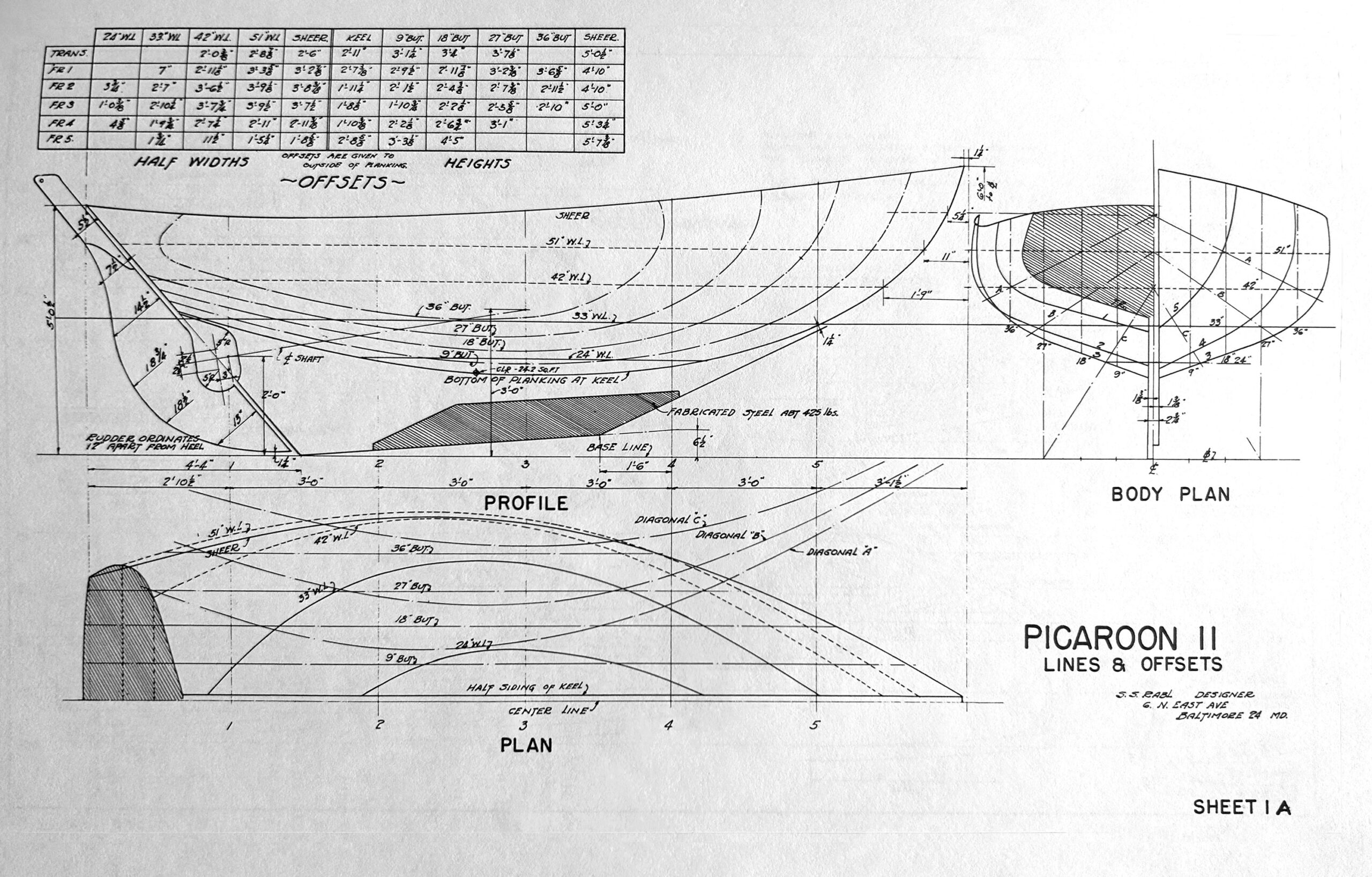
The Picaroon II followed the dimensions and overall principles of its predecessor, but with a round-bottomed hull.
Rabl also developed two more versions of Picaroon that were included in his landmark book, Boatbuilding in Your Own Backyard, published in 1947 with a second edition in 1958. One of these was adapted for marine-plywood hull and deck sheathing, and Rabl noted that “plywood has produced a better hull….” He also developed a strip-planked, soft-chined version that he labeled Picaroon II. Finally, the 1959 Sports Afield Boatbuilding Annual presented an enlarged version. Picaroon III was a 23-footer that retained the original’s V-bottom. When considering all these sequels, though, Farmer reported that “Sam always came back to Picaroon as being his favorite.”
Although notes said to have been kept by Hank Hemingway about his Picaroon-building-and-sailing adventure didn’t turn up during research for this story, others with experience of the boat reported very favorably about it. California small-craft enthusiast Annie Holmes of San Diego never forgot her first impression of the Picaroon II she bought. “I first saw it in the early ’70s at a local marina and thought, ‘How cute, a miniature cruising boat.’ I learned to sail on her and spent many nights aboard with my husband. I had the best days of my life sailing on that boat.”
Michael Effler, who today restores wooden boats on Bainbridge Island, Washington, with his partner, Erin Leader, at Sea Sensations, owned a plywood version of Picaroon. Effler, who is a couple inches taller than Rabl was, reported that cabin headroom wasn’t a particular problem but that the boat “was not accommodating for ladies.” Effler cruised his Picaroon, which had a Yanmar 1GM, along the California coast and later found it well-suited to cruising in the San Juan Islands. It was trailerable—a potentially important feature to some—with a gimbaled cooker, a kerosene lamp, and leaded-glass windows in the companionway.
Matt Jonas had begun dreaming about Picaroon ever since he acquired a copy of Boatbuilding in Your Own Backyard. He purchased his beautifully built Picaroon II, PATIENCE, in 2016. “The boat is cedar-stripped over larch framing,” Matt said, “and sheathed on the outside in fiberglass. The deck is strip-planked. She has a high-peaked gaff as shown in Rabl’s book [on a daysailer version] but she is a ‘big’ little boat, so in light wind it can be a struggle to get moving.” After his first season, Matt had a 150-percent jib made that helped greatly, especially to windward. However, in very light air, the foresail may need to be backwinded to tack.
“She is a very stable boat,” Matt said. “Reefing early and keeping the sails trimmed keeps her easy to maneuver.” Matt sails on Lake Erie and recalls being on Presque Isle Bay in late fall with one of his young sons when the breeze increased to 20 to 25 knots, with gusts to 30. “I had a double reef and the small jib, and my son rolled out of the bunk but was flopping around down there and having a good time.” Matt often spends nights aboard at the marina and, at 5′ 8″, he says his head just touches the cabintop. “It’s a great little boat,” he reports. “Sailing on her is an aesthetic experience. When sailing on her, you go back in time.”
 Boatbuilding in Your Own Backyard
With his Buddy design, Rabl built on the Picaroon concept by adding a raised deck for more accommodation.
Although Picaroon may be the best-known of Rabl’s designs, he created many others, all aimed at the amateur boatbuilder. Buddy was just one of 22 Rabl creations ranging from kayaks to racing scows to one-design sailboats, auxiliary cruisers, and outboards published in Fawcett’s How to Build 20 Boats between 1933 and 1950. Eleven more including Picaroon I and II were portrayed in Boatbuilding in Your Own Backyard.
Boatbuilding in Your Own Backyard not only presented clear drawings and instructions of each design but very useful general thoughts and hints ranging from information on metalwork, caulking, making a small portable galley box, and a formula for proportionally increasing or decreasing hull size. The book doubtless influenced great numbers of readers, and so did another of Rabl’s books. In 1941, as part of his wartime teaching, he published Ship and Aircraft Fairing and Development for draftsmen, loftsmen, and sheet-metal workers. To those interested in small-boat design, it became evident that the methods Rabl described could also be adapted for plywood construction.
 Boatbuilding in Your Own Backyard
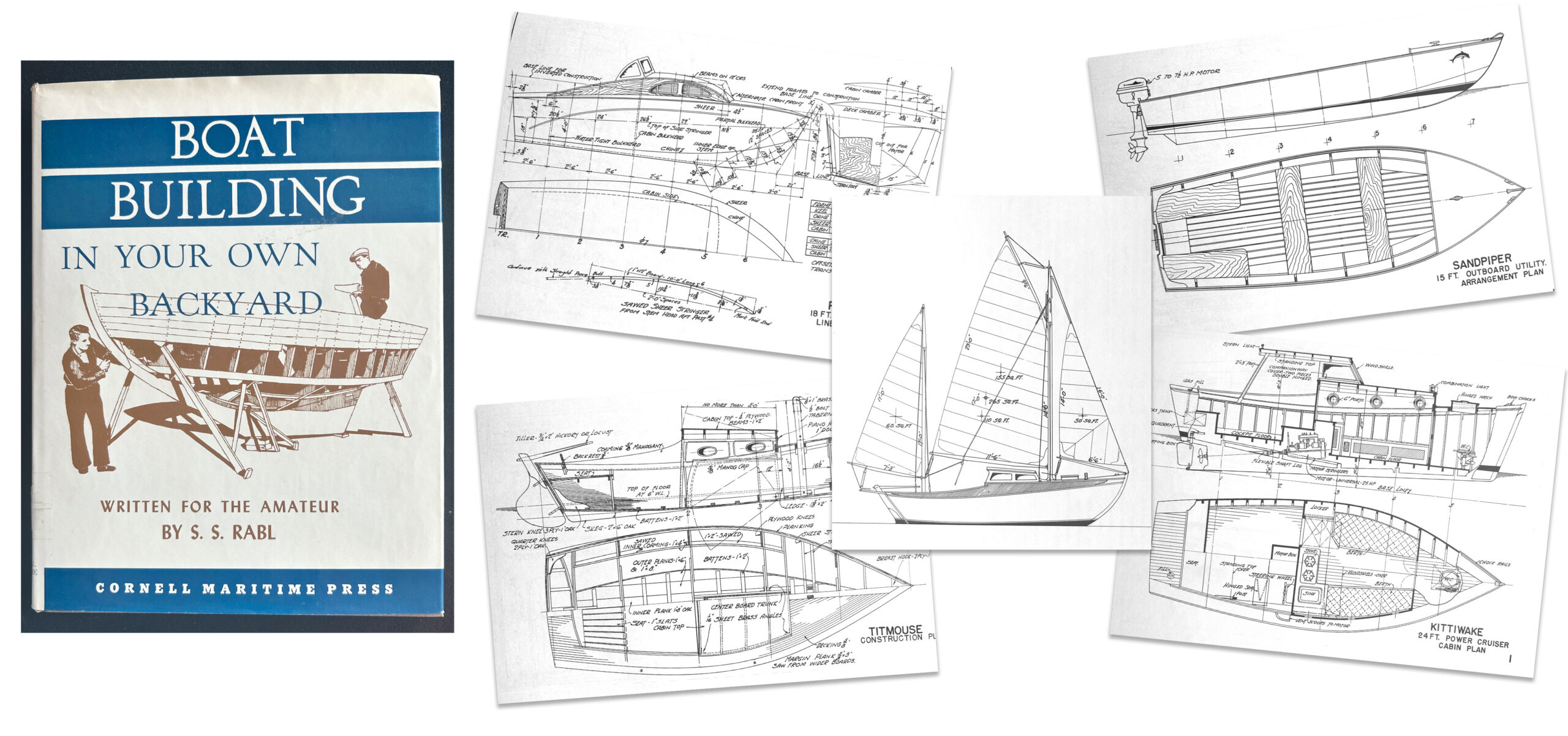
Rabl’s book, subtitled “Written for the amateur,” included numerous designs for small craft that could be built at home. Some examples are (clockwise from top right) Sandpiper, a 15’ outboard-powered skiff; Kittiwake, a 24’ power cruiser; Titmouse, a 15’ trailerable sloop; Puffin, an 18’ outboard cruiser; and, at center, Pelican, a 24’ gaff ketch.
One of those who recognized this was exactly the sort of individual that Rabl had in mind with his boat designs: Glen Lewis Witt. “As he grew older, [my] dad wanted to build a boat because he couldn’t afford to buy one,” Gail Witt Brantuck said of her father, who died at age 98 in 2017. In 1953, Witt established Glen-L Marine, a business devoted entirely to the amateur boatbuilder. In his “Designer’s Notebook” in 2011, Witt wrote, “Sam developed a method of fairing a boat framework to accommodate sheet plywood that is simple and accurate: it takes the guesswork out of fairing. We call it the ‘Rabl Method.’” The technique involved marking reference lines at regular intervals between the keel and chine, setting a straightedge on edge on each line to determine the amount of bevel necessary at the keel and chine, cutting notches to match the bevels, then planing each structural piece fair between the notches.
How many people Rabl influenced and continues to influence in one way or another is impossible to measure. What may be his final design—“the latest of Sam Rabl’s long line of small sloops”—was published in Boating in its January/February 1961 issue. This was a 2,025-lb-displacement 20′ sloop to meet the requirements of the Midget Ocean Racing Club (MORC). Although the article noted the boat would go into production, this didn’t happen, perhaps because Rabl was then seriously ill. On January 19, 1962, The Baltimore Sun reported the death, at 67, of “Samuel S. Rabl, a Baltimore naval architect and builder of model ships and planes.”
I suppose all we need to know about Rabl can be summed up by two pictures. One is the evocative, perhaps romantic, drawing he did of his PICAROON casually beating to windward accompanied by birds beneath a sky filled with puffy clouds. The other is a photo in Boatbuilding in Your Own Backyard. Sam’s on his knees lofting a hull using a batten and homemade lead “ducks” he’d cast himself. He’s doing this on cleared floor space in front of the kitchen stove.
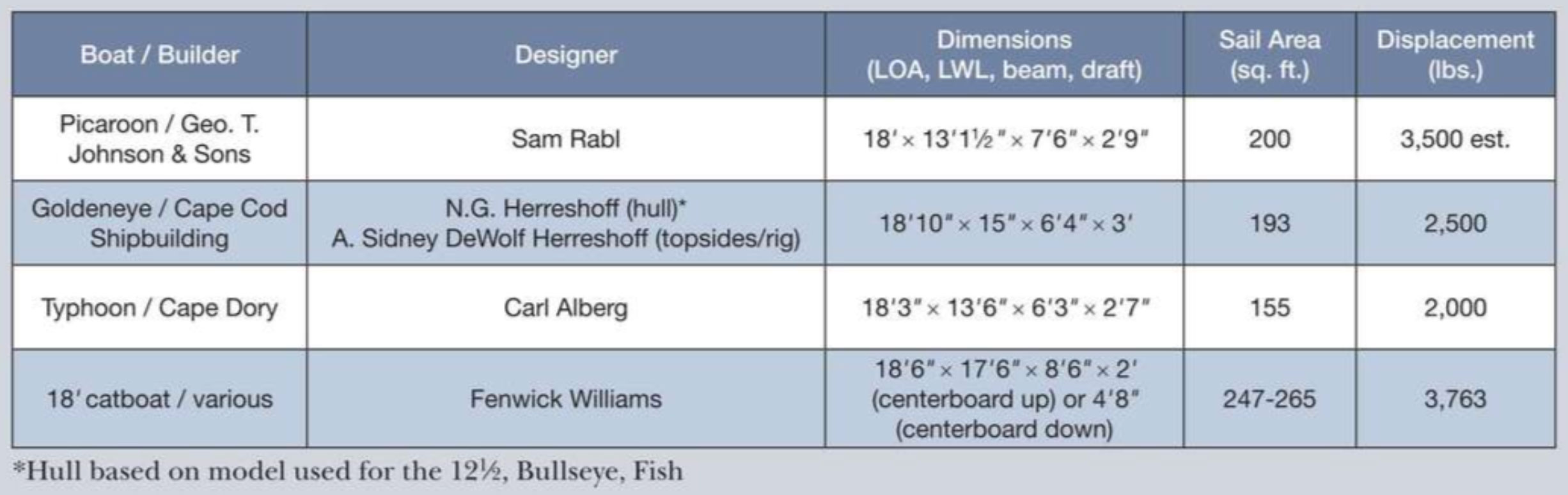
Picaroon by the numbers
The accompanying table compares Picaroon to three boats that may be familiar to today’s readers. Picaroon’s dimensions suggest a much roomier boat than either the fiberglass Goldeneye or Typhoon, probably more comfortable in rough going, and slower under all conditions. However, with her comparatively roomy cabin, inboard motor, and rig arranged for singlehanding, Picaroon would likely be the one a hardy cruising sailor would do best with. The catboat would serve equally well, perhaps better, for those willing to deal with the single large sail. Of the two wooden boats, though, for the home-builder, the hard-chined Picaroon would be easier to build.

Stan Grayson is a regular contributor to WoodenBoat.