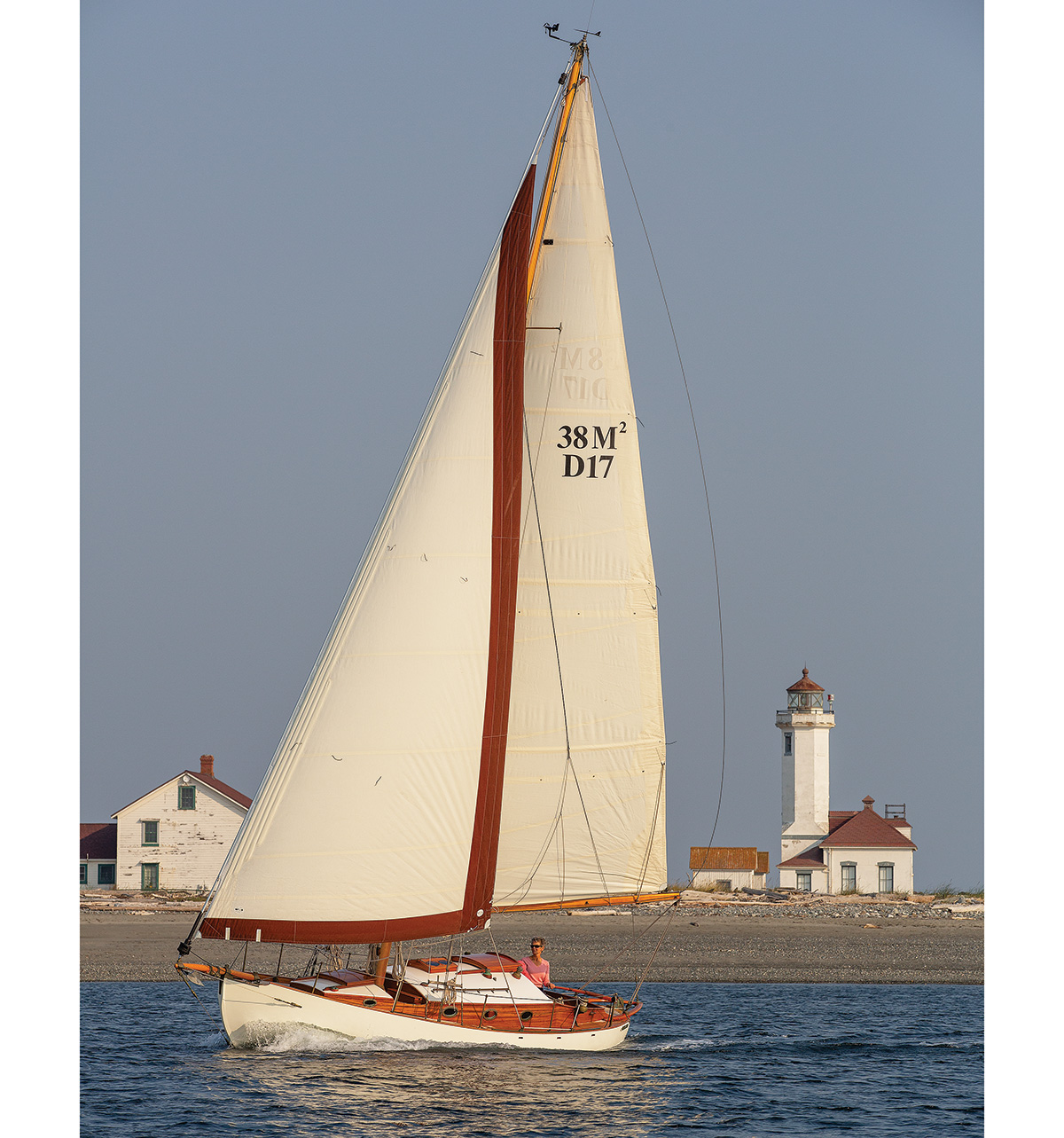
HELMA, originally built in Denmark in 1938.

HELMA, originally built in Denmark in 1938, was rebuilt over several years ending in summer 2023 in Port Townsend, Washington. Here, she sails off the city’s Point Wilson Lighthouse in her first sailing season since relaunching.

Imagine a boat of such a right size and type that she seems to speak to you personally, one whose many needs could also be interpreted as opportunities, one that calls siren-like for bringing to her all of the craftsmanship you possess or can acquire. For many, such a boat would look a lot like HELMA, a 26′ spidsgatter, or double-ender, built in Denmark in 1938. For Ollie and Janice Pedersen of Bainbridge Island, Washington, that siren’s song was a powerful one.

Although they had never owned a sailboat, they had sailed with island friends and found that classic designs captured their interest most. When they thought of acquiring one of their own, they drove the 46 miles from the island to the 2005 Port Townsend Wooden Boat Festival to explore what possibilities might be found there. At bronze specialist Pete Langley’s display for Port Townsend Foundry, they were attracted by a 17′ sloop that carried quite a bit of the foundry’s bronze hardware. Pete recalls taking them for a sail, but the boat wasn’t quite what they had in mind; they needed something larger. Then they encountered the festival’s usual cluster of much-admired spidsgatters, an astonishing collection of Danish double-enders built in the 1930s that over many years had proved popular in the Pacific Northwest and in British Columbia.

“There was a whole row of them,” Ollie said, “and my attention went immediately to the stern of PAX, which has that very severe turn and a beautiful finish. So I was oohing and aahing, and there was this gal standing off to my right, and I said, ‘That is a beautiful boat.’” That happened to be the boat’s owner, Kaci Cronkhite, a former Northwest Maritime Center and festival director who was similarly smitten; she wrote about her own spidsgatter in WB No. 245 and in 2016 published Finding PAX, a book about her search for every detail about the origins and life of the boat, which was designed by Marius Sofus Johannes Hansen.

Ollie’s grandparents, emigrants from Norway, homesteaded on Bainbridge Island in 1900 when his father was four years old, so the appeal of an authentic Scandinavian design was compelling. “It’s in my DNA,” he said. His search for a boat type ended right there; his search for a particular boat began.

He and Janice scoured boat listings, and before long they came across one for a spidsgatter named BOUT (ex-HELMA, the name they would give her once again years later). The boat was for sale in California; she had been shipped there from Denmark in 1960. Listings for such boats are rare, because these boats are relatively scarce, tend to be treasured by their owners, seldom come up for sale, and remain in high demand. Ollie went to San Diego to have a look. “It was totally covered with green tarps and canvas, so I could hardly see anything,” he said. “The gate was locked, so I walked way down the marina,” where he could take photos with a long lens. “I focused in on the stern, and I knew right away that it was a Hansen boat.” She was a 26-footer, 2′ shorter than PAX.

Ollie and Janice bought the boat in 2006. They had some cosmetic work done, and moved her to Anacortes, Washington, where she was relaunched for the short trek to Lopez Island, where they had rented a house. Going to the island for four or five days at a time, they tried to sail every day they were there, learning by doing. “It’s the first sailing we did on our own,” Ollie said. “I’d never captained a boat before—not a sailboat.” They observed how other sailors in the area handled their own boats, and they invited sailor friends to go along with them, hoping to glean additional knowledge. “We learned little by little,” Ollie said. “We had a lot of wonderful experiences, just gunkholing around and sailing into Deer Harbor and just about everywhere around. It was just a wonderful introduction.”

Ollie and Janice Pedersen of Bainbridge Island, Washington, found the boat in San Diego, California, in 2006.

Ollie and Janice Pedersen of Bainbridge Island, Washington, found the boat in San Diego, California, in 2006. Some years later, persistent deck leaks convinced them to seek advice about her needs; it was an instinct that became the first step toward a remarkable reconstruction.

The boat, however, began to show her age. “It always did leak, but not terribly, not at first,” Janice said. “But it was pretty moldy, and green—you couldn’t get it clean.”

As the shipwright Robert d’Arcy of Port Townsend recalls, Ollie first came into the Northwest Maritime Center, where Robert had a project under way, every Friday for several weeks in 2013. Ollie didn’t say anything at first, just looked around and watched the work proceeding. Finally, he approached Robert about taking a look at his boat to advise him what she might need.

Their early discussions focused on leaks in the decks and around the mast. The leakage in the laid iroko deck was a typical problem, worsened by the rainy weather of the Northwest. The mast’s troubles were unusual: originally stepped on the keel, it had broken at some point and the solution at the time had been to cut off its below-deck section and install an oak compression post. Compression posts are not uncommon, but this one was strange: it extended above deck level through the existing mast partners to receive a tabernacle; but it wasn’t high enough for a mast mounted that way to clear the deckhouse when lowered, and it would have been very risky in any event to lower a heavy mast that way; plus, it complicated periodic downrigging. Robert described it as the worst of both worlds. In addition, the compression post and maststep were deteriorating and risked failure under the mast’s compressive forces.

“Robert felt that it was kind of unsound to sail, structurally, at that time,” Ollie recalls. That brought up the next logical subject: a deck replacement and reconfiguring and repairing the mast to step on the keel, as designed.

Robert d’Arcy (left) led the reconstruction of the boat.

Over the course of the project, Robert d’Arcy (left), working at the Northwest Maritime Center, led the reconstruction of the boat. Her iron-sick planking was entirely replaced with 1″-thick western larch.

“The genesis of the project was decks—it had leaks everywhere,” Robert said. “When we took the decks off, we found severe deterioration of the deck framing and the fastenings. I think she had chronic deck-leak issues for many years, and it just destroyed the iron fastenings, and of course it was oak, so the oak was shot, too,” as expected in a Danish boat of her vintage using ferrous fastenings in a combination of oak sawn frames at every third station with two intermediate steam-bent ones. Leaks make such construction highly subject to iron sickness.

The deterioration just didn’t end. “We pulled the deck off, and everything else became extremely obvious,” said Doug Jones of Traditional Boat Works of Port Townsend, whom Robert had brought in as an associate on the project. “I was shocked at how bad the deck framing was,” Robert said. “It was so polluted and iron-sick everywhere, and so we stopped, called these guys”—meaning Ollie and Janice—“and scheduled a meeting.”

Ollie and Janice listened, but they nevertheless decided to proceed. “It’s kind of the first time I’ve ever had a customer trying to talk me into a project while I’m trying to talk them out of the project,” Doug said. “Both Robert and I thought we were going to be cutting the boat up and throwing her away.”

“As we got into the deck framing,” Robert said, “we found the clamp, the breasthook, and the stem were bad, and the sternpost had some iron-sick issues. So we investigated further down and found more problems, stopped the project,” and met again. The couple again persisted. Work resumed with keelbolt removal. “The keel where all those bolts went through was just toast,” Robert said, and so was the forekeel. The whole centerline structure needed replacement.

She was reframed with laminated oak frames in place of sawn ones, and all of her intermediate steam-bent oak frames were replaced.

Originally conceived as a deck replacement, the project took a different turn after the trunk cabin and deck were removed, revealing extensive deterioration. She was reframed with laminated oak frames in place of sawn ones, and all of her intermediate steam-bent oak frames were replaced.

It doesn’t take a long acquaintance with Ollie and Janice to understand that they would be unlikely to walk away from anything they loved. For 40 years, Ollie has run a landscaping company on Bainbridge Island with a demanding specialty in Japanese gardens. Janice, a Montana ranch girl unafraid of hands-on work, founded the Hazel Creek Montessori School on the island in 1989. “The facilities there are from their own two hands,” Robert said.

“We’re romantics,” Janice said. “I would say that at the top of the list of things that are important to us are relationships and tradition and culture,” Ollie added. “All those things are just really important to both of us. We grew up in families that really value those things.”

“We work really hard; we still work pretty full-time,” Janice said. “It was just such a joy to have a purpose outside the life we were already living.”

The discussions quickly, and repeatedly, focused on how much all of this was going to cost. “Our main concern was that we didn’t have the ability to just write a check to do this thing—not even close,” Ollie said. He focused on monthly cash flow and slowed the project’s pace (with a couple of six-month breaks) to make the finances work.

The progress continued in phases over three years. New centerline timbers, all made of purpleheart, went in, with silicon-bronze bolts replacing the iron ones. Robert and Doug replaced the sawn frames with laminated ones, sided 2″ and 2¼″ thick at deck level. Instead of carrying the laminations down to the keel, they made them full-width, using oak glued with G-Flex epoxy, and running across the centerline over shaped sawn white-oak blocks that extended down to the keel in way of the deadrise. “We didn’t want to put the laminations in the bilge, for obvious reasons,” Robert said. “The laminations are never in the drink; they’re up out of the water.” They also replaced all of the 1″×1″ white-oak steam-bent frames. As with the bolts, all the new fastenings were of bronze. The hull planking, too, was iron-sick; they replaced all of it using 1″-thick western larch screwed to the laminated frames and copper-riveted to the steam-bent ones. The original iron hanging knees were replicated in bronze at Port Townsend Foundry.

At some point, the project stopped being a boat repair and started to become something else: a collaboration in craftsmanship. “I always told Robert, you know, we’re just the stewards,” Janice said. “We just happened to fall in love with the boat initially, and then we fell in love with the shipwrights, and fortunately we had enough cash coming in, in our lives, that we could make the decision to shift it over here. I think she is so worthy of having done that, not just to us but to the community.”

Ollie concurred. “It was a huge commitment, and I don’t want to make that commitment a smaller issue than it really was. But it was an exciting commitment, and one that grew in importance in terms of what was coming back to us. Robert was awesome; he would take the time to walk us around to really introduce us to all of the different methods that they used to accomplish all this wonderful joinery work and shipwright work. We were just relishing getting to know the boat from the keel up, to really understand what in the world we really have.”

During one early meeting, they discussed whether the boat was worth such effort. “I remember saying, it depends on how you measure,” Robert said. “If you’re trying to get your economic investment out of the boat—never. It’s a loser all the way down the line.” Doug, too, got involved in that discussion, and used his own 48′ Sparkman & Stephens yawl, PACIFICA, as an example. “Doug told them, ‘I’ll never get my investment out of PACIFICA, but that’s not what it’s about. It’s the lifestyle, it’s saving a vessel, it’s all the things that are part of that culture.’

“It’s the first and only time that I’ve had this kind of conversation with a client,” Robert said. “It wasn’t that money didn’t matter—money did matter, but it was only one facet of the equation.” Janice said that Ollie during his career had been on the opposite side of that equation: Only one experience stood out as a time when the client gave him wide latitude and support for creative decisions. “With the right person,” Ollie said, “there’s no anxiety, and it releases all these creative juices that can come to the fore and really create something wonderful.” For HELMA, he wanted to be that client, and Janice recognized the moment: “So now, we were put in that position, but we knew what that meant; we knew that when his client trusted him, he produced the most beautiful product, and in the end it was just this glorious garden.”

About halfway through the hull’s reconstruction, they started envisioning what could be done with the boat’s interior. Spidsgatters were designed as racing classes based on square meters of sail area. Their interiors, though wide (HELMA’s beam is 8′) typically have relatively spartan accommodations. Below, the boat had a small sink and counter adjacent to the companionway to port, and to starboard was a wet locker. Forward of a bulkhead, settees on both sides, barely long enough for berths, extended forward to a bulkhead at the mast. In the forepeak, a V-berth provided the best sleeping berths, with a head between them under the forward scuttle.

New elliptical bulkheads.

The gutted interior became “a blank slate—with a few complications,” as Robert d’Arcy said. New elliptical bulkheads gave it an open feeling, with the aft one positioned to make room for a full galley.

“These boats were camp boats,” Robert said. “You cleaned up in a bucket, you cooked on a Primus stove.” The boats originally didn’t have engines, and they had no systems to speak of. With modifications over time, HELMA was given an engine, water and fuel tanks, and batteries, all of which were installed aft and required offsetting trim ballast—nearly 800 lbs of lead—forward. For Ollie and Janice, the gutted interior became a way to envision how they would live with the boat. As the original iroko-sided trunk cabin, which was saved, reconditioned, and given a new teak butterfly hatch, was reinstalled and the deck was replaced with ½″-thick teak glued over ½″-thick plywood, they turned their attention to what life below would be like for them.

At a boat show in Seattle, they encountered the Finnish-made Wallas stoves, which double as cooktops and cabin heaters and run on diesel fuel. They thought a two-burner unit would be nice and also practical. “We decided on a full galley,” Robert said, “and we really loved the Wallas stove, and somebody said, ‘Yeah, and they make an oven, too,’ and Janice perked up. And I went, ‘oh, boy….’” Janice began to think in terms of fresh-baked pies.

The galley has a Wallas cookstove.

The galley has a Wallas cookstove that doubles as a cabin heater; below it is an oven by the same company. The interior woods are iroko and larch, with Port Orford cedar bunk and locker slats.

Making a bigger galley meant moving the location of the bulkhead at the aft end of the settees forward. The wet locker, which Robert termed “the black hole of doom” as a place prone to trapping moisture, was taken out. That made room for a counter and an icebox using high-tech, R50 insulation only 1″ thick. The icebox has shelves meant to fit frozen casserole dishes sized to fit directly into the oven.

Since the bulkhead was never structural, its reconfiguration opened up more possibilities. Ollie had seen a bulkhead on the aft end of the galley on the 1907 B.B. Crowninshield schooner MARTHA, which Robert’s nonprofit Schooner MARTHA Foundation operates for sail-training and passenger excursions. Its half-elliptical opening struck him, and he thought a similar shape would be an elegant touch for HELMA and a way to open up her interior to be less confining. To make the settees long enough for berths, the much smaller forward bulkhead was removed and reconfigured forward, giving a matching elliptical shape. The settee seat backs fold away on bronze hardware that Pete’s foundry patterned and fabricated to solve the complicated geometry of their shapes. The plan made the V-berths easier to get to, and a composting toilet is set between them. The bulkhead staving is made of western larch and the trim is of sapele, with Port Orford cedar bunk and locker slats. “We realized that by doing this, it sleeps the same, it sits and entertains the same, but now we have a galley,” Robert said.

“There are a million little things like this on this boat,” Ollie said, pointing to the seat-back fittings. “Everything has a place, and everything is in its place. The way that he executed it is so elegant.”

For Robert, weight distribution was a challenge. “So when we wanted to bring some modernity to the spidsgatter, upgrade the galley and its functions, bring in a navigations suite—now you need power to run those kinds of things,” he said. Battery weight became a serious concern, on top of earlier concerns for the engine weight, fuel tanks, and water tanks. “These boats had no engine, nothing. They ended up getting really stern-heavy. That’s why most of the spidsgatters I’ve worked on have 600 or 800 lbs of lead stuck up in the forecastle.” In consultation with a naval architect, he chose to place the two NorthStar NSB 105 Blue batteries forward, near the mast. In addition, the batteries are not separated into engine and house batteries; instead they have a low-voltage cutoff set to switch off the house power automatically to assure that enough capacity is reserved to start the engine. “The idea,” Robert said, “was to have both batteries in parallel to produce 200 amp-hours, in parallel to ensure both batteries are balanced. The low-voltage disconnect opens the house circuit at 50 percent of battery charge, which is about 12.2 volts.” Switching the house power off at 50 percent prevents a deep discharge, ensuring long battery life. The diesel engine is a new 20-hp Beta, replacing a three-cylinder Universal. The new HELMA has a single 15-gallon fuel tank and a single freshwater tank. Previously, the systems were all aft, making the boat “pop a wheelie,” and Robert worked to move as much weight forward as possible, eliminating the need for trim ballast forward.

The boat was launched, unfinished, during the 2019 Wooden Boat Festival, partly to clear out the Northwest Maritime Center so it could accommodate exhibitors. Robert decided to take advantage of the moment by using antifouling paint only up to a point deliberately below the projected waterline, to avoid having to grind any off later. “I told Ollie, what we’re going to do is put buckets of weight in the engine space representing the engine, we’re putting battery weight up forward, we’re putting chain weight in, we’re going to put rig weight in, and we measured all these things.” In calm water, the antifouling paint ended up being only ¼″ low forward and ½″ aft.

With the weights confirmed, the builders proceeded with the interior and systems fitout in all confidence.

The rig posed its own conundrums. A bowsprit had been added at some point, in order to give her a masthead sloop rig instead of her original fractional one. A boomkin arrangement was added to dispense with running backstays. And then there was that mast.

“I basically took that mast apart almost completely,” Doug said. It was a box-sectioned construction, with rounded-off forward and after staves making it oval-shaped in cross-section. He scarfed new Sitka spruce onto the after section to make the length suitable for the mast to be stepped on the keel, as original. “The front of the mast is completely new, and the sides are probably two-thirds new,” he said. He added taper aloft that the previous mast didn’t have and planned for a replacement of the oversized stainless-steel masthead fitting with a lower-profile new one of bronze.

Ollie and Janice decided to keep the masthead rig because shortly before the reconstruction they had had Carol Hasse’s sail loft in Port Townsend build a new suit of sails. With the commitment to the rig, the collaborators agreed that the short bowsprit and the clunky connection for the backstay both needed to be re-examined. They mocked up longer bowsprit options, ruling out a straight one and settling on one about 1′ longer that the existing one and slightly curved downward. For the boomkin, Robert used a modification inspired by the V-shaped one aboard MARTHA; Doug built it out of teak. The doubled mainsheet’s blocks are custom made in bronze by Port Townsend Foundry, and the lower ones mount on custom bases that anchor the legs of the boomkin, receiving bolts extending from below the deck structure and threading into the underside of the bases.

The comfortable cockpit.

The comfortable cockpit is also practical. The double-ended mainsheet reeves through open-shell bronze blocks that are among the many custom bronze fittings made by Port Townsend Foundry. The blocks’ bases double as nuts to receive bolts from below to anchor the teak boomkin legs. The bronze winches are set on custom bronze bases reinforcing the coamings.

Craftsmanship also played a definitive role in her fittings on deck and in the rigging. Bronze work is everywhere, and almost all of it was custom-made by Pete’s foundry. The list would be long: handrails on each side of the cabintop; anchor roller fittings on both sides of the bowsprit; the heel fitting for the bowsprit doubling as an elegant cleat for the mooring line; chainplates and turnbuckles; sail tracks and cars; stanchions; bases for the Polish-made self-tailing winches doubling as brackets to support the outward-canted cockpit coamings; open-shell mainsheet blocks that Pete based on patterns in a 19th-century Chas. Durkee Company catalog; fittings for easy and at-hand storage for winch handles in the cockpit and near the mast.

The bowsprit.

The bowsprit has fittings for two anchor rollers, and its custom heel socket has arms that serve as a cleat for making off a mooring line.

“Of course, we started with the keelbolts, and that’s usually the place you’ve got to start—get the foundation done and then work your way up,” for example to the hanging knees and rudder fittings, Pete said. The rigging, made by Ian Weedman and his crew at Brion Toss Yacht Riggers in Port Townsend, incorporated Dyneema in lifelines and halyards but is otherwise conventional. All of the boat’s hardware, which had been mostly stainless-steel, was replaced. “My theory is always ‘form follows function,’ so you want to get the function going as best as possible, and then the aesthetics just come along naturally, and everything blends together,” Pete said. “I think that’s really kind of what they were looking at—‘Once these guys do what their craft is, we’re going to end up with a beautiful boat.’” The importance of function extended to designing pieces such as the bowsprit and boomkin fittings and oval portlights, all of which can be easily removed when it’s time to repaint or revarnish.

HELMA.

HELMA is, effectively, a new boat, one that Ollie and Janice Pedersen plan to use primarily for daysailing and short cruises among Washington’s San Juan Islands.

“I think she’s definitely a gem,” Doug said. “That was probably one of the best projects I’ve ever been in. Ollie and Janice are probably the best customers I’ve ever dealt with. They slowed us down a couple of times, understandably, but there was never, you know, ‘Let’s cut the corner here,’ or ‘We can’t do that’ type of thing. They wanted to do the best for the boat. I hope they have a long time sailing HELMA, because they deserve it. They did very well for the boat, and she’s definitely going to be around for the long term, if people keep up with her.”

“To me,” Pete said, “it’s like they built a museum piece. The potential for that boat is that not only can it go out and be sailing, but it’s a jewel box to get others enthused.”

Ollie and Janice, however, view the boat as one meant to be sailed, enjoyed, and incorporated into their lives. “We didn’t want to have a boat that we would be afraid to sail,” Ollie said. “We didn’t want to have something and then put it in the Smithsonian.”

She is, by all accounts, a new boat. All that remains of the original are the aft breasthook, the trunk cabin sides, the toe rails, and the ballast keel.

And her soul.  Article ends.

Tom Jackson is WoodenBoat’s senior editor.