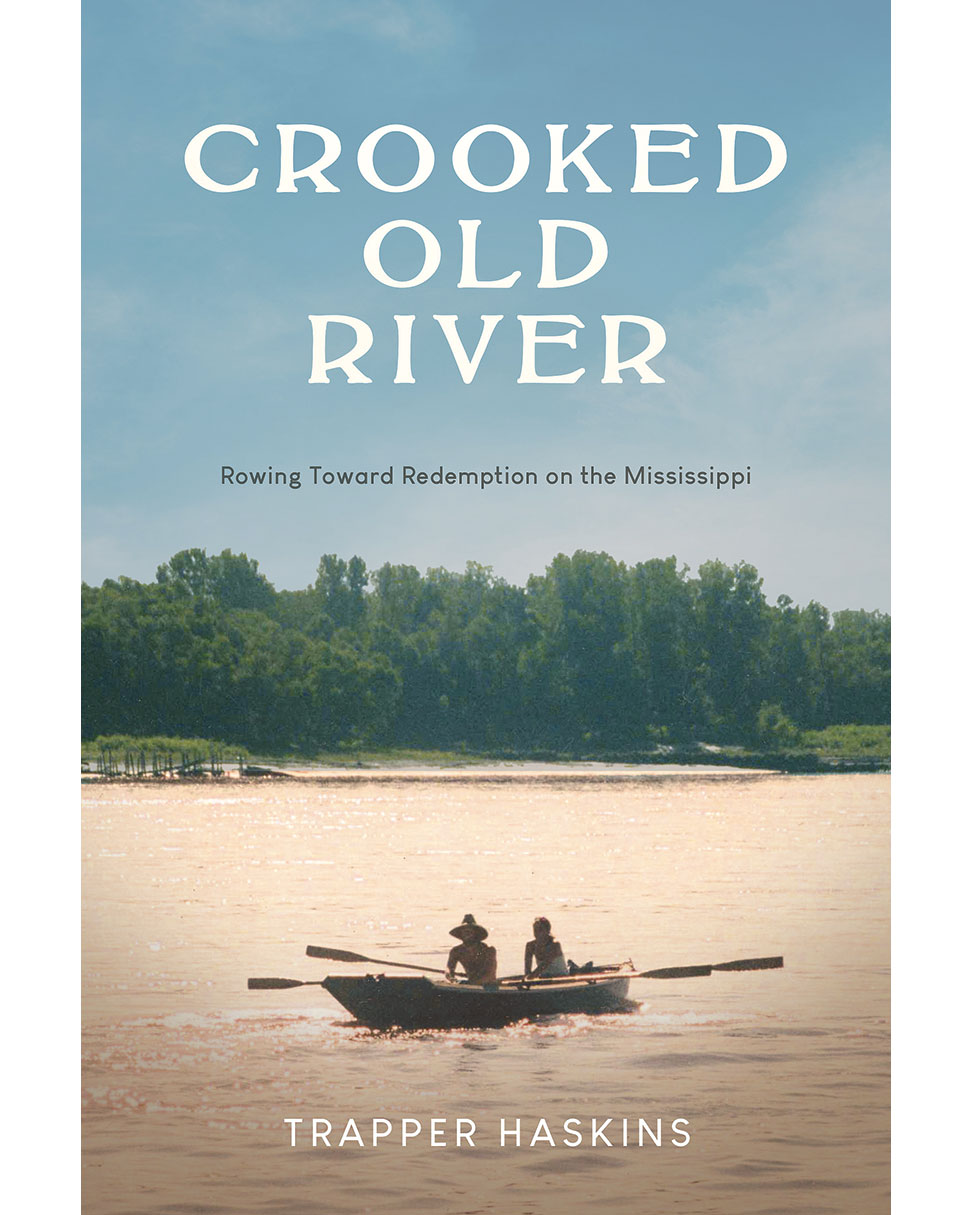
Crooked Old River: Rowing Toward Redemption on the Mississippi, by Trapper Haskins. Map, bibliography, 280 pp. $19.95.
One of the fascinating aspects of traditional wooden boat construction is its persistent relevance in the modern world. Yes, there have been infinite developments in other materials and methods of boat construction, from fiberglass to ferrocement to steel. Amazingly, however, if one were wanting to leave the land today and voyage on a body of water, a traditional boat of plank-on-frame construction with solid-wood timbers and mechanical fastenings would still be a viable option. Plank-on-frame construction is strong and safe and can hold its own against more modern materials, and there is one advantage it has over other construction methods: Traditional construction offers a completeness to the cycle of building, from harvesting and milling materials to the vessel’s movement through the water. Its allure is irresistible for those of us who want to go deep and follow the process from beginning to end.
Trapper Haskins is this kind of person. His book, Crooked Old River: Rowing Toward Redemption on the Mississippi, takes the reader on a boat voyage down the Mississippi River, a voyage that started in 2002 but ended up taking 16 years due to a major interruption just 100 miles from the Gulf of Mexico. Not just any boat would do for Haskins, who grew up in Memphis and spent much of his youth on the banks of the river. There is a thoroughness to his way of thinking, an obsessiveness about doing things the right way. Specifically, he builds a traditional 18′ plank-on-frame skiff and names it OXBOW. The lines of OXBOW came from Howard Chapelle’s American Small Sailing Craft, where it is labeled “River skiff, fitted to sail, for use on the lower Mississippi, 1889.” Although “fitted for sail,” OXBOW ends up being rowed by Haskins and his wife, Mandy, nearly the entire length of the 2,552-mile-long river.
Haskins explains his obsessive attraction to anything that his curiosity latches onto:
“Whenever I fixate on a thing, I am given to mythologize its past, and the past of that past—to obsessively pull at a thread, chasing antecedents. The feeling is like a nostalgia for a time I’ve never actually known. It is not enough to casually pick the flower, I need to dig for the root.”
To counter Haskins’s mental machinations and at times tortured state of mind is his indefatigable partner, Mandy. After much deliberation, Haskins asked her if she would join him to row the length of the Mississippi from the headwaters at Lake Istaca to the Gulf of Mexico. She replied nonchalantly, “Hell yeah, why not?”
Because of Haskins’s need to “pull at a thread” and “dig for the root,” Crooked Old River is a story rich in details of building OXBOW during his time as an apprentice at The Apprenticeshop in Rockland, Maine. It is also a good survey of Mississippi River history and of other people who travel and work on the river today. But like many great tales, Crooked Old River has an internal mental saga that parallels the physical.
In the beginning chapters of the book, Haskins presents an idea from the educator Kurt Hahn: There is more in you than you think. As Haskins reflects on his childhood and his relationships, we get the first hint that his mind is at times, like most of us, a churning cataract and not a peaceful river. This tension builds first with his decision to terminate the voyage in New Orleans, a hundred miles short of the Gulf of Mexico. The reasons for ending the trip early are not obvious, and it feels incomplete to not reach the ocean. But he puts the voyage on hold for the next 16 years. During this time, Trapper and Mandy move to “one of Tennessee’s poorest counties,” high on the Cumberland Plateau, where they try to eke out a living on low wages. The 2008 economic recession brings this experiment to an end, forcing them to sell their house and move in with family in Nashville. There are further misfortunes: Haskins is diagnosed with diabetes and must slog away at an office job in Nashville.
For all these years, OXBOW waits for the time she is needed again—sometimes under cover and filling with rat poop, other times overturned and slowly rotting. The story’s low point comes when Haskins has a series of panic attacks that send him to Nashville’s Vanderbilt Psychiatric Hospital. “I recognized,” he writes, “for the first time, a great immeasurable vacancy in all things.”
But Crooked Old River is a story of redemption. There is more in you than you think, and despite Haskins’s despair, he retains a few weapons with which to slay his dragons. With a John Hartford tune in his head—“Ain’t nothin’ like a crooked old river, straighten my head right out”—OXBOW is brought back to a condition seaworthy enough to finish the journey to the Gulf. Haskins writes that he finds the restoration of OXBOW “cathartic.”
It is fitting that a wooden boat is the lifeline that Haskins reaches for to regain his mental health. I remember the satisfaction of the first boat I built as an apprentice. Although progress was slow, at the end of the workday there was no arguing about whether another plank had been hung or frame had been fitted. It was there on the shop floor for all to see and no philosophizing or arguing could deny the product of my physical efforts. This kind of work is a soothing balm to someone questioning what is real and what has value.
I also know from my own voyaging in wooden boats that the people you meet and the experiences you have are defined, in many ways, by the vessel in which you travel. In Crooked Old River, Trapper Haskins has written a book about taking a wooden boat down one of the largest rivers in North America, and he has done it in a boat he built himself. Despite the many obstacles encountered—both physical and mental—no shortcuts are taken, and for this reason the eventual success is all the greater and the redemption that much sweeter.

This 1949 map shows the portion of the Mississippi covered in Trapper Haskins’s Crooked Old River.
Bruce Halabisky is a boatbuilder and sailor who lives on Orcas Island in Washington State. From 2004 to 2015, he and his wife, Tiffany, sailed around the world in a 34′ gaff cutter named VIXEN (see WB No. 146).![]()
