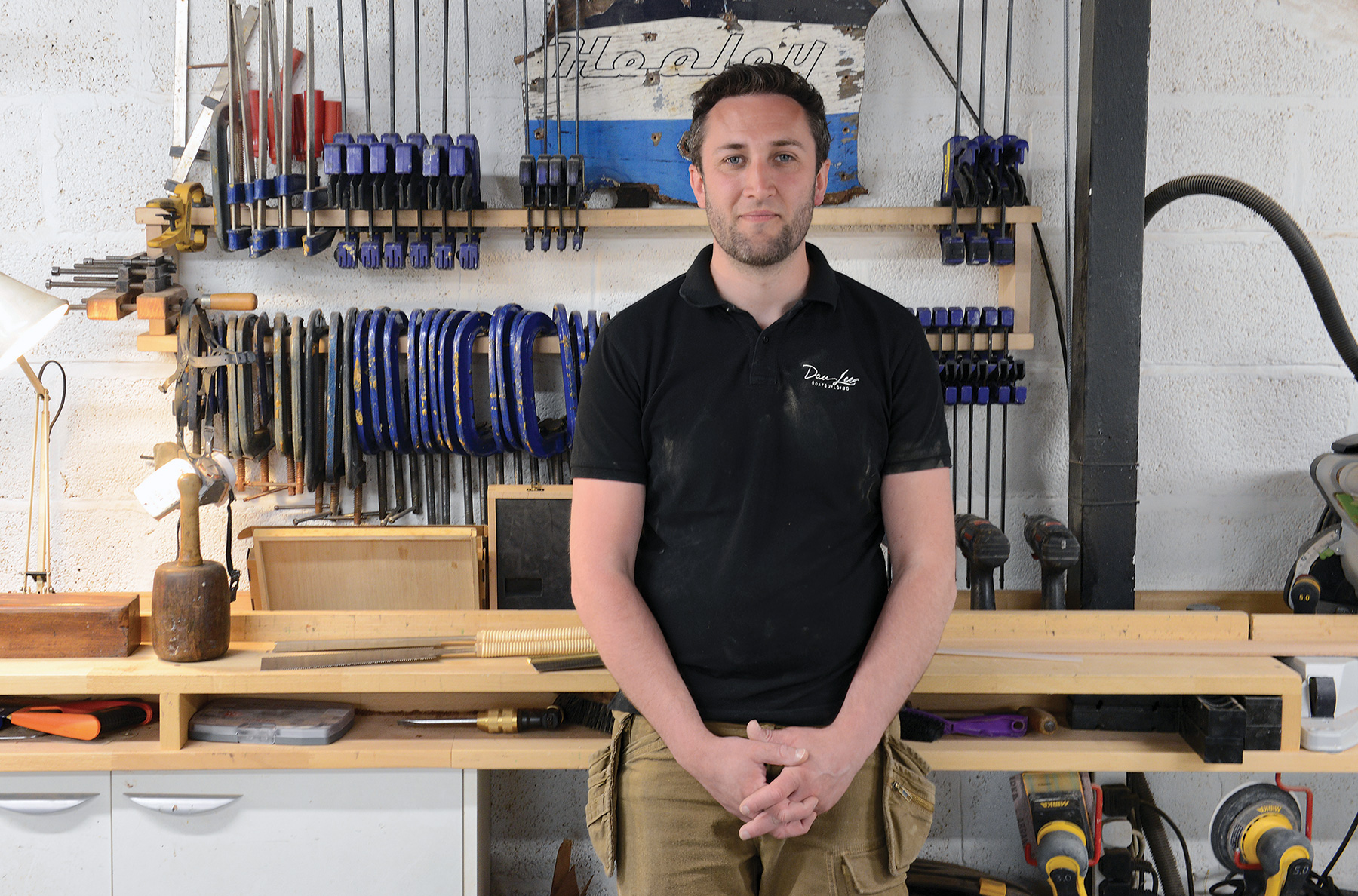
Nic ComptonDan Lee, boatbuilder, of Gloucestershire, England, brings a cutting-edge sensibility to wooden boat construction—and to teaching the trade. His YouTube channel has more than 35,000 subscribers, and his most popular video has more thanone million views.
Dan Lee has an astonishingly high profile for someone who only became a full-time boatbuilder two years ago. Regular readers of WoodenBoat have encountered him and his classic speedboat MISS ISLE since March 2023 on the back cover, as the poster boy and boat for Epifanes varnish. Elsewhere, the same boat has been used as the face of WEST System epoxy. And anyone with an interest in wooden speedboats can’t have missed his YouTube series on building and restoring various boats, the most popular installment of which has had over one million views. All of this attention got me to wondering: Who is Dan Lee?
It so happens that Dan’s workshop in Gloucestershire in southwest England is only a two-and-a-half-hour drive from where I live, so I set off early one morning to seek the answer to this burning question. I expected to find a busy workshop, with machinery whining, wood shavings flying, and dust everywhere; the usual sights and sounds of a bustling boatyard. Instead, what I found was a super-tidy space, big enough for at least half a dozen people to work in, with a couple of speedboats in mid-restoration, a CNC machine dominating one corner, a circular saw, and a huge old planer-thicknesser lying idle. Upstairs, there was a small stack of lumber, half a dozen boat frames made up, a large office and, tucked to one side, a very professional-looking umbrella light. And silence.
For, despite the amount of equipment packed into this space, the workshop is used by just Dan and his wife, Sasha. With Dan busy being interviewed and Sasha busy on the computer fulfilling orders for another joint business, the workshop was eerily quiet. And that is just as it should be. This isn’t a regular boatyard churning out dozens of new boats and restorations. This is a multimedia craft workshop, where building boats is only part of the picture and where the actual earning part of the business happens online. Welcome to the world of cyber boatbuilding.
Dan Lee BoatbuildingInstruction for how to build the Rocket runabout appeared in a vintage issue of Science and Mechanics magazine. Dan digitized the boat’s plans and created CNC cutting files for it.
“At heart, I see myself as hobbyist boatbuilder, because that’s where I started,” Dan says. “I design plans for other home-builders. I wouldn’t want to design for commercial boatbuilders and forget the home-builder. YouTube works with that: sharing with other people at home who are doing the same thing. I don’t ever want to be a big commercial entity building 10 boats a year. In an ideal world, I’d like the business to be me doing my hobby for a living. I’ll choose a boat, build it at my own pace, exactly as I want to, and fund it through the video series. That’s how I’d like to earn a living.”
It turns out that Dan is much more than just a YouTube phenomenon. As well as filming his own boatbuilding projects, he sells CNC-ready boat plans for home-based builders, makes video product guides for Epifanes, and creates online courses for various boatbuilding skills. The latest string in his bow is teaching a kit-boatbuilding course at the highly respected Boatbuilding Academy in nearby Lyme Regis. It’s an impressive output requiring a very different range of skills than you’d expect from a typical boatbuilder, but then Dan hasn’t come to this via the traditional boatbuilding routes.
Born and bred in Cirencester, which lies 39 miles northeast of Bristol on the River Churn, a tributary of the Thames, Dan attributes his interest both in boating and woodworking to his grandfather, who built several boats, including a James Wharram–designed catamaran. The senior Lee was a keen woodturner, too. His grandfather focused on sailing boats from an early age, but Dan was always drawn to powerboats. At age 18, in 2005 he and his brother-in-law built a 14′ Cobra speedboat designed by William Jackson from free plans Dan found in an old copy of Science and Mechanics magazine. Built of plywood and fitted with a 30-hp outboard motor, it was every teenager’s idea of a cool speedboat. GOOD ENOUGH FOR JAZZ (as the boat was named) was followed by a 13′ rowing skiff.
Dan had caught the boatbuilding bug and, always one to do things properly, he decided to buy himself a 40′ container, which he stuck in a nearby field to use as a workshop. After GOOD ENOUGH FOR JAZZ, he built two more Jackson designs, a Jazz Baby named AURORA II in 2008 and a Playboy named LADY S in 2012.
Nic ComptonDan built his first Rocket before digitizing the plans. He calls the Boat MISS ISLE.
Back in the real world, Dan had by this time trained in electronics and started working for a scientific instruments company, testing chips and playing around with circuit boards (a skill that would have a surprising application later in his boatbuilder career). Boatbuilding was still very much a hobby, but as his skills developed, so his ambitions grew. Whereas his first three speedboats all had outboard motors, for his next project he decided to go for a very cool-looking 1950s classic inboard speedboat, yet another Jackson design from Science and Mechanics: the 15′ Rocket. “She was my childhood poster boat,” he says. “The boat I wanted and was only ever going to have if I built it.”
At around this time, however, he also started a small business making tree-shaped shelving. It was only intended as a sideline, initially to pay for his and Sasha’s wedding in 2015, but soon took off and became a full-time job, quickly outgrowing its premises and eventually employing half a dozen people. As the business boomed, Dan’s boatbuilding aspirations had to be pushed to one side and his half-finished boat was sidelined.
That all changed (along with so many other things) with the Covid-19 pandemic. Orders slumped and the workshop lay empty for weeks at a time. With time on his hands, Dan returned to his old love of boatbuilding. By then, he had used CAD design and CNC cutting extensively for his shelving business and, being something of a computer nerd as well as a craftsman, had taken to it like a duck to water. Convinced there must be a way of combining digital technology and boatbuilding, he started adapting the old Science and Mechanics plans, which were by then out of copyright, for CNC construction. It was only intended as a side business, but soon he had a website selling boat plans.
Nic ComptonDan’s career, which blends the old and the new, is perfectly aligned with the interests of a tech-oriented 37-year-old millennial with close links to traditional crafts.
Dan had always had an interest in posting videos on YouTube, just for fun. It started in 2013 when he posted photo montages of the three motorboats he had built up to that point. He started taking actual video footage when he embarked on the Rocket project, and a 2014 video shows him (speeded up) setting up the frames and stringers in the narrow confines of his original container workshop. That was followed by 20 or so videos, posted between 2014 and 2020, focusing on specific aspects of the build, from cutting chines to drilling the propeller shaft to making Kevlar fuel tanks. Some of these videos attained more than 100,000 views. But the real clincher came in 2021, toward the end of the project, when Dan posted a montage of the entire project, which eventually garnered more than one million views. Suddenly, the idea of being able to earn a living from making videos seemed very real.
It didn’t take him long to realize that the two sides of the burgeoning business could work together. Videos of the boatbuilding plans were followed by videos of CNC-cutting and assembling the backbone for what he called Rocket MKII—the CNC version of the original Rocket; this series, however, stopped short of building the whole boat.
Dan Lee BoatbuildingDan’s varnishing skills—and his teaching of that process on video—drew the attention of the Dutch varnish manufacturer Epifanes, who were so impressed they commissioned Dan to create a series of video tutorials. They also placed his runabout MISS ISLE in their advertising.
He took an online course to improve his videos, followed by an online course on making online courses. The result was another piece of the Dan Lee jigsaw: instruction on varnishing, painting, and spray-painting, with another on CNC woodworking coming soon. It sounds easy enough, but the varnishing course alone contains 8½ hours of video, broken down into 11 modules and about 50 lessons. It took Dan nearly a year to make the course and another year for it to gain an audience. It’s now one of the most profitable parts of his business, with 433 subscribers paying £148 (about $192) each for lifelong access. His painting course has 91 subscribers. You don’t need to be a math genius to work out that those two courses alone have earned a sustaining salary over the past two years.
The Covid hiatus also provided Dan an opportunity to finish building his beloved boat. Unlike the original, which was entirely planked in plywood, Dan planked the topsides with a thin layer of plywood topped with a longitudinal layer of solid sapele, glued to the plywood and screwed through to the frames. He then added extra bungs to the planking to give the appearance of a traditional carvel hull. The whole lot was then varnished to a high standard and fitted with custom-made hardware. The result was a little jewel of a boat called MISS ISLE, and she is photogenic from just about every angle. It was as good a calling card as an aspiring boatbuilder could wish for, and the calls soon came—first from Epifanes (who had enrolled in his varnishing course) and then WEST System epoxy (with whom he had collaborated on his epoxy video), who both used photos of the boat in their respective advertising campaigns.
So impressed was Epifanes with Dan’s varnishing course that they commissioned an ongoing series of videos, demonstrating each one of their products. The series was in its 15th episode as this issue went to press, and provides ample evidence of Dan’s likable on-screen personality.
Dan Lee BoatbuildingDan restored this circa 1964 Tideway-class dinghy and presented the process in a slideshow on his YouTube channel.
If you’re wondering how good a boatbuilder Dan really is, consider this: in July 2023 he won a rare double at the prestigious Thames Traditional Boat Festival. His first award was a first prize in the Piston category (for cruisers and launches) for MISS ISLE’s engine installation; then came another first in the Chaplin category (for unpowered craft) for his restoration of a Tideway dinghy. It was all the proof required that his work could stand up to scrutiny in the real world just as much as in the virtual world.
Beautiful as she is, however, MISS ISLE is, in truth, already out of date. An eight-year project, she encompassed Dan’s transition from traditional boatbuilding methods such as setting up frames and keel by eye to an increasing use of computer-dependent methods, mainly CAD and CNC. Perversely, one of the boat’s most traditional-looking features is also one of the most modern. The fancy rudder quadrant, which looks like an antique piece of hardware salvaged from the 1930s, is in fact brand new: it was designed by Michel Berryer (whose Berryer Design & Manufacturing is based in Lansing, Michigan) after a chance encounter on a boatbuilding forum. The fitting was cut out of aluminum on Dan’s CNC cutter.
Left—Nic Compton, Right—Dan Lee BoatbuildingLeft—The steering quadrant for MISS ISLE was designed by Michel Berryer of Berryer Design & Manufacturing in Lansing, Michigan—a connection Dan forged in an online boatbuilding forum. Dan cut the aluminum parts on his CNC cutter. Right—Dan’s installation of MISS ISLE’s engine won an award at the Thames Traditional Boat Rally in July 2023.
Dan likes to mix old and new: manual and mechanical; analog and digital; classical design and CNC production; and traditional skills, such as varnishing, with online demonstration. It’s a blend of interests tailor-made for a 37-year-old millennial with close links to traditional crafts. This forward-backward approach is evident in Dan’s workshop, where sitting side by side with bow saws made by his grandfather is a brand-new laser cutter on loan for a test. Indeed, Dan has the best collection of high-quality hand tools—brass-backed saws, wood-handled chisels, and hand planes of every description—that I’ve seen in any workshop. There’s nary a plastic handle in sight.
At the same time, he clearly loves his tech. “The accuracy you are able to obtain very early on using CAD and CNC is the massive difference,” he says. “It follows on through with everything else, such as setting in the topside battens. A traditionally lofted frame might be 5–20mm wider on one side, and you might not know it. CAD and CNC will hugely reduce that. If things are accurately set up at the start, everything else will follow. You’ll get fairer framework, fairer planking, fairer finish. But CNC only gets you so far. When it comes to setting in the topside battens and planking up, there’s no substitute for your eye looking down the boat and trimming things by hand.”
Left—Nic Compton, Right—Dan Lee BoatbuildingLeft—The precision of CNC cutting, as seen here in the stack of frames for TEMPTRESS, brings an extreme accuracy that “follows on through with everything else, such as setting in the topside battens,” Dan says. Right—Dan hastens to add that, with the boat set up (in this case ROCKET MKII), “there’s no substitute for your eye looking down the boat and trimming things by hand.”
By way of demonstration, Dan takes a length of planking stock for a cold-molded, quarter-size model he is building of his Temptress design and shows me how easy it is to mark it off, cut it, and trim to fit, using just a tenon saw and a block plane. By contrast, to cut them on the CNC cutter, he would have to draw each plank in CAD—probably around 100 for each of the four layers, so approximately 400 planks in all—and even then they would still need to be trimmed to fit, because the actual boat is unlikely to exactly match the CAD model. And that’s not to mention the wastage of time and material involved in nesting the planks in dozens of sheets of plywood.
“There will never be a better method than spiling by hand and cutting the planks with a tenon saw and block plane,” he says. “I’m all for keeping trad skills alive and still breaking out the hand plane, still doing traditional woodworking alongside the modern tech. CAD just helps you get set up more accurately and a bit more quickly.”
Dan was invited by the Boatbuilding Academy to give a talk on the uses of modern technology such as CAD, CNC, and 3D printing in boatbuilding—not, he emphasizes, to replace traditional skills but as “bolt-ons” to use alongside them to save time and make a business more viable. The difference for an aspiring boatbuilder, he believes, might be staying in business or going bust.
Meanwhile, Dan has continued to expand his range of boat plans. The chance encounter with Berryer, who is a former designer at Van Dam Custom Wooden Boat & Yachts in Boyne City, Michigan, has borne fruit. Berryer has provided a range of new designs that Dan then developed for CNC production. At least six boats from their designs are currently in-build, including a 24′ runabout, of the Temptress design, being built in the United States, and a Marilyn, a 25′ slipper launch, under construction in The Netherlands.
Nic ComptonDan spent 400 hours building a scale model of Michel Berryer’s Temptress design, a particularly stunning runabout reminiscent of vintage Chris-Crafts and Rivas.
The Temptress design is particularly stunning: it’s reminiscent of a Chris-Craft or Riva runabout with considerable tumblehome at the shapely stern. Dan is clearly besotted with this ultimate poster boat and started building a quarter-sized model of it—partly, he says, as a guide to using the plans and partly to test the waters for a video series. After investing 400 hours building the model, which is still only partly planked, he decided to take the plunge and build the full-sized boat.
“Ten years ago, I would have needed a customer or a chunk of money behind me to build this boat,” he says. “Now I can either take an order or just build it, make videos of me making it, and potentially fund it through those videos. At the end, I can sell it if I want to or keep it if I want to. The fact that’s an option is pretty incredible.”
Thanks to his high online profile, he’s had no trouble getting sponsorship from various companies for the materials he needs, including wood from Sykes Timber and Robbins Timber, epoxy from WEST System, and varnish from Epifanes. However, he’ll be relying on donations and video revenue for the costs of such an ambitious project.
Another important and steady income stream is from his Patreon account, which allows supporters to sponsor him by choosing one of four levels of membership: Hull Plank (£3 per month, or $3.81), Frame (£9, or $11.68), Transom (£25, or $32.45), and keel (£100, or $129.82). And for the casual viewer, there’s “buy me a beer,” which gives the option of buying him up to five pints of beer, at $5 per pint, as a thank-you.
An important by-product of this approach to boatbuilding is that it allows, and even encourages, a more experimental approach than client-driven boatbuilding. With no owner breathing down his neck, Dan can play with all that CAD and CNC power that he is able to harness and come up with new ideas that not only make good subject matter for his next video but also work in real life.
When I visited him at his workshop, Dan had half a dozen frames built for the Temptress. He showed me the ingenious pegboard system he’s developed to
locate the various sections of the CNC-cut frames during assembly. The idea came from his first job in the electronics factory when he made electrical circuit boards in which the numbered holes correspond to specific wires. For the current project, the holes correspond to the boat’s 13 frames, which are lined up and glued on the board. Once cleaned up, the frames are put back on the board and the waterlines and other information are transferred so they can be accurately lined up on the strongback.
Dan Lee BoatbuildingDan is currently building the full-sized Temptress, a rendering of which is shown here, and funding it through videos.
Dan tested this idea successfully with the quarter-sized Temptress model and then scaled it up for the full-sized boat. The builder in the United States then had the idea of putting the board on legs to turn it into a workbench, and Dan then added a grid of holes to create a multifunctional table, which has the shape of the frames embedded within it and which can also be used with special clamps and stops for general woodwork. Clever stuff.
Dan is also experimenting with using the CNC cutter to cut the bevels on the frames and even, in a recent video, the stem. So far, the method is working well, though he realizes it’s of limited interest to most amateur builders, who don’t necessarily have easy access to a CNC cutter.
It’s certainly not boatbuilding as we know it. In fact, Dan estimates only 10 to 20 percent of his time is spent actually woodworking; the rest is spent on the computer. But it’s certainly a boon to other fellow boatbuilding hobbyists—which is exactly what Dan intended.
“The business is a blend of all my interests: boats, woodworking, tech stuff like CAD and CNC, and also filming and editing, using my creative side,” he says. “I like all the elements; there’s not one bit I don’t like. But I probably enjoy the woodworking most—being down in the workshop making stuff. It’s how I started with all this, and it’s what I like best.” ![]()
More information at www.danleeboatbuilding.co.uk. You can see Dan’s videos at youtube.com/danleeboatbuilding. His supporter’s page is at patreon.com/danleeboatbuilding.
Nic Compton is a freelance writer and photographer based in Devon, England. He lived on boats in the Mediterranean until the age of 15 and worked as a boatbuilder for many years before swapping his chisel for a pen and his router for a computer. He sails a Rhode Island–built Freedom 33, currently based in Greece.