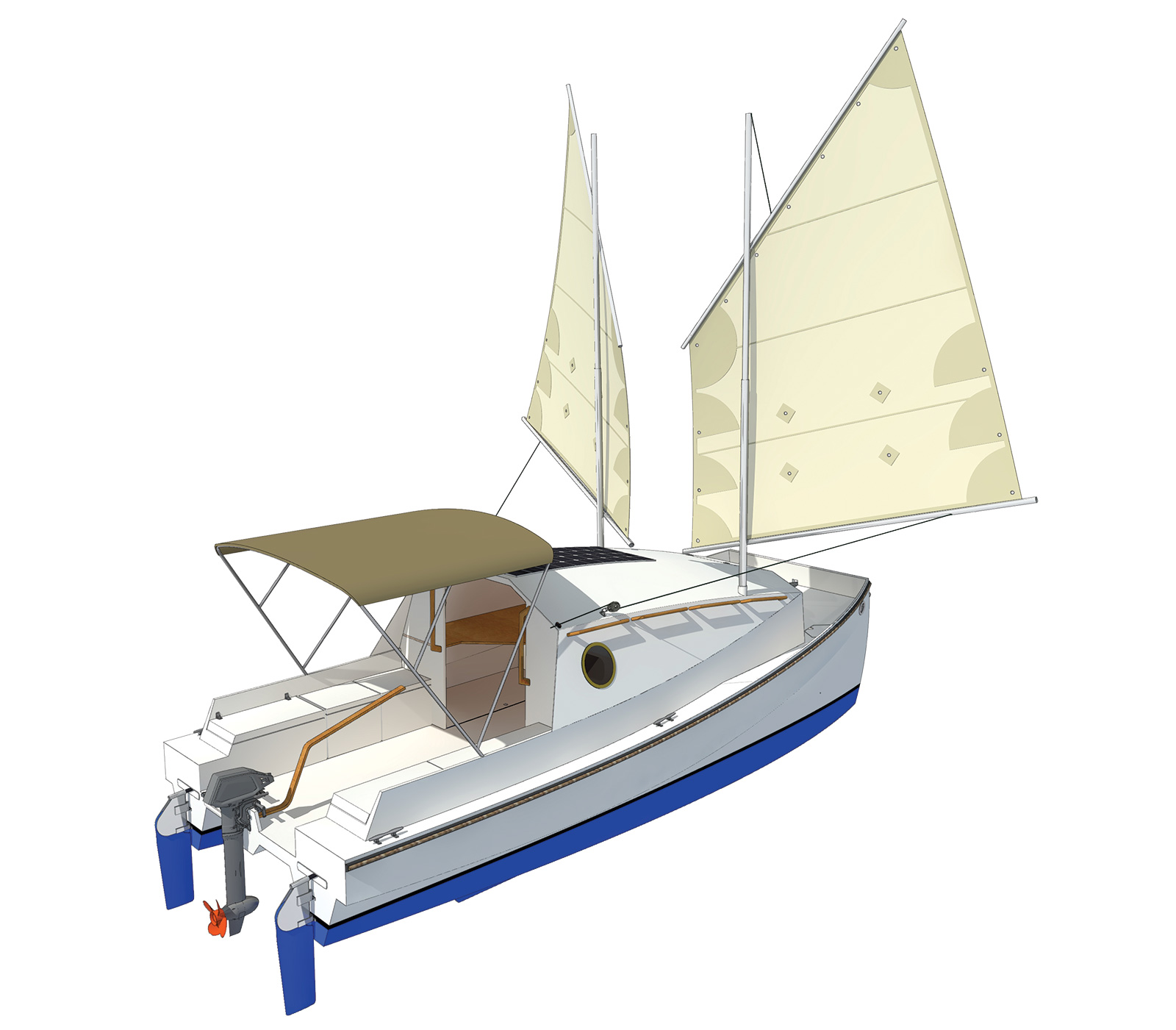
ECCENTRIS

ECCENTRIS is an unconventional mashup of a motorboat, trailer-sailer, daysailer, catboat, and catamaran. She’s meant for a retired couple looking to upgrade from a 14′ sailing skiff.

Dear JF.

I was surprised by how much I liked HUCK’N’JIM, the river-raft-styled pontoon boat concept presented in WB No. 298. Pontoon boats on the Connecticut River out here in western Massachusetts have been the bane of my existence when sailing, but your sketch opened my eyes. My wife and I are planning to graduate to bigger waters, such as Lake Champlain, and need something more comfortable than our 14′ home-built sailing skiff—something at least 17′ LOA.

Do you have any suggestions for a design that might use a similar hybrid drive for propulsion and might even have some modest sailing abilities? I’m a 74-year-old with funky legs trying to please a crew who doesn’t like “tipping!”

I’m hoping to keep the boat within legal trailering width, which somewhat limits the length. I’m trying to sell it to my wife as a “floating summer cottage” and I’m flirting with a couple of used Com-Pac Sun Cats as the bare minimum. Their mast-tabernacle system looks about right for an old guy. I really like shallow draft but don’t like a centerboard trunk dividing both the cockpit and cabin.

My wish list includes:

  • Tabernacle mast(s), roller-furling jib (if needed), and a mizzen that can serve as a riding sail.
  • An anchor that can be set and raised from the cockpit.
  • Bulwarks for security on deck.
  • A stern-mounted boarding ladder that can be deployed from the water.
  • “Single level living,” as much as possible.
  • Overhead handholds from the V-berth to the cockpit—possibly running the whole length of the cockpit as a base for a bimini or enclosure.
  • Hand holds everywhere, stem to stern.
  • Your cool hybrid power scheme with an electric outboard.
  • Solar chargers for house batteries.
  • Accommodations for two and seating for four belowdecks.
  • A minimal galley, a porta-potty or Airhead, and a solar shower in the cockpit

There must be a growing group of baby boomers who want to stay on the water, one way or the other.

—Frederick H. “Dan” Pratt
Hadley, Massachusetts

ECCENTRIS

The hulls don’t require large underwater volume. Chine flats serve as spray deflectors, lend volume above the waterline, and diminish a potential slab-sided appearance. The controlling depth is under 12″ with the rudders retracted.

Dear Dan,

I enjoyed reading of how you envision your future outings and what kind of platform would serve that purpose best. Your criteria, to me, made clear that a motorsailer would be a good candidate for you. And what better fit for an electric power plant that is somewhat limited in range than a set of sails, which has an unlimited one, while the propeller removes the tedium of going upwind or waiting for the Greek god of the winds, Aeolus, to keep up his side of the bargain? There are a variety of motorsailers out there, but in my mind, those are voluminous cruisers above a certain size with intricate accommodation. What if I drew a motorsailer that’s trailerable, mostly for daysailing, with a modest cabin for protection from the elements and the occasional overnight?  She’d be a motor-trailer-daysailer.

I ran that idea by Editor Matt Murphy and he said, “Yeah, I’m imagining it with the cockpit conviviality of a cat” and I immediately proceeded to draw a catamaran. I can see Matt from here shaking his head and saying, “I meant catboat!”  I did incorporate elements of this fine traditional craft as well; a motor-trailer-daysailing-catboat-catamaran. Now that’s a cool concept with lots of wiggle room.

Microcruiser aficionados who are reading this probably find a certain familiarity with the concept I’ve drawn. Everyone else can take a few minutes to check out the microcat MISS CINDY, designed, built, and sailed by out-of-the-box designer-builder-sailor Tony Bigras. Tony sailed his 16-footer 4,500 miles from the Sea of Cortez to Florida via Nicaragua and Cuba in 2008–09 and wrote an ebook about it, which I read avidly back when it was published. MISS CINDY, along with Matt Layden’s LITTLE CRUISER and Eric Henseval’s SOURICEAU heavily influenced what I thought of at the time as the perfect cruising sailboat. I’ve revisited Tony’s site lately, and it was still fresh in my head when your email landed in my inbox. A respectful wink would be appropriate I thought, so I borrowed the big sheer sweep, stepped chine above the waterline, and aesthetically pleasing cabintop profile of MISS CINDY. Then I went to town. The result is ECCENTRIS, an unconventional and slightly strange motor-trailer-daysailer-cat.

The Concept

ECCENTRIS Particulars

  • LOA: 20′10″
  • LWL: 22′5″
  • Beam: 8′5″
  • Draft: 12″
  • D/L ratio: 75
  • Sail area: 144 sq ft (13.4 sq m)

First, the overall dimensions: In order to trailer legally in most locations, a boat is required to measure a maximum of 8′6″ in overall beam. You mentioned 17′ as a bare minimum length, so I’m going to extrapolate that you’d be comfortable pulling a very light 22′ boat. Since your wife doesn’t like “tipping,” a multihull makes sense and lends itself naturally to having all accommodation elements on a single level.

The length overall of 22′ is long enough to balance a cabintop height that will allow comfortable sitting without being overbearing in profile. You mentioned an easy rig to set up, via a tabernacle system. Two side-by-side masts of modest size, as Bigras’ MISS CINDY has, is even better in my opinion. With a pair of small balance-lug sails, each mast weighs a little over 10 lbs, which will be a breeze for you to slide down the mast tubes.

Because she’s a motorsailer, pointing ability is not critical, so there is no real need for a keel; she’ll go reasonably well to weather without one, especially with a little push from the outboard. I sprinkled in a few catboat elements and modified them freely, and that resulted in a foredeck surrounded by a bulwark.

The ECCENTRIS cockpit.

The cockpit has standing headroom under a Bimini and leads into an open cabin on the same level.

Hull

Starting with the basics: There is no reason for a boat of this size to have a structure of wood and fiberglass sheathing heavier than 1,000 lbs, in addition to roughly 500 lbs of ancillary systems such as the outboard motor, batteries, and rig. That puts us at a displacement of roughly 1,900 lbs loaded, give or take a few hundred pounds. By maximizing the waterline length (of course!) we get an extremely low displacement-to-length ratio of 75, to produce a hull that will move very easily through the water.

The bottom of each sponson is flat, yet narrow, because we don’t need large underwater volume. The outboard topsides are split close to the waterline by chine flats (thank you Tony!) that will serve as excellent spray deflectors, establish volume in the sponsons above the waterline, and visually cut the slab-sided plywood panel. In our case, I didn’t need it on the inboard side of the hulls because the spray will not make its way on deck. I therefore let the inboard topsides run all the way to the bridge deck, which is high at the bow.

The run—meaning the after end of the hull’s bottom—is typical of multihulls in that it doesn’t come back up to the waterline at the stern, resulting in a submerged transom that keeps more underwater volume aft. Navigational depth is under 12″ with the flip-up rudders retracted, so you can beach her anywhere.

Large berth forward.

There is a large berth forward. Angled seating at the saloon table places the occupants’ bodies in the portion of the cabin with the greatest headroom.

Layout

The deck arrangement is driven by the cabintop. I wanted standing headroom in the cockpit under the Bimini and an open feel to the cabin, which serves as a shelter from sun, wind, and rain; it’s a good place to take a nap and have lunch. The port hull’s volume is sacrificed to storage. A large, removable panel exposes a head to starboard, the user getting privacy via a wrap-around curtain. There is a large berth forward and a diagonal saloon flip-up table to port. The reason for the unconventional angle of the latter is to keep the occupant’s upper body within the area of the cabin with maximum headroom.  During meals, this arrangement would give the feel of sitting adjacent to each other at a square table in a restaurant on Valentine’s Day.  When stowed away to open up the sole plan, the part that stays up becomes a navigation station or work desk.

Instead of fixed seating, I replaced the port-side cockpit seat with two boxes that can be unlatched and moved around. Secured in the cockpit, they’d look very similar to the starboard-side seating but would be moved to the cabin during meals or at anchor. One could replace these boxes with similar-sized off-the-shelf coolers. The after end of the cockpit is wide open, which allows you to climb up or down the stern very easily. If the boat is beached you’d be able to walk right off the stern. If anchored in deeper water, you can use the telescoping ladder to port. For your peace of mind, you might latch a lifeline across the after end of the cockpit while underway.

One can walk around the cabin via the side deck, using the plentiful handholds, to the rather spacious foredeck, which is organized around an anchor roller, samson post, and a couple of self-bailing anchor lockers. Alternatively, you could crawl over the berth and open the large hatch to access the anchor directly from the cabin. There’s no need for a door in the cabin; a snap-on canvas partition will do a great job of keeping the no-see-ums out, give you some privacy at night, and mitigate stuffiness in the cabin.

Rig and Sail Plan

The beauty of keeping the boat light is that it requires very little canvas to move it. And nothing goes to windward like an outboard. Jokes aside, a couple of 72-sq-ft sails bring the sail-area-to-displacement ratio to 15, which is excellent for your needs. This amount of canvas will keep you out of trouble and remain manageable in just about any conditions; there’s very little danger of capsizing, even if you tried. And on days that you don’t feel like sailing, just leave the sails on the trailer and motor around. The longitudinal distance from the center of effort of the rig to the center of lateral resistance underwater, which is called the lead, is 1′11″, or 9 percent of the LWL. That figure is on the high side for a multihull and on the low side for a traditional catboat, thus striking a good balance. A couple of reefs will increase the versatility of the rig.

The range with this motor is 14 miles at 70 percent power.

A 10-hp (8kW) motor yields a top speed of 8.5 knots. The range with this motor is 14 miles at 70 percent power; motorsailing will increase this considerably.

Power

Speed prediction gets a little foggy when analyzing catamarans because they punch right through their theoretical hull speed before lifting out of the water, and the narrower the sponsons the truer this is. As a basis, we can safely say that ECCENTRIS will reach 6.2 knots, a speed-to-length ratio of 1.34 (the traditional hull speed) with roughly 4 hp. You can see that, as usual, the speed requirement curve is very tame at low speeds and gets seriously steeper above 6 knots. I originally thought of using roughly 20 hp (15kW) to get a top speed of 10.5 knots. In reality, reducing the outboard size by 50 percent to about 10 hp (8kW) only cuts 2 knots from the top speed. The expense and weight just might not be worth it.

Using 10 hp as my power source, I’d get 14 nautical miles out of running it at 70-percent throttle, with no sails up, which is a good range for a typical day out. Now, if the sails are up and half that power is generated by the wind, my range increases to a very comfortable 27 miles—and that’s with a single 8kW outboard motor powered by two 5kW lithium batteries. We have to be careful about battery capacity, keeping in mind that ECCENTRIS has a displacement-to-length ratio of 75. That is extremely low, and only possible because we are using wood-epoxy and keeping systems to a minimum, so here you’ll want to stay away from lead batteries.

Construction and scantlings and systems

The hull is built of 6mm okoume plywood sheathed on both sides in 6-oz cloth set in epoxy. the bridge deck (which is also the cockpit and cabin sole) is of 18mm okoume, and the bulkheads and seat tops are 9mm. The cabin trunk is all in 6mm plywood, sheathed on the outside. Douglas-fir cleats and structural stringers under the seats and berths add stiffness without much added weight. There are foam-filled crash boxes under the anchor lockers. The twin rudders are linked via a tie bar that runs inside a little step-up box on the cockpit sole to declutter the space. The tillers pass through the transom, which is made watertight by a rubber boot. In turn, the tie-bar is connected to a tiller amidships.

I hope you like my little motor-trailer-daysailer-cat-cat experiment. I think she’s got a lot of charm and is quite practical on the water, and she certainly deserves to be called ECCENTRIS, which, as noted above, is defined as unconventional and slightly strange. On the practical side, the stability and ease of use might help you enjoy many more years on the water.

Happy motorsailing!  Article ends.

JF Bedard is a graduate of the Westlawn Institute of Marine Technology. He owns Bedard Yacht Design (www.bedardyachtdesign.com) of Tarpon Springs, Florida.

Please send concept proposals for Sketchbook to sketchbook@woodenboat.com.