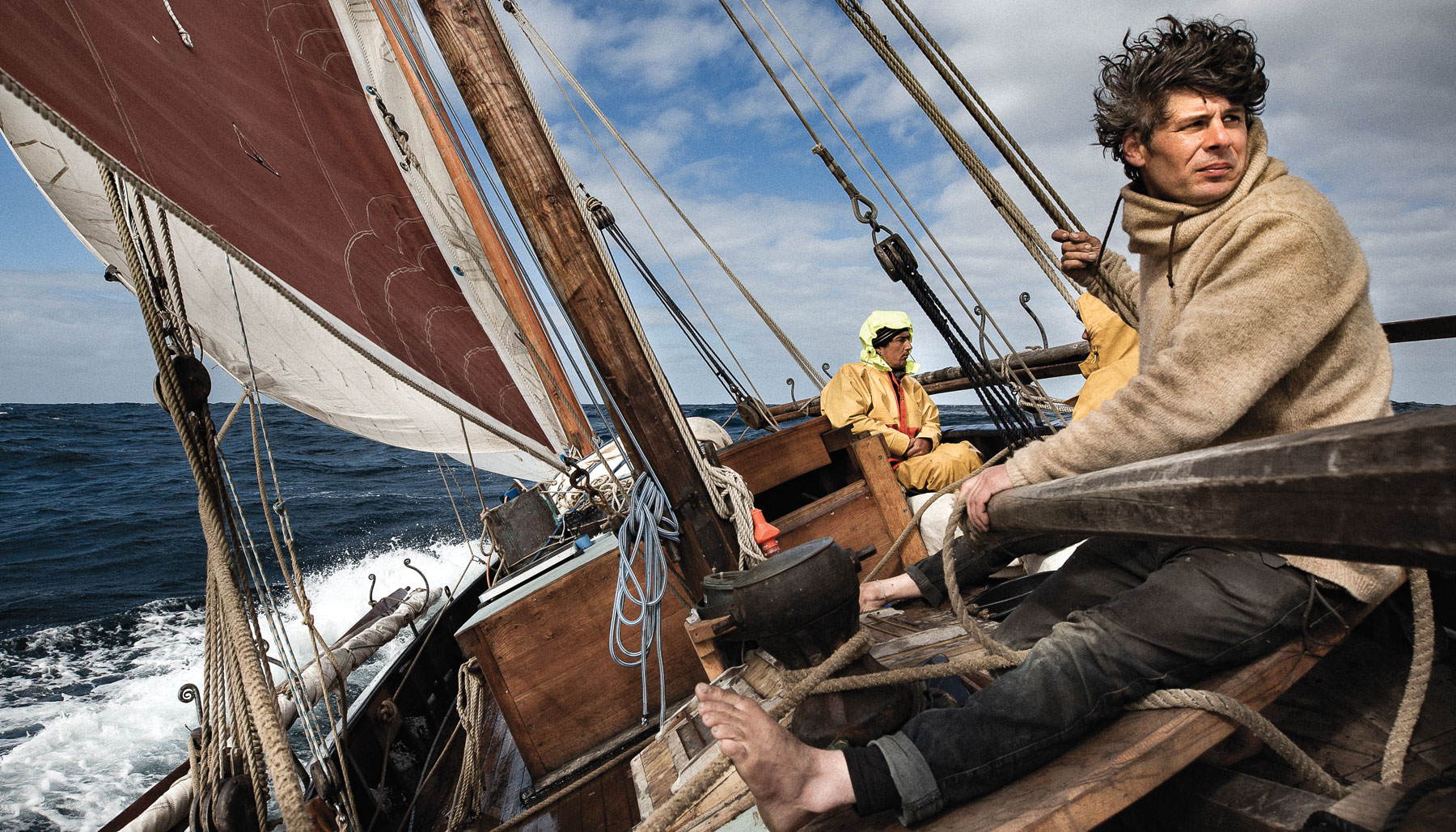
The 43′ Scottish Zulu MAGGIE HELEN.

Since 2004, the Breton shipwright Benoît Cayla has led a string of remarkably efficient and intense working-vessel reconstruction projects. Here he is at the helm of his group’s most recent relaunching, the 43′ Scottish Zulu MAGGIE HELEN as the vessel returns from Brittany to the village of Mousehole in Cornwall, England, in July 2024. The boat was rebuilt in summer 2022 mostly using available and recycled materials.

To an outside observer, it might all have seemed a bit chaotic, anarchic even. In Lerwick, on the Scottish isle of Shetland, during the summer of 2022, as many as 15 people at a time worked 12-hour days, seven days a week, to restore the 1904 Zulu-class fishing boat MAGGIE HELEN. They came from all over Europe—France, Holland, Italy, the U.K. They were boatbuilders, riggers, and mechanics, all with varying degrees of skill. They worked for free because they believed passionately in the project and wanted to see the vessel sailing again. Some hoped to join her at sea; others were just passing through and enjoyed working with a group of like-minded people.

Despite the apparent disorganization, it was a highly focused operation that completed the job with remarkable speed. After some initial skepticism over one of the island’s historic craft being rebuilt by a bunch of foreigners and taken away from its home, the local community got behind the project and donated all manner of things, from lead for the ballast to the old mizzenmast that had been stored in someone’s house. There were even cash donations to help feed the hungry workers. After three months of intensive work, this friendly enterprise achieved what a fully funded professional yard would have struggled to do: they got MAGGIE HELEN sailing for the first time in 60 years and headed off over the horizon to a new life.

The restoration of MAGGIE HELEN was just the latest in a string of remarkable projects led by the Breton boatbuilder Benoît Cayla and his colleagues Élise Neau and Bleuenn Chorlay. Their run of success began with the 1964 Loch Fyne skiff ROSE OF ARGYLL, which Benoît and a friend restored in 2004–09, and which was followed by the 1926 Danish fishing ketch SWALLOW (ex-GENARA) restored in 2011–21.

The group has developed a distinctive approach to restoring old wooden boats, one that is highly skilled yet functional; it is respectful of tradition but not purist. You might say the boats are low-tech but possess a high aesthetic value; they are rustic rather than smart, in the way a log cabin is beautiful compared to a modern glass house.

I first met Benoît when he and his crew sailed SWALLOW into Falmouth, England, in June 2021. They had left France a few days before, near the end of the third Covid lockdown, because they were impatient to sail the boat after their 10-year restoration. They headed out of Aber Wrac’h in northern Brittany not really knowing where they were going, but the wind stood fair for Falmouth, so that’s where they went. I happened to be in Falmouth on my boat, and as soon as I heard they were anchored off the docks I went over to say hello. It turned out they didn’t have the paperwork needed to visit the U.K. at that stage of the pandemic and, with the Border Force keeping a close eye on proceedings from the other side of the harbor, I wasn’t allowed to even step aboard let alone sail with them. They were forced to leave the following day.

I saw enough during that brief visit to know it was a project worth pursuing. The rough finish—mostly bare wood sealed with linseed oil—concealed a high standard of craftsmanship. As a longtime fan of the book Handmade Houses: A Guide to the Woodbutcher’s Art, by Art Boericke and Barry Shapiro (Scrimshaw Press, 1973), I felt a great affinity with this pared-back, rugged approach to woodworking. The closest equivalent I’d seen on a boat was on the 1878 Lowestoft drifter GLEANER, which Spike Davies and friends dismantled and rebuilt in Penryn in 2013–18—and indeed the two groups know each other and go to each other’s boat parties.

MAGGIE HELEN at the Shetland Museum & Archives.

MAGGIE HELEN was rebuilt at the Shetland Museum & Archives in Lerwick, in the very shed where she was originally built in 1904. Up to 15 volunteers worked for three months to bring her back to life.

It was three years before I managed to catch up with Benoît, Élise, Bleuenn, and SWALLOW again, and much had changed in that time. Not least was the acquisition and restoration of MAGGIE HELEN, the new darling of the fleet. There was no lockdown this time, so they went to Mousehole, in Cornwall, for the annual Sea Salts & Sail Festival in July 2024. The French contingent has been a regular feature of the festival for the past 10 years, first with the engineless ROSE OF ARGYLL, which they sailed or sculled through the narrow harbor entrance, and then with the two bigger engineless boats in which they carry on the same tradition.

I joined SWALLOW, skippered by Élise, for the first day of racing at the festival. At 55 tons, she’s a heavy boat, and we had 10 crew on board to handle the sails. The day’s crew included a contingent of boatbuilders from Ullapool whom Benoît and Élise had befriended on a previous trip to Scotland and who had come down to lend a hand. This Breton posse make friends wherever they go, it seems.

The 1926 Danish hajkutter SWALLOW.

The 1926 Danish hajkutter SWALLOW was the second project undertaken by Benoît and friends. It took them 10 years to get the boat sailing again. She is seen here sailing in Scotland in 2023.

Some things are easy on SWALLOW: a large electric windlass operated by a small engine in the saloon hauls the anchor chain back aboard, link by link. No such luck when it comes to the mainsail, jib, foresail, and mizzen which all have to be hoisted by hand. Once the sails are set, the boat’s loose-footed mainsail has to be re-sheeted on the leeward side, along with the jib and staysail, on each tack. Only the mizzen is self-tacking.

Élise was a calm presence at the helm and the only shouting onboard was the regular call of “Oh-hisse!” (“haul away”) as the crew lined up, sometimes five deep, to haul in a sheet. We were soon powering along at 8 or 9 knots, though it felt like less due to the size of the boat. As we romped across Mounts Bay toward the iconic St. Michaels Mount, the boat hit her stride and one could feel the power of her huge “dandy” rig (gaff main, lug mizzen). But all too soon we had to turn around and head back toward Mousehole for the next lap of the race.

Later, I asked Élise what attracted her to this precarious lifestyle.

“The sea and the people,” she said. “The boat is just a tool to be with other people. To share with others. We have lots of friends and going sailing is an opportunity to be together. With a big crew like this, you have put your trust in others. Everyone is important. When each person finds their place, then it’s great.”

Bleuenn Chorlay professional boatbuilder.

The professional boatbuilder Bleuenn Chorlay was closely involved in rebuilding both SWALLOW and MAGGIE HELEN.

How did it all begin? I arrived early the next morning and, in the comfort of MAGGIE HELEN’s cozy saloon, Benoît talked me through the past 20 years and three boats. Brought up in Morlaix, in northern Brittany, Benoît trained as a furnituremaker before switching to boatbuilding. He and a friend, Cyrille Hébert, were looking for a boat to learn to sail on and were naturally drawn to wood.

“We didn’t have any money,” he said, “so we bought a wreck.”

ROSE OF ARGYLL was a replica of a traditional herring-fishing boat from the west coast of Scotland. She was designed by James McGruer (better known for his line of smart 8-Meter cruiser-racers) and built at the James Adam & Son yard on the River Clyde in 1964. After several decades of cruising, the 33′ lugger ended up in a sorry state in the Golfe de Morbihan on the west coast of France, which is where Benoît and Cyrille found her in 2004. They embarked on a five-year restoration with all the zeal of new young converts. Initially, they used only hand tools, although they acquired a few handheld power tools along the way.

“In the beginning, we tried to be more traditional,” said Benoît. “We wanted nice sails, the correct fittings.” They soon realized, however, that “it was too expensive to work in this way. We had to recycle and use the materials we had. We couldn’t be purist—and really, I don’t want to be anyway. It’s hard work if you always have to buy the exact right wooden block instead of maybe using a galvanized block, which will work equally well.”

ROSE OF ARGYLL was an ideal boat in which to practice this approach, because nobody would complain about someone altering a 50-year-old working-boat replica that had been on the verge of disintegrating before its rescue. And, once finished, the boat made a striking sight with her dipping-lug rig with non-original mizzen topsail and boomkin, her oiled timbers, and her assortment of young crew on board. Who cared if it wasn’t exactly what a Loch Fyne skiff would have looked like in the late 1800s? This was the 21st century, and it was enough that there was someone with the skills and imagination to bring an old wooden boat back to life and share the experience of sailing a traditional rig with another generation of young people.

After a year or two of sailing ROSE around Brittany and taking part in several maritime festivals, Benoît and Élise began seeking a bigger boat to restore. During a visit to Falmouth, they heard about a Danish hajkutter being used as a houseboat on the beach at Penryn. Although the type’s name translates literally as “shark cutter,” hajkutters didn’t actually catch sharks. They were fishing vessels that operated under sail and power and were said to be as voracious as sharks. Hence the name. SWALLOW (ex-GENARA) was built in 1926 and operated out of Grimsby, on the East Coast of England, until 1989.

By the time Benoît and his friends spotted her, she was in a sorry state and needed patching up just to get her moving again. Undeterred, they jury-rigged an engine and emergency rig and motored the decrepit boat across the English Channel to Brittany. They started work on a beach on the Aber Wrac’h estuary but were soon told to leave by the local authorities. Instead, they found a home at Association des Amis de Jeudi-Dimanche (AJD). Formed in 1951 by a Jesuit priest named Michel Jaouen, this organization helps disadvantaged young people through a variety of programs, including expeditions in their large schooners, BEL ESPOIR and the RARA AVIS. They also run a boatbuilding school on the coast at Lannilis, where SWALLOW soon became a part of the scenery.

The original idea was to restore a bit of the boat each winter and go sailing each summer. But after a couple of years, as the extent of the needed rebuild became apparent, Benoît realized that plan was impractical and that only a thorough rebuilding would work. They were already working in conditions that would have horrified most people.

“The tide was coming in and out of the boat two times a day,” Benoît said. “The boat was sinking. We tried to keep her afloat for the first two years, but when we started [removing] the framing, all the planking moved and it was too much work to keep her floating. We went on board at low tide to make the templates, and when the tide came in we went on shore to make the frames. We made dry storage for tools, and fixed the deck quite quickly so the rain didn’t get in. After five years, she was floating again.”

It was a massive undertaking. They ended up replacing the stem, keelson, sternpost, and rudder, as well as most of the framing, deckbeams, and planking. Benoît estimates they used about 20 cubic meters (706.3 cu ft) of wood every year—mostly oak and a bit of larch—much of which ended up as waste. “We didn’t know how much work it would be at the beginning,” he said. “But when we put in the first frame, it was already too late to go back.”

Most of the fittings were recycled or bought secondhand, regardless of whether they were age-appropriate for a 1926 hajkutter. Even the mainsail was cut from an old mainsail of the 19-Meter yacht MARIQUITA, donated by a local sailmaker. They didn’t take any chances with the glued hollow masts, however, which were made from the best Douglas-fir shipped from the United States.

Finally, in June 2021, after nine years of hard work, SWALLOW was complete and her saviors decided to go sailing, pandemic or no pandemic. And that is when, thanks to a useful tip from my boatbuilder friend Ashley Butler, I met them in Falmouth for that brief encounter across the water. None of us knew at that moment that they were on the verge of their third major rebuilding adventure.

Chiara Di Modica

Chiara Di Modica, a forecast data analyst, took time out from her career to help rebuild HAWILA in Denmark and later MAGGIE HELEN in Shetland.

From Falmouth, the group headed north to Scotland, visiting Ullapool, where they were introduced to the local boatbuilding community. There, they heard about another volunteer project, the rebuilding of the 114′ Baltic trader HAWILA in Denmark, for sustainable cargo transport. It was an idea that fitted their ethos, so they decided to sail around the north of Scotland and across the North Sea to help the effort.

“We wanted to go to the Orkneys and then straight to Denmark,” Benoît said. “But the wind was too strong. So we decided to sail to Shetland instead. We had to wait a week for the weather to change, so we went to the maritime museum to pass some time. That’s when we saw MAGGIE HELEN.”

For years, Benoît had been obsessed with Zulus (see WB No. 113)—a particular type of Scottish fishing boat with a plumb stem and dramatically raked sternpost, described by author Mike Smylie as “the mightiest of all British sailing fishing craft.” A few years earlier, he and Bleuenn had spent several weeks hitchhiking around Scotland looking for information about Zulus and hoping to find one they could restore. It had all come to nothing, until now.

Bleuenn fairs a forward frame.

Bleuenn fairs a forward frame in MAGGIE HELEN. About a third of the frames were replaced and a new stem was fitted.

MAGGIE HELEN had been built in 1904 by Hay & Co. in the very shed where she now sat as a museum exhibit. After nearly 50 years of fishing, she had been converted into a yacht in 1952 with the addition of a Bermudan schooner rig. Renamed LOKI, she was sailed extensively around Shetland and to Scandinavia. Eventually she was converted into a motorboat. By 2007, she had been placed in the maritime museum at Lerwick and was partly restored over the next two years, until the funds ran dry. The museum’s curator, Ian Tait, had searched far and wide for someone to take the project off their hands, but the logistics of transporting the boat from Shetland had put everyone off—until Benoît and his crew came along.

“At the beginning, nobody wanted it,” Benoît said. “We had just finished SWALLOW, and they didn’t want another project. But I had been interested in Zulus for a long time, so for me it was a lucky chance. When we arrived in Denmark, I rang the museum and said, ‘Okay, I will come back in the springtime and I will find a way.’ I didn’t know how long it would take. I thought maybe I’d come back on my own and rebuild her slowly. Then I spoke to a few people, and many of them were enthusiastic to come back.”

Benoît marks a piece of timber.

At his shop in Brittany, Benoît marks a piece of timber. Many of the components for MAGGIE HELEN were prefabricated in France and transported, along with much of the new wood, aboard SWALLOW to Lerwick.

It must have seemed like a long shot, that a boatbuilder based 800 miles away would take on such a major project in such a remote location. The Shetland Islands lie 100 miles north of mainland Scotland and 200 miles from the coast of Norway. The main form of transport to the islands is a 12-hour ferry journey from mainland Scotland.

Benoît, however, had a plan. While he was in Shetland the first time, he took patterns and measurements of the main parts that needed replacing, such as the bulwark stanchions, sheer clamp, sternpost, rudder, deckbeams, and coach roof. After sailing SWALLOW to Denmark and working on HAWILA for a few weeks, he and some of his crew returned to Brittany, where over the course of that winter they made many new pieces, mostly using wood left over from SWALLOW and other projects. Come the spring, they loaded up three vans with everything they needed and drove back to Denmark.

One of the victims of the incoming tide during those years working on SWALLOW at Aber Wrac’h was a rather fine Gardner diesel engine, which had rusted up beyond redemption. They had sailed the boat without the engine so far and, rather than waste time trying to fit a new one, had decided to get rid of the old Gardner and not replace it. They would use the freed-up space to load the 7 tons of tools and materials they had gathered for the new project.

On March 15, 2022, SWALLOW left Denmark and headed north on her rescue mission. On board was a big pile of wood (Shetland being famously treeless) and a large crew of volunteers who had responded to the word-of-mouth appeal for help. They arrived in Lerwick on April 10 and soon got to work. They had planned to take Sundays off, but as the scale of the task became apparent, they ended up working seven days a week, often starting at 8 a.m. and going late into the night.

Élise arrived with a crew to sail SWALLOW to Norway, where the boat had been hired as part of a circus tour to raise awareness of climate change and raise funds for the rebuild. Someone else arrived from Brittany with another van-load of wood. Once SWALLOW had gone, there were eight regular crew and occasional visitors working on MAGGIE HELEN.

There was Tom Lamoureux, who had worked on the HAWILA project but lent his expertise sourcing timber for the rebuild. There was Max, a former AJD trainee, who left his boat in Greece to join the team. There was Ellie Reynolds Feeney, a graduate of the Boat Building Academy in Lyme Regis, England, who had previously worked on the Ceiba Sailcargo project in Costa Rica, and considered herself lucky to be working with lumps of timber rather than sweeping the workshop floor. There was Akim, a boilermaker who had never set foot on a boat before but nevertheless made a fine set of keelbolts. And there was Chiara di Modica, from Italy, who took charge of the rigging.

MAGGIE HELEN.

After a lightning-fast rebuild, MAGGIE HELEN set sail for Norway. Here, Benoît is at the helm and the British boatbuilder Ellie Reynolds Feeney, director of the HAWILA project, is at right.

For many of us who are tied to a salary and mortgage and looking after children or other dependents, it’s hard to imagine giving three months of our life to any endeavor for free. And indeed, one boatbuilder did complain to me that projects such as Ceiba take advantage of people’s good nature and that their leaders should factor in salaries for all the workers from the outset. Yet, if that had been done in MAGGIE HELEN’s case, the restoration almost certainly wouldn’t have happened, and she would still be languishing in her shed in Lerwick. I was struggling with this idea, until I read some words in the French magazine Le Chasse Marée by one of the project leaders, Bleuenn (here translated from the original French):

Some people need the boat to belong to them to do it up. Not me, not at all. I don’t see the point in owning my own boat. Here, I know there will be nine bunks on board, that we will sail on it; that’s enough for me. We didn’t do any calculations at the beginning to work out how much it was going to cost us. I’m not interested in knowing in advance, otherwise you say to yourself, “Holy cow, how are we going to find all that money!” Stop asking yourselves a thousand questions and dare to do things, that’s something we learnt from the AJD, from Michel Jaouen.

(left to right) ROSE OF ARGYLL, MAGGIE HELEN, and SWALLOW.

The fleet, seen here at home in Brittany before setting off for Mousehole in June 2024, consists of (left to right) ROSE OF ARGYLL, MAGGIE HELEN, and SWALLOW.

The start of the work was hard. After a month and a half, things are better, we have a plan. It’s great to think that we’re laying the frames now, and that in two months we’ll be at the helm. That’s what motivates me. I think about it all the time. A bit of sun, a little breeze, and that’s it; it makes you want to go and fit some planking so you can sail. There are projects that can take ages; they run out of steam. But I know we’ll soon be finished, we’ll leave, and we’ll find SWALLOW somewhere out at sea. It’s going to be so beautiful.

And so it was. MAGGIE HELEN left Lerwick on July 22, just over three months after Benoît and friends arrived on the island. Her maiden cruise was across the North Sea to Norway, where she joined SWALLOW for the rest of her circus tour. She spent that winter in Denmark before sailing to her new home in Brittany the following year. Already, she had welcomed dozens if not hundreds of people on board.

MAGGIE HELEN (left) and SWALLOW.

Benoît and friends returned to Scotland in 2024, after the Sea Salts & Sail Festival in Mousehole, sailing two of the three boats: MAGGIE HELEN (left) and SWALLOW.

Back in Mousehole, I joined MAGGIE HELEN for the second day of the Sea Salts & Sail Festival, with Benoît at the helm. Although much smaller than SWALLOW, she is in some ways a harder boat to sail due to her dipping-lug rig. There were seven crew aboard that day, several of them newcomers like me, so not yet fully effective as crew. It was certainly not the slickest operation, and the local luggers such as the Manx nobby GLADYS and the Looe lugger GUIDE ME swept around the course in a league of their own. Meanwhile, MAGGIE HELEN looked as though she had sailed straight out of a Mad Max movie: a breathtaking spectacle of how much can be achieved with very little.

The complicated rig seems to be one of the main reasons Benoît likes the boat so much. “I really like this maneuver, this dipping lug,” he said. “It’s interesting to learn. You must really coordinate with the other crew; you can’t do it on your own. If someone is too slow, you have to adapt. You have to take care of all the crew.”

Lowering SWALLOW’s staysail.

Sail handling—including lowering SWALLOW’s staysail—calls for experience in traditional rigs.

It’s all about the crew. Which reminds me of what Élise said to me the day before: “The boat is just a tool to be with other people.” But it’s a big logistical operation organizing so many people—a total of 80 worked on SWALLOW and MAGGIE HELEN at various times during the summer of 2022. And it seems the times are changing. Every year, Benoît says, it gets harder and harder to find enough crew to sail all three boats, as their friends become older and more settled, and start families. Running three wooden boats is expensive too, so they will almost certainly have to sell their first project, the pretty ROSE OF AGYLL. The money raised might then be used to fund another project.

MAGGIE HELEN at anchor.

MAGGIE HELEN, seen here riding at anchor in Denmark in September 2022, has no engine, and neither do the other two boats. All are maneuvered entirely under sail and oars.

Benoît talks as if it’s the end of an era, but I doubt this is the last we’ve heard of him and his troupe. While they were in Scotland, he was given the plans for an 80′ Zulu, an absolute giant of a boat. Meanwhile, back home in Brittany, he has been collecting timber for another big project. You can be sure that if he decides to go ahead with building his dream boat, he will soon gather a group of happy volunteers only too pleased to work on another mad boat project with him.  Article ends.

Nic Compton is a regular contributor to WoodenBoat.

Photographer Nedjma Berder is a director of cinematography specializing in documentaries. He went to sea at a young age which, he says, taught him to “open my eyes and sharpened my senses.” He has published two books of photographs: Pécheur d’Iroise, which follows the lives of Breton fishermen; and Bel Espoir, which is about the Association AJD (see main text) and the rebuilding of its eponymous three-masted schooner. He lives in Douarnenez, France.