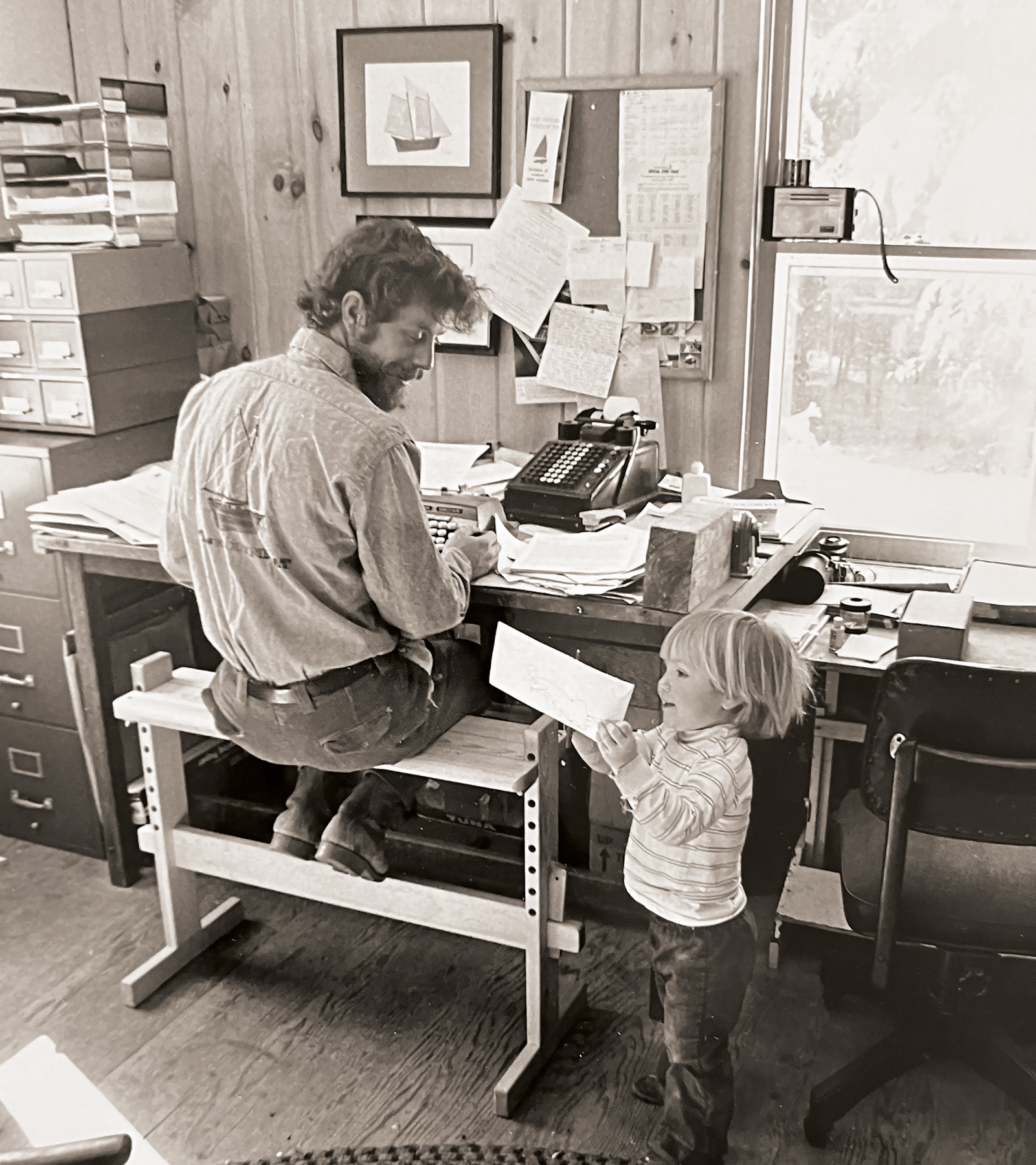
Craig MilnerWith his son Christian assisting, WoodenBoat founder Jon Wilson, soon after his return from the Annapolis Boat Show in 1974, works on an early issue of the magazine from his off-grid home office.
Maybe it was fate…or maybe just a happy accident. But Jon Wilson and The WoodenBoat, Volume 1, changed a lot of lives, mine included. It began for me on a bright warm, autumn day at Annapolis, Maryland, in 1974.
But first a bit of backstory. I was 26, a young writer, sailor, and wooden boat custodian fresh from graduate school in New Hampshire. In 1974 I had been drawn from New England by the possibility of a teaching job near the shores of Chesapeake Bay and a search for my roots.
According to family lore, I was descended from the bay’s watermen, so I had begun to explore the watermen’s ports of the Chesapeake. In late winter 1974, I was in Cambridge, Maryland, when I got my first glimpse of working skipjacks. Four boats were unloading their daily catch of oysters at the wharf. I was blown away by their graceful sheers, long and proud bowsprits, raked masts, and immense amount of oyster grit. The crews had a rugged independence, a distinct drawl, a comical litany of hard-times tales, and a peculiar way of calling their shipmates “honey.” The scene struck me as a tableau from a hundred years ago, and something about these crews and their skipjacks seemed simultaneously foreign and hauntingly familiar.
I wanted some of that. So when I saw “Tilghman Island” written as the hailing port on the transoms of the skipjacks, I knew Tilghman would be the next stop on my search for my roots. But the teaching job, and a summer of reconditioning and sailing a tired Wianno Senior knockabout on Cape Cod, intervened.
I didn’t get back to the Chesapeake until that sunny fall day in ’74 at Dock Square in Annapolis. It was the annual boat show—part fall ritual, part fair, part carnival. But while the show teemed with happy people and gleaming boats, I found myself feeling a bit estranged from the euphoria surrounding the rafts of fiberglass production boats that I could neither afford nor relate to.
Then I turned a corner on one of the alleys between vendor kiosks and there was Jon Wilson, not much more than a kid my own age in a rugby shirt. He was seated in a tiny cubby of a kiosk decked out with a WoodenBoat banner and smiling at me over a stack of magazines. There was something about that smile, both gentle and playful, that drew me in.
“It’s a new magazine,” he said. “You like wooden boats?”
I told him about the Wianno Senior that had stolen my heart on Cape Cod.

The WoodenBoat No. 1 featured on its cover the Murray Peterson–designed schooner SILVER HEELS.
He handed me a copy of The WoodenBoat, as it was then called, issue No. 1, with the iconic photo of the Murray Peterson schooner SILVER HEELS under full sail on the cover. I pictured myself at her helm and my mind started to turn to crème brûlée.
“We’re an alternative to all the other boating magazines that do not cover wooden boats anymore,” he said as I thumbed my way through the full feature about SILVER HEELS. The schooner and the photos were breathtaking.
“Sign me up,” I said. Then, as I was sinking deeper into SILVER HEELS and her story—telling myself that maybe someday, if I were very, very lucky, I would own a schooner like that—I had an idea. I told Jon I was a writer. Would The WoodenBoat be interested in a story about skipjacks.
“What kind of story?” asked Jon. “Oyster dredging?”
He looked a little skeptical, as if a story about oyster dredging was more suited to National Fisherman, so I shifted gears in my mind.
“I was thinking more like a story about the Sandy Point skipjack race at the beginning of November.” I told him it kicked off the oyster season and drew skipjacks from up and down the bay. It was a celebration of wooden boats.
Jon’s eyes lit up.
“How about if I join the crew of a boat from Tilghman Island?” I said I had a photographer friend. We could do the story on speculation.
“Hell, yes,” said Jon. “Go for it.”
Buoyed by his optimism, confidence, and enthusiasm, that was the day I took my first copy of WoodenBoat and headed to Tilghman Island. That was the day I befriended two skipjack captains, Bart and Wade Murphy, and gained some credibility as a seafarer and writer with them by showing them my copy of The WoodenBoat. It was the day I became a greenhorn skipjack deckhand. My story about the race appeared a few months later in WB No. 3.
That story launched my career as a maritime writer. It wasn’t long before I was writing regularly for WoodenBoat and other nautical magazines such as Sail, working as a part-time waterman on the Chesapeake, and getting my 100-ton master’s license. Then Jon asked me to be the Chesapeake Bay editor for WoodenBoat, and my narrative about the skipjack race became the opening chapter of my first book, Watermen.
Over the succeeding decades, while writing features for WoodenBoat, I have watched the magazine grow from the dream of a young New England boatbuilder. I have watched as the “WoodenBoat phenomenon” has celebrated an art form, its practitioners, and its lovers. I have witnessed WoodenBoat drawing together watermen and yachtsmen, builders and modelers, tinkerers and collectors, dreamers and designers, landlubbers and seafarers, children and grandparents. WoodenBoat has become an inspiration, a community builder, and a forum for tens of thousands of like-minded people around the world. In short, Jon and his dream have given us roots for our restless souls.
“That’s the right smart o’ it, honey,” as I learned to say after a well-sailed race aboard a skipjack. ![]()
Randall Peffer is the author of more than 25 books. His work has appeared in National Geographic, Smithsonian, international travel magazines such as National Geographic Traveler, and the adventure sections of U.S. major metro dailies such as The New York Times and The Washington Post. He has never lost his affection for wooden boats; their builders and custodians; the magazine; and its founder Jon Wilson. He has published approximately 70 features in WoodenBoat.
Jon Wilson vividly remembers meeting Randall Peffer at the Annapolis Boat Show in 1974. He also recalls meeting the boat designers Thomas Gillmer, Melbourne Smith, and Mike O’Brien at the same event. Gillmer’s and Smith’s considerable efforts have been covered in the magazine over the years since, and O’Brien, who was senior editor for more than 25 years, still serves as boat-design editor.