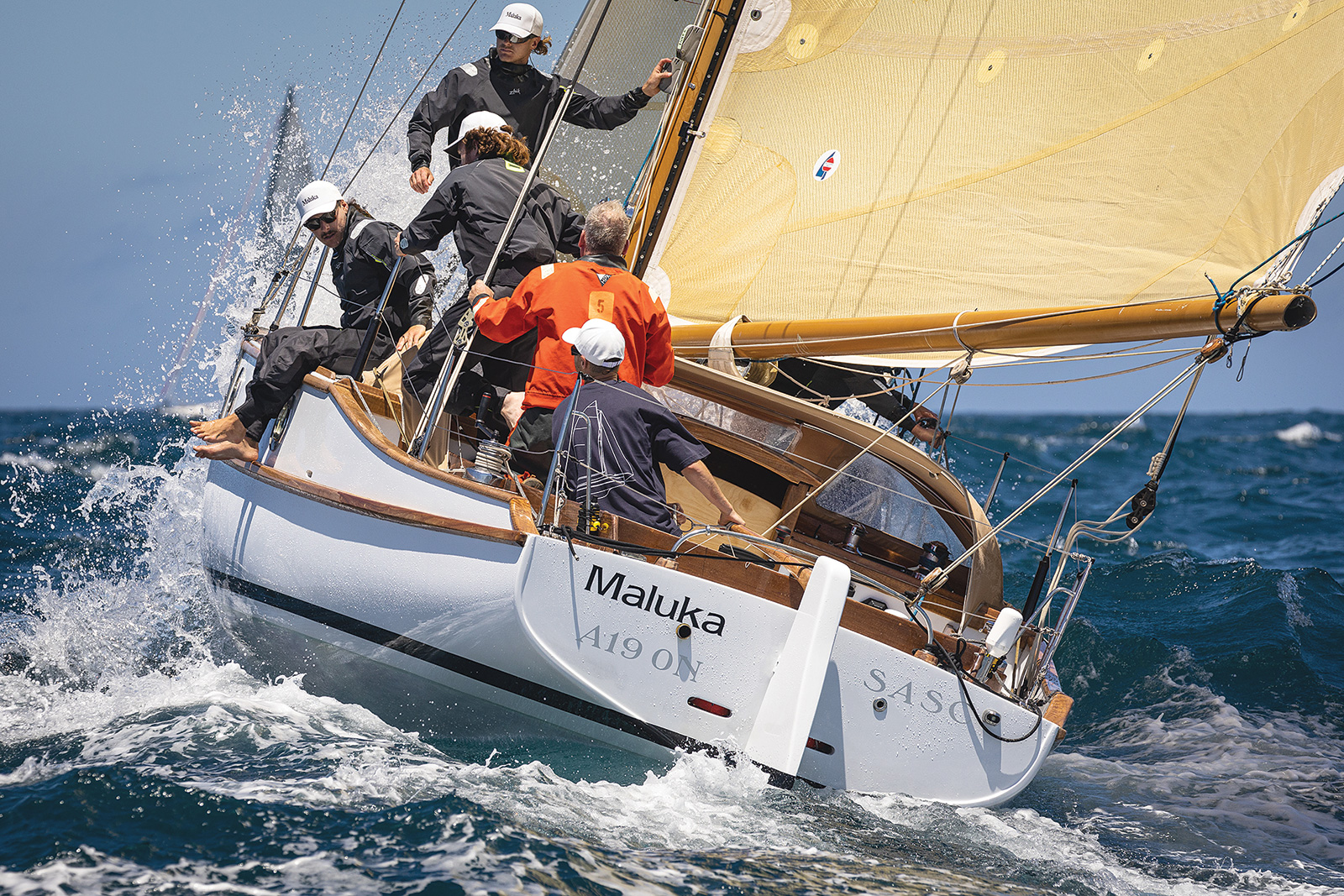
Courtesy of Rolex/Andrea FrancoliniMALUKA raced in the 2022 Rolex Sydney Hobart Race with Peter Langman at the helm. She has taken part in eight Sydney Hobart races so far, winning her class in 2016 and 2022. At 28′ LOA, she’s invariably not only the smallest competitor but also the oldest (at 91) and the only one carrying a gaff rig.
It was a wild and windy start for the 2023 Rolex Fastnet Race last July. Winds of over 40 knots screamed down The Solent as a fleet of 430 yachts battled across the starting line off the Royal Yacht Squadron in Cowes on the Isle of Wight. The wind was from the southwest, which meant the fleet had to beat to windward as it headed past The Needles at the island’s western extremity, down the English Channel, and onward to the Irish Sea. One boat sank, four were dismasted, and more than 100 entrants retired within the first 24 hours. Who could blame them?
Despite the dire conditions, one little boat toughed it out long after many much bigger competitors had given up. The 28′ MALUKA had been shipped 11,000 miles from Australia, and nothing was going to stop her highly committed crew from completing the course. She might have been the smallest and the oldest boat in the fleet, but her progress in the first 24 hours was nothing short of outstanding as she hugged the south coast of England, sailing the shortest possible course, while the “big boys” fought it out in the English Channel.
The next day, skipper Sean Langman summed things up in his own inimitable way: “Been a little fruity out here,” he wrote on Facebook. “Little MALUKA and crew toughed out a big night. Now reaping beautiful sailing.”
Courtesy of Australia National Maritime MuseumIn this 1930s photo of the start of an A-class race on Sydney Harbour, MALUKA is at the left. The boat was owned for several years by Sil Rohu, designer of Australia’s Vaucluse Junior dinghy, who used her for shark fishing.
It was a remarkable turn of events for this modest wooden gaffer, which was built for long-distance sailing off the east coast of Australia but was by no means intended as an ocean racer. Yet here she was, at 91 years old, on the other side of the world, sailing alongside some of the most competitive racing yachts in the world. And make no mistake about it, the Fastnet still attracts the crème de la crème—especially since the finish line was moved from the Devon port of Plymouth to Cherbourg in Normandy, France. The 2023 fleet included 100′ trimarans, Open 60s, and every type of fancy modern speedster. Even the other boats in MALUKA’s class weren’t exactly sluggards, including two Sigma 33s and a Swan 36.
Yet this little boat with big ideas has a habit of punching above her weight. From the moment she was launched, she was sailed farther and harder than what’s expected of most boats her size. More recently, in 2006, she competed in her first Rolex Sydney Hobart Race and was the first boat under 9.5m (about 31′) to finish, claiming eighth place overall on handicap and becoming something of an unlikely Australian hero. In December 2022, a few months before being shipped out of Sydney for the Fastnet Race, she completed her eighth Sydney Hobart and once again won her class, this time with Sean’s son, Peter, at the helm.
MALUKA’s origins in the early 1930s are closely entwined with those of the Ranger class, a 24′ family centerboarder designed by Cliff Gale that still has an active fleet sailing in Sydney Harbour today. In addition to skippering the Fife 9-Meter JOSEPHINE to victory on many occasions, Gale had designed a string of small boats for local sailors. He may well have been working on what became the Ranger design at the time that two wealthy brothers, George and William Clark, approached him about developing a seaworthy boat capable of long-distance cruising. He offered them a scaled-up version of the boat he had been working on.
The new design had the same distinctive raised foredeck as the smaller boat, but instead of a centerboard Gale gave the 28-footer what might be best described as a cutaway bow and a long fin keel with a draft of 5′6″. Combined with a 10′5″ beam and a firm tuck in the bilges, it made for a fast and stable boat with enough reserve buoyancy to feel safe in a seaway. MALUKA, as she was named, was built of Huon pine by the legendary Sydney boatbuilder William “Billy” Fisher and launched in 1932.
Courtesy Of Australia National Maritime Museum/Bill GaleGeorge and William Clark (left) and two workers stand by MALUKA after their first attempt to sail her to Tasmania, in 1934, ended in disaster. They had better luck the following year.
The Clark brothers, who had made their fortunes grazing sheep in the Australian outback, had ambitious plans for their new acquisition. In an age when few people ventured far afield in small yachts, they became famous for their long cruises along the continent’s east coast, sailing as far as Queensland, Tasmania, and Lord Howe Island—the latter some 425 miles northeast of Sydney. Not all their voyages went according to plan. Their first attempt to sail to Tasmania ended in disaster when MALUKA was wrecked on rocks on the coast of Victoria. Undaunted, they patched her up, sailed her back to Sydney, and the following year tried again, this time reaching their intended destination, thereby anticipating, by a decade, the first Sydney Hobart Race in 1945.
Meanwhile, no doubt prompted by the success of MALUKA, Gale pressed ahead with his 24-footer, which was also built of Huon pine by Billy Fisher. Named RANGER, which later gave the class its name, she was launched a year after MALUKA. With her large cockpit and useful accommodation space, she was an ideal family boat for Sydney Harbour, and others soon wanted something similar. VAGRANT came next in 1937, followed by VALIANT (1938), ETRENNE (1946), CHERUB (1949), CAREEL (1948), and KILKIE (1953). Eventually, Gale replaced the centerboard with a fixed keel, more in the style of MALUKA, and the rest of the class did the same. The Rangers were surprisingly fast racing among themselves, and they regularly won handicapped races sponsored by the Sydney Amateur Sailing Club.
It was one of these Ranger-class boats that drew Sean Langman back into vintage yachts. Born in Sydney on a 52′ pearling lugger, Sean was a former rigger turned entrepreneur who set up a shipyard business called the Noakes Group and also owned a string of hotels and ferries. In his spare time, he raced extensively in Sydney’s famous 18′ skiffs (see WB No. 222), as well as on 16′ International 49er Olympic-class dinghies. To date, he has raced in 30 Sydney Hobart races, mostly in state-of-the-art modern yachts.
His family had owned the second Ranger, VAGRANT, back in the 1960s and ’70s, and Sean grew up sailing the boat on Sydney Harbour. They eventually sold her; Sean, who was 12 years old at the time, cried about that for a month and vowed to buy her back again one day.
Nearly 20 years passed before Sean was able to make good on his childhood promise. By then, VAGRANT was suffering the effects of a long life in a hot climate, and Sean set about restoring her, not in a purist fashion but using modern materials wherever necessary to make her stiff and strong enough to race competitively. He sheathed the deck and hull above the waterline with fiberglass set in epoxy and fitted laminated ring frames. He also installed a new carbon-fiber mast and extended the maststep to spread its load.
The modifications were a game-changer, and other boats of the Ranger class soon followed suit. The first was VALIANT, which Sean helped to rebuild. Soon after, he and his team built a new, strip-planked Ranger, VANITY, which was the class’s first new boat in nearly 50 years. Launched in 2001, she quickly showed her mettle racing against the rest of the fleet.
By then, Sean had become a regular fixture in the Sydney yachting scene, racing ultramodern boats such as the 90′ maxi AAPT (ex-NICORETTE). His foray into wooden boats might have seemed like a romantic gesture, except that he came across MALUKA and started thinking about the possibilities of racing this slightly larger Ranger-type design.
“I had just moved into the push-button, canting-keel, super-maxi offshore-racing scene, and I absolutely hated it. I felt really disenfranchised by such a reliance on engines and technology,” he said. “It didn’t feel like real sailing. Then I read about the Clark brothers and their exploits on MALUKA, including sailing to Tasmania 10 years before the first Sydney Hobart Race, and I wondered if we could do the same.”
Courtesy of Peter LangmanMALUKA’s spotted gum frames are closely spaced to give maximum strength for minimum weight. Sean replaced three frames with laminations. He made these slightly wider than the originals for extra stiffness.
Bringing MALUKA up to standard to comply with 21st-century scantling rules for racing, however, required some radical work. First, the old deadwood was removed and replaced with recycled mahogany from a superyacht shipping crate (such are the perks of owning a large boatyard), adding a few inches to her draft in the process. All the frames were removed and replaced with 62 steam-bent frames of spotted gum and three laminated ring frames of flooded gum (aka rose gum), all traditionally fastened with copper rivets. Then the entire hull was sheathed with six layers of fiberglass set in epoxy.
The original cockpit was too big to conform to race rules, and it was rotten anyway, so it was removed and replaced with a shallower version with higher seats. The coach roof was extended aft by 18″ to reduce the length of the cockpit, and the original deck’s western red cedar was sheathed with a layer of plywood and two layers of fiberglass set in epoxy to bring it up to the required thickness.
Nic ComptonThe coach roof had to be extended aft to limit the size of the cockpit as specified in race regulations. The change created enough space to enlarge the galley and chart table and add two quarter berths.
Belowdeck, the original joinery, which looked to be in terrible shape under countless layers of shellac, cleaned up beautifully with the help of a little oven cleaner. That all went back in unaltered, apart from a new, lower cabin sole. Lengthening the coach roof and raising the cockpit sole created more accommodation space, which allowed Sean not only to enlarge the galley and chart table but also to add a couple of 9′-long quarter berths.
He then turned his attention to the rig. First, the symmetric spinnaker and overlapping genoa were removed to improve her rating under International Rating Certificate (IRC) rules. Then the mainsail’s area was reduced and the amount of roach was diminished. The more he and the sailmakers at Doyle Sails worked on it, the closer the sail plan returned to its original 1932 configuration. The main addition was a super-lightweight Code Zero spinnaker for light winds, with longer spreaders and a Dyform wire forestay to support it.
The original plan had been to make a new wooden mast for the boat, but with time running out for the start of the 2006 Sydney Hobart Race, the Noakes boatbuilding team realized it would be quicker to make one out of carbon fiber. The new mast, which took just three days to build, is not especially light but was described as “bulletproof.” Its strength was proved when it survived a 360-degree knockdown in 75-knot winds in Bass Strait, which destroyed MALUKA’s dodger and left her crew battered and bruised.
Courtesy of Peter LangmanMALUKA was built with a deep keel and cutaway forefoot, and during the 2006 restoration Sean reconfigured the keel to add 6″ of draft for improved upwind performance.
MALUKA surprised everyone in the 2006 Sydney Hobart Race not only by not finishing last but also by winning the Plumb Crazy Trophy for first yacht under 9.5m (about 31′) to finish the race. More to the point, she was by far the oldest boat in the fleet and the only gaff-rigged one. The very idea of Clark’s knockabout cruiser competing in such an auspicious event must have seemed ludicrous—until she did it.
The boat has raced in seven editions of the race since then, with mixed results. She finished last in 2011 and 2012 but recorded her fastest-ever speed, 17.7 knots, in 2014. In 2016, she won her class and broke her 24-hour distance record: 240 miles with a top speed of 14 knots.
Nic Compton (both)Left—MALUKA has a mix of old and new technologies, with a fiberglass-sheathed hull and modern stainless-steel fittings next to her spotted-gum trim. Right—Even the traditional-looking wooden blocks have modern ball-bearing sheaves inside.
The secret of her success that year seemed to be an extreme form of water ballast: “Our take-no-prisoners approach to sailing MALUKA meant that she had three on the helm and, by allowing the cockpit to fill with water, she maintained sufficient stern-down trim to carry full sail in winds exceeding 30 knots,” Sean wrote in the Old Gaffers Association’s Logbook. “At the time, I didn’t admit it to the crew but this was, to me, both exciting as well as frightening sailing.”
In between times, Sean was still messing about on modern boats, racing AAPT and then the 100′ LOYAL from 2009 onward. Since 2018, he’s campaigned his 69′ MONEYPENNY, from Reichel/Pugh Yacht Design in San Diego, California, winning the 384-mile Noakes Sydney Gold Coast Yacht Race three times. He was racing MONEYPENNY in the 2022 Sydney Hobart Race while Peter was in the same race with MALUKA, and Sean was reportedly in tears when MALUKA finished first in IRC Division 5, two days after MONEYPENNY finished first in Division 0. It was a special moment for father and son, sailing one of the fastest and one of the slowest boats in the race; MONEYPENNY was 9th over the finish line and MALUKA was 97th.
Nic ComptonThe stellar crew sailing MALUKA three days before the 2023 Fastnet Race consisted of (left to right) Volvo Ocean Race veteran Gordon Maguire, owner Sean Langman, and Olympic medalist Ian Barker.
When it came to competing in the Fastnet Race, however, Sean always knew he wanted to compete with the older boat. And so, in the middle of May 2023, MALUKA arrived in Cork, Ireland, which happened to be the place the boat could be most conveniently shipped. But Sean used the delivery from Cork to Southampton to check out the first half of the Fastnet course and to get acquainted with those pesky tides, which are something Australian sailors don’t usually have to worry about. In fact, it turned into a delightful cruise that included visits to the Scilly Isles and various pretty harbors along the south coasts of Cornwall and Devon. Along the way, he even managed to get an invitation to helm another highly tuned racing gaffer, the legendary Falmouth Working Boat VICTORY, during the class’s weekly race on the Carrick Roads. That, he said, was “a boyhood dream come true.”
MALUKA and her crew were in tidying-up mode when I visited them in Southampton three days before the start of the 2023 Fastnet Race. Bags were being unloaded, the cabin sole vacuum-cleaned, and tools tucked away in anticipation of a rough passage. Sean proudly showed me the new “baby stay” he had just fitted for the race so that they could set three headsails—a flying jib from the end of the bowsprit, a staysail on the forestay, and the storm trysail on the newly added stay—without affecting their handicap rating.
Nic Compton (both)A carbon-fiber mast and alloy boom and gaff, which appear wooden thanks to a coat of brown paint, reduce weight aloft and simplify Peter Inchbold’s task of lowering the mainsail. Inset—The cockpit console is fitted with a self-tailing mainsheet winch.
What was immediately apparent, looking at MALUKA from the outside, was her uncompromising mix of modern and traditional materials. The bowsprit, rubrail, and caprail are all made of varnished spotted gum, with its quirky, swirling grain giving a reassuringly “woody” feel. A closer look at the flawless hull showed that it was sheathed, and the stout brown mast was painted carbon fiber. The self-tailing winches, halyard jammers, modern cordage (including Dyneema forestays), and some very expensive-looking laminated sails were more than enough to get the purists all hot under the collar.
Nic ComptonAlthough MALUKA’s interior appeared to be in poor condition when Sean bought her, a good cleaning and refinishing brought back the patina, and with it an oasis of calm while racing.
Down below, however, was another matter. The original joinery saved during the boat’s rebuild had the warm, soft patina that only comes with age. It was easy to imagine this big, open space becoming an oasis of calm when things get hectic outside.
It so happened that Sean wanted to try out the sails that day, so I joined MALUKA for a quick spin around Southampton Water. And what a crew we had. Sean is massively experienced in a wide variety of boats—including, now, the 60′ trimaran TEAM AUSTRALIA, in which he’s broken several records. With him was his longtime friend Gordon Maguire, a veteran of the Volvo Ocean Race and five-time winner of the Sydney Hobart Race. And, just as we were about to leave the dock, the British sailing legend Ian Barker, a 49er champion and 2000 Olympic silver medalist, hopped aboard for the ride.
With such an illustrious crew, there was no doubt that MALUKA would be taken through her paces. Despite the laid-back Australian vibe, what soon became apparent was how hard these guys sail, even on an old gaffer. As we tacked upwind in a gentle breeze, the sheets were winched in taut and the sails centered and flat. There was little concession for the age of the boat or the limitations of gaff rig when sailing to windward.
Advances in sail materials, in combination with stiffer hulls and rig structures, have greatly improved the performance of modern gaffers. Even upwind, MALUKA is able to hold her own against most modern yachts. That is exactly how the Falmouth Working Boats are raced, and it’s the main reason MALUKA has been able to compete in events such as the Sydney Hobart and the Fastnet races with impunity.
For the 2023 Fastnet, Sean was joined by Gordon Maguire as well as by Volvo Ocean Race veteran Josh Alexander, Sean’s son Peter, and longtime Noakes employee and regular crew Peter Inchbold. A quick calculation suggested their combined presence represented 200 years of sailing experience.
Nic ComptonWith her jib and mainsail sheeted flat, MALUKA looks to be in racing trim before the 2023 Fastnet Race.
All that sailing know-how was needed for the first 24 hours of the race, when the fleet suffered a record rate of attrition that suggested to some observers that the race entrants weren’t being vetted hard enough in the first place. The five men on MALUKA were in their element, however, as the little boat flew along the south coast of England. It was only when the wind eased crossing the Irish Sea that the old lady began to feel her age and slowed down somewhat.
It took MALUKA six days, three hours, and 40 minutes to complete the 695-mile course; she was 185th out of 201 finishers and won her IRC class on handicap. Not only that, but she was second over the finish line in her class, beaten only by a Sigma 33 that finished a mere one-and-a-half hours ahead of her despite being half her age.
It was all a long way from MALUKA’s cruising origins, although racing is really just an excuse to carry on the intrepid antics of her original owners. “To race is to always do your best,” Sean said after the race. “Winning our class was the icing on the cake.”
It was a sentiment with which the Clark brothers would surely have agreed. For if her history says anything, it tells us that MALUKA will always do her best. ![]()
Nic Compton is a regular contributor to WoodenBoat.