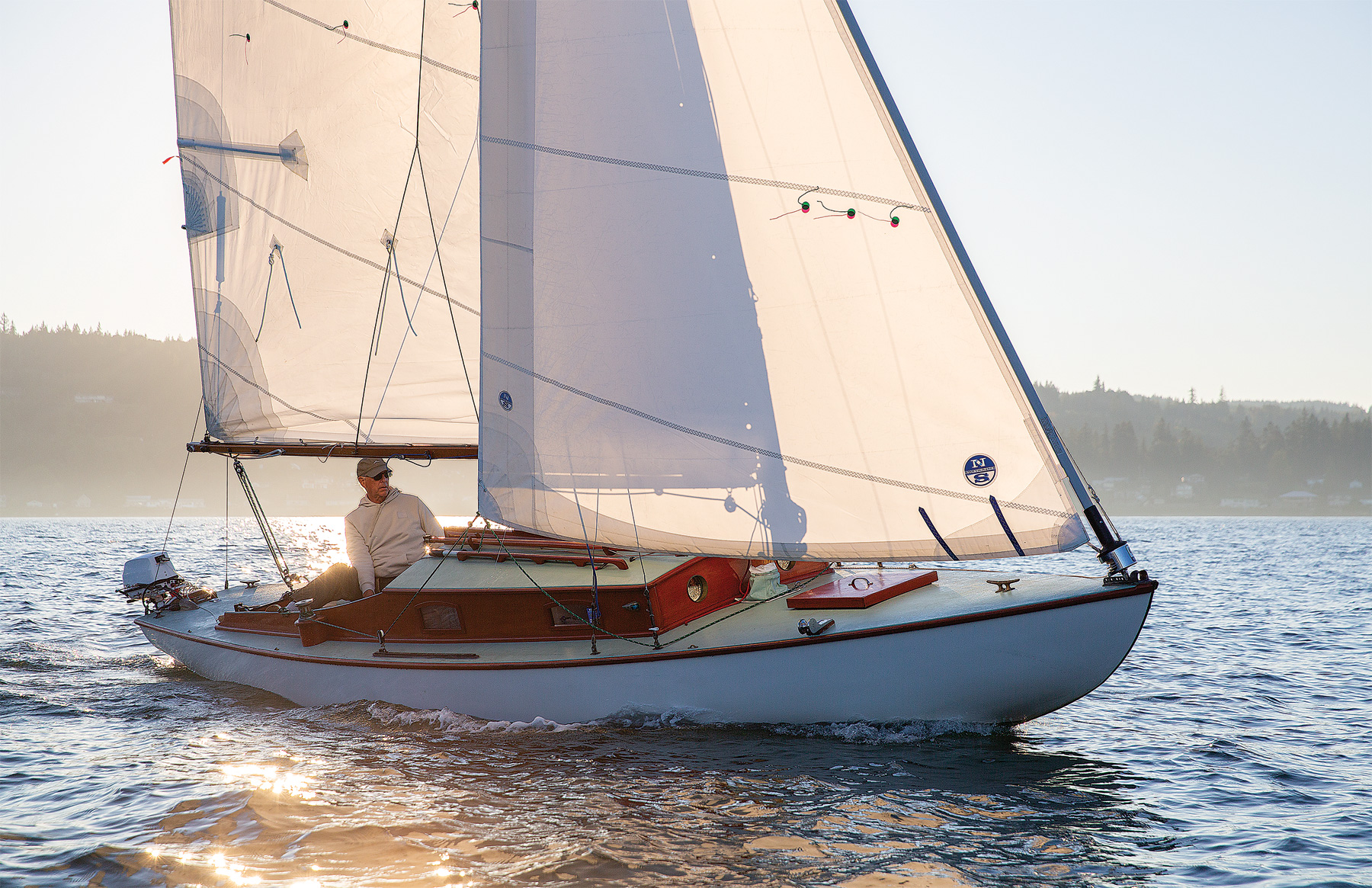
Neil RabinowitzBrothers John and Rob (at the helm) Wilkinson grew up sailing a Blanchard Senior knockabout in the mid-1950s. Now in their mid-70s, they recently acquired a derelict Senior, thoroughly restored it, and named it ILLUSION.
Classic boats do not necessarily spring from auspicious beginnings. As the boatbuilder Norman C. Blanchard of Seattle stated in his memoir, Knee-Deep in Shavings, one day in 1933 a group of Sunday strollers stopped into his Lake Union boatworks to ponder the 23′ Star-class sailboats the shop had been building. Nice little boats, the browsers sniffed, but for that lofty price—$750—they would expect a cabin. This was in the doldrums of the Great Depression, and for comparison, a new Ford V8 coupe could be bought for as little $500. The strollers drifted off. Blanchard’s father and business partner, Norman J. Blanchard, thought for a few moments and said, “Dammit, let’s build a cheap sailboat with a cabin on it.”
And that’s what they did—though the modifier “cheap” needs to be taken apart and inspected from several angles.
Throughout the first six decades of the 20th century, Seattle’s vigorous boatbuilding industry, clustered in a ring around Lake Union in the heart of the city, cranked out several wooden production boats that have become treasured for both their practicality and surprising beauty—and durability (see “The Dream Boats of Seattle,” WB No. 277). It was an era when “cheap” had a different resonance than it does today: boats such as these wouldn’t be around nearly a century later if they had been built expediently and flimsily.
Courtesy Of Jim LlewellynBlanchard built 97 Seniors between 1933 and 1960. Eighty percent of that output was built to order; the rest was built on speculation, to keep the crew busy during lulls between bigger jobs.
Norm J., a ninth-grade dropout who began learning boatbuilding as a teenaged apprentice, had opened his own shop in 1919 and was immediately successful. His first commission was a 62′ schooner. Impressively large motoryachts followed, some over 100′ long. His son, who’d turned professional as a teenager—with a $10 commission for a model boat—became a partner in the company full-time after his high-school graduation in 1931. Times were hard, though. Most of the large-boat commissions had evaporated. The Blanchards lost their family home to foreclosure. The small boats they built helped keep the shop doors open, but they didn’t contribute much to the bottom line. In 1974, Norm C. told an interviewer that the company had built 80 percent of their Senior Knockabouts to order; the rest were built as filler to keep employees busy between larger orders. The shop whisked them through production as deftly as possible for a carvel-planked boat. They had a standard mold to bend frames around, and they are believed to have had templates to mark planks for bandsawing. “We would start framing a Knockabout on Monday and it would be off the mold by Friday,” Norm C. told another journalist in 2000. Yet, he claimed, they never managed more than 3 percent profit on the Seniors.
The design origin of the boat is a little hazy. In some sources, it is attributed to Ben Seaborn, who two decades later designed the groundbreaking plywood Thunderbird sloop, but this is unlikely: Knee-Deep in Shavings makes no mention of any association with Seaborn until the late 1930s. Jim Llewellyn, who has restored a Senior and curated a website full of documentation about the boats, believes the Blanchards sprang a fairing batten against the hard-chined hull of a Star to develop the new boat’s rounded lines—and then simply grafted on a cabin and appropriated the Star’s spars and sail plan. The first one or two Seniors were the same 22′7″ length as the Star, then the design was stretched to 24′. In 1947 the boomkin was traded for an afterdeck, and the boats grew to 26′6″. A few were produced with inboard engines caged in a box just ahead of the companionway, but the Blanchards must have realized that this further compromised the already small cabin’s habitability. Later models incorporated an outboard motor in a well, and a prowl through Seattle newspaper classified ads of the 1940s and ’50s reveals that most owners had equipped their Seniors with outboards.
That same prowl turned up nothing to confirm whether the Blanchards hit that $750 “cheap sailboat” target price early in the production cycle. But a Blanchard Boat Co. classified ad in 1947 offered a new Senior for $2,045. That year, a new Ford coupe sold for a base price of $1,410—nearly the same, within a couple percentage points, as the Ford-to-Star ratio in 1933. Other ads for Seniors in the late ’40s, including some used boats, listed for several hundred dollars more, so Blanchard’s advertised price was almost certainly for a bare-bones model built on speculation.
Production finally ended in 1960. The Blanchard business held out against the fiberglass tsunami for a remarkably long time but finally closed in 1969. Norm J. died in 1954, leaving his son in full charge of the business. Norm C. was 98 years old when he died in 2009.
Courtesy Of Jim LlewellynThe Senior was billed as a racer-cruiser and remains competitive on the classic circuit.
Jim Llewellyn says there are about six Seniors sailing around the Pacific Northwest today in “really good shape,” perhaps 20 others in sailing condition, and an unknown number of survivors huddled under backyard tarps. But they were built very well, he says, and acquit themselves in racing even today. In 2006, he won his yacht club’s annual race around Bainbridge Island. “It’s a sleeper,” he says. “People don’t even notice it until I beat them.”
One particularly eye-opening document on Llewellyn’s website is a handwritten note from an owner who researched the history of his boat in 1983. He claimed a former owner had sailed from the Puget Sound down the Pacific coast to Panama, crossed into the Gulf of Mexico through the canal, and continued on to Florida, where he commissioned a trailer for the boat and brought it home again. Llewellyn doesn’t know whether the story is true. “But if you’re young, strong, and not risk-averse,” he says, “I could believe it.”
By 21st-century standards, the Senior doesn’t look like a terrifically practical boat. It’s as slim as a weasel with a 6′6″ beam. Advertised dry weight was an improbably light 2,500 lbs, with the iron ballast keel accounting for 1,200 lbs of the total. The cockpit is both short and narrow, thanks to an afterdeck stretching nearly 5′ long. The cabin offers no pretense of luxury; it has only a couple of settee-berths on the sides, stowage under the foredeck, and standing headroom for a 3′7″ gnome. For the Blanchards’ marketing purposes, it was a racer-cruiser, but by today’s standards it appears skewed 90 percent to the racing end of the spectrum. It wouldn’t have seemed thus to a buyer in 1950, though, when pocket cruisers were the middle-class norm and the comforts of a floating apartment were not expected. Llewellyn, who has owned his Blanchard for 47 years, recalls cruising in it with his entire young family—him, his wife, and their kids, aged two, eight, and nine.
It might not have been the ideal boat for the Wilkinson family when they bought a used Blanchard Senior in 1955, but three-fourths of the family richly enjoyed it while they could. John Wilkinson, a physician, had come to the Seattle area from Gulfport, Mississippi, and had messed around with boats all his life. His sons—Rob, eight, and John, nine—had already immersed themselves in building model hydroplanes. The family owned a waterfront home on Mercer Island in Lake Washington, 15 minutes from downtown Seattle, back in the shining days when a middle-class family could afford such a thing. John and his sons avidly took to Lake Washington on the Senior. The boys’ mother, Bea, decidedly did not. “She didn’t like the way it ‘tipped,’” Rob says. “My father would keep saying, ‘This is what sailboats do; there’s nothing to worry about.’ But she would chain-smoke the whole time we were out, nervously puffing away. She was afraid her babies would be lost at sea.”
Rob recalls his childhood as idyllic—until 1958, when he was 11 and his father died of cancer.
For a time, the boys continued to sail the Blanchard by themselves, and its snug cabin also became their place of refuge from the sadness in the family home. Money was tight, and their mother was struggling to cope with the death of her husband and both of her own parents.
Finally, she sold the Blanchard over the boys’ objections. Maintenance had become an issue, and the boat was just crowded out of the family’s priorities.
Some six decades passed.
Rob WilkinsonThe Wilkinson brothers located their project boat at the Jensen Motor Boat Company in Seattle, and towed it 300 miles to John’s home in Spokane.
One day several years ago, John phoned Rob and said he needed a project to work on now that he was retired. He proposed finding a Blanchard Senior—maybe even the same boat they once owned—to restore. Rob agreed it was a fine idea, and they began looking. They couldn’t locate theirs, but they found a derelict stored at the iconic Jensen Motor Boat Company in Seattle. The boat’s owner, David Willard, worked there, but he hadn’t found the time to do anything with it, so he just gave it to them. The brothers renamed it ILLUSION, which had been the name the Wilkinson family gave their boat in the 1950s. John towed it 300 highway miles east to his home in Spokane, and in the nebulous space-time continuum that wooden project boats sometimes occupy, nothing much happened for five years. And then John called Rob again to report that he’d been diagnosed with a disabling neurological disorder.
Rob and John considered their options, including having her broken up. But then certain stars clicked into alignment. The Jensen shop had closed down in 2019 after 92 years in business, and Willard now had time on his hands. He agreed to take on the restoration, with help from Rob, and Seattle’s Center for Wooden Boats (CWB) would provide them with boatyard space at the north end of Lake Union. Back over the mountains from Spokane rolled the Blanchard, and the serious work began.
Rob, a retired art photographer, had built nine boats and conducted a resplendent restoration of a 1941 Chris-Craft speedboat, so he certainly had the skills to take on the project by himself. He didn’t, he says, because he’d been tackling big projects nearly nonstop for years. He’d built a house and a backyard cottage and poured several thousand hours into the Chris-Craft. “Another boat restoration was just a bridge too far,” he says. “I like to think I have a 22-year-old’s mind, but I definitely have a 77-year-old’s body.” And the Chris-Craft project, it must be said, had taken him 30 years.
ILLUSION’s bones and much of its skin were in fairly good shape. The western-red-cedar planking was all sound except for the garboards and a couple of other planks aft. Willard replaced those and refastened all the planking. Several broken steam-bent oak frames were removed and replaced. The original planked deck was supplanted with a new one of plywood sheathed in canvas and then painted a remarkably graceful teal. The cabin trunk had eroded at the corners, so the damaged pieces were replaced with new pieces scarfed into place. New and beefier deckbeams went in, along with floor timbers and a new cockpit sole. Rob routinely made two or three weekly trips to the CWB work site to assist Willard, and he fabricated some new parts, among them a tiller and handrails, at home in his basement workshop.
“David is a very fussy perfectionist—but in the good way,” Rob says. “He’d never say ‘no’ to an idea, but instead, ‘We’ll see about that.’ Once I asked him if he really meant ‘no’ when he said that. ‘Yes,’ he said.”
The restoration consumed a year and a half and ballooned to more than double the cost the brothers had originally projected. Their total investment, Rob says, ended up somewhere north of $100,000. “I think even David thought it was going to be a much easier project than it turned out to be,” Rob says. “But everyone who’s undertaken a wooden-boat restoration understands this. Time. Stands. Still.”
“I warned him this would definitely take a while,” Willard says. “You could probably build a new boat in less time than it takes to do a restoration like this.”
Neil RabinowitzThe Senior’s designed weight is 2,500 lbs, and it is driven by 250 sq ft of sail. It moves in the lightest of wind.
Rob wanted the restoration to be faithful to the essential nature of the Blanchard, but there would be a large and expensive suite of additions for modern convenience and safety. “There had to be a lot of what I call age-appropriate modifications,” Rob says. “It had to accommodate one person with severe mobility issues and the other, me, who’s just condemned to be old.” All the lines now lead into the cockpit, and the 6-hp Tohatsu outboard motor is equipped with a remote throttle-shift gizmo and an extension for the pull-start cord. Even the choke is integrated into the remote-control unit. The motor doesn’t swivel, so low-speed marina maneuvering relies solely on the rudder—and maybe a crew person roaming the foredeck with a wary boathook. The jib has been outfitted with roller furling. With all this, there’s rarely any reason to leave the cockpit, which is fortunate, since the side decks are extremely narrow and there’s not even a toerail between boat and deep blue. There’s an impressive suite of electronics, including a Simrad tiller autopilot and a Garmin 943 instrument that displays boat speed, true and apparent wind speed and direction, and much more. The Garmin even talks to the Simrad.
Inside the cabin, Rob spiffed up the habitat by installing a meranti ceiling, but he was never tempted to risk the boat’s proportions by sneaking a bit of extra height into the cabin trunk—even though he’s 6′3″ and even while seated repeatedly scuffs his skull on the overhead. A propane camp stove serves as a galley, and the Blanchard’s original cabin illumination—a candle—is now a battery-powered LED light that just looks like a candle.
Neil RabinowitzAll of ILLUSION’s sail controls and halyards lead to the cockpit, for easy and quick handling.
Under sail, ILLUSION’s discomforts seemed inconsequential. Although the sail area of 250 sq ft is not large for this boat’s size, its slippery hull and feathery weight assures that it makes notable progress in light air—nicely documented on the Garmin. When I joined Rob for a sail, closehauled we saw 2.8 knots of boat speed with 5 knots true wind and 5.2 knots with 7.4 true wind. At 9 knots of true wind, we reached 6 knots of boat speed, which is just shy of the Blanchard’s theoretical hull speed of 6.1 knots. The bow tends to slice through chop more than bouncing over small waves, giving a surprisingly comfortable ride. The boat points impressively high as well; we could press it to about 42 degrees off true wind before the jib shivered and messaged the cockpit, “Enough of this nonsense!” I steered and trimmed sail, and felt that with more practice and fiddling I could notch the speed and attack angle a little higher still.
Neil RabinowitzThe Blanchard Senior offers snug accommodations for two with a pair of settee-berths, a flat for a portable stove, and modest storage space.
It does heel readily since the narrow hull doesn’t provide as much form stability as beamier modern production boats. It feels secure, but one can maybe sympathize with the complaint of “tipping” noted by Rob and John’s mother. This might not be the best sailing introduction for a nervous lubber, despite a brochure the Blanchard shop produced late in the Senior’s production run that touted it as “a very safe, non-capsizable craft for son, father, mother, or sister.” Llewellyn, with decades of racing experience in his Knockabout, told me there’s no value in letting the boat heel more than 20 degrees—it just slows down.
Neil RabinowitzJohn (left) and Rob Wilkinson aboard ILLUSION, summer 2024.
Rob made it clear that while reincarnating the vessel of happy childhood times was the main driver for all this effort and expense, the Blanchard’s aesthetic attraction also contributed substantially. He had spent 35 years of his adult life as a photographer traveling the world photographing fine art and design, and although he had no formal training in art, the work gave him a well-developed aesthetic sense. “This boat,” he says, “is one of those things you just can’t take your eyes off of. And it’s as beautiful out of the water as it is in. You get it propped up in the air, it’s an orca.”
Steve DavisIn this Steve Davis rendering of a Blanchard Senior, the suspected Star-class influence is clearly evident in the underwater profile.
All in all, a rather impressive package for “a cheap sailboat with a cabin on it.” ![]()
Larry Cheek is a regular contributor to WoodenBoat.