Standing Rigging

The force that drives your boat is dazzling, and the boat requires well-engineered and well-maintained tensile strength in all elements of its rig to harness this force properly and safely.

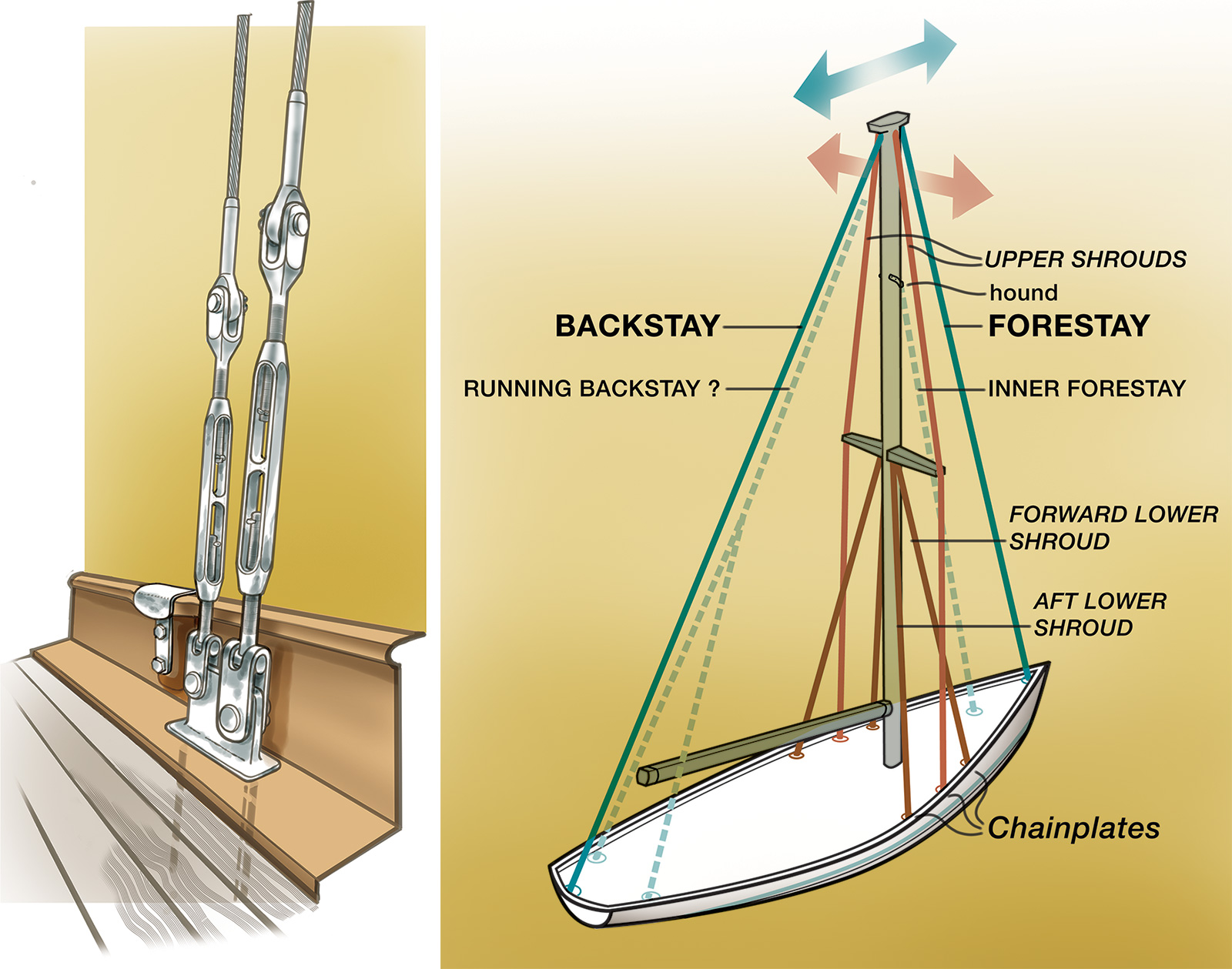
A conventional sloop’s mast is customarily supported by six shrouds: two diagonal “lowers” that run from the deck’s edge to point where the first spreader meets the mast, port and starboard, and one on each side rising from the deck edge parallel to the mast to the same spreader’s tip, where it redirects to the masthead. Backstays, running or fixed, and forestays support the mast fore-and-aft. Applying proper tension to these sinews is complex marine engineering beyond our four-page scope; we’re merely touching on the immense forces your hull, mast, and standing rigging sustain.

Because the wind’s speed and direction are constantly shifting, your boat’s standing rigging endures sudden jolts of force in inconvenient directions, so marine engineers won’t hazard more than 20 percent to 35 percent of a shroud or stay’s breaking strength in normal tensioning. Calculating a ballpark total of tensions imposed on your hull and its fittings amounts to tons of quiet but hazardous force. Add to this the force of the sails directed toward your hull and mast by halyards and sheets.

All of this tension is borne by cables (aka “rigging wire”) connected to devices and fittings that incorporate the forces with your hull and mast. In light of Murphy’s immutable law, “anything that can go wrong will go wrong, and at the worst possible time,” prudence is paramount. Our solution is constant, suspicious vigilance: check the rig!

Steel Roap.

STEEL ROPE

Steel rope was a necessity for the radical clipper ships that raced around Cape Horn and across the Pacific in the last half of the 19th century. Their multiple masts, acres of canvas, and obsession with speed at any cost demanded metal cables carrying hazardous tensions. They were desperately protected from water, salt, and weather by worming, parceling, and serving beneath coats of tar, but when a shroud or stay (inevitably) rusted and parted, the kick-back could scythe down an entire working party of deckhands.

Ship Rigging.

SHIP RIGGING

Masts of men o’ war and merchantmen were towering structures of multiple spars beyond even the ideal heights (150 and even 200) of Pinus strobus, the eastern white pine, which was a colonial obsession with King George III, who dispatched official timber cruisers to mark the best ancient mast pines with George’s broad arrow. Woe betide an obstreperous American colonist who felled one of the Royal Navy’s mast trees for wide floorboards. Timber sovereignty was expectable: the Pine Tree Insurrection occurred across New England in 1772, an apt precursor to even more unpleasantness in 1776. One of the earliest Revolutionary American flags was adorned with a green pine tree.

Hemp

HEMP

Hemp rope, which has very low stretch characteristics, was the benchmark of tension resistance in the Age of Sail, the strongest and most stable tension connection, far and away the best rope fiber for standing rigging. Hemp was an important cash crop in young America, grown on vast slave plantations supplying ropewalks north and south. Our very best rope for running rigging came from the Philippines, manilla, made from abacá, an island strain of hemp with particularly good water-endurance and rot-resistant qualities. The Imperial Japanese Navy cut off supplies during World War II, so in the United State the Department of Agriculture demanded the planting of thousands of acres of hemp to supply the Navy’s needs for strong cordage. Battlewagons were steel but every man o’ war needed miles of line for docking, winching supplies aboard, hanging hammocks, and a multitude of other tasks.

Cable Elements.

CABLE ELEMENTS

Cable seems like a simple twisting of metal “fibers,” like a Tin Woodsman’s rope. Dismiss this lubberly notion, because rope cordage, itself, is an ancient and brilliant engineering concept understandable only in three dimensions: in laid line the hair-thin natural or synthetic fibers are twisted right, the yarns twist left, the strands twist right, the rope (in hawser-laid line) twists right, and cordage cable is a left-hand twist of three ropes. (Shroud-laid differs in twisting four ropes left around a central strand.) Yes, it’s confusing, but look closely at the individual fibers within the rope’s helix: each fiber lays significantly parallel to the rope’s or cable’s axis, placing the fibers at near-optimum position to resist tension, within a stable helix held in place by interlocking right- and left-twist friction.

Cable types

CABLE TYPES

Wire cable is another complex helix woven of individual wires in specific bundles. There are dozens of variations, but we’re most familiar with the common 7×19 (seven bundles of 19-wire strands), the uncommon 1×19 (one bundle of 19 thicker wire strands, which is stiff with little or no stretch), and 7×7 (seven bundles of seven strands, with medium flex and stretch).

Some high-performance yachts do away with wire cable in favor of solid rod, which has lower stretch, less windage, and reduced weight. Rod shrouds are expensive, however, and any nick, ding, or corrosive invasion of a rod degrades the rod’s total strength. In a 7×19 cable, each of 133 wires is independent, while their helix is bound by twisting friction into a whole. Damaging or even severing one of these wires affects the overall tensile strength of the cable very little, since the severed wire’s strength is re-bound into the helix within a few feet.

Workboat cable

WORKBOAT CABLE

Workboat cable, like workboats, had a shelf life. There are still hundreds of salt marshes up and down the Atlantic coast haunted by the hulks of quickly built, hard-used, worn-out tugs, trawlers, barges, and ferries. For a century, workboats set up rigging with hot-dipped galvanized steel cable affixed with purpose-engineered clamps. Galvanized cable worked. For a time. Hot-zinc coating was a thin protection that chipped and wore away, but it lasted a few seasons. A workboat may have worn several suits of the inexpensive galvanized cable before the hull and timbers couldn’t handle the job.  Article ends.