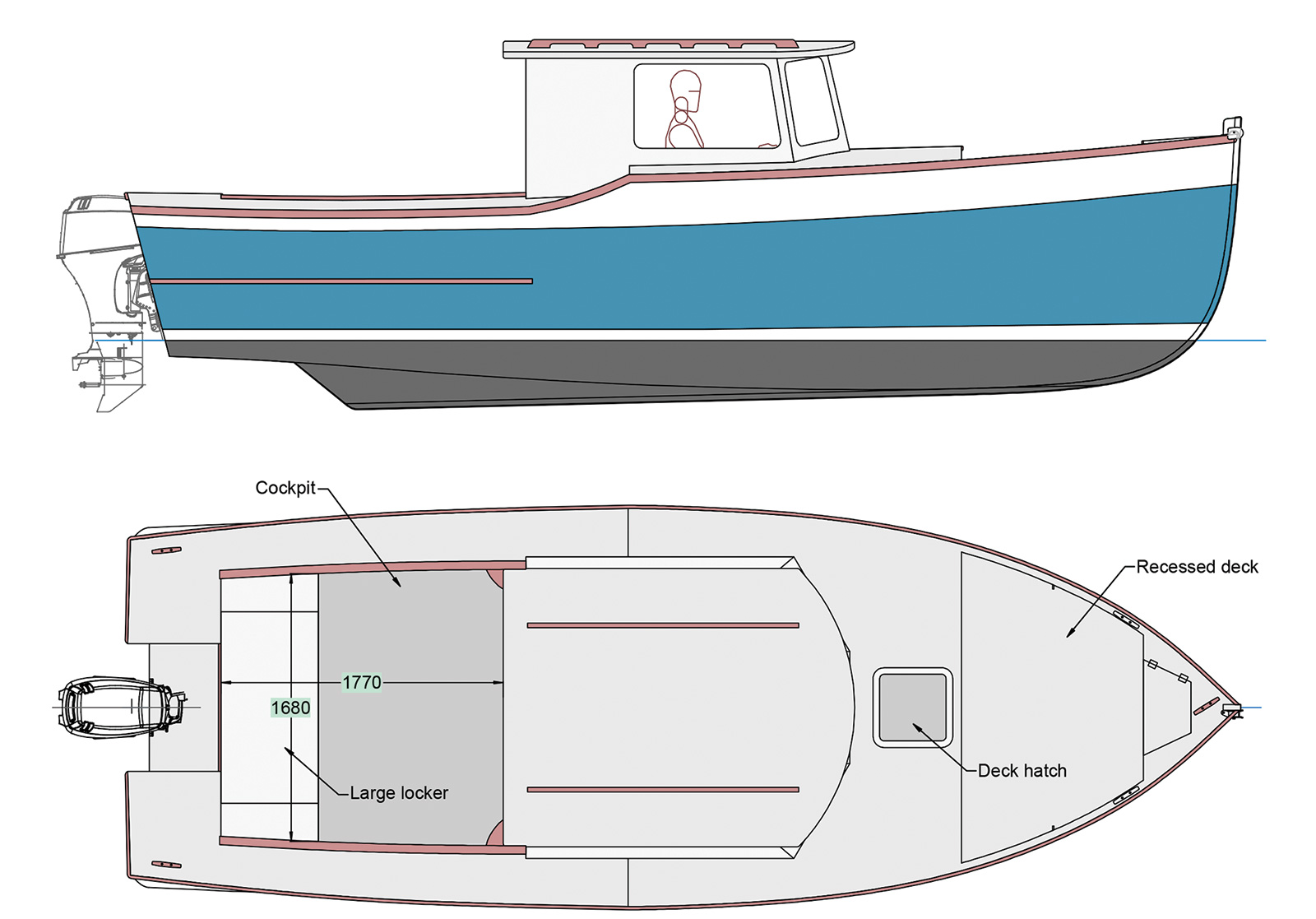
François Vivier’s Koulmig 23, a purposeful outboard cruiser, has a theoretical cruising range of 200 miles at 12 knots.
Particulars
- LOA: 22′10″
- LWL: 21′4″
- Beam: 8′3″
- Draft: 15″
- Weight: 2,800 lbs
- Power: 25–60 hp
Small powerboats must always balance function and beauty; possibly we expect more function from the type, but everyone wants an attractive boat. The Koulmig 23 is an attractive little ship, and a big part of this attraction is all the function and versatility evident from its beamy and high-sided hull along with its excellent pilothouse and decent cockpit.
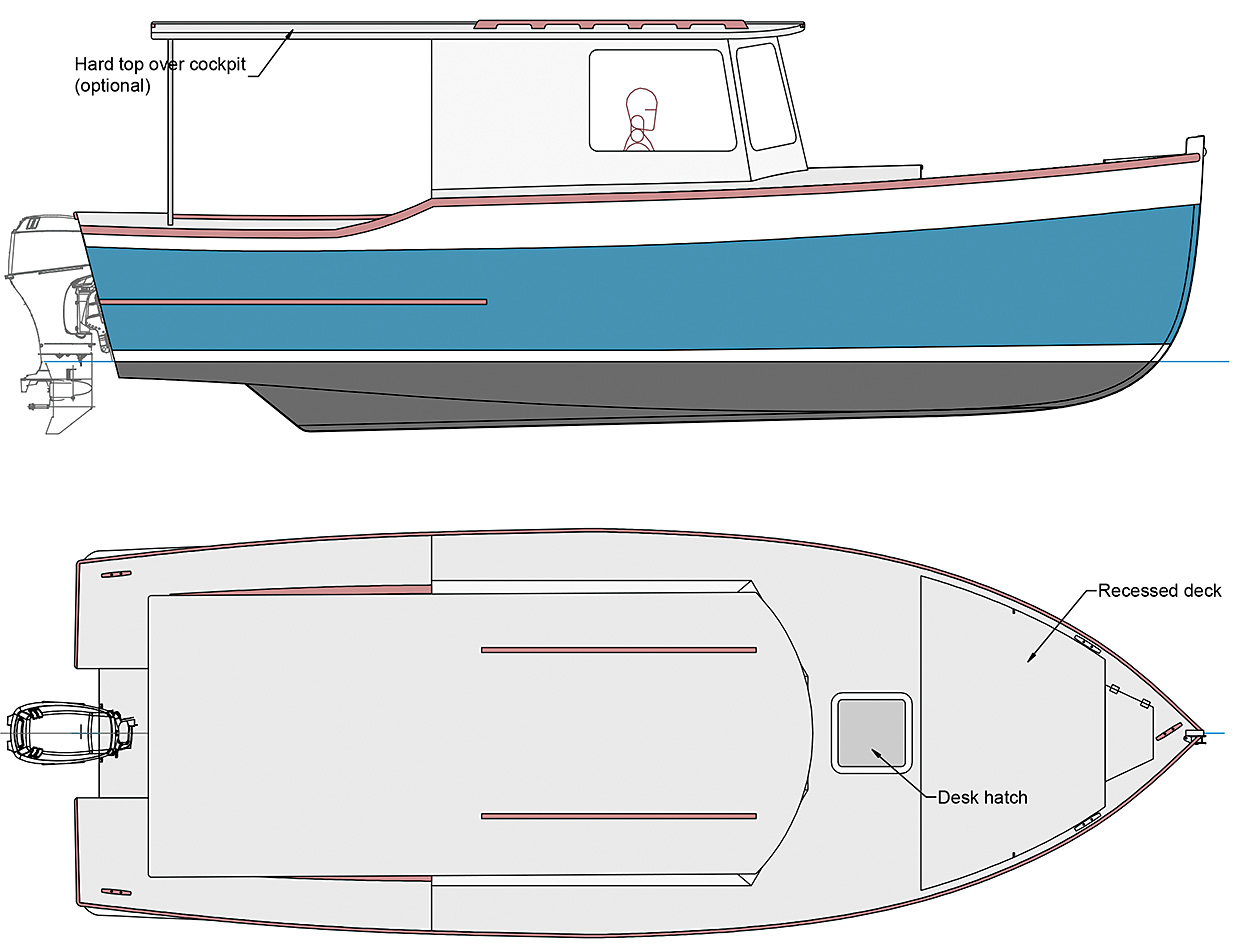
The design has two cabin versions: the shorter and lower pilot house and open cockpit shown on the previous page, and the taller and longer pilothouse and sheltered cockpit shown at left.
The design is offered in two cabin versions on an identical hull: Version A with a shorter and lower pilothouse and open cockpit, and Version B with a taller and longer pilothouse and sheltered cockpit. The lower center of gravity and reduced windage of Version A make it more suitable for open water, whereas Version B is more of a houseboat type suitable for protected water such as lakes and rivers. I’ll concentrate on Version A.
The first thing I notice about the Koulmig 23 is the boat’s upright good looks. This is a function of proportions, which the designer, François Vivier, got right. A big hull with relatively small superstructure will always look better than the opposite. The vertical stem and raked flat transom nicely match the slightly raked windshield and vertical cabin back. The raised deck forward makes all kinds of good sense; it increases freeboard and interior volume where needed, and provides a substantial bulwark around the forward well deck.

The boat’s semi-displacement shape has an entrance that will slip through waves, and deep, flat aft sections to provide some dynamic lift at top speed.
Powerboats are all about speed and range, with the hull form being a function of the required speed. Vivier states this hull is ideal for cruising speeds in the 12–15-knot range, 12 knots being well above displacement speed, and 15 being right at the bottom of full planing speed for a hull of this waterline length and weight. The Koulmig is decidedly a semi-displacement boat, and to suit this crossover role it has an entrance shaped to slip through waves, and aft sections that are deep and flat enough to provide some dynamic lift at top speed. The deeply immersed transom will increase drag at low speed, but that’s not what this boat was designed for. The shape is a compromise, and a boat intended for absolute minimum power will be an entirely different shape from this one, with less immersed transom.
A major factor in efficient semi-displacement operation is displacement, and the Koulmig’s light but stiff construction and proper weight distribution reflect this. Any builder would be wise to follow closely the scantlings in the drawings, saving weight wherever possible. At an estimated operating displacement of 3,200 lbs, the displacement-length ratio is about 150, promising excellent performance at low-teens speeds. Weight distribution in a small boat is always problematic, because slight differences in loading can have a big effect on performance. I prefer flexibility and simplicity, so my freshwater system would consist of portable jugs, rather than a fixed forward tank. Likewise, I would install the batteries in a more central location, under the aft port dinette seat with the electrical panel directly adjacent, and make up the longitudinal trim with an oversized anchor or two up forward.
If we look at required horsepower, at an estimated operating displacement of 3,200 lbs with fuel and crew aboard, 12 knots requires approximately 26 hp at the propeller, and will burn about 1.8 U.S. gallons of gas per hour. The standard fuel capacity is 35 gallons of gas stored in two tanks under the cockpit sole. This gives the boat a theoretical cruising range of just over 200 miles at 12 knots. At the same 3,200-lbs displacement, the engine will burn 2.44 gallons per hour at 15 knots, and again this will give a theoretical cruising range of just over 200 miles. Either way that is a very comfortable cruising range for a 23′ boat, and the boat is obviously fully capable of carrying much more fuel to vastly increase range.
These days people want to know about electric options. While we don’t yet have easy access to electric outboards of 50–60 hp, nor to lightweight batteries to power them, we can find units of from 5–7 hp, and even 9.9-hp equivalents have become available recently. Though they are not inexpensive, I can see someone wanting to try a pair of 5-hp (3.7kW) electric outboards; these would give a top speed of perhaps 6.5 knots, which might be fine for short-range local cruising with modest battery size. A pair of 7-hp (5.2kW) units will give a top speed of around 8.5 knots, which gives a satisfying daily cruising range if recharging is available at day’s end. There is room to mount 600 watts of solar panels on the cabintop and foredeck to augment shoreside charging stations, and this could make a real difference if you move short distances and stay a few days in one spot during the long daylight hours of high summer.

The shapely hull is planked in a skin of plywood applied in 12″-wide vertical strips over closely spaced longitudinal stringers.
Vivier has gone to considerable effort to create a shapely hull, adopting a vertical strip plywood skin in the topsides. These ½″-thick plywood strips of about 12″ width are draped from deck-edge to chine over closely spaced longitudinal stringers, easily forming the flare forward and tumblehome aft. Considerable rounding of the sections is apparent down low in the forward sections; this is a unique solution to easing entrance angles and keeping the bow wave minimized. This unique topside planking system adds some complexity, but it’s a small addition compared to the overall man-hours to build the entire boat, and the result in looks and seagoing performance will be pleasing in the long-term.
The specifications for the Koulmig 23 mention the European Union’s Category C rating with six people aboard. Boats of this design category are considered capable of safely handling 6½′ waves and wind gusts of 22–27 knots. Realistically most of us will be seeking shelter in these conditions in a 23′ boat, but knowing that performance and stability are theoretically satisfactory in such weather is comforting.

There is good visibility from the helm when either sitting or standing, and a small galley space aft of the helm. A V-berth forward and a convertible table provide sleeping accomodations for three.
Interior accommodations are challenging in a 23′ boat, but the Koulmig makes excellent use of the space available. The deckhouse includes a helmsman’s seat, and good visibility either sitting or standing. A minimal galley space is aft of the helm, to starboard, with a good-sized two-person dinette opposite. The dinette table can be lowered to form a third berth. Forward under the foredeck are lockers and the big V-berth. There’s a space for a self-contained-type toilet to starboard, and the designer indicates the ship’s batteries and freshwater tank under the V-berth. The overhead foredeck hatch/skylight is essential for light, ventilation, and the all-important escape should the need arise.

The aft cockpit is deliberately small to limit the amount of water that could flood it and reduce freeboard and stability.
As shown in the drawings, the aft cockpit of the Koulmig 23 might seem a bit small to those who would like a roomy cockpit for fishing with a couple of friends. Its small size is part of the Category C classification I spoke of earlier. Limiting cockpit size limits the amount of water that, in very bad conditions, could flood the cockpit and reduce both freeboard and stability. In North America this sort of safety regulation is applied only minimally, with utility taking precedence, and mostly skippers are careful and avoid really bad weather. But it is something to be aware of, and a bit of attention to cockpit drainage will never hurt.
In an ideal world I’d have a pair of 10-hp electric outboards on my Koulmig, and a big battery. Failing budget for that, a single 50-hp four-stroke would be fine. I would install a towpost forward of the engine for those occasional boat-moving jobs, and a second set of controls outside in the cockpit. I would also arrange a folding canvas top over part of the cockpit, if not all of it, to keep the sun and rain off. My boat would also have two opening windows in the aft end of the pilothouse, both to open up the space and increase forward visibility from the cockpit. It’s a boat I could use a lot. ![]()

Tad Roberts designs boats on Gabriola Island in British Columbia, Canada.
Plans are available from designer François Vivier at 7 avenue des Courtils, 44380 Pornichet, France; fr@vivierboats.com; www.vivierboats.com.