Introduction due from Matt…..
Lakeshore High School in Stevensville, Michigan
Photos by LANCER: Mike Kiefer; PARTEE: Hanns Heil
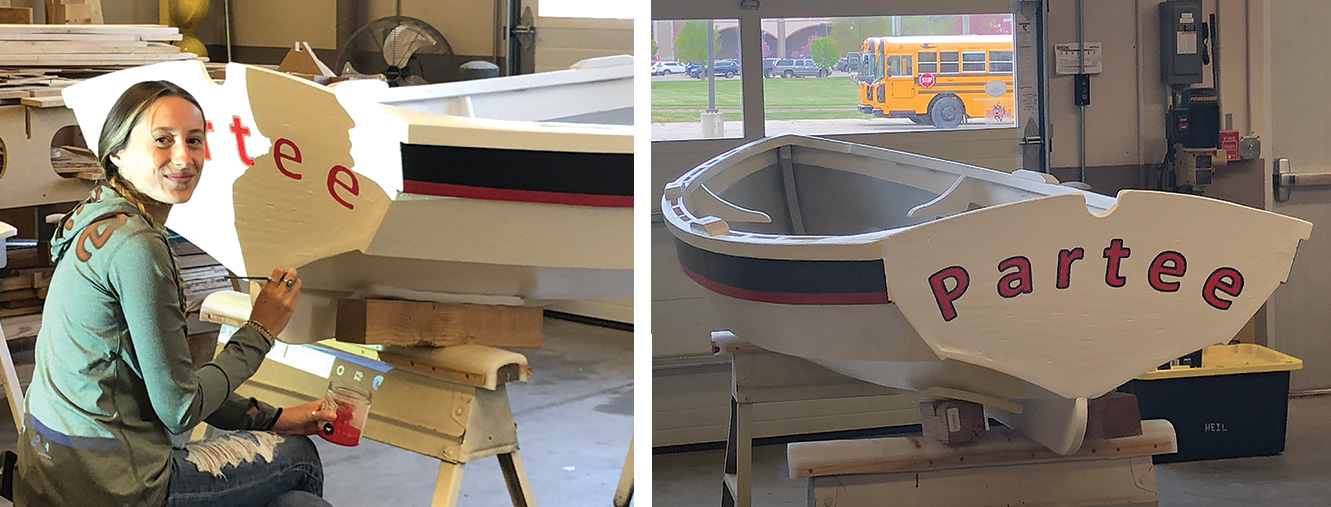
Hanns Heil and his students at Lakeshore High School in Stevensville, Michigan, built a Shellback dinghy, LANCER (top), in the school woodshop during the 2022–23 academic year, and another in the second-semester Woods and Technology Explorations class in 2024. The new boat is named PARTEE for the school district administrator, Curtis Partee, who retires this year. Both Shellbacks were, Hanns says, built on a “shoestring budget using exterior plywood, PL Premium construction adhesive, and water-based paints.” Hanns uses Eric Dow’s book How to Build the Shellback Dinghy and full-sized plans to instruct the students, with advice from a local boatbuilder, Mike Kiefer, who also donated hardware and a miter saw to the program. LANCER won first place at the Michigan Industrial and Technology Education Society Student Project competition in May 2023. She was launched the following month near the school at North Lake. PARTEE was scheduled to be launched at the end of the school year 2024.
S.C. ASHTON
Photo by Chris Warren
Chris Warren of West Simsbury, Connecticut, built this rowing-only Shellback dinghy for his brother, Dana, who wanted a boat in which to enjoy “calm summer lake mornings.” Chris built the hull of okoume plywood using ¼″ for the side planking, ½″ for the bottom panel, and ¾″ for the transom. He coated it, inside and out, with fiberglass and epoxy. The stem and ’midship frame are laminated Douglas-fir and the gunwales, breasthook, and oarlock pads are from a single piece of 2″-thick mahogany. S.C. ASHTON was named for Chris and Dana’s grandfather, who “built our first rowboat for us, 60 years ago.” She was launched in May 2023 at Harmon’s Beach on Sebago Lake, Maine.
Chesapeake 14
Photo by William Sheldon III
Having built a Chesapeake 14 from Chesapeake Light Craft for his daughter, William Sheldon of Greene, Rhode Island, decided to build this 16′ version for himself. Working from CLC plans, he cut out the parts using a CNC router. The kayak is built of 4mm okoume marine plywood. Bill sheathed the interior of the cockpit with 5.8-oz woven carbon fiber and used fiberglass cloth on the exterior—6-oz on the bottom and sides, 4-oz on the deck. Bill also built Greenland paddles for himself and his daughter using two pieces of clear pine sandwiching a central layer of carbon fiber for strength. The new kayak was launched in July 2023, and Bill and his daughter use their boats up and down the East Coast.
DRAGONFLY
Photos by Tom Cook
Tom Cook of Georgetown, Massachusetts, built this David Stimson–designed Ocean Pointer. She is 19′6″ × 6′9″ and built of ¼″ × 1¼″ western red-cedar strips over a marine-plywood frame. Tom trimmed her out in mahogany, finished the transom with a layer of sapele over marine plywood, and went for that “old-school look with bronze cleats and running lights.” Tom launched DRAGONFLY in August 2023 on Lake Winnipesaukee, New Hampshire, and plans to use her on New Hampshire lakes and off Cape Ann, Massachusetts.
MERLIN
Photo by John Dickason
Sixteen years ago, John Dickason of Bristol, Vermont, took a boat-design course with Paul Gartside at WoodenBoat School in Brooklin, Maine. During the course he designed a 30′ schooner but decided it was too big for him. Instead, he chose to build a 26′ LOD John Atkin–designed Live Yankee. He launched MERLIN in September 2023. John says he has been a house builder for 30 years, had built a strip-planked canoe and a dinghy, and thought “how hard could it be to build a little schooner?” But, he says, it was very hard and over the many years of work he was always learning and never bored. MERLIN is oak-on-oak with a plywood deck on oak deckbeams. Both her foresail and mainsail are gaff-rigged and, while John says she tacks easily and has “good upwind performance, with six sheets she’s not the easiest boat to sail.” MERLIN is homeported on Lake Champlain, in Addison, Vermont, and is, John says, “the talk of the harbor.”
PRINCESS ELLEN
Photos by Christian Anfinsen
PRINCESS ELLEN is a 15′×5′ Windward 15 designed by Karl Stambaugh, based on a traditional Chesapeake Bay crabbing skiff. She was built by Christian Anfinsen of Carlisle, Pennsylvania, to be sailed on the small lakes of his home state. Her hull is ⅜″ marine plywood on mahogany frames and Christian used western red cedar, oak, Douglas-fir, and white pine for the fitout and trim. This was Christian’s first time working from plans, and the project took him three years. He says he had much to learn and often figured out the “how-to-dos” in the middle of the night. PRINCESS ELLEN was launched in September 2023.
SNOWBIRD
Photos by Patty Hart
SNOWBIRD, a replica of the Frostbite dinghy designed by C.D. Mower (see WB No. 287) in 1932, was built by Geoff Hart of Alachua, Florida. Geoff had plans for the boat from a 1955 issue of How to Build 20 Boats by the editors of The Rudder magazine. The plans consisted of two 6″× 9″ magazine pages with the advice, “Anyone who has had any experience building round-bottomed clinker-built dinghies will find sufficient information on these pages to enable him to build a Snow Bird for himself.” Geoff had previously built a Wee Lassie strip-planked canoe but had long wanted to build a small traditional wooden boat. It was, he says, a steep learning curve: “I think I spent as much time figuring out how to build it as I did actually building.” SNOWBIRD is 12′ long with a beam of 4′ 7½″. Her ⁵⁄₁₆″-thick lapstrake planking is local cypress on laminated-cypress frames fastened with bronze screws and copper rivets. Her lug-rig spars are of Douglas-fir. She was launched in July 2023 and Geoff will be sailing her on area lakes, the Florida Gulf Coast, and the St. Johns River.
TYEE
Photos by JJ Gould (top); Emily Burns (bottom)
Building TYEE was a five-year-long project for the Gould family—JJ and Linda and their three now-young-adult children—of Boise, Idaho. She is a 22′ 7″ × 8′ 7″ Jiffy V-22 designed by Arch Davis. Her hull, deck, and cabin are all built of okoume plywood on vertical-grain Douglas-fir frames. The keel, chines, sheerstrakes, and rubrails are Douglas-fir. TYEE was launched in Anacortes, Washington, in August 2022 and she is now homeported in Everett, Washington, where the family uses her for cruising and salmon fishing on the Salish Sea.
BONNIE
Photos by Sandy White
Sandy White, a first-time boatbuilder in Mantoloking, New Jersey, built this Chester Yawl from Chesapeake Light Craft in his garage. He was inspired by his brother, Timo, who is the manager and a wooden boat builder at the North Carolina Maritime Museum, located in Beaufort. Sandy says he chose the 15′ pulling boat because he was looking for a boat sturdy enough to be used in waters prone to “high winds and a fair amount of motorboat traffic.” John Harris’s design, with its classic good looks, generous freeboard, spacious interior, and suitability for solo or tandem rowing, fit the bill. BONNIE was launched in Barnegat Bay, New Jersey, in July 2023.
GRACE
Photos by Pat Venturino Photography
The team of volunteers at the Maritime Museum Boat Shop in Havre de Grace, Maryland, faced a new challenge when the museum accepted the mold for a 10′ L.F. Herreshoff pram from a Delaware donor whose husband had died before he could get very far into the build. During the next 16 months, the crew learned how to read an offset table, loft lines, spile northern-white-cedar planks, steam-bend white-oak timbers, peen rivets, cut and fit knees—some from traditional applewood crooks—and apply traditional finishes. The pram, 10′× 3′9½″, was launched in October 2023 and will be used on Chesapeake Bay. When not in the water, GRACE will be kept on display in the woodworking shop as an example of “period construction.”
TOTORO
Photo by Virginia Reinhart
With plenty of encouragement and a little help from his sons, Will and Danny (now aged 4 and 7), James Kealey of Richmond, California, built TOTORO in his basement and backyard. A François Vivier–designed Seil, she is 17′9″ long with a beam of 5′4″, and was built of CNC-cut plywood, cherry, and cedar felled and milled by “a beloved uncle.” The project spanned three years and culminated in TOTORO’s launching in June 2023. Since then, she has been much used and is, James says, already a “veteran of camping trips on Lake Tahoe, Spicer Meadows Reservoir, Tomales Bay, and San Francisco Bay.”
TALLY HO
Photo by Tom Jackson
In April 2024, a crowd gathered in Port Townsend, Washington, to celebrate the relaunching of the historic gaff cutter TALLY HO (see WB Nos. 267 and 298). Seven years earlier, boatbuilder Leo Goolden had seen the yacht as a derelict in Brookings, Oregon. The 48′ cutter was designed by Albert Strange and launched as BETTY in West Sussex, England, in 1910. In 1927, she won the Fastnet Race, but over the next nearly 90 years she fell on hard times, most recently being used as a fishboat. She was saved from being broken up by the Albert Strange Association, which acquired her with hopes of a restoration. Leo bought the yacht from the association for $1 in 2017 and had her shipped overland to Sequim, Washington, where he set to work in a family friend’s workshop. In 2021, after neighborhood grumbling, he moved her to a more suitable leased building in Port Townsend. Over the seven-year restoration Leo has been helped by many volunteers, independent contractors, and marine-trade specialists from throughout the community. He plans to complete the remaining work—including installing the original reconditioned windlass—while afloat, and sea trials are expected during summer 2024. Ocean passages are certain to be in TALLY HO’s future on an indefinite timetable, and no doubt her return to England will be a triumphant one. To date Leo has posted 189 YouTube videos with 6,602,000 views and 493,000 subscriptions, and he vows to continue producing videos from sea; see www.sampsonboat.co.uk or search TALLY HO on YouTube.
Nº1
Photos by Riley Hall (bottom); Curtiss Hall/Craig Johnson (top)
Owned and restored by the Harbor History Museum in Gig Harbor, Washington, the first of the Thunderbird class, known simply as Nº1, was relaunched in August 2023 at the Gig Harbor Boatshop, Washington, former site of the Eddon Boat Co. and birthplace of the Thunderbird class. The Thunderbird was designed by Ben Seaborn specifically for plywood construction, and Nº1 was built by Ed Hoppen in 1958. The class became a successful and popular racer-cruiser design both in the Pacific Northwest and abroad. After Nº1 was acquired by the Harbor History Museum, a full restoration was undertaken by a group of volunteers under the direction of the museum’s shipwright, Riley Hall. Most of the structural restoration work was carried out by volunteer Dave Federig. The work included rebuilding the stern, replacing the stern deck from the transom to the winch pedestals, building a new cockpit bench, replacing the forward port corner of the cabin trunk as well as all the cabin trim and a new deckbeam beneath the forward end of the trunk, and building a new foredeck hatch. Belowdecks, a new galley space was built. The mast was fully restored, new spreaders were made, and all-new rigging was fabricated under the direction of Jamie Storkman at the Gig Harbor Boatshop. After being exhibited at the Port Townsend Wooden Boat Festival in September 2023, Nº1 was returned to the Harbor History Museum for permanent display.
These pages, along with the Boat Launchings section of www.woodenboat.com, are dedicated to sharing recently launched wooden boats built or restored by our readers. If you’ve launched a boat within the past year, please email us at launchings@woodenboat.com, or write us at Launchings, WoodenBoat, P.O. Box 78, Brooklin, ME 04616.
Please include the following information:
- The boat’s length and beam;
- The name of its design class or type;
- The names of the designer, builder, owner, and photographer;
- Your mailing address along with an email address or phone number;
- The port or place of intended use;
- Date of launching; and
- A few sentences describing the construction or restoration. Send no more than five photographs (jpg images at 300 dpi) and enclose a SASE if you want anything returned.
Hints for taking good photos of your boat
- Set your camera for high-resolution images. We prefer jpg format, at 300 dpi minimum.
- Stow fenders and extraneous gear out of the camera’s view. Ensure the deck is clean and uncluttered.
- Take your photographs in mid-angle sunlight for best results. Mid-morning or mid-afternoon usually work well.
- Keep the horizon level and the background simple and scenic so your boat stands out from its surroundings.
- Take some pictures of the boat underway and some at rest. Often a vertical format works well for sailboats. Shoot a lot of images, then send us your five favorites.
We enjoy learning of your work—it affirms the vitality of the wooden boat community. We receive so many submissions that there is not room in the magazine for all of them to be published. Launchings not printed in the magazine can be seen at www.woodenboat.com/boat-launchings. ![]()


