New introduction from Matt goes here…
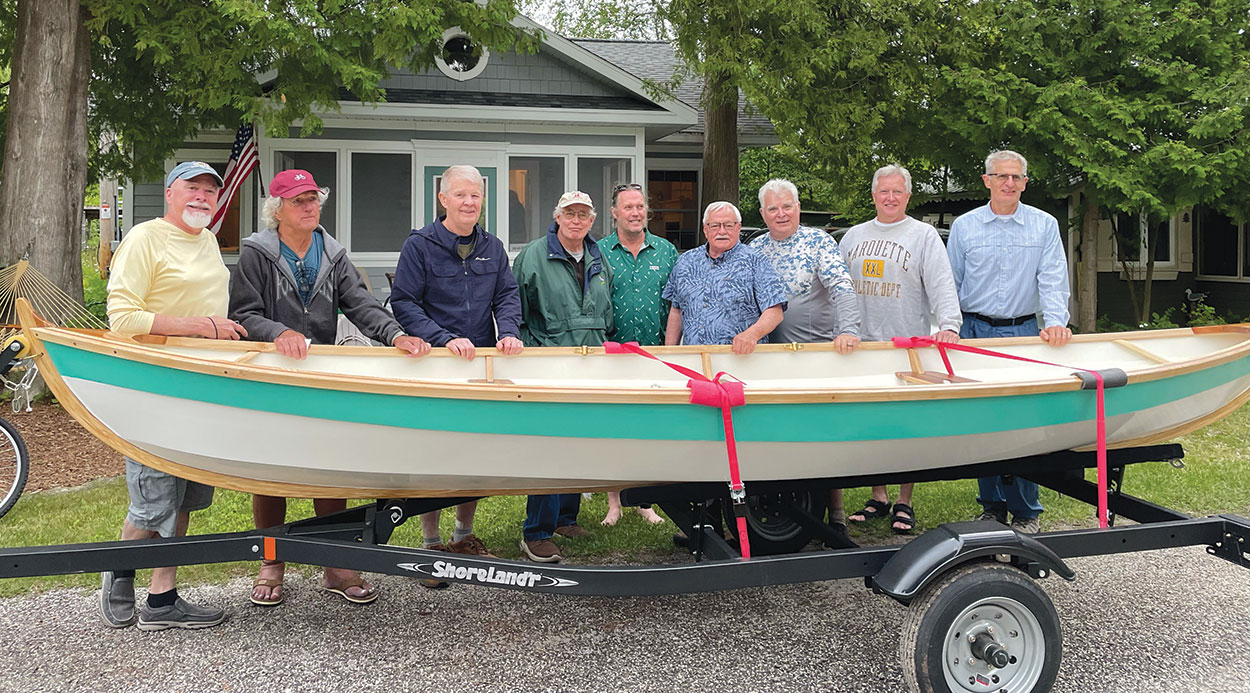
Double-ender Shearwater
Photos by Joel Pagel
The mission of the Door County Maritime Museum in Sturgeon Bay, Wisconsin, is to preserve Great Lakes maritime history and, in part, foster boatbuilding knowledge and skills. The museum has been hosting boatbuilding classes since 1998 and has produced 27 small boats. The most recent, built by the class of 2024, is a 16′ × 4′5″ Shearwater, a double-ender designed by Joel White, inspired by Norwegian faerings. In a weekly class that began in October 2023 and ended in June 2024, instructors Jerry McNamara, Bob Schotmuller, David Morgan, and John Pabich led students with a wide range of skills through the construction. The planks, three to a side, are ¼″ okoume plywood and the frames and backbone are native Door County white ash, locally milled. The finished boat was displayed at 10 area festivals, and was the prize of a raf e that raised funds to support the museum. The winner was announced in November and the boat, complete with trailer and oars, was taken to her home in Madison.

VESPER
Photos by Robin Roaf (top); Sarah Hale (below)
Russell Heath of Steuben, Maine, jumped into the deep end when he built VESPER, a 17′ Duck Trap Wherry designed by Walt Simmons. It was his first boatbuilding project, and every step was an uphill climb on a steep and often Sisyphean learning curve. He had ripped out and replaced so many pieces that by the time he finished he reckoned he had built the one boat three times. He never let frustration get the best of him, and launched VESPER in August 2024. He has rigged her with a sliding seat and plans to row around Newfoundland, Canada, in 2025.
FIG
Photo by Bob Jayne
In 1963, John Atkin designed the 22′ Ninigret as a bass boat for a client who spent winters fishing the Gulf Coast of Florida and summers trolling Rhode Island’s Block Island Sound. Sixty years later, and the span of a continent away, Jeff Patrick built a Ninigret for fuel-efficient camp-cruising the Salish Sea waters surrounding his home on Bainbridge Island, Washington. Adapting the Ninigret for a new place and purpose, Jeff raised the sheer forward and extended the after end of the cabin to provide more comfortable accommodation for the crew. Jeff acknowledged the importance of the original design, noting “all the parts of Ninigret that touch the water remain as designed by Atkin.” Jeff launched FIG in August 2024. Powered by an enclosed 30-hp four-stroke outboard motor, she cruises comfortably up to 12 knots.
SKOOKUMCHUCK
Photos by Tom Moore (above); Judy Savage (below)
For years, Dave Savage of Moscow, Idaho, nurtured the dream of building his own boat by reading WoodenBoat. He made his first strides into boatbuilding by going to Brooklin, Maine, to take a WoodenBoat School class, Traditional Plywood Boatbuilding, with Bill Thomas. He also attended two workshops led by Brad Dimmock and Cricket Rust, one for McKenzie River drift-boat construction and the other building a replica of PORTOLA, environmentalist Martin Litton’s first river dory. For the boat Dave chose to build for himself, he followed plans for the 14′ Standard drift boat, designed by Don Hill and built with the free-form method, stitching plywood panels together without a strongback for support. In August 2024, Dave launched SKOOKUMCHUCK on Idaho’s Clearwater River. He fishes from her while drifting the Clearwater, Grande Ronde, and Saint Joe rivers.
PAXON
Photos by Gerald Ingersoll
When Nixon Bevington was in the eighth grade, he could build almost anything with Legos. His grandfather, Gerald Ingersoll, was impressed by the boy’s knack for complex projects with the plastic bricks and mentioned in passing to Nixon that building a boat would be no more difficult. A few months later, Nixon called: “Papa, when I come to visit in the summer, can we build a boat?” Gerald had built a couple of Dynamite Payson’s Pointy Skiffs in years past and thought it would be the perfect project for the two of them. He gathered the materials in preparation for Nixon’s annual visit, and the two worked together to build the 10′6″ plywood skiff. In August 2024, she was christened PAXON, a blending of Papa and Nixon. Her home port is St. Andrews, New Brunswick, Canada.
Kaholo
Photo by Christine Engel
Cedar strips seem to turn boatbuilders into artists. Hulls may be made with long strips in fair curves to follow the flow of water, but decks are often put together with the strips cut into all manner of shapes and sizes, like tiles for a mosaic. Geoffrey Meissner, who makes his home in Cushing, Maine, has built 11 boats—three canoes, seven sea kayaks, and one rowboat—all of them cedar strip. He enjoys the building more than the boating and when he finishes a boat, he may use it briefly, then give it to a relative or to charity and start another. His latest build is a Kaholo, a 14′ stand-up paddleboard offered as a kit by Chesapeake Light Craft. Geoffrey’s deck is composed of thousands of pieces, more intricate than a Navaho blanket, and an expression of the pleasure and pride he takes in his work.
LISA LOU II
Photos by James Miller (above); lisa marcy (below)
At WoodenBoat School in Brooklin, Maine, in 2021, Dave Marcy of Grantham, New Hampshire, and his classmates built a Doug Hylan–designed Beach Pea under the direction of Vermont boatbuilder Geoff Kerr. The finished boat, rigged to sail, went to Michigan with one lucky builder. Dave thought a rowing version of the Beach Pea would be well suited to trolling New England lakes for pike and built a Beach Pea of his own in his garage, putting to good use all he’d learned about glued-lapstrake construction. Working alone, he spent five and a half months turning sheets of sapele plywood into the 15′× 4′6″ peapod. He launched the finished boat in September 2024 and christened it LISA LOU II after his wife. While the boat rows effortlessly, Dave has yet to land his trophy pike.
PRINCESS BRYNN
Photo by Philip Simone
In 1966, Gary Carbocci was fishing with a friend on Church Pond in New York’s Adirondack Mountains. His friend had hooked a northern pike of maybe 30 lbs, and when Gary grabbed the line to help bring the fish aboard, the pike got free. Gary never forgave himself and vowed to build an Adirondack guideboat and take his friend back to the same pond for a second chance. Decades passed, but when Gary read Building an Adirondack Guideboat by John Michne and Michael Olivette, he found his atonement. Following the detailed instructions in the book, he built his guideboat in the traditional manner with spruce frames and white pine planks, held together with thousands of copper tacks and brass screws. In June 2024, Gary launched the 16′× 3′2″, 75-lb PRINCESS BRYNN in a pond near his home in Saint James, Long Island. Upstate, the pike are waiting for them.
HIDEAWAY
Photos by Ann Owsley (above); Ann Owsley (below)
When Chelcie and Kathy Liu of Port Townsend, Washington, switched from sailing to motoring, they didn’t give up on the peace and quiet of wind power. Their latest boat, HIDEAWAY, designed by Sam Devlin, is driven by solar panels and an electric outboard. Brandon Davis customized the design to meet the Lius’ vision for the boat, and Kees Prins and Laingdon Schmitt built her of okoume plywood in the stitch-and-glue method Devlin is known for. At 22′ long and with a beam of 8′4″, the trailerable shantyboat is comfortably appointed with a galley, dinette, settee, and an enclosed head. The cabin roof is equipped with eight 100W solar panels that supply power to a 6kW outboard motor by way of a 96Ah bank of lithium batteries. HIDEAWAY was launched in Port Townsend in August 2024 and will cruise the Salish Sea.
JENNIFER LEE
Photos by Paul Baylog (above); Drew Tooker (below)
From 1985 to 1990, Ronald Hearon, a New Jersey boatbuilder, worked in his Dias Creek workshop with his father to build a 22′ Muscongus Bay sloop for himself. The lines and offsets for the boat—a centerboard version of a Friendship sloop—appear with drawings of a sloop from 1889 in Howard I. Chapelle’s American Small Sailing Craft. Drew Tooker, a Tuckerton, New Jersey, boatwright who works at de Rouville’s Boat Shop in Bayville, acquired JENNIFER LEE in 2021. She was in good shape, and he spent three years restoring and refinishing her. He made only slight changes, such as resheathing the deckhouse with fiberglass and epoxy instead of canvas and repainting her white hull black. JENNIFER LEE now has Tuckerton Creek as her home port, adding her 19th-century midcoast Maine charm to the Jersey shore of Barnegat Bay.
GRACE
Photo by Palmetto Bluff
GRACE, an elegant 60′ motoryacht, was built in the Bronx in 1913 by the New York Yacht, Launch, and Engine Company with keel and steam-bent frames of white oak and planking of cedar and yellow pine. In her long history, she has gone through eight owners—including a women’s-shoe manufacturer, a dentist, and a trapeze artist. She has had four names and four different engines and has been rescued from demise three times. She is now owned and cared for by The Grace Club, a nonprofit in Palmetto Bluff, South Carolina. Her latest restoration and engine replacement were completed in November 2023. A subsequent extensive refit followed in 2024, and she returned to her dock on the May River in early September. Only weeks later, on the 28th, Hurricane Helene tore through Palmetto Bluff and sheared off GRACE’s canopy and seating, leaving little standing on deck. The hull and deck, remarkably, were unscathed in the mayhem that left the canopy skewered on the dock’s pilings. Repairs are underway at Thunderbolt Marine in Savannah.
ODYSSEY
Photos by Chris Anfinsen
ODYSSEY, a 15′ semi-dory, was built by The Carpenter’s Boatshop in Pemaquid, Maine, some 30 or 40 years ago. Little is known about her life on the water before she ended up landbound on the fringes of the Appalachian Mountains in Carlisle, Pennsylvania, where Chris Anfinsen noticed her in a neighbor’s yard. She had been sitting there, uncovered, for a decade; vines had grown through the open lapstrake seams, and the bottom was rotten from stem to transom. The boat’s next stop would have been the dump, but Chris took what was left of her home to attempt a restoration. It took him two years to remove and replace the rotten pieces, but by September 2024 ODYSSEY was once again seaworthy. She and Chris now frequent Pennsyl-vania lakes and the northern reaches of Chesapeake Bay.
These pages, along with the Boat Launchings section of www.woodenboat.com, are dedicated to sharing recently launched wooden boats built or restored by our readers. If you’ve launched a boat within the past year, please email us at launchings@woodenboat.com, or write us at Launchings, WoodenBoat, P.O. Box 78, Brooklin, ME 04616.
Please include the following information:
- The boat’s length and beam;
- The name of its design class or type;
- The names of the designer, builder, owner, and photographer;
- Your mailing address along with an email address or phone number;
- The port or place of intended use;
- Date of launching;
- A few sentences describing the construction or restoration. Send no more than five photographs (jpg images at 300 dpi) and enclose a SASE if you want anything returned.
Hints for taking good photos of your boat
- Set your camera for high-resolution images. We prefer jpg format, at 300 dpi minimum.
- Stow fenders and extraneous gear out of the camera’s view. Ensure the deck is clean and uncluttered.
- Take your photographs in mid-angle sunlight for best results. Mid-morning or mid-afternoon usually work well.
- Keep the horizon level and the background simple and scenic so your boat stands out from its surroundings.
- Take some pictures of the boat underway and some at rest. Often a vertical format works well for sailboats. Shoot a lot of images, then send us your five favorites.
We enjoy learning of your work—it affirms the vitality of the wooden boat community. We receive so many submissions that there is not room in the magazine for all of them to be published. Launchings not printed in the magazine can be seen at www.woodenboat.com/boat-launchings. ![]()


