A simple device for measuring comparative wood-bending strength characteristicsDr. Richard Jagels

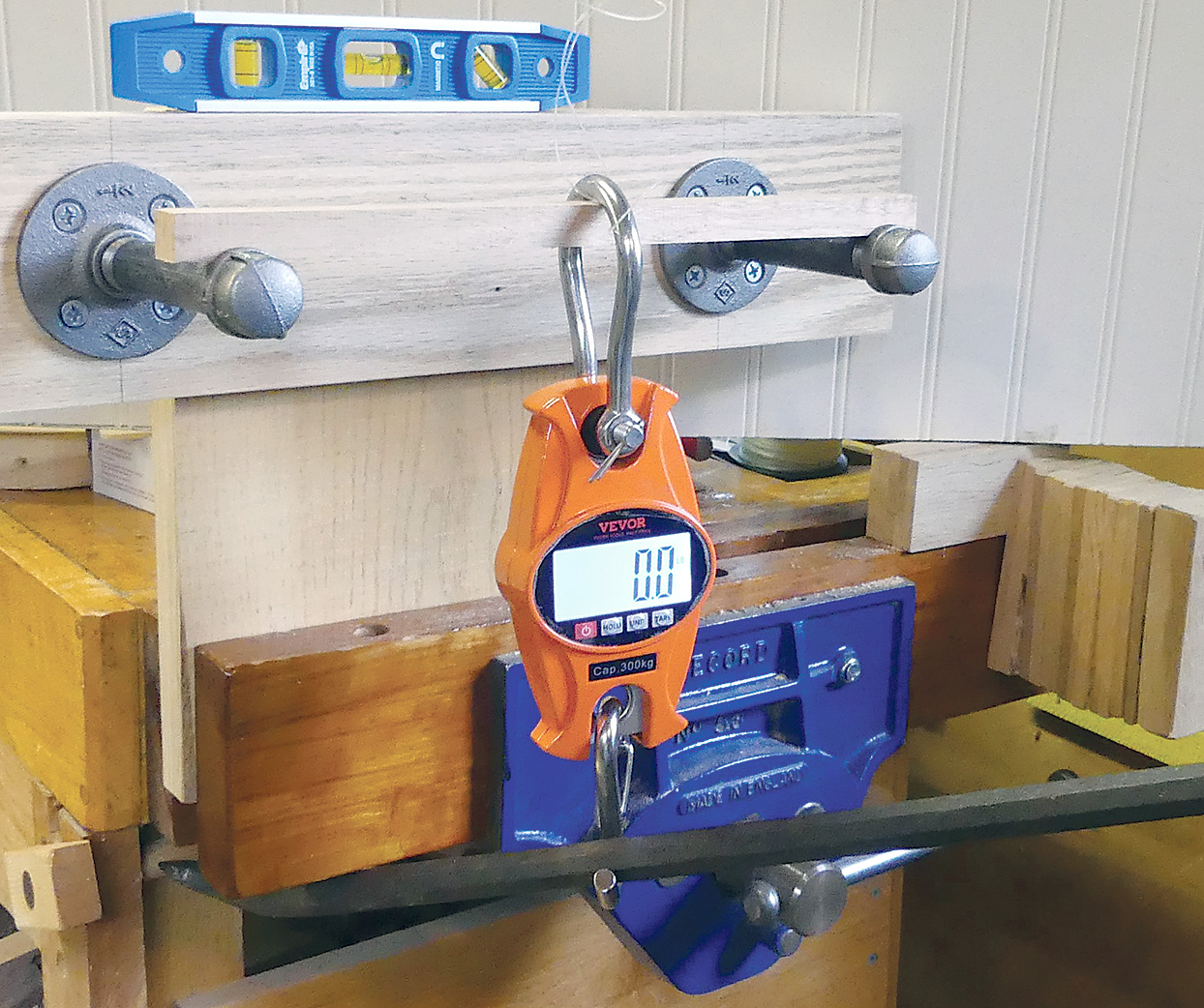
Photo 1—A simple device for measuring comparative wood-bending strength characteristics uses a pair of ½″ × 5″ black-iron pipe nipples capped and screwed into pipe flanges mounted 12″ apart on a ⁵⁄₄-thick oak plank. When this assembly is clamped into a bench vise and leveled, a hanging-crane scale with 300kg (660 lbs) capacity measures the bending force to the point of fracture.

Reclaiming timbers from ocean wreckage is a centuries-old enterprise practiced by many cultures, especially those who lack land-based timber resources. Inuit of the Arctic regions, South Sea islanders, and even Newfoundlanders who lack diversified forests have sourced wood from beach flotsam. Finds can range from shipwrecks to logs accidentally freed from water-transport rafts.

While still an important source of timber in a few places, the diminishing supply of large wooden ships and the declining practice of rafting logs to sawmills have combined to reduce the supply of wood flotsam at the same time that plastic and other manufactured ocean debris has been on the rise.

Yet one can still find occasional logs or other timbers washed up on coastal shores, as an email from reader Mike Parent affirms. He wrote, “I live in Puget Sound, 6 miles southeast of Port Townsend, Washington. In 2005, I came across an Alaska yellow cedar log 28′ long with a 28″ butt. It has been sitting on our beach for years, out of the water most of the time. Would the lumber from this log still be usable for boat planking after 25 to 30 years? If the lumber is still usable, would there be any special precautions I would need to take when planking?”

Salt Seasoning

Logs or other timbers that have spent many months or years floating in a marine environment before reaching a shore will have exchanged the living tree sap with seawater, thus absorbing marine salts that include not only sodium chloride but also other anions and cations, including relatively large quantities of arsenic. These salts provide a good measure of decay resistance, especially for the sapwood, which is rot-prone even in decay-resistant species such as Alaska yellow cedar (Cupressus nootkatensis).

After the log has been deposited on a shore, some of those salts may be leached out when exposed to rainstorms. But if the wood is bathed in seawater at high tides, salt extraction may be minimal. If the log is high and dry, the sapwood may, over time, be subject to decay, but the heartwood should be unaffected.

Long immersion in saltwater has another favorable effect: it improves dimensional stability, reducing shrinkage or swelling with environmental changes. For this reason, logs washed ashore often do not develop the kind of severe checking and splitting that would occur in a log that is drying on land. This is why logs waiting to be processed at sawmills are often kept under continuous water spray.

Beached logs will have originated from trees with moderate to low wood density. Generally, wood species with specific gravities above 0.80 will sink quite soon after immersion—and more rapidly in fresh water than seawater. When logging operations depended on floating logs downriver to sawmill destinations, high-density woods were avoided. In tropical America, this meant moderate-density woods such as mahogany (Swietenia spp.) and Spanish cedar (Cedrela odorata) became well-known commercial species while higher-density tropical species had to wait until truck and rail transport permitted exploitation. The relatively recent trend toward the use of high-density porch and deck woods such as ipe (Handroanthus spp.) and tigerwood, also known as goncalo alves (Astronium spp.), is one consequence of overland log transport. Tigerwood has a specific gravity of 0.8 to 0.91, while ipe ranges from 0.91 to 1.10, the latter higher than water’s 1.0.

I am reminded of an incident that happened on a tiny, offshore island on the coast of Maine about 35 years ago, when the manned lighthouse there was to be converted to an automated light. This necessitated the construction of a helicopter pad for routine servicing of the light. Borneo ironwood (Eusideroxylon zwageri) was chosen as the pad construction material. A U.S. Coast Guard vessel ferried the wood to the island, but with no safe landing place, the wood was dumped overboard to be floated to the island. With a specific gravity of 0.86 to 0.92, the logs promptly sank to the ocean floor.

Sinker Logs

While logs beached on ocean shores may be protected from rot by seawater immersion, logs that litter rivers or freshwater lake shores will rot within a short time unless the heartwood is naturally decay-resistant. In that case, the sapwood will likely deteriorate and may surround a sound heartwood.

If, instead of floating, the logs have a specific gravity high enough to sink within a short time, the wood will be protected from decay fungi due to lack of sufficient oxygen. If water depth is not too great, these logs can be retrieved decades later and produce usable boatbuilding wood. Articles in Wooden­Boat, and Wood Technology in WB No. 175, have addressed uses of sinker logs.

Example of a brash break, a characteristic of weak wood.Dr. Richard Jagels

Photo 2—Using small-dimension beams cut to identical dimensions, comparative breaking strengths can be tested. The top example shows an example of a brash break, a characteristic of weak wood. The long-splinter break in the bottom example demonstrates strong wood.

Inspect and Test

Inspection of the log by prodding with an ice pick and, if possible, an increment corer, should be the first step in assessing whether a log is sound. If these steps don’t reveal wood decay, a cost analysis is a useful next step. What will it cost to get the log or log segment to a sawmill, and will those costs combined with milling costs be substantially less than purchasing green, rough-sawn lumber of equal quality? If you go forward, you need to recognize that you will be accepting some level of risk. And before you invest any dollars, you will likely need to check with local authorities to determine whether you can legally take possession of a beached log, which may depend on whether you own the beach.

Finally, if you decide to turn the log into lumber, you might want to do some further testing of the wood before final milling for use as boat planking. A simple test involves sinking a knife blade into a wood sample at about 45 degrees to the long axis of the wood fibers and lifting sharply to pop out a sliver of wood. If the sliver is relatively long and pointed at the end, this is evidence that the wood is not “brash,” a term used to describe brittleness, an indicator of possible incipient decay. A short sliver with a blunt end may be a sign of some wood deterioration. A comparison with a known sample of sound wood of the same species will confirm these results.

A more quantitative test involves performing a bending test on a small beam. The American Society for Testing Materials (ASTM) establishes standards for testing wood-strength properties, but this involves expensive testing equipment beyond boatbuilders’ pocketbooks. I have made a simple apparatus that uses smaller beam sizes than that used in formulating the ASTM standards to get a rough idea of wood bending strength (photo 1). Two ½ × 5″ black-iron pipe nipples are capped and screwed into pipe flanges that are spaced 12 apart and screwed onto a ⁵⁄₄ oak plank. My apparatus is clamped into my workbench vise and leveled. I use a digital-readout, hanging-crane scale with 300kg (660 lbs) capacity, and I recommend at least 150kg capacity. This is not a spring scale, so scale movement is basically eliminated as load is applied. With a heavy pry bar, I very slowly apply leverage on the hanging hook until the beam fails. A 150-lb-test monofilament safety cord hung from the ceiling prevents the scale from crashing to the floor as the beam fails. You will not likely catch the final scale reading before failure, but, more important, in addition to rough load capacity you will be able to examine the type of failure. In photo 2, the top example shows a brash break of weak wood compared to the long-splinter break of strong wood shown at the bottom of the photograph.

I use square beams, 13½ × ½ × ½ for most woods. For very strong woods, I reduce beam size to ⅜, and for exceptionally weak woods, I may increase to ⅝. These beam sizes are smaller than ASTM standards and only provide very rough results, useful for comparative assessments.  Article ends.

Dr. Richard Jagels is an emeritus professor of forest biology at the University of Maine, Orono. Please send correspondence to Dr. Jagels by mail to the care of WoodenBoat, or via e-mail to Senior Editor Tom Jackson, tom@woodenboat.com.