Hampton Boats
Dear Editors,
I enjoyed Stan Grayson’s article on Hampton boats, which included quoted reports about these boats in early Motorboat magazines. One important bit he didn’t use but that could be pointed out to readers is the letter that David Perry Sinnett had published in the June 10, 1908 Motorboat. He notes that he was responsible for the first Casco Bay strip-built boat, and includes details of the 1877 build. By the time he wrote his letter, he had built 175 square-sterned, strip-built boats. He figured there were 300 of them, all motorized, by then in use on Casco Bay. “Five years ago,” he wrote, “there was only one motorboat in the bay, and now there is only one sailboat…. On the fourth of last April a 24′-boat equipped with a 5½-hp motor went out to the fishing grounds from the island fifteen miles to the leeward. Shortly after the boat reached the grounds it began to blow hard, developing into a forty-mile-an-hour northwesterly gale. This boat made the run home, against the wind in two hours and forty minutes.” The implication, of course, was that the sailboats would have had a tough time, with losses. Sinnett notes that the boats were 16′ to 32′ with a price of from $5 to $12.
There is also a great full-page illustration of these boats in the magazine’s April 10, 1908 edition. Besides the photo that you republished, there are some great ones of ice-covered Hamptons in the collection of the Penobscot Marine Museum in Searsport, Maine. Readers might also be interested to know that the museum has in its collection KINGFISHER, a Sinnett-built motorized Hampton. Mystic Seaport Museum also has one—a pleasure boat that Sinnett built in 1902.
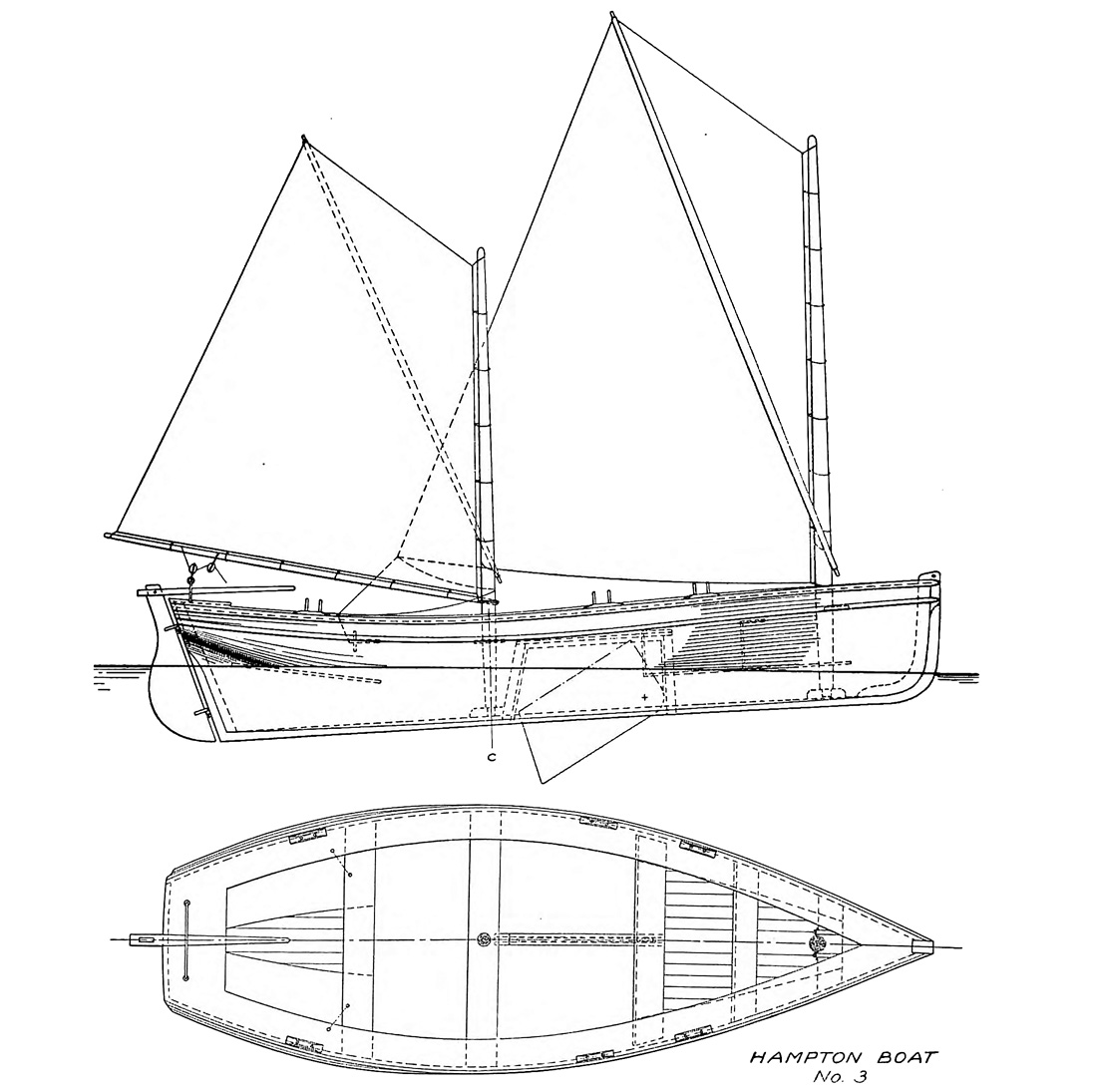
American Neptune, APRIL 1943A classic square-sterned Hampton boat (see WB No. 295).
The illustrator and historian Sam Manning resolved that these boats should be called “New England boats,” noting that such ketch-rigged open boats were common from Massachusetts to Canada. The oldest strippers were on the South Shore of Massachusetts, and called Kingston lobsterboats.
Ben Fuller
Via email
To the editor:
Regarding the fine article by Stan Grayson on the Hampton boat, I can help with one minor point that is probably outside the author’s area of expertise. In the section about the development of the design, he mentions that Allan O. Goold refers to many of the boats being painted Paris green. Paris green is a pigment that was heavily used in the 19th century because it was attractive, cheap, and fairly long-lasting—though not what artists would call permanent. As an arsenic compound, it was also useful as a rat poison and, as you can well imagine, is not used much now. It was, however, not dark green but rather a fairly light value. Being in the more light-sensitive portion of the spectrum for the orthochromatic film then in use, it would also have registered as a light gray in contemporary photos. The photo shows a Hampton of just about the right value of gray for this color. A dark color in the photo would have indicated either a black or reddish subject color.
Guy J. Smith
Via email
Concordia Yawls
Dear Matt,
Queene Foster’s report about Concordia yawls in WB No. 295 brought to mind some memories I have of these great boats, and their origins. Around 1975, when I owned a Seven Seas cutter, SWALLOW, designed by Wilder B. (Bill) Harris and built in 1929 at the Kennedy yard in Quincy, Massachusetts, my friend Jack Towle came for a sail with me. He was impressed with SWALLOW, and expressed interest in buying something similar but larger. He soon bought SISYPHUS, a Ray Hunt–designed Concordia yawl, in 1976, and owned her for a long time. We sailed that yacht to Bermuda in 1979, where my wife, Ann, and I were married; we honeymooned sailing home, and after a few more Bermuda trips Jack berthed his Concordia in Baddeck, Nova Scotia, and sailed her around Labrador for many years.
Having spent many miles lying in a Concordia berth or sleeping in the forepeak, I always admired the beautiful shapes overhead and the cabin house profile as much as I did the way she slipped though the water. That shape and those curves, reminiscent of my SWALLOW, seemed so similar to the Concordia that my curiosity about their origin was long unsatisfied.
Bill Harris gets full credit for the small Concordia boats—the 28, 31, and 33, and looking at other boats he designed, as documented in Waldo Howland’s books, the similarity of the Harris-designed interiors is undeniable. There’s no question great boats are often a collaboration, and many draftsmen got little credit for the often huge contributions they made. A few years ago, Sham Hunt, Ray’s son, dropped me a copy of the recently published book about his father. I asked carefully, “I don’t doubt for a moment that Ray deserves full credit for the Concordia hull, but is it possible Bill Harris drew the house, details, interior?” Sham answered “you’re probably right. Dad had very little patience for detail.” And the beauty of the yawls is not just how they sail. It’s all those simple details.
Bob Morris
Via email