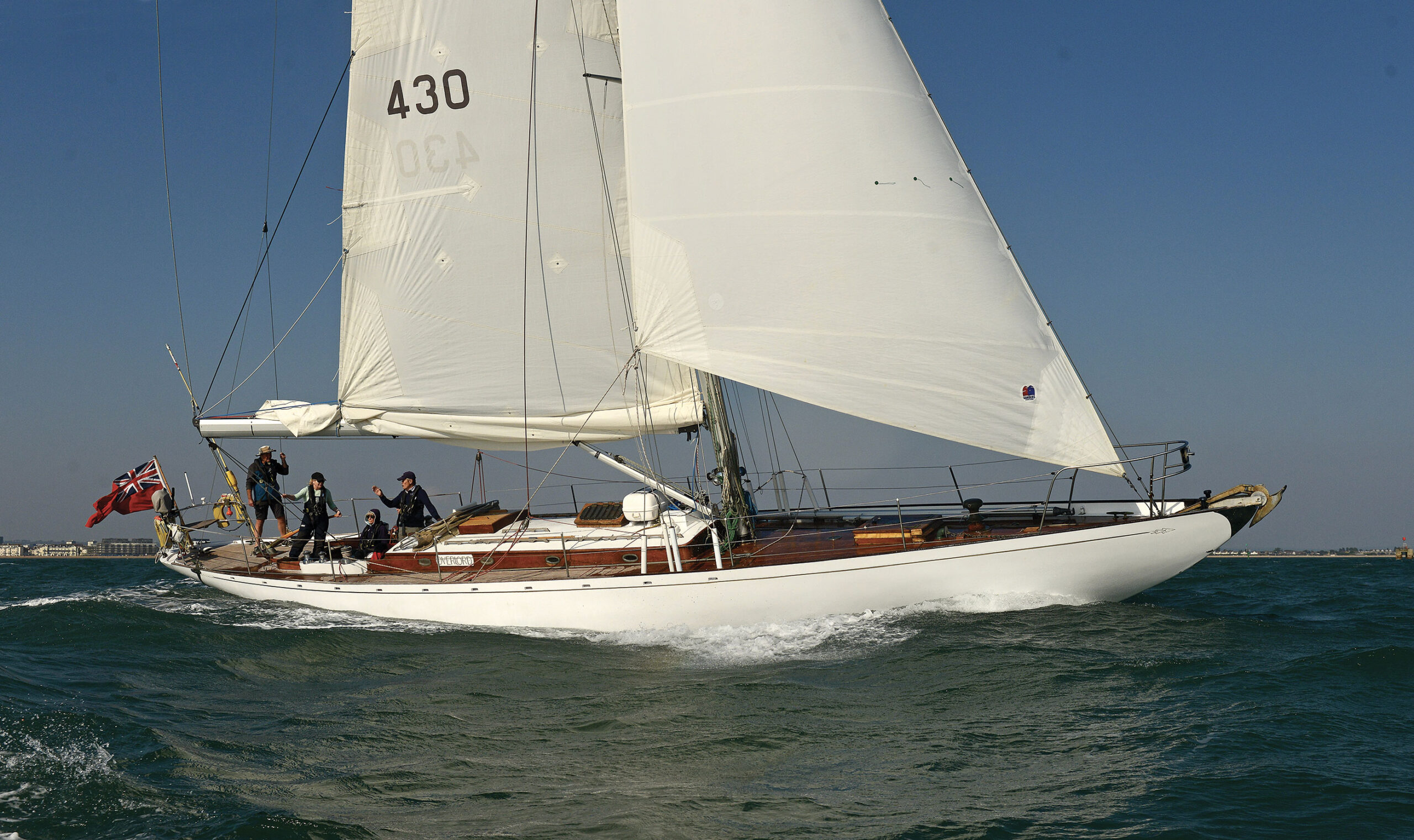
Nic ComptonThe sloop OVERLORD (ex-PELIKAN) was built in 1936 as a training vessel for the German military. Seized by the British as a prize after World War II, she similarly served British soldiers for more than a decade before becoming a club boat—a role in which she still serves. Despite the gusty conditions seen here off Portsmouth, England, she is fast and comfortable under reefed main and Yankee jib.
It’s easy to miss a small detail screwed onto the cabin side. It was only after going below on my own as we were sailing across a choppy Solent that I fully registered it. And then it stopped me in my tracks: a small wooden panel, no more than 5″ tall by 3″ wide, with two brass plaques screwed onto it. The top one shows an image of an eagle with wings outspread, holding a swastika in its claws: the unmistakable symbol of the German Luftwaffe.
Above the logo are the words Standort Segel Wettfahrten (Area Sailing Race); under it is inscribed 1. Preis 11.7.43 (First prize).
The second plaque reads:
PELIKAN
Regatta Greifswald-Peenemünder-Bodden
Skipper Oberleutnant Wilhelm Meyer
The indication is that PELIKAN competed in an event from Greifswald-Peenemünder-Bodden, near the border with Poland, skippered by Oberleutnant (First Lieutenant) Wilhelm Meyer, and won the race.
The plaque is a powerful reminder of the provenance of this yacht: she was built for the Luftwaffe in 1936 and used by its crews for recreation and team-building exercises both before and during World War II. It’s also a fascinating testimony that in June 1943, nearly four years into the bloodiest war in human history, the Luftwaffe found time to organize a yacht race along Germany’s Baltic coast. The following month, more than 1,500 Luftwaffe aircraft were destroyed, one of the highest tolls in its existence, and within the year it would be all but wiped out as an effective fighting force—and all thoughts of German yacht racing erased for the foreseeable future.
Yet, out of that darkness something joyful emerged. At war’s end, PELIKAN was seized by the British armed forces as a prize of war, along with dozens of other craft, collectively known as the “windfall yachts.” She was sailed across the North Sea and, renamed OVERLORD, sailed by British regiments in much the same way that she had been by the Germans, even competing in several races from 1949 onward.
In 1961, she was retired from military service and turned into a club boat. She has cruised extensively ever since, taking hundreds of club members on adventuresome cruises, sailing as far afield as Scotland, Scandinavia, Turkey, the Azores, and everywhere in between. In the process, she has introduced several generations to the joys of sailing in a vintage wooden yacht—for less than the price of an average movie-streaming subscription. It’s a remarkable success story and a shining example of how to keep an old yacht sailing and earning her keep over many decades.
It was a blustery, sunny day when I joined OVERLORD in Gosport, England, toward the end of last summer. She’s an impressive boat; at 58′ long, with 19′ of overhangs and an 11′ 4″ beam, she looks the epitome of a classic racing yacht. She also looks like a boat that’s well-tended—not overdone, but maintained. The varnish and paintwork are in good condition, despite the evident age of most of the woodwork; the decks are well scrubbed; and the canvas covers all neatly and tidily. This boat wears her age with pride and doesn’t pretend to be in the first flush of youth.
Belowdeck, it’s a similar story. The interior is neither precious 1930s-vintage joinery nor a fancy restoration. Most of the accommodation was rebuilt in the 1960s, so the surfaces are Formica, the woodwork is solid rather than elegant, and there are random inlaid panels where someone got creative with some veneer. It’s all well-worn in a cozy and welcoming way. This is not a tablecloth-and-coaster kind of boat; there are simply too many people coming and going to support that kind of micromanagement.
Nic ComptonLeft—This sail plan was drawn for OVERLORD’s new mast, which was built by Atlantic Spars in 2002. Right—The lines drawings were created by an Offshore Cruising Club member in the 1960s.
After a quick tour of the interior, I was offered a mug of tea and soon found myself sitting around the saloon table with the rest of that day’s crew. A wide range of professions and ages were represented—though in common with the membership in general, the assembled crew tends toward the older end of the spectrum. In fact, nearly everyone here is past retirement age.
Nic ComptonOVERLORD heads across The Solent toward Spitbank Fort, one of a trio of Napoleonic-era fortifications now converted to luxury homes and spas.
Our skipper for the day was Paul Lund, a retired lawyer, who is the current commodore of the Offshore Cruising Club (OCC), which owns and runs OVERLORD. The rest of the crew included a retired chartered building surveyor, a retired IT consultant, and a retired secretary. The youngest person there was Laura Salmon, a mechanical engineer who retrained as doctor and once sailed her own boat across the Atlantic as part of the Atlantic Rally for Cruisers, or ARC series. The oldest person was Miggie Bruce, who had only ever sailed dinghies until she joined the OCC in 2009 and has since become a stalwart member.
Miggie is also the unofficial club historian. While sipping her tea, she told me about the boat’s history. “She was built for the Luftwaffe at the Abeking & Rasmussen yard in 1936 and campaigned before the war, winning the 1937 Heligoland Race,” she says. PELIKAN, she explains, was one of 10 windfall yachts designed to the 100-Square-Meter Rule—a popular Scandinavian design rule based on sail area, which produced long-ended, deep-drafted boats ideal for racing in deep Baltic waters. The story goes that Hermann Göring liked to sail the boat and that the extra-wide quarter berth was built to accommodate his large frame.
After the war, PELIKAN was one of an estimated 200 yachts seized by the Allies as war reparations. The boats taken ranged from sharpies and Star-class dinghies to 30-, 50-, and 100-Square-Meter yachts, and larger yachts rating up to 300 Square Meters. The United Kingdom didn’t have such a developed sail-training program for its military, but these newly acquired boats kick-started a movement that survives to this day.
The concept of sail training for aircraft pilots and soldiers might seem strange—after all, they aren’t likely to sail a boat into battle—but the 1985 documentary Prizes of War about the windfall yachts based in Kiel (see the youtube video: Windfall Yachts – “Prizes of War” TV programme 1985), has an interesting take on the subject. A Royal Engineers officer interviewed in that film observed:
“When we go to sea in a boat, it’s all real. People have to get out of the situations they get themselves into. There’s no way they can decide to stop playing and get off and walk. Therefore, we can put a bit of fear into them, make them a bit worried, make them anxious, make them a bit cold and uncomfortable. Make it really adventurous. After doing one of our courses here, I’m quite sure that the soldiers go back to their units as better soldiers, knowing a bit more about themselves, how far they can push themselves, what their limits are from both a physical point of view and a mental point of view. They learn a lot about themselves at sea.”
PELIKAN was allocated to the Royal Engineer Yacht Club (REYC) who renamed her OVERLORD, presumably in honor of the Allied code name for the D-Day invasion plans. In 1946 she was sailed along with three other windfall yachts to the REYC base at Marchwood, at the top of Southampton Water on England’s South Coast. The club was famously competitive and OVERLORD was keenly raced on the Royal Ocean Racing Club (RORC) circuit, competing in two Fastnet Races and taking third place in the 1949 Channel Points Series.
Nic ComptonMost of the boat’s accommodation dates from the 1960s, when she was bought by ex-serviceman Tony Venables and turned into a club boat.
Nic ComptonA healthy membership means she’s been kept up-to-date with navigation equipment (left) and fully functioning galley (right).
In the early 1950s, the REYC ordered themselves some new yachts, and OVERLORD was transferred to the Royal Army Service Corp (RASC) Yacht Club in May 1955. Tony Venables was a captain in the RASC and, according to the book The Windfall Yachts (Michael Cudmore, 2007), he was asked “if he had webbed feet.” When he answered “in the affirmative,” he was given charge of running the organization’s new acquisition. It was the start of a longstanding relationship that would prove crucial to the boat’s survival and to the hundreds of people who would subsequently sail in her.
It’s perhaps an indication of Venables’s feelings for his new charge that when he got married in 1956, he and his bride honeymooned aboard OVERLORD before he headed off to Suez, where British troops were embroiled in a spot of bother. That same year, OVERLORD was fitted with her first engine, a 24-hp Parsons gasoline four-cylinder model. Things came to a head four years later, however, when the yacht’s wooden mast broke while sailing off Guernsey. The RASC decided it had had enough and put the boat up for sale. Venables had by then left the service but was evidently still enamored with his former charge; he submitted a bid of £750, which was duly accepted by the War Department.
Venables’s idea was to upgrade her, sail her for a couple of years, and, he hoped, sell her at a profit. A new rig was designed by Illingworth & Primrose, one of the top British design companies of the day, converting her from fractional to masthead rig, with a shorter boom and rope tackles for the running backstays instead of Highfield levers. The wooden mast was replaced with an aluminum one, which at that time was the biggest aluminum spar built by Ian Proctor Metal Masts Ltd., based near Southampton.
Nic ComptonLeft—The original anchor windlass remains in use to this day. Right—The skylight window frames also date to the 1930s.
In summer 1962, Venables organized a cruise along the English Channel, with friends and acquaintances chipping in on the costs. So successful was the trip that he was persuaded to keep the boat and set up a club to continue sailing on the same basis. He agreed, with the provision that at least 30 people would sign up. Progress was slow until he hit on the idea of offering new club members a necktie with an anchor motif. He took the ties and a burgee, both designed by the Captain OM Watts chandlery, to the January 1963 London Boat Show and applications soon came flying in. By June, he had 19 members, and by the time of the first annual meeting in November he had 60.
“It was the ties that did it,” he later said.
Venables never looked back, and the club—originally called the Overlord Sailing Club but soon changed to the Offshore Cruising Club—has gone from strength to strength ever since. Crucial to that success, according to Venables, was choosing a club-committee structure rather than a syndicate. Under this type of organization, the club owns the boat (Venables sold OVERLORD to the OCC in 1969) and members pay an annual fee to join the club plus a day rate to sail on the boat. Committees oversee maintenance, membership, and the sailing schedule. By contrast, in the syndicate model, all members own a share of the boat and split the operating costs among themselves.
Over the years, the OCC cruising program has become increasingly ambitious, starting in the English Channel and France, then sailing across the Mediterranean to Turkey, with winter sailing in Majorca, Sicily, and Turkey. In 1982, OVERLORD joined the Tall Ships Races, sailing one leg from Falmouth, England, to Lisbon, Portugal. She has cruised the Baltic several times, often overwintering there for a year before returning to her base in Gosport, near Portsmouth, the following year. Her longest trip was to the Azores and back. “That required a big level of commitment,” Paul Lund said, “as it’s a long way there and long way back, and a long way in between.” Throughout this time, Venables has stayed actively involved, initially as the principal skipper and then, after he sold OVERLORD to the club, as OCC Admiral.
OVERLORD is often recognized as a windfall yacht in the Baltic, though so far without rancor. Wherever she goes, her size and shape cause her to stand out from the usual glut of boxy white plastic boats. “Wherever you go, there’s always somebody who’s either sailed on her or whose parents have,” Miggie said. “The boat attracts attention and opens doors.”
And there are stories aplenty. One time, while the boat was waiting to enter the picturesque harbor on the Isle D’Yeu on the west coast of France, Paul spotted a fisherman carrying a fine large bass and asked if it was for sale. The curt reply came: “Non, monsieur.” Moments later, there was another call of “monsieur,” and the fish came flying over, still alive. The fisherman still refused payment.
“I made a filet de bar with mustard, dill, and crème fraiche,” Paul said. “There was bass for sale in the market that morning for 48 euros per kilo, so that was about 140 euros of fish. You just never know what’s going to happen when you’re sailing on this boat.”
Nowadays, the OCC has about 200 members, though only about 100 sail regularly and the demographic is steadily aging—so much so that the Ancient Mariner category, an honorary membership status for veteran crew members who no longer sail, has been closed due to over-subscription. Of the 100 active members, 20 or so are qualified skippers, of whom about 12 are regularly available. Although the boat sleeps a crew of 10, eight is preferred for comfort’s sake and five or six is the minimum, depending on conditions.
The cruising program is arranged by the Sailing Committee with input from members, particularly the skippers. The program usually includes two or three Junior Offshore Group (JOG) races around The Solent and over to France, short cruises to the Channel Islands and France, and a long summer cruise. The final schedule is put to the vote, but the Round the Island Race (around the Isle of Wight), the D-Day commemorations, and Trafalgar Day are fixed dates in the calendar.
“We usually have a skippers’ meeting to determine the appropriate parameters,” Paul said. “Last year it was a choice between the Baltic and the Canaries, and the members voted for the Baltic. But it was almost 50/50. The Canaries might again be an option for this year, but I’m concerned we don’t overextend ourselves. Ireland is always popular, and the Western Isles of Scotland, though they are getting crowded these days as more people head north. Fewer people are going to France because of the post-Brexit regulations.”
Nic ComptonOffshore Cruising Club member Laura Salmon hoists the hanked-on jib.
The members voted to cruise down the west coast of France in 2025, starting with a delivery trip to Brest on June 14 followed by a series of weeklong cruises based in Pornic at the mouth of the Loire River before heading back to Gosport on August 23.
OVERLORD costs about £20,000 to £30,000 (about $26,000 to $40,000) per year to run, including her mooring in a prime sailing location on The Solent. Membership is £120 ($158) per year, plus £65 ($86) per day to go sailing, which adds up to £575 ($756) per year if you only do a week’s sailing or £1,030 ($1,355) for two weeks. Members get a reduction if they work on the boat, equivalent to £2 ($2.60) for every day they work. Some people clock up so many days’ work, they go sailing for free, as Miggie did one year.
Nic ComptonAs a club boat, OVERLORD has cruised as far as Turkey and the Canary Islands.
“The volunteer program is fundamental to running the club. Without it, the club couldn’t survive,” said Nick Molteno, the Boat Committee chairman, who manages the refit program. “We have about 40 volunteers who work on the boat during the winter, doing everything from varnishing to interior painting and engineering. One member recently rebuilt the forehatch. The club simply couldn’t afford to pay to have it all done professionally. Volunteers get a discount when they go sailing, but mostly they do it out of sheer love of working on the boat.”
It’s a well-judged formula which enables people of modest means to go sailing in exotic places on a beautiful wooden boat that would otherwise be beyond their means. At the same time, the boat is not only well maintained but has a surplus to pay for the big jobs when they arise. And when the costs do exceed the club’s reserve funds, the membership can be counted on for an injection of cash. When the engine was replaced in 2023, at the cost of £16,000 ($21,050), an appeal was launched; it raised £7,000 ($9,210), and the old three-cylinder Yanmar was duly replaced with a 45-hp four-cylinder Beta.
Most recently, OVERLORD was extensively refurbished by the Elephant Boatyard on the River Hamble in Hampshire. The work included replacing a section of starboard planking that was damaged when a mooring line snapped during a storm. Several steel frames and floors were also replaced, her deck was recaulked, and the stem and keelson were partly rebuilt.
It takes a particular type of person to head out to sea on a vintage wooden boat with half a dozen acquaintances. The benefit, however, is that members get to meet and sail with like-minded people. “I’ve had some of the best meals around this table,” one woman crewmember said.
“Yes, we have some excellent cooks,” Nick Molteno replied, prompting another comment from her.
“And some of the best company,” she said. People come from all walks of life, and all professions. Some have lots of time to give and are incredibly committed; others are trying to balance a full-time job but still want to support the program. There’s real diversity.”
“And great camaraderie,” Miggie added.
Indeed, several couples have met through their involvement in the club, and it’s said that Göring’s extra-large quarter berth has been put to good use by certain young people.
Back at the marina in Gosport, the wind was gusting up to 20 knots, and I was concerned that my long-awaited sail might get canceled. I need not have worried. Once the crew had downed their tea, they busied themselves putting a reef in the mainsail and we headed out of the marina without hesitation. The chop was up as we sailed across The Solent, weaving our way between a small fleet of cargo ships anchored off Portsmouth. But the crew were oblivious to the stiffening breeze and the spray crashing across the boat’s foredeck. OVERLORD is that kind of boat. With her long overhangs and a displacement of 18.3 metric tons, she is ideally suited to these conditions, cutting through the waves with ease and keeping her momentum going. Even when spray did come over the foredeck, it rarely reached the cockpit, and the crew carried on with their chatter regardless.
It’s this sense of power that inspires confidence in the boat and has enabled her not only to survive but also to undertake an ambitious cruising program almost every year. She might be an 89-year-old classic yacht, but she is sailed hard and with confidence, while a healthy income from her membership fees ensures that she is well-maintained and fit for purpose. The same characteristics that made her such a success training pilots in wartime are, it seems, equally appreciated and valued by civilians in peacetime. Long may that last.
Other windfall yachts
MARABU
MARABU is another stunning 100-Square-Meter windfall yacht also built by Abeking & Rasmussen and also said to be Hermann Göring’s favorite. This time the evidence is an extra-large forecastle berth, thought to have been fitted specially for him. Built in 1935 for the Luftwaffe, she served as a sail-training vessel in the Baltic. She was acquisitioned by the Allies after the war. Allocated to the Coastal Forces Sailing Club based in Portsmouth, she kept her original name, unlike most windfall yachts. She was raced hard for many years, including eight Fastnet Races, and in 1952 she sailed across the Atlantic to compete in the Newport-
Bermuda Race.
Nic ComptonMARABU, which sails on Lake Constance, was transformed after a seven-year restoration during which boatbuilder Josef Martin removed a non-original doghouse and returned her to cutter rig.
In 1951, under the supervision of John Illingworth, the forestay was moved forward by 3′ to increase the area of her genoa, and a doghouse was added in anticipation of her forthcoming transatlantic journey. The following year, she was converted from cutter to ketch rig, wheel steering replaced the tiller, and a small engine was fitted.
MARABU left military service in 1978 and was bought by former OVERLORD skipper John Kapp (with help from Tony Venables), who formed a syndicate to run her, based in Brighton. The syndicate soon attracted more than 100 members, who paid £100 ($132) per share, up to a maximum of £600 ($790) per person. The members also contributed to the boat’s extensive maintenance over the years, including dropping the keel and fitting new keelbolts in 1987. According to one former syndicate member (who asked not to be named), despite the organization’s financial woes, “MARABU was faster and could beat OVERLORD in a race any day.”
The syndicate eventually ran out of steam and was disbanded in 2005. MARABU was sold to a private owner and sat in Ipswich Marina for several years before she was spotted by a German boatbuilder, Josef Martin of Martin Yachts. Despite not having a client for the boat, he had her shipped on a low-loader to his yard on Lake Constance. Eight years later, and still without a client, he set about restoring the boat himself, eventually selling her in the later stages of the project (documented in superb detail by photographer Kerstin Schulze, see her photography page). MARABU was relaunched in June 2024, looking more glorious than ever—including a return to cutter rig and the removal of the boxy wheelhouse.
SEA SCAMP
A little sister to OVERLORD and MARABU, the 50-Square-Meter SEA SCAMP was bought by Tony Venables and John Kapp on a whim. During an OCC party in 1984, Venables casually mentioned to Kapp that the boat was being auctioned off by the Admiralty and reportedly Kapp said “without thinking, ‘Let’s buy her.’” They submitted their bid two days later, and the boat was theirs. The SEA SCAMP syndicate has been going strong ever since. Being smaller than OVERLORD, she has a shorter range. She sails from her base at Shamrock Quay in Southampton along England’s South Coast but ventures on cruises as far as Scotland, Ireland, and France. Membership is £90 ($118) per year plus £60 ($79) per day for sailing.
Nic ComptonThe 50-Square-Meter SEA SCAMP is still going strong after 40 years as a club boat. She is based at Shamrock Quay in Southampton.
SEA SCAMP (ex-ZEISIG) was also built by Abeking & Rasmussen for the Luftwaffe in 1936; at war’s end she was allocated to the Royal Marines in Plymouth, Devon. She was used by naval training bases on the Tamar River until 1974, when she was donated to the local Sea Scouts. For more information, visit SEA SCAMP’S website.
KESTREL
A yacht of many names, SEENIXE is a 50-Square-Meter yacht built by Abeking & Rasmussen. Seized after the war as a windfall, she was misnamed SEEJUNGFER by the British Admiralty before being renamed GRIFFIN. She was allocated to Royal Naval College Dartmouth, Devon, which after three years renamed her GRYPHIS to avoid confusion with another GRIFFIN. By 1956, she had been renamed KESTREL and was transferred to the Naval Air Command, first in Portsmouth and later at Culdrose, Cornwall. She left military service in 1967 and went through a string of civilian owners, before being snapped up by John Kapp in 1990 and joining the MARABU Syndicate in Brighton. Like SEA SCAMP, she played an important role in training skippers to qualify to take charge of the large boats. She was sold off when the MARUBU Syndicate folded in 2004. After 10 years in Ipswich, on England’s East Coast, she was taken to the German shipyard Hanseatische Boots & Yachten Manufaktur at Freiburg, Germany, on the River Elbe, for restoration.
SUNA
The smallest of the Venables-Kapp fleet of windfall yachts is the 30-Square-Meter SUNA (ex-AEGIR). Built by Abeking & Rasmussen in 1936, she was transferred to Gibraltar after the war and then to Malta, where she was based until the late 1960s. She entered civilian life in the 1970s and was brought back to England, where John Kapp eventually bought her in poor condition for £500 ($658). The idea was for her to join the MARABU Syndicate in Brighton, but that never happened. Instead, after an extensive restoration, she was taken to Liverpool, where she was run as a separate syndicate. She went into private ownership in 2003, and after a further restoration in 2010–13, ended up in a sorry state in Scarborough Marina, where she was auctioned to a new owner in 2021. She is currently undergoing restoration.
OVERLORD Particulars
- LOA 58‘ (17.7m)
- LWL 39‘ (11.9m)
- Beam 11‘5“ (3.5m)
- Draft 7‘6“ (2.3m)
- Displacement 40,345 lbs (18.3 metric tons)
- Sail area 1,209 sq ft (112.37m2)
Nic Compton is a regular contributor to WoodenBoat.
For more information, visit the Overlord – Offshore Cruising Club website.