You’re the master of your boat and a keen weather forecaster; you’ve got local knowledge and a bushel of experience; your gear is tough and smart. You don’t wear a silly orange life vest or a red clown nose.
So much for hubris. Ask old fellahs and bluewater shellbacks just how they felt at the moment they realized that order had failed and adrenalin arrived. They felt exactly what you’ll feel when your confidence evaporates with the sound of a shroud parting or the smell of smoke.

Ancient Persian shepherds took their sheep and their provisions over rushing rivers on rafts of blow-up bullock hides.
You could make a list of three dozen things that could debilitate you, toss you overboard, and make you wish you had that vest and a buoyant red clown nose as you sank. Catch up to technology and fashion, skipper. A contemporary lifejacket is not your grampa’s orange ox-yoke but a casually wearable accessory that can also hold your Clif Bar and iPhone.
Lifejackets, or personal flotation devices, have evolved over millennia, and the system for classifying them in the United States is in transition right now.
When passenger liners ran their ocean routes, stewards conducted lifeboat drills during which the paying gentry donned cork-block life vests. Molly Brown survived the TITANIC sinking and later became a renowned socialite. Here, she’s wearing her unfashionable early life vest.
Our stereotype PFD probably comes from the U.S. Navy’s battle life vests and R.A.F. Spitfire pilots’ inflatable vests. These concepts are still around because they work so well. They perform two of the three functions of a proper PFD: they provide buoyancy and they maintain an injured or unconscious person floating in a vertical, head-back position.
You are not required to wear a PFD aboard your boat (unless you’re 13 or under). However, you must have a U.S. Coast Guard–approved PFD for each person aboard. Some PFD types must be worn in order to qualify for this required inventory (see table below); a standard PFD is required to be on standby. Six passengers means six Coast Guard–approved PFDs. These must be easily available in open compartments, not in locked spaces. Many sets of PFDs are supplied in weather-resistant packages that can be located in an accessible place.
Belt-pack PFDs leap into service when inflated manually (pull tab) or automatically (pressure or water-activated). They are convenient, unobtrusive, but require that the wearer duck into the neck-harness when it blossoms; an unconscious shipmate can’t do this. Give thought to your sailing mode: if your racing adventure expects you to get wet on the foredeck, choose a vest incorporating a pressure trigger rather than a moisture detector.
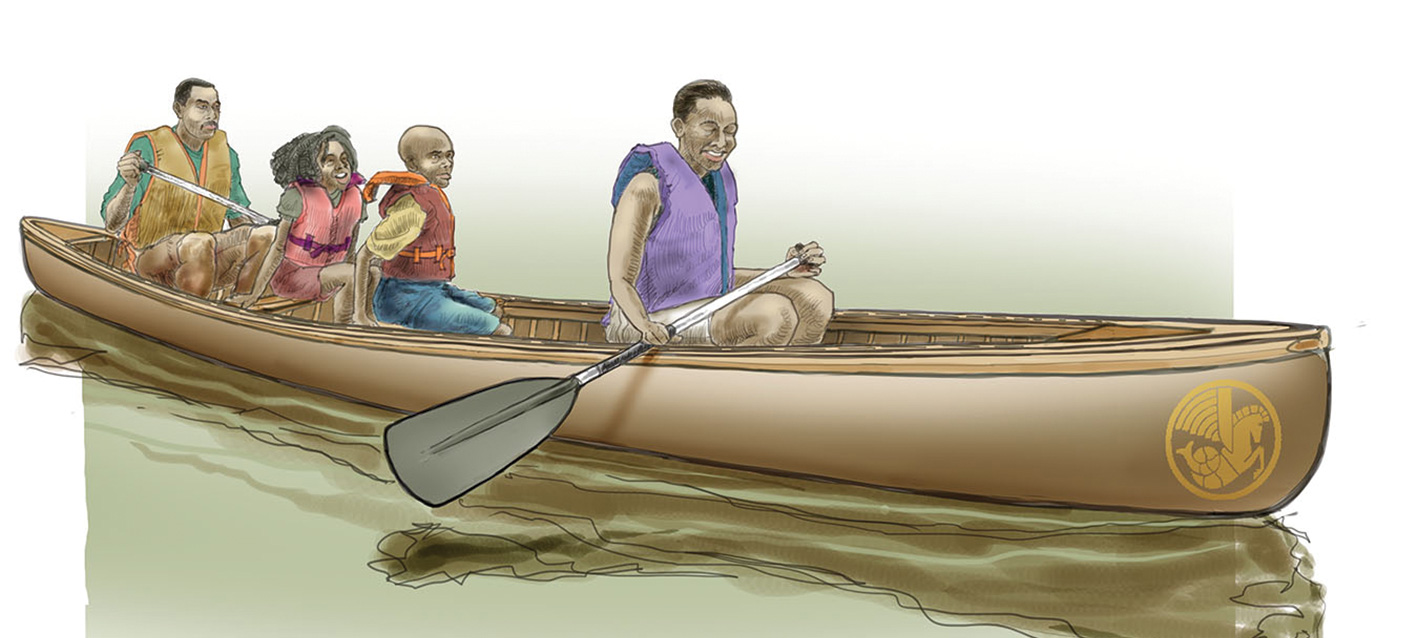
Family is the most precious cargo you will carry. There are PFDs for children of every age, size, weight, and disposition. Federal Law requires that children 13 or under must wear one at all times under way, though if there is a state law in effect, it takes precedence. One approach is to identify the child’s PFD as a badge of maturity and belonging: “If you’re a good shipmate, you might get your very own PFD.” Another ploy, highly recommended, is to allow the kid to choose the PFD regardless of your refined taste.
Until recently, the Coast Guard classified PFDs into five distinct types.
Type I is for open water, where rescue might be slow to arrive. These PFDs have the highest buoyancy of all the types, are meant to turn an unconscious victim face-up (in most cases), and, correspondingly, are the most bulky and least comfortable to wear.
Type II, the near-shore option, is intended for inland waters where a quick rescue is likely. It’s a more comfortable option than a Type I but is still designed to turn an unconscious wearer face-up (in most cases). There are inflatable Type II options, but not all inflatables are Type II (see Type V).
Type III PFDs are for specific pursuits, such kayaking, waterskiing, and fishing in inland waters. They favor wearer comfort over buoyancy, the logic being that waterskiers, for example, have the added benefit of eyeball supervision from the towboat. These PFDs are not required to turn an unconscious person face-up.
Type IV PFDs are throwable devices such as approved buoyant cushions, ring buoys, and horseshoe buoys. They are not meant to be worn and are required on boats greater than 16′ LOA.
Type V PFDs are specifically designed for activities such as whitewater paddling, boardsailing, or commercial work; they must be worn in order to be legally valid. There are inflatable Type V PFDs, but they are not as buoyant as their Type II counterparts and are not required to float an unconscious person face-up.
The Coast Guard now classifies PFDs according to “levels,” which are based on bouyancy.
The times they are a-changin’. In January 2025, the Coast Guard, to align with international standards, switched from its system of five distinct “types” to five distinct “levels” whose numbers correspond with their buoyancy—in Newtons. And what, you may ask, is a Newton? It’s the unit of force required to accelerate one kilogram of mass one meter per second squared. More simply, it’s a measure of the invisible force that will keep you afloat. The new system and the old system are running concurrently right now, and you might find one or both standards on the tags of lifejackets on your chandlery shelf. You don’t need to throw away your old PFD as the transition occurs; just assure that it complies with the standards set forth in this table. And note that Level 70 and above counts as the required inventory for your boat. ![]()
Jan Adkins is a regular contributor to WoodenBoat. Visit his blog, Dockwolloping (www.dockwalloping.boats), for more insightful illustrated discussion of all sorts of maritime matters.
In the next issue, we’ll cover harnesses and tethers.


