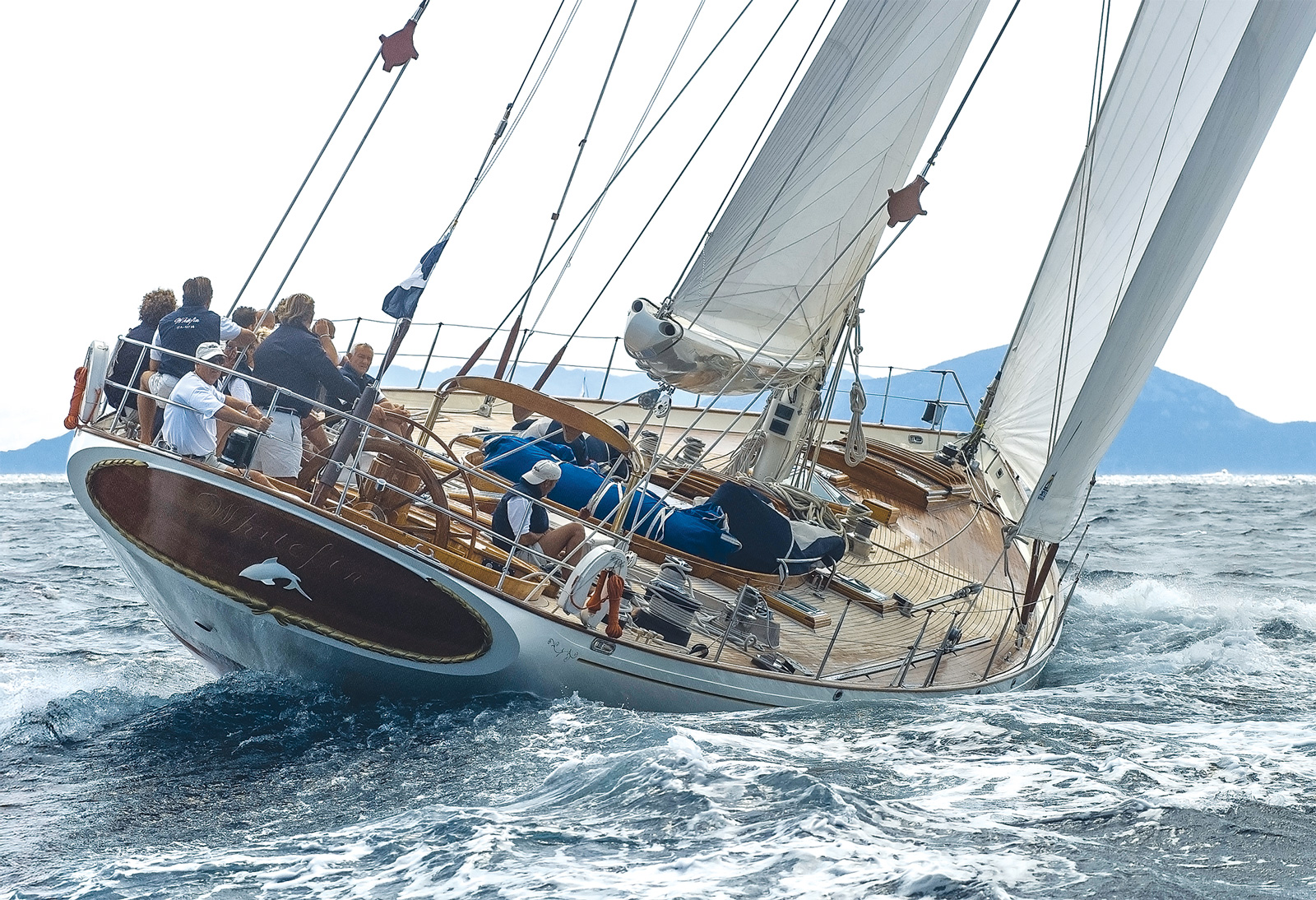
James Robinson TaylorWHITEFIN, a 90′ LOA sloop built in Maine, has been sailing the Mediterranean for many years.
During winter 2023, the 90′ LOA cold-molded sloop WHITEFIN, designed by Bruce King and launched in Maine in 1984, was well secured in the port of L’Estaques in the bay of Marseilles, France. She lay closest to the quay, port-side to, in a long line of yachts, all of which were moored stern-to along a floating dock without pilings or finger-piers. All of the yachts had bow lines out to heavy mooring chains on the seabed directly ahead to keep them perpendicular to the float. This is a common mooring method in Mediterranean ports, and it works well in the sheltered harbor.
In mid-December that year, however, a storm came in from the southwest. The harbor’s rock breakwater provided reasonable protection from the steep and short Mediterranean swells, but the gale-force winds were strong enough to press the stack of yachts moored to windward of WHITEFIN down against her starboard side. Fenders were popping, rigs were touching, and in the driving wind WHITEFIN was pressed against the concrete quay—hard enough to even damage the concrete.
Had she been exposed to the swell, the damage to WHITEFIN could have been far more severe. But as it happened, she suffered only damage and chafe to her topsides as her hull ground against the quay. It was a testament to her inherent strength that the harm was not more extensive.
After the storm passed, two marine carpenters—a father-and-son team who had been doing routine maintenance, including recaulking her teak decks under a temporary shelter—began to assess the damage. It appeared that the outer layer of her cold-molded hull and bulwark planking had taken the brunt of the force. But the carpenters could not be certain how deep the damage might extend into her six layers of cedar planking. In any case, the necessary professional survey and repairwork would require her to be hauled out, so she was taken to the Classic Works shipyard in La Ciotat, some 50km (about 30 miles) away. The survey and subsequent repair were put in the hands of Alex Laird, a co-founder of the yard and its current production manager.
The first task was to gather information. “Bruce King retired from yacht design in 2004,” Alex said, and the builder, Renaissance Yachts, founded by Phil Long to build WHITEFIN, was no longer in business. “Miraculously, we had an original copy of WoodenBoat No. 57 [March/April 1984] featuring WHITEFIN’s build sitting in an archive box just 10′ from my desk. The 10-page article, bursting with photos and technical details of her construction, gave us more than enough information to get going.”
Alex also reached out to Clark Poston, a yacht restoration specialist who is now the lead shipwright at McMillen Yachts in Portsmouth, Rhode Island. “I met Clark when he was in Cowes in the mid-1990s as lead shipwright running the restoration of AVEL for Maurizio Gucci at Spencer Thetis Wharf,” Alex said. “I was restoring PARTRIDGE about 300 yards away in the old Groves and Guttridge yard and would often call by to see Clark and Harry Spencer,” a renowned rigger. “We have kept in touch since.
“I knew he had many U.S. East Coast connections, and the WHITEFIN story in those days was a big event in the wooden boat building world,” Alex said. Clark, in turn, managed to contact Pam King, the designer’s wife, and “somehow, a thumb drive with exactly the plans we hoped for arrived in the mail. Getting the plans for WHITEFIN was a defining moment in the project, as we could at once see how she was built. Before receiving them, for example, we had assumed the bulwarks were built up separately above the covering boards and supported by invisible through-bolts. However, once we saw the plans we realized that the bulwarks were in fact an integral continuation of the layers of the cedar topsides.”
Clark also put Alex in touch with Donn Costanzo, founder of Wooden Boatworks in Greenport, New York, to recommend a source for northern white and Port Orford cedar. “Donn explained that finding good-quality ‘Maine cedar’ nowadays is not easy and suggested we switch to Atlantic white cedar.” Donn had a good supply that he had bought 20 years earlier, plus a quantity of Port Orford cedar. But Donn soon discovered that getting the timber from the United States to France would take as long as seven months. Donn instead suggested contacting John Lammerts van Buren at Touchwood in The Netherlands. “That was an easy phone call to make, as John had supplied us with Sitka spruce for a number of projects, including a new 48m (157′ 6″) built-up mast we made in 2004 for CAMBRIA, the 111′ LOD William Fife III cutter of 1928, built with wooden planks over steel frames. John eventually supplied the Alaska yellow cedar that we used for WHITEFIN’s repair.”
WHITEFIN’s owner is Patrick Salomon, a French businessman living in Paris, who has sailed tens of thousands of nautical miles. He has an eye for classic sailing yachts: he sailed his DONNA S, a 72′ ketch built to an L. Francis Herreshoff plan inspired by the well-known TICONDEROGA, on a circumnavigation of the globe; WHITEFIN is based on that same Herreshoff design.
When Patrick went to Newport, Rhode Island, in 1983 to watch the 25th AMERICA’s Cup—the race in which AUSTRALIA II wrested the cup from U.S. hands for the first time—one of the yachts that caught his eye was probably WHITEFIN’s predecessor, WHITEHAWK. Seeing WHITEHAWK was a case of love at first sight. He did not have the experience or the means at the time to dream of owning such a large and powerful yacht, but the impression she made on him that day was lasting.
WHITEHAWK was another Bruce King–designed yacht, a 92′ ketch that had also been commissioned by Phil Long as an enlargement of the TICONDEROGA design. At the time she was launched in 1979 from Lee’s Boat Shop in Rockland, Maine, WHITEHAWK was the largest yacht yet built with wood-epoxy cold-molding methods. She was followed five years later by WHITEFIN, launched by Renaissance Yachts, the firm Long founded in Thomaston, Maine, to build her. She was an even larger expansion of TICONDEROGA and was meant to perform better under sail than WHITEHAWK.
Almost four decades after that AMERICA’s Cup, while traveling near Genoa, Italy, Patrick came upon WHITEFIN—and she was for sale. She had been constantly maintained and upgraded during a successful charter career cruising the Mediterranean, including a major systems refit in 2015. Better yet, the price was right. Not believing his luck, he immediately opened negotiations; soon, the yacht of his dreams was his. He felt that he would probably spend the rest of his sailing years with her.
With such a yacht and such an owner, there was never any doubt that her damage would be repaired.
Classic Works1. It was only after we started stripping paint from the affected area that we began to discover the full extent of the damage. The worst was found to be a transverse crack that had been caused by tensile forces in the outer surfaces of the topsides wood.
Classic Works2. The principal crack appeared at or slightly above deck level. Its total length was 3.3m (10′ 9¾”), and it ran from a fairlead aft to a chainplate forward. A section of the caprail, which had been damaged for 5.4m (17′ 7½″) of its length, was also removed to make way for the repairs to the damaged topsides.
Classic Works3. We knew from the 1984 WB article that the first, or innermost, longitudinal layer was ¾″-thick tongue-and-groove northern white cedar, followed by four ¼″-thick layers of the same wood laid on opposing diagonals, and then a final longitudinal layer of 1⁄2″-thick Port Orford cedar, for a total hull thickness of 2¼″. (The metric equivalents are approximatley 19mm, 6mm, and 22mm for a total thickness of 57mm.) The original cross-sectional drawing from the plans we had received confirmed these specifications for the individual layers in the topside timber lamination. In addition, the plans showed an outer lower bulwark strake of 1⁄2″-thick black locust, set fore-and-aft and clearly visible in this photo, but we found that either teak had been substituted for locust originally or the locust had been replaced at some point with teak. Also, the inner bulwark had a longitudinal facing piece of ½″-thick Alaska yellow cedar.
Classic Works4. We originally envisioned using routers to remove the cedar and shape the repair areas. However, we encountered a considerable number of bronze nails and screws—many of which are visible in this photo—in addition to the plastic staples we had anticipated. Therefore, we carried out the work using disc sanders, which required considerable skill on the part of the operators. (In our numbering system, No. 1 is actually the second layer of planking, since the first layer was not replaced. Nos. 2, 3, and 4 shown here are the other three diagonal layers; No. 5 is the longitudinal layer of Alaska yellow cedar, and No. 6 is the teak sheerstrake.)
Classic Works5. Gradually, the area being opened up was expanded until the full length of the damaged wood was exposed. The inner longitudinal layer of northern white cedar, fortunately, did not need to be replaced, since the damage didn’t extend that deep. This inner layer served as a foundation for new layers laminated over it, which greatly simplified our work of fairing the hull repair.
When taking into account the additional area required for joining and scarfing the various layers of the repair, the total topsides area involved was about 6.8m long (22′ 3¾″) × 83cm high (2′ 8⅝″).
Classic Works6. The area was prepared to receive the new layers of wood matching the original pattern of the cold-molding, and the scarf patterns for the layers were planned, marked out, and shaped to receive the new planks.
Classic Works7. We repaired the innermost damaged layer using diagonal planks of Alaska yellow cedar, which were fitted and then glued with epoxy, using a slow-setting hardener. Here, the first planks of the second layer are being installed at left. The remaining diagonal layers of Alaska yellow cedar were glued into place, with plastic staples securing each plank in place. We left the upper edges of the repair strakes slightly over-length initially, as visible here, so that once all the layers had been glued into place the sheerline could be restored by springing a long batten to establish a curve faired to the existing sheer forward and aft.
Classic Works8. After all the diagonal layers had been completed, pilot holes were bored to receive 90mm (about 3½″) countersunk silicon-bronze wood screws to mechanically fasten the planking into the sheer clamp, as specified in the plans.
Classic Works9. After the final diagonal planking layer was faired, the topsides were then ready for the final longitudinal strakes of ¼″-thick (6mm) Alaska yellow cedar.
Classic Works10. At the same time as the final layers of planking proceeded, a new section of caprail was shaped in the workshop and made ready for installation.
Classic Works11. With the planking finished, the new section of the 12mm-thick (½″) teak strake on the exterior of the bulwark was installed. Once all the surfaces were faired, the cove stripe was faired and routed into the repaired wood. Also, the replacement facing piece on the inboard side of the bulwark was installed, using Alaska yellow cedar.
Classic Works12. The new scarfed teak caprail section was installed as the planking was being finished, and then the stanchions were mounted on solid fiberglass rods bonded into the bulwark. There were additional broken stanchions outside of the repair area, which required drilling out and replacing them using a jig (as shown) made with a steel plate to receive a magnetic drill press, which is an unusual tool in a boatyard but commonly available.
Classic Works13. WHITEFIN’s topsides were freshly painted all around, using a full cycle of epoxy high-build primers followed by Awlgrip, and the caprail was varnished. The cove stripe and boottop colors were chosen to match the fabric used for WHITEFIN’s sail and deck-fitting covers.
![]()
Originally from New Britain, Connecticut, Erik Wirta is the managing director of Classic Works in La Ciotat, France, which has specialized in the care of classic and unique yachts since its founding in 2003. Classic Works, Chantier Naval, 46 Quai François Mitterrand, 13600 La Ciotat, France; www.classicworks.fr.