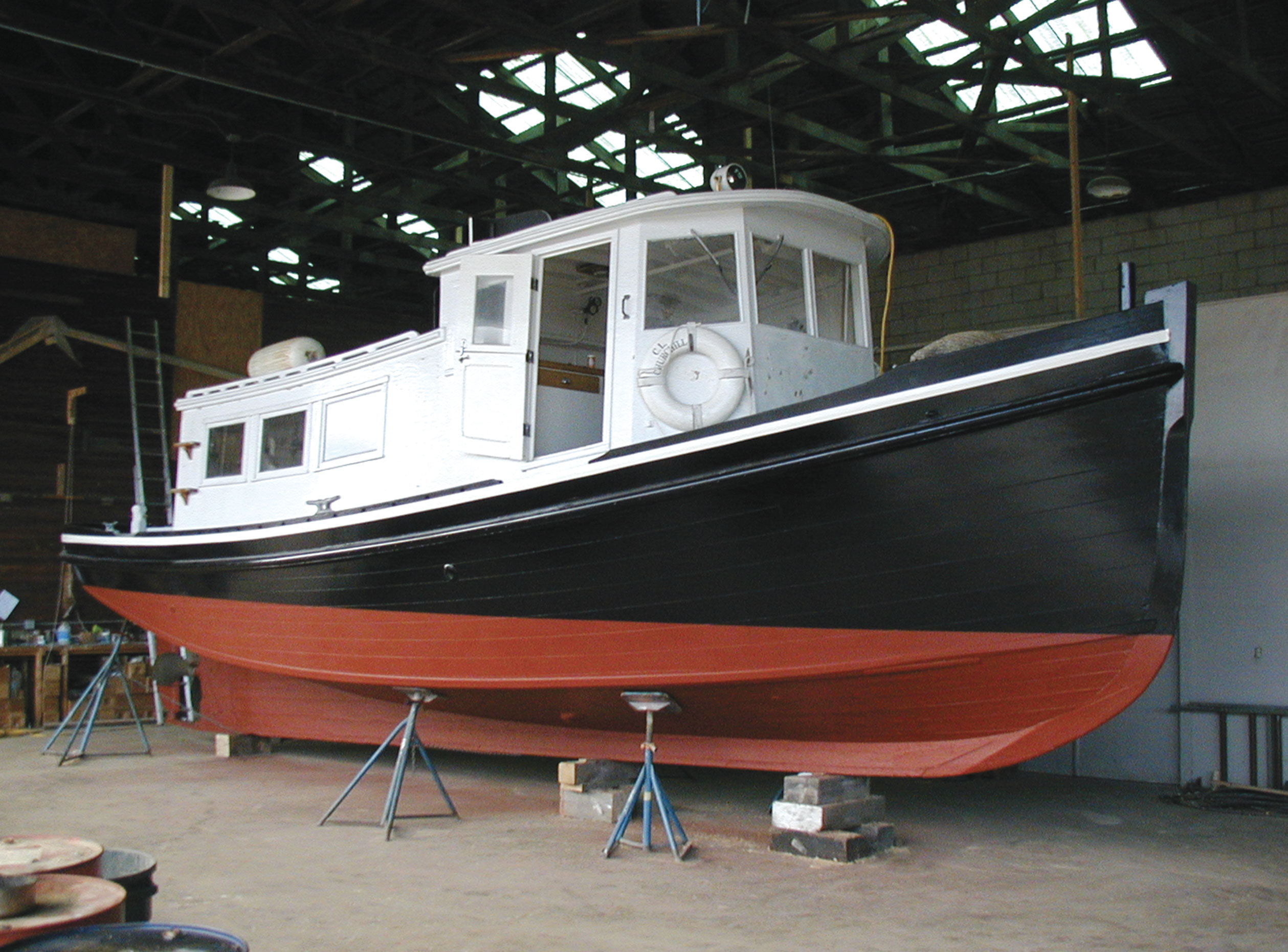
Kerry BatdorfThe 34′ tugboat C.L. CHURCHILL was built in Cohassett, Massachusetts, in 1963, and from 1979 to 2023 she operated on Lake Champlain in Vermont. She served for many years as the escort vessel for the replica canal schooner LOIS McCLURE—all the while undergoing a phased refit—and has recently moved to Buffalo, New York, where she will perform the same duty for the Erie Canal boat SENECA CHIEF.
My favorite sweatshirt has just about given up the ghost. I suppose that’s what happens when it’s the piece of clothing you always grab first when you need a layer that might get a little paint on it. It’s a gray cotton hoodie with the word “CREW” on the back and an image of the tugboat C.L. CHURCHILL on the front, accompanied by the words “Celebrating 50 Years of Steady Dependable Service.”
I never served aboard the CHURCHILL underway—not in good weather while she towed her charge, the 88′ canal schooner LOIS McCLURE, through slow, still canals; nor in foul weather when she was bound tight on the McCLURE’s hip, bouncing in cross chop and wind on the broad Lake Champlain in Vermont. I have not spent a single night tucked into one of her berths nor prepared a meal in her galley. I would only see the CHURCHILL during the off-season, when her work was done. I do, however, know the CHURCHILL well, every bit of her, having rebuilt close to 80 percent of the vessel. Over a period of 16 years (2004–2020), I led the CHURCHILL’s multi-stage restoration and ongoing maintenance. In 2014, when she won “tug of the year” at the Waterford (New York) Tugboat Roundup, her real crew decided I had earned a sweatshirt.
It quickly became a favorite—in part because it is comfortable and a nice safe shade of gray; more so because it connects me to the boat and a group of great people who would come in and out of my life every few years, tell me a batch of fresh stories, and then tell me to hurry up about the repairs because they had big plans for the coming season. I liked working on the boat. I liked being a part of that community. Wearing the sweatshirt reminds me of all that. If you wear a shirt that advertises you are crew on a boat, it isn’t long before someone asks you about it, and I always like the opportunity to tell the CHURCHILL’s story.
Kerry BatdorfRight—The initial phase of the CHURCHILL’s refit involved replacing her stem, which was laminated from mahogany reclaimed from use in vacuum molds for prototype spaceship components. Left—Charlie Beyer replaced the CHURCHILL’s forefoot before the boat’s recent move to Buffalo, New York.
In 1963, the lumberman Chester L. Churchill commissioned the naval architect John W. Gilbert to design a wooden tugboat using a still-in-the-crate, coal-fired, 1918 military-surplus steam engine as the powerplant. It was one of Gilbert’s first commissions. He drew up the plans for a 34′ boat with a fantail stern, a steep sheer forward, and a plumb bow. The boat was based on the Chesapeake deadrise style, built in Cohasset, Massachusetts, by Charles Buttman, and launched in 1964 as the PRISCILLA H. CHURCHILL in honor of Chester’s wife.
The realities of managing such an engine and the space it took up must have quickly worn through the charm of the idea; within a year or two, the steam power was swapped out for the turnkey dependability of a 120-hp Ford Lehman diesel. Even with the steam engine gone, no one ever had the heart to remove the CHURCHILL’s distinctive steam stack. At that time, the boat was renamed for Chester, who kept her until 1973, when he sold her to Blair Lamont of Camden, Maine.
In 1979, the Griswold family, then-owners of the historic Shelburne Shipyard in Vermont, purchased the CHURCHILL from Lamont. The boat thus moved from the Maine coast to Lake Champlain, where she spent the next 25 years in the Griswold family’s care. With only a single propeller, the CHURCHILL was less maneuverable than desired in the tight confines of the Shelburne harbor, limiting her commercial work, but she did towing operations on marine-rescue calls. During that time, the tug was primarily used as a picnic boat for the family and an excursion boat for community groups. She was roundly observed to “sleep two, feed six, and party twenty.”
In 2004, the Griswolds donated use of the boat to assist the Lake Champlain Maritime Museum (LCMM) on the inaugural tour of the newly launched canal schooner LOIS McCLURE. After a season chugging around the lake, it proved to be a great pairing, both aesthetically and functionally. But there were safety concerns in shifting the CHURCHILL’s duties from family picnic boat to hard-working tug.
After 40 years, the CHURCHILL was tired. Although the cypress planking was mostly sound, the galvanized screws that fastened it were largely wasted and much of the underlying oak structure was failing. Having just completed the LOIS McCLURE, the museum had the infrastructure of an outfitted yard and a crew of experienced volunteers to perform the required work. But the boat was not theirs to rebuild.
Art Cohn, a cofounder and, at the time, director at LCMM, had quickly developed a strong bond with the CHURCHILL. Over the years, this bond would grow as he lived aboard and captained the boat. From the beginning, he was a steadfast advocate for restoring and using the boat, which he came to believe was “…the finest vessel of its size I have ever been on…that boat never let us down.” His commitment to the CHURCHILL and her mission were key factors in her getting a new lease on life.
Art discussed the possibilities with Steele Griswold, the patriarch of the family. The Griswolds generously donated the CHURCHILL to the museum, along with funds to begin restoration and an understanding that the Shelburne Shipyard would seasonally haul and store the boat at no charge. Further, shipyard mechanic Van Powell would continue to maintain and service the engine. The people who had cared for the boat wanted to see the restoration work done. With that support, LCMM decided to take on the project and hired me as lead builder.
Kerry BatdorfThe early restoration phase also saw replacement of the boat’s white-oak sternpost, as well as some topside planking in Alaska yellow cedar.
From the start, it was clear that no one was interested in a “patch job” to squeeze out just a few more seasons. The intent was always to go deep and do it right. Nonetheless, there were real time constraints on the work; the boat would have to be ready for use each spring for the foreseeable future. A multistage plan was developed to meet these goals. Step one, during the winter of 2005–06, would be a big one, ultimately requiring the replacement of much of the CHURCHILL’s structure and planking. Beyond the replacements, one new thing was added to the boat: a pair of large, heavy bitts for towing astern.
Demolition can be a grim business. Deterioration is often more extensive than initially thought. Every time you think you have cut back to sound material, another pocket of smooshy wood reveals itself. When we started, I warned Art that things would get worse before they got better. I still recall the shock on his face when he showed up near the end of the demolition phase, looked at the tug with her bottom half gone, and asked me in a shocked voice, “What the hell have you done to my boat?” He tried to laugh it off, but the tone did not imply confidence in a spring launch.
We were fortunate to have good-quality, seasoned oak timber on hand, left over from the recent construction of the McCLURE and just right for rebuilding the CHURCHILL’s structure. For planking, I stumbled on a small stockpile of salvaged long, clear 8/4 Alaska yellow cedar to supplement another stash of gorgeous local white cedar. The shorter, more dimensionally stable white cedar was perfect for the cross-planked bottom. The longer, stronger Alaska yellow cedar served admirably to fill the high-wear areas above the chine. The new stem and horn timber were laminated from reclaimed, pattern-grade Honduras mahogany.
It was an exhausting winter. With the steady aid of a core volunteer team, we were able to get the boat back together, caulked, and painted in time for the required spring launch. The crews were off on “The Grand Journey,” the historic trade route for canal boats of the era: down Lake Champlain through the canals to the Hudson River, on to New York City, and back again.
In 2010, the CHURCHILL came in for Phase Two of her restoration. The work scope that winter was far more modest. At the bow, below the chine, the CHURCHILL has six conventional planks running fore and aft each side. These are short planks, with a great deal of twist, that run aft 6′ to 8′ before terminating on a long floor timber that serves as something like a long butt block where her cross-planked bottom begins. This bow planking was the only original bottom planking left after Phase One, and it needed to be replaced. The following spring, we were all comforted to know that no longer were any of the tired old plank fastenings securing anything below the waterline.
Kerry BatdorfPhase One work also included replacement of the crosswise bottom planking in northern white cedar (above right), and replanking the elliptical transom (above left). The boat was caulked, painted, and put into service for the season following these projects.
Out she went again to push the big schooner around on another series of extensive educational tours. She traveled along the Erie Canal and Mohawk River to Rochester, New York, then back again and around Lake Champlain.
In fall 2013, it was time to start Phase Three. With the critical, below-waterline hull work complete, our focus moved higher. The fiberglass deck was cracked and delaminating, the oak sheerstrakes had many rot pockets and iron sickness, and the plywood cabin sides were mush along the base and at each windowsill. As always, volunteers stepped up to make a daunting task manageable and donors stepped forward to cover the costs. It is a wonderful thing to work with a well-loved nonprofit organization and see the pleasure people take in being part of something that contributes to the community and makes possible that which otherwise would be unlikely to occur.
More tours, more visitors, and more storytelling followed. The mix of challenging weather, flooding, and lazy summer days was becoming a routine for the tight-knit crews. After 10 years of touring the region, they were greeted as old friends by the communities they passed as they slipped along the waterways.
The year 2018 was the last time I would dive into significant work on the CHURCHILL. This round had several components, some structural and some cosmetic. The boats were going to be headed out the following season on a group tour with the Corning Museum of Glass’s GLASSBARGE and the South Street Seaport Museum’s tug W.O. DECKER. With such fine company, everyone wanted the CHURCHILL polished up and looking her best. We smoothed the dinged hull and applied fresh paint top to the bottom. We replaced cracked windows and made new split Dutch doors for the pilothouse, port and starboard.
Kerry BatdorfPhase Two of the project, accomplished in 2010, involved the replacement of the short fore-and aft below-waterline bow planking. In the final phase, done in 2018, the Dutch doors in the pilothouse were replaced and a portion of the afterdeck was reframed.
Unfortunately, in the afterdeck, more than paint and putty were required. Rot that we knew had been festering for years could no longer be ignored. It had expanded into some of the vertical-stave planking that wraps the stern…planking that we had replaced in the first phase of work. It was frustrating, but we could never have tackled it all at once. This had to be viewed as an acceptable cost to the multi-phase approach.
For 20 years, the CHURCHILL was the dedicated working companion to the McCLURE. Over those years, the boats would log well over 10,000 miles and see more than 300,000 visitors among hundreds of ports. Although I was not present on these voyages, the crew always made me feel a part of the family that they had become, sharing their enthusiasm for the educational mission of the team and relaying the kind welcomes they received as they traveled about. It was a wonderful traveling show, focused on the journey and not the destination. The people involved were an eclectic collection of educators, historians, archaeologists, and mariners, moving through the old commercial waterways on a pair of time-displaced vessels. At each stop, they would bring the public onto the schooner, immersing them in the maritime past of their hometowns. Feeding off the passion of volunteers and the enthusiasm of the visitors, the crew would stay a few days at each stop and then move on to do it again at the next port. People loved it. The response from the public was strong, consistent, and positive everywhere they went. For many it was a chance to walk on and into a large traditional ship—a marvelous experience for those unaccustomed to it.
The time came when the museum was faced with difficult choices for the future of the LOIS McCLURE. Annual operating costs for an 88′ schooner are large, and substantial repairs were coming due if the vessel were to remain in active service. In 2023, LCMM made the hard decision to retire the schooner and transfer ownership to the Canal Society of New York State. The organization’s intent is to keep the McCLURE as a static display in an authentic 19th-century excavated canal channel—a so-called “prism”—in Port Byron, New York.
The decision rendered the CHURCHILL an obsolete member of the museum fleet. Fortunately, a connection was made with the Buffalo (New York) Maritime Center, which was completing construction of the Erie Canal Boat SENECA CHIEF. After her 2024 launching, she would need an accompanying powered vessel. The CHURCHILL, a proven performer, seemed a good fit and a sale was arranged. In spring 2023, the CHURCHILL departed Lake Champlain for her new home port of Buffalo. There she received a new engine and a new crew as she set off on new adventures providing “Steady dependable service.” ![]()
Rob Thompson is a boatbuilder and woodworker based in a one-man shop, Windfall Woodworks, in Huntington, Vermont. He sends thanks to Kerry Batdorf, who photographed the CHURCHILL’s reconstruction—and also helped with the effort, crewed aboard the vessel, and took care of her.