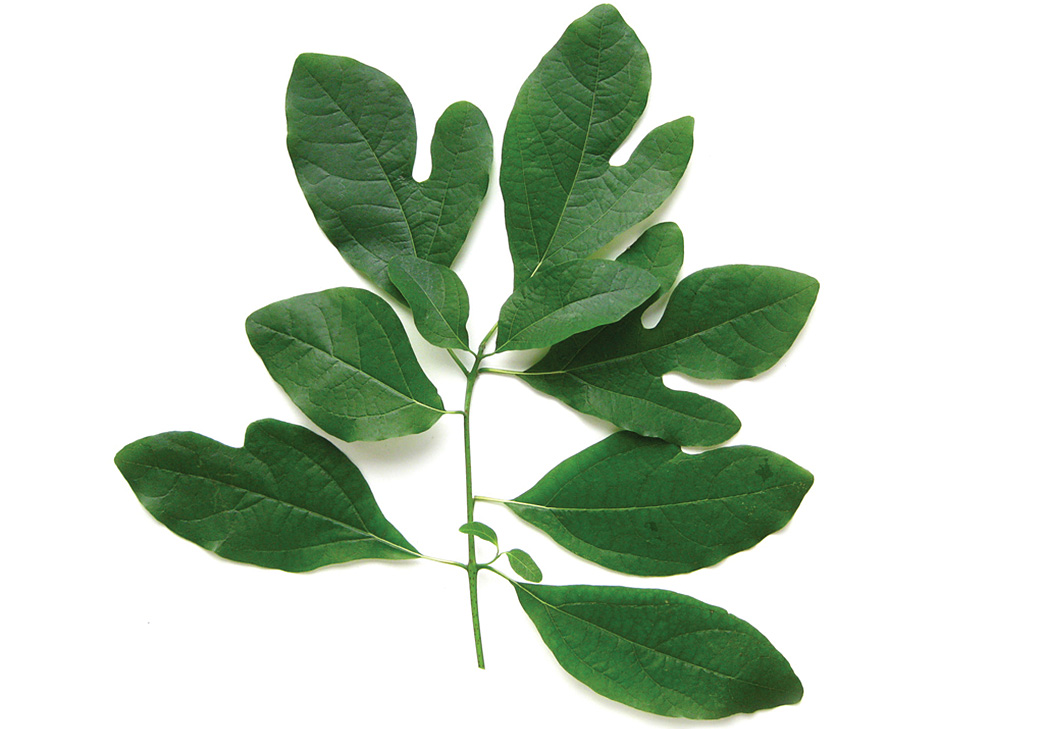
Sassafras trees have distinctive mitten-shaped leaves.Courtesy of Blue Ridge Discovery Center, Virginia

Sassafras trees have distinctive mitten-shaped leaves. Long a prized wood for paddles, it could have multiple uses in boatbuilding, including planking.

Longtime WoodenBoat reader Larry Van Meter wrote: “I don’t recall seeing an article about the use of sassafras in hull construction. I have a sassafras paddle made by Shaw & Tenney in Orono, Maine, that is my favorite, and as one might expect it is both light and very flexible. I believe sassafras is also quite rot resistant, and that has caused me to think about its use for, say, skiff construction where one might otherwise choose Atlantic white cedar. Where I live near Delaware Bay in rural southern New Jersey, sassafras trees sometimes grow to 50′ to 60′ in height and as much as 24″ in diameter at breast height. Fairly long, wide boards are occasionally available from small, family-owned sawmills, and over the years I have used sassafras for garden furniture and other outdoor applications. Thank you for whatever advice you can provide.”

Our native sassafras (Sassafras albidum) is part of a small genus comprising only three species. The other two are native to mainland China and Taiwan. In the United States, S. albidum is found throughout the Eastern states, ranging from southern Maine to northern Florida and west to Missouri and eastern Texas. In size, sassafras ranges from small to moderately large, the latter found mostly in the rich, moist soils of the southern Appalachian and Ozark mountains. It generally consists of scattered trees, not pure stands. Because of its low abundance, it is a rare find at many lumberyards, where it is often mixed with black ash (Fraxinus nigra). The tree is easily identified in the forest by its mitten-shaped leaves.

In the Ozarks, sassafras has been a prized wood for paddles and oars since the middle of the 19th century. Many years ago, I gave some sassafras wood to Paul Reagan, a former owner of Shaw & Tenney, and he produced two paddles, one for me and one for his paddle museum. Apparently, that gift set a trend in motion.

In a previous column (WB No. 107) I discussed the use of sassafras as a boatbuilding wood, stating: “Many johnboats and other river craft in the Ozarks have been traditionally planked with sassafras for decades.” More recent digging by me has cast some doubt on that statement. I have learned that the vast majority of johnboats and other flat-bottomed, blunt-ended skiffs, and larger workboats were planked with pine, which likely meant shortleaf pine (Pinus echinata), the only pine native to Missouri. This hard pine was favored because it was abundant and produced planks wide enough to create boat sides from a single board. Cost was also a factor, especially for the workboats used to transport agricultural products and other merchandise downriver to major cities. With simple construction and cheap wood, the boats could be scrapped for lumber at markets downriver. At the approach of the 20th century, however, a special group of boatbuilders switched to sassafras.

The Sporting Life

The final decades of the 19th century in the United States were marked by an industrial revolution that led to the amassing of wealth among industry owners and their bankers, especially in the Northeastern states. With cash and free time on their hands, many wealthy magnates chose to engage in outdoor recreation, away from the cities they were polluting.

The Adirondack Mountains of New York State, the Rangeley Lakes of western Maine, and the lower Penobscot River of eastern Maine attracted sport fishermen pursuing trout and salmon. Local boatbuilders soon saw opportunities to develop lightweight watercraft, mostly constructed of northern white cedar (Thuja occidentalis), thus producing the renowned Adirondack guideboats, Rangeley boats, and Penobscot peapods.

The sportfishing that blossomed in the Northeast formed the template for a similar development in the Ozarks a few decades later. Flat-bottomed boats that had been used for commercial transport and timbering operations and by local people for duck hunting, night gigging, pearling among freshwater mussels, trapping, running trot lines, and setting fish traps were repurposed. The new market emerged with an influx of sport bass anglers who booked several-day float trips down the many free-flowing rivers in the region. Since these craft often needed to be transported by rail from the endpoint of a float trip back to home port, weight became an important factor. Reducing weight also improved draft and increased maneuverability when running the region’s many rapids.

An early adopter of sassafras for building sportfishing johnboats was guide Ike Sturgeon, known locally as the “Natty Bumpo” of the Osage River, after James Fenimore Cooper’s frontiersman character. The boat type he developed was about 25′ long and 3′ wide. For ease of transport on railroad cars, he built them in three sections. Lighter than pine boats, this type was said to be: “as buoyant and easily guided as any craft ever built, that would run the rapids of the Osage with a small tent and carrying outfit.”1

Another famous fishing guide of the area, Charlie Barnes of Galena, is credited with building more than 500 johnboats during his lifetime. His clients were avid sport anglers ranging from industrialists to movie stars, and he guided down the free-flowing James and White rivers until dams were built at Bull Shoals and Table Rock in the later 20th century.

Changes Arrive

Stocking of rainbow trout in the Ozarks began in the 1890s and brown trout introductions followed in the 20th century. Trout require cooler and more-oxygenated waters than bass, but extensive dam construction soon turned free-flowing rivers into reservoirs with warmer water. Trout are still stocked and survive in feeder streams and in dam tailwaters, but the reservoirs are now vast arenas for bass anglers and big-prize professional fishing derbies.

As multiday float trips waned on the rivers, the traditional, long, river-running johnboats were replaced by outboard-powered bassboats for still-water fishing. Individual boatbuilders using wood construction were displaced by large corporations building in aluminum and fiberglass. Fortunately, this shift could favor amateur or small-operation wooden boatbuilders, who now have a chance of getting decent-sized sassafras lumber from local sawmills.

Early Spanish, French, and British explorers were led to believe that sassafras bark and root were remedies for malaria and a panacea for ills of the liver and stomach, “cold humours, griefes of the head,” and other assorted maladies2.In the 1500s and 1600s, English explorers were charged with procuring large quantities of sassafras, which fetched as much as £336 per ton on the London market. The same author who cited the supposed remedies also wrote, “No other American tree was ever exalted by such imaginary virtues, in expectation, as sassafras, or has fallen so far in esteem.” While sassafras has lost most of its allure as a folk remedy, some minor competition for sassafras trees still comes from herbalists who harvest roots for commercial distillation of oil of sassafras, which is used in teas, soaps, perfumes, flavorings, and medicines. (The original root beers, which were considered medicinal, were flavored with sassafras oil.) I don’t expect competition from this group would be fierce.

In China, ships have been built from sassafras wood for centuries, and in the Ozarks popular belief held that sassafras hulls were safe from shipwreck. On the other hand, some Kentuckians believed that burning sassafras wood could lead to the death of the transgressor’s horses or mules. More ominous than these folk beliefs is the health risk posed by safrole, a potentially carcinogenic compound found in sassafras roots, especially for those who routinely drink sassafras tea.

Wood Properties

Sassafras wood is somewhat lighter than shortleaf pine and considerably weaker, as the accompanying table shows. However, sassafras ranks among the best woods for decay resistance. It is easy to work, shrinks very little on drying, and has high dimensional stability in use. Although somewhat weaker than yellow poplar, which has a similar density, sassafras has a higher value for shear parallel to the grain. This means it has good resistance to splitting under the kind of dynamic twisting stress that boat planking can be subjected to. For comparison, I have included American chestnut in the table to show that it has similar density, decay resistance, and strength properties but lower shear strength. As I noted in a previous column (WB No. 276), this is likely why chestnut was rarely used in boatbuilding.

Wood Technology.

Sassafras should be an ideal planking wood when combined with a frame of white oak or a similar strong wood. It will, however, produce a heavier hull than one planked with Atlantic white cedar unless the planking thickness is reduced.  Article ends.

Dr. Richard Jagels is an emeritus professor of forest biology at the University of Maine, Orono. Please send correspondence to Dr. Jagels by mail to the care of WoodenBoat, or via email to Senior Editor Tom Jackson, tom@woodenboat.com.

¹ Taney County Republican, July 3, 1890
² Peattie, D.C. 1948. A Natural History of Trees of Eastern and Central North America. Houghton Mifflin Co.