
 Nic Compton
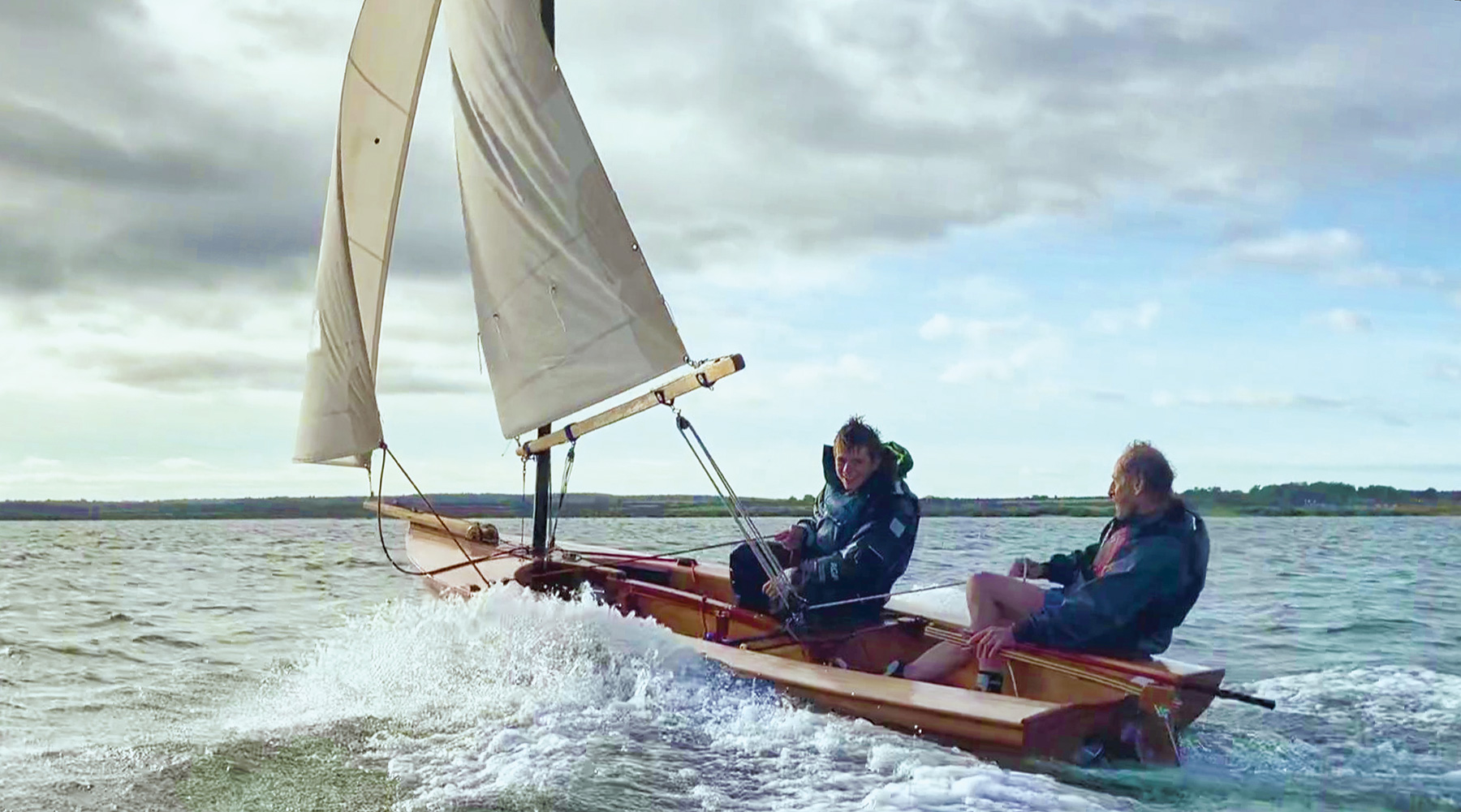
In the Windsong class, John Owles set out to design the fastest lug-rigged dinghy he could imagine; the prototype planed at 12 knots in 20 knots of breeze.
It was just after sunrise when I arrived at Burnham Overy Staithe in Norfolk, England, to witness the birth of a new racing class. Despite the early hour, people bustled on the foreshore in front of the massive, rustic boathouse. Four new dinghies were on trailers being readied for launching. Although they were built of wood, there was no mistaking the shallow draft and flat run aft of a hull designed for planing. The carbon-fiber spars and modern rigging also pointed to the boat’s racing pedigree. And yet when the boats’ sails were hoisted they revealed a surprise: a lug mainsail. Unless your name is Nigel Irens, the lug rig seems to have few fans among contemporary race boat designers, so the launch of a new racing class driven by this supposedly archaic rig was not to be missed.
The four boats made a magical sight as they headed out in a line down the River Burn, punching the last of the incoming tide, with the picturesque village behind. A bank of low clouds was blocking the sun to the east, but sky to the west was turning a brighter blue by the minute. It looked every bit like a painting by one of the old masters (carbon-fiber masts notwithstanding). By the time the fleet reached Overy Harbour, an enclosed bay sheltered from the North Sea by sand dunes, the sun had risen over the clouds and the breeze had picked up. The four boats started darting around the bay, occasionally accelerating in gusts. Lug or no lug, these boats were determined to plane.
There was a lot riding on this modest gathering. Ever since the 1950s, Burnham Overy Staithe has been the home of the Twinkle 12. Up to 30 of these wholesome lapstrake dinghies regularly compete on these tricky tidal waters. Recently, the Twinkle 12 fleet has dwindled, with only a dozen or so boats regularly in commission. Seeing this sad state of affairs, the local photographer and artist Harry Corey Wright went on a mission to find a new one-design for the waterway. The trick was to find something that would be exciting to sail and yet connected with the area’s sailing heritage.
While Burnham Overy Staithe might look like a sleepy backwater, it was here, according to local legend, that John Winter and Peter Scott first experimented with the trapeze, before their triumphant victory in the 1938 Prince of Wales Cup. And it was here that the prototype Laser had its first test in Europe in the early 1970s.
At about the time Harry was ruminating over a replacement for the Twinkle 12, local boatbuilder John Owles, who has designed several traditional lug-rigged dinghies for amateur construction (see www.summer-boat-design.co.uk), got into a discussion (okay, an argument) with fellow members of the Trailer Section of the Old Gaffers Association (OGA). “They were saying the lug rig was no better than a bedsheet hung on a broomstick, and that most working boats had switched to gaff as soon as they possibly could,” John said. “That might have been the case for boats on the south coast, like Falmouth, where they sailed straight into a rich fishing ground. But boats in places like Loch Fyne in Scotland stuck with lug rig because they had a big plug to windward before they reached their fishing grounds. The lug rig doesn’t point high, but it’s very powerful and much more efficient at tacking than gaff. The gaff rig is too slow; it doesn’t have the raw power of lug.”
To prove his point, John set about designing the fastest boat he could with a lug rig. It’s no accident that the search for speed took him down the road of previous planing boats, such as Uffa Fox’s Flying 15 and Bruce Kirby’s Laser, both of which bear similarities to the new design. As for that retrograde lug rig, he only had to look as far as the designer of some of the fastest boats on the planet: Nigel Irens. Nigel’s lug-rigged Roxane and Romilly designs (see WB No. 125), while not in the same speed class as his record-setting multihulls, are deceptively fast for their appearance and driven by high-peaked lug mainsails and raked masts.
“I started sketching and developing a shape, based on a derelict boat I’d seen in the Golfe du Morbihan in France,” John said. “Then one night I got up at 4 a.m. and turned on the design program and cracked it. I just whittled and whittled and whittled until I reduced the hull resistance to as low as possible.”
 Nic Compton
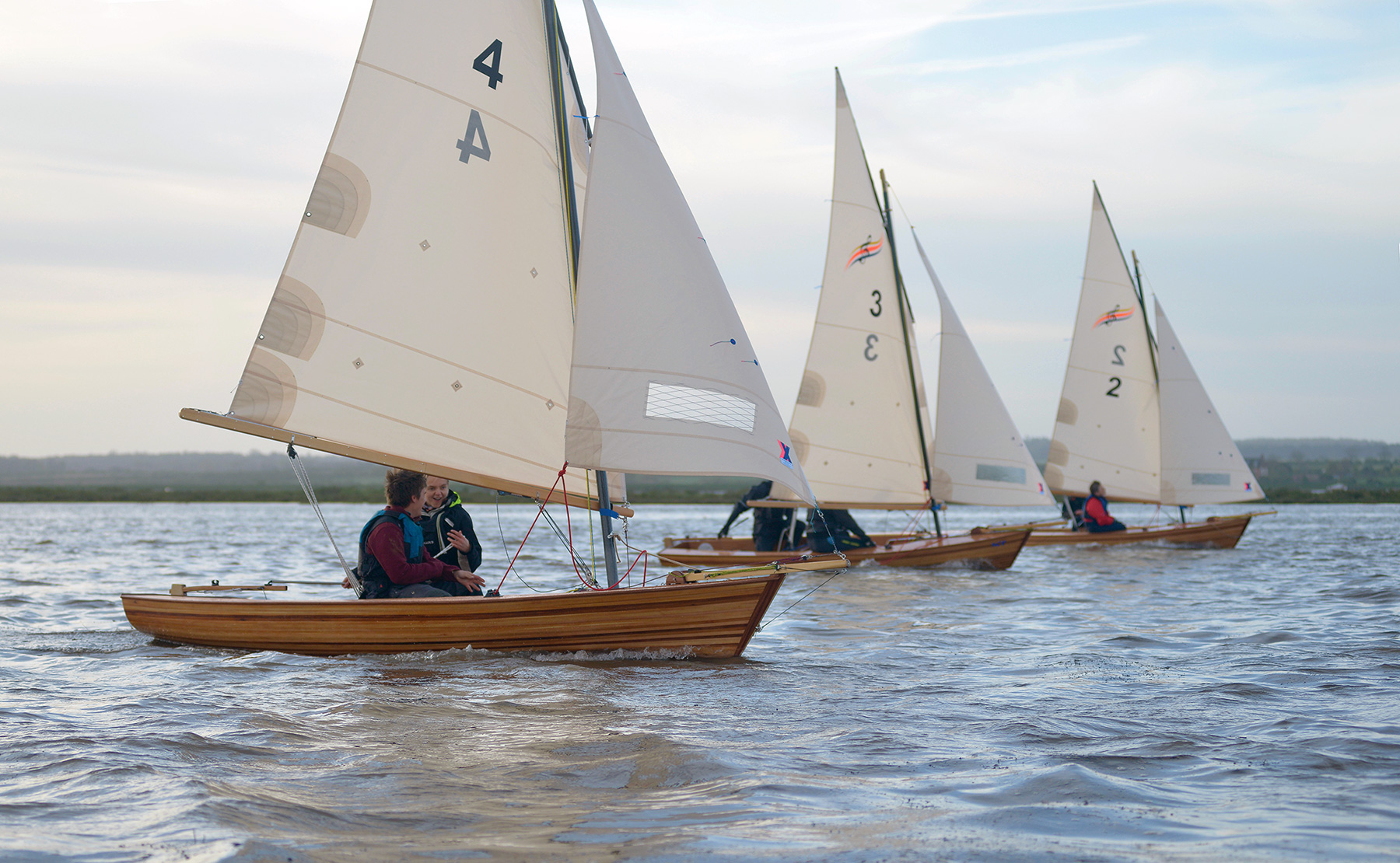
The first Windsong captured the attention of sailors at Burnham Overy Staithe in England, who soon placed orders for six boats.
Harry happened to see the drawings and immediately saw the boat’s potential as a replacement for the declining Twinkle 12 fleet. First, however, someone would need to raise the funds to build a prototype. It says a lot about Burnham Overy Staithe and its latent boating community—not to mention the power of Harry’s connections—that the pair managed to raise the £15,000 (about $20,000) needed in less than a week.
The prototype Windsong was built during the winter of 2020−21 by John’s wife, Maxine, who manages the Burnham Overy Boathouse, and launched in September 2021. The boat’s performance was nothing short of spectacular, particularly in strong winds, and a video Harry took of the boat planing at 12 knots in a fresh breeze of about 20 knots created a minor sensation in the local boating community. Classic Boat magazine in England was moved to describe the boat as “possibly the coolest wooden boat ever built.” Better still, the good people of Burnham Overy Staithe put their money where their hopes lay and placed orders for six boats. Suddenly, the concept of a new fleet of racing dinghies was starting to become a reality.
Having sailed the first boat for a few months, John made several design changes for the subsequent boats. The most radical was to raise the sheer by three plank strips, or about 11/2″. This was to enable the boat to sail in less-sheltered waters without fear of shipping water. In practice, the boats have proven extremely dry, and the bow seems to throw the waves aside. However, the coast of Norfolk can be a dangerous place, so slightly higher freeboard is probably a good feature. Other minor changes included adding a bobstay, because the bowsprit on the prototype was showing signs of stress, and getting rid of the self-bailers in the transom, which were deemed unnecessary.
There were three new boats and the prototype sailing when I joined the fleet in Burnham Overy Staithe that day, with three more hulls taking shape in the workshop. The boats on the water were sailed by an eclectic collection of sailors, including a 12-Square-Meter Sharpie champion and several other keen racers, ranging in age from 22 to over 60. New owner Chris Butterwick, himself a Sharpie sailor, pronounced himself delighted with his new acquisition, saying it was “a thinking boat.” Alex Scholes, an OK-class-dinghy builder and racer, said it forced him to rethink his sailing habits. Everyone came ashore beaming—apart from the Sharpie champion, who fell over the side, making everyone else smile.
I joined Ashmole Faire-Ring, a 23-year-old local sailing instructor and classic-vessel prodigy, on boat No. 4. I found the boat fast and responsive on the helm, and stable enough that I could stand on the foredeck to take photos without feeling we were going to capsize. The wind wasn’t strong enough to get the boat consistently on plane, but there was a moment when the bow lifted and the rudder started humming, a sensation I’d last experienced while sailing a Laser borrowed from my local sailing club.
Will the Windsong replace the Twinkle 12 in the hearts of the sailors of Burnham Overy Staithe and perhaps farther afield? It’s too soon to say, but it’s certainly off to an auspicious start. Meanwhile, John is quite content to have conclusively proven his point: the lug rig can be fast and exciting, beyond a shadow of doubt.
Building Windsongs
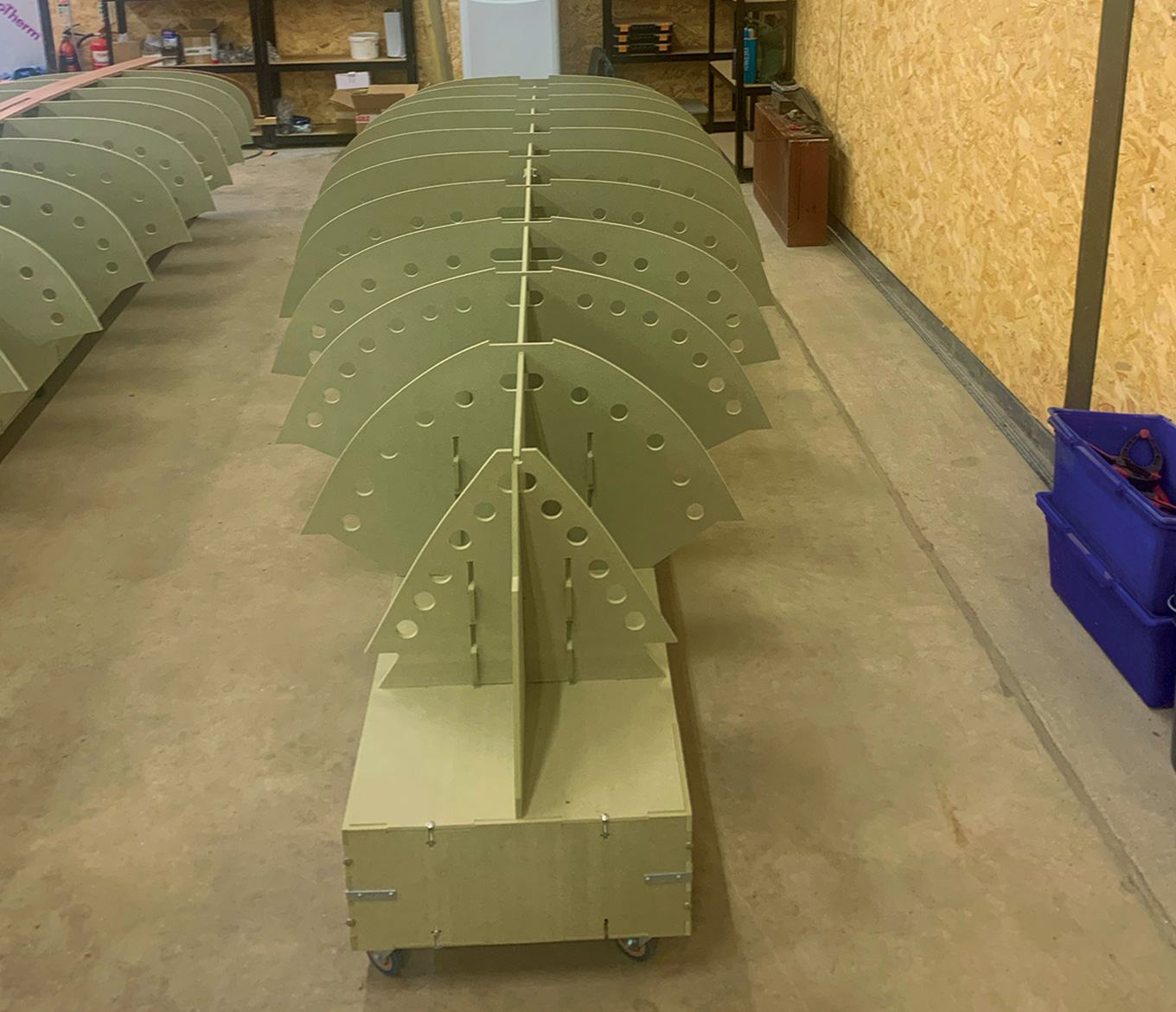 1. The shape of the hull is established by slotting together the MDF molds, designed on a CAD program and cut at a local CNC facility. There are 11 stations between the transom and the apron, set 14″ apart. Pre-cut holes in the molds facilitate clamping the planks into position.
The mobile jig is on wheels. The boats were built in pairs, by two boatbuilders, with four boats being built at the same time. The wheels allow the boats to be moved around easily during construction, with two at each end and two in the middle of the long span to prevent sagging. “I put just about everything in my life on wheels,” John says. “If you’re in a relatively cramped space, it means one person can shift things around through the different modes. I’ve done it for years.”
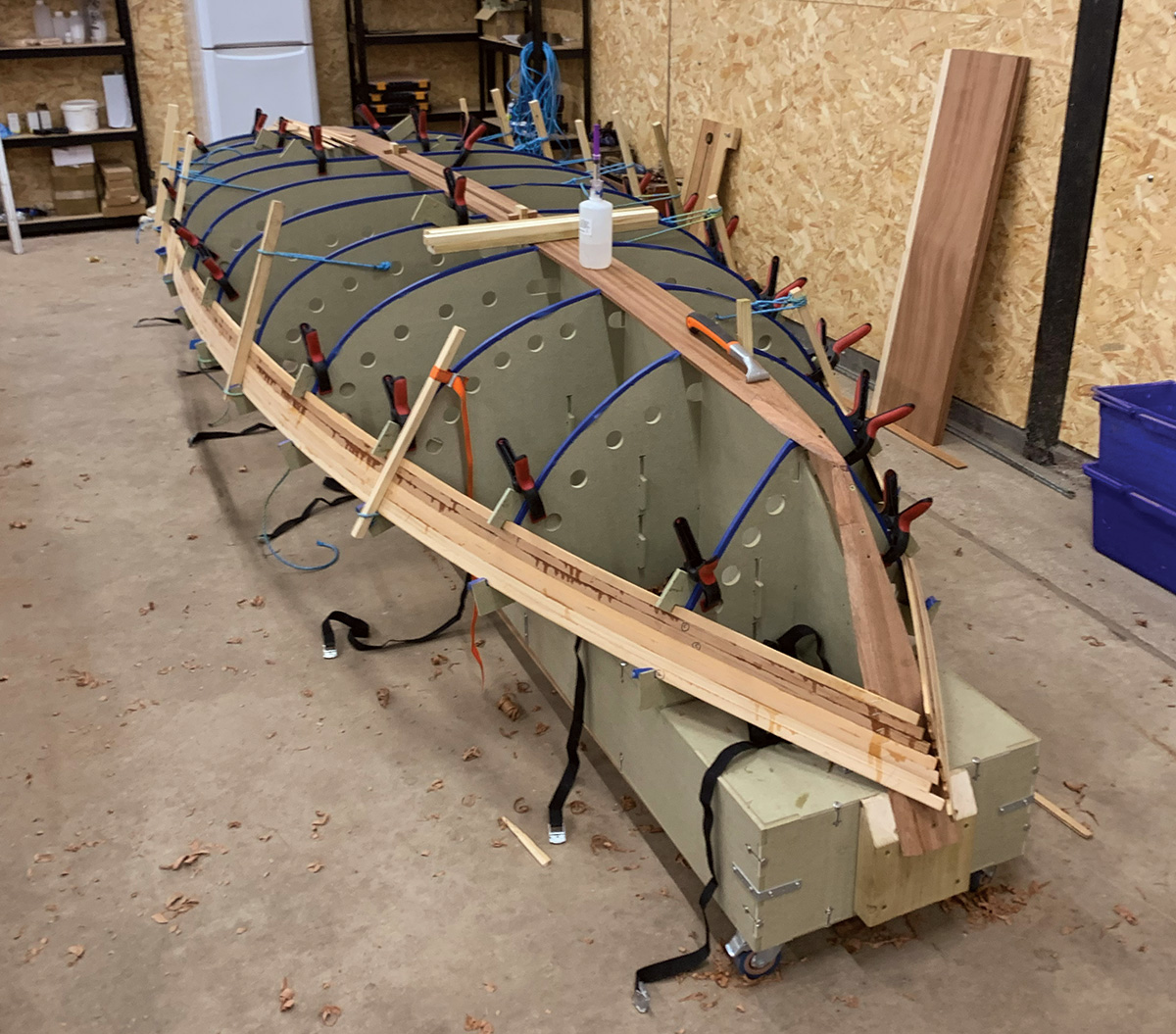 2. The first pieces to be fitted are the stem and transom and their associated knees, all of which are made from sapele plywood sourced from a sustainable West African plantation. The transom is made from 16mm plywood. Two CNC-cut MDF patterns, one for the outside and the other for the inside, establish lines to guide the accurate planing of rolling bevels on the transom’s edge to accept the planking. Once the transom and stem are in place, the hog piece, or keelson, slots into place.
The first few strips of 6mm western red cedar planking are being fitted here, starting at the bottom and working upward. Clamps and spruce offcuts lashed with short lengths of line and webbing are used to bend the planks to shape. Blue masking tape on the molds prevents the planks from being glued to them.
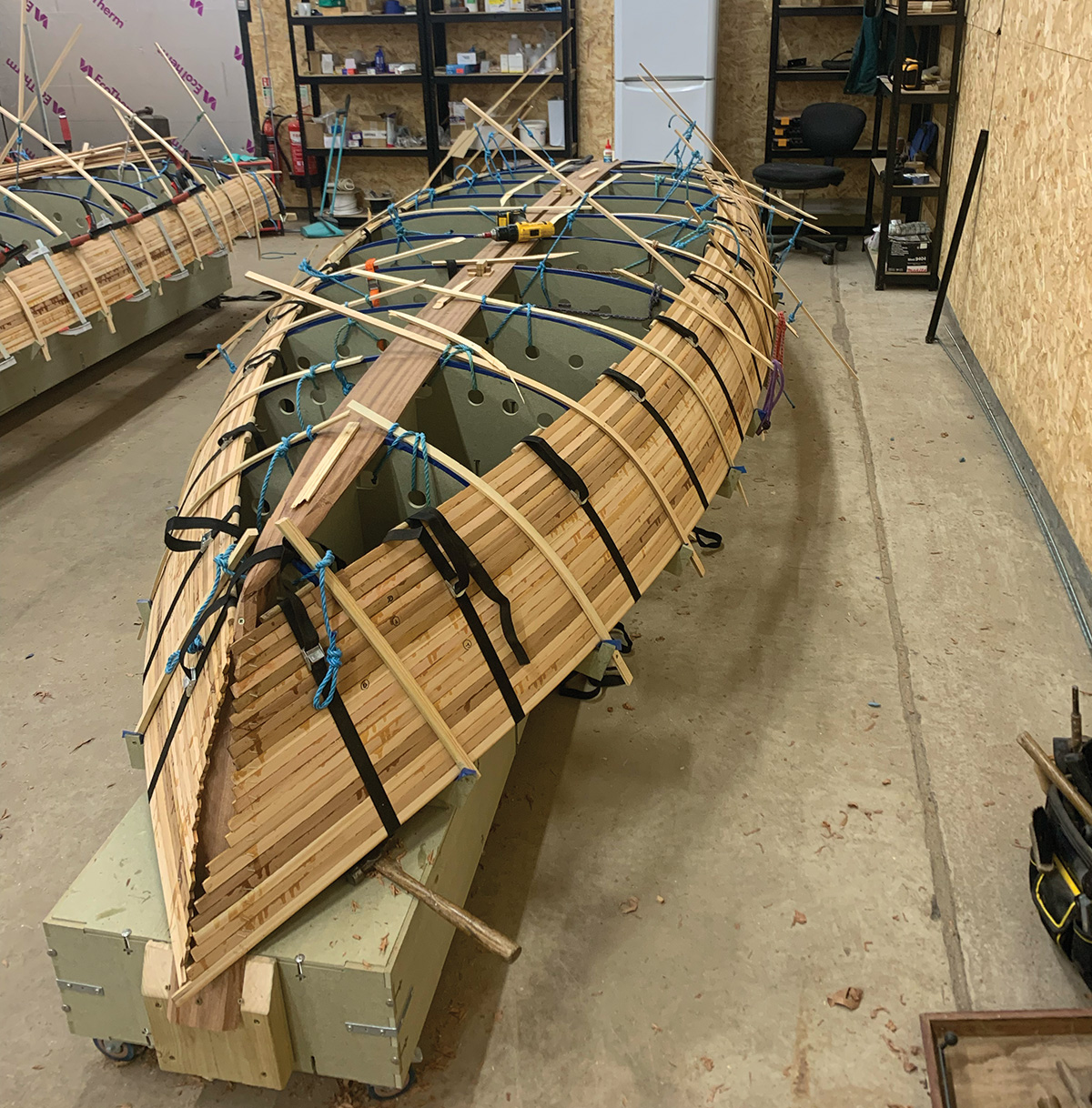 3. Persuading a straight length of wood into a curve and holding it there without the use of unsightly and heavy mechanical fastenings is the name of the game during planking. Webbing straps hold the planks together, while spruce offcuts pull them into the molds.
John is a fan of the legendary American boatbuilder and author Robb White, one of whose suggestions was to use super glue to “spot weld” the planks together—the point being that the boat’s strength ultimately comes from the interior and exterior fiberglass sheathing; the planking acts as a core material. John and his team follow this approach for the most part, because it allows them to work fast: they can fit five or six planks per day per side using superglue, compared to only three or four using epoxy. In areas of severe twist, they switch to epoxy for its holding power. John describes strip-planking boats as “like building a house of cards”; if you try to do too much at once, the structure will eventually become unstable.
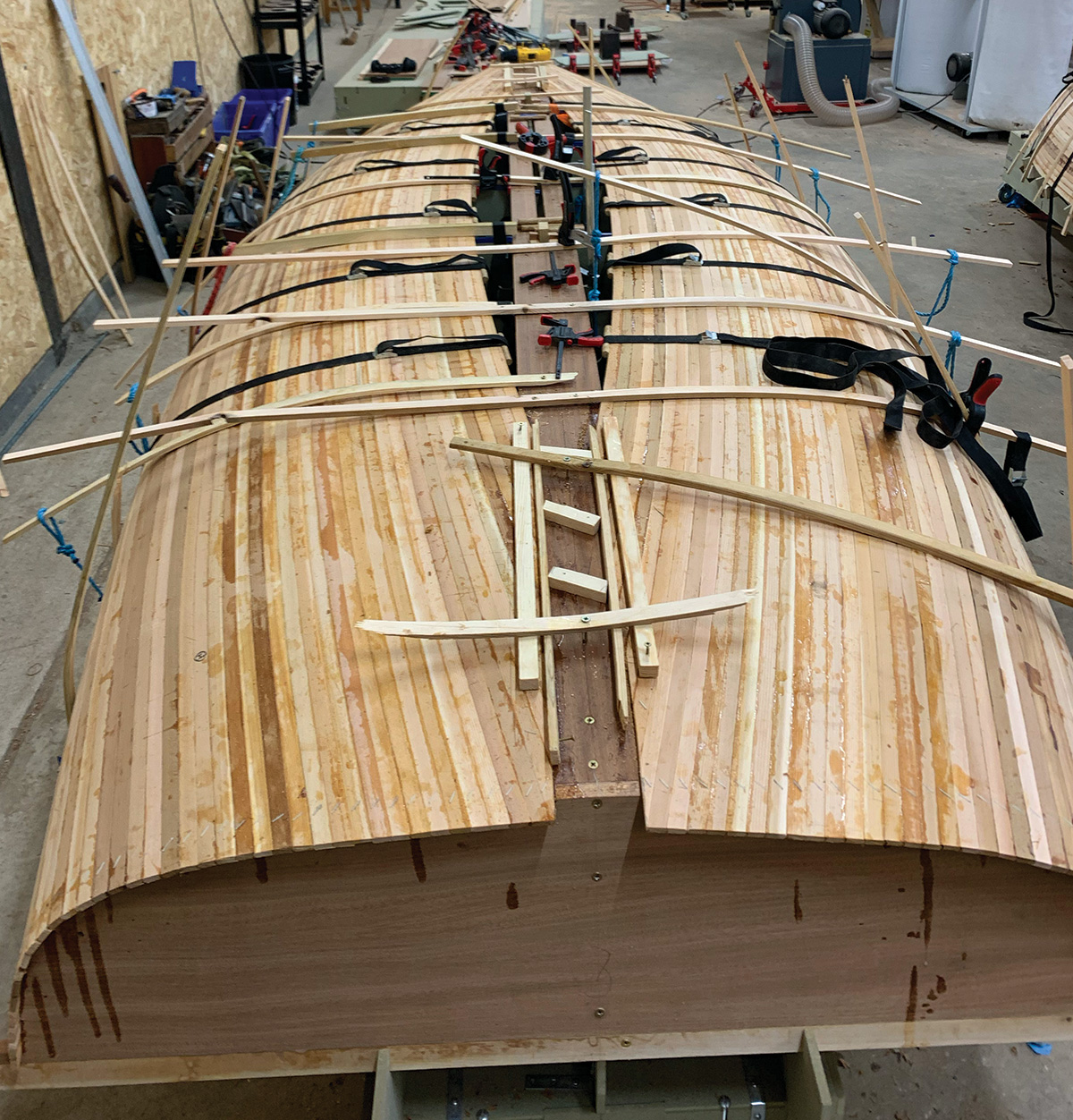 4. It took 37 full-length strips per side and a dozen shorter ones to create the shape of the 15′ 10″ Windsong. The plank ends were cut flush with the transom once the planking was completed. The boat’s planing hull shape is clearly visible here, with that long run aft and flat aft sections. The wide transom creates the extra buoyancy to lift the hull out of the water. John sees similarities with the after sections of the Flying 15 designed by Uffa Fox, while the forward end resembles a Laser.
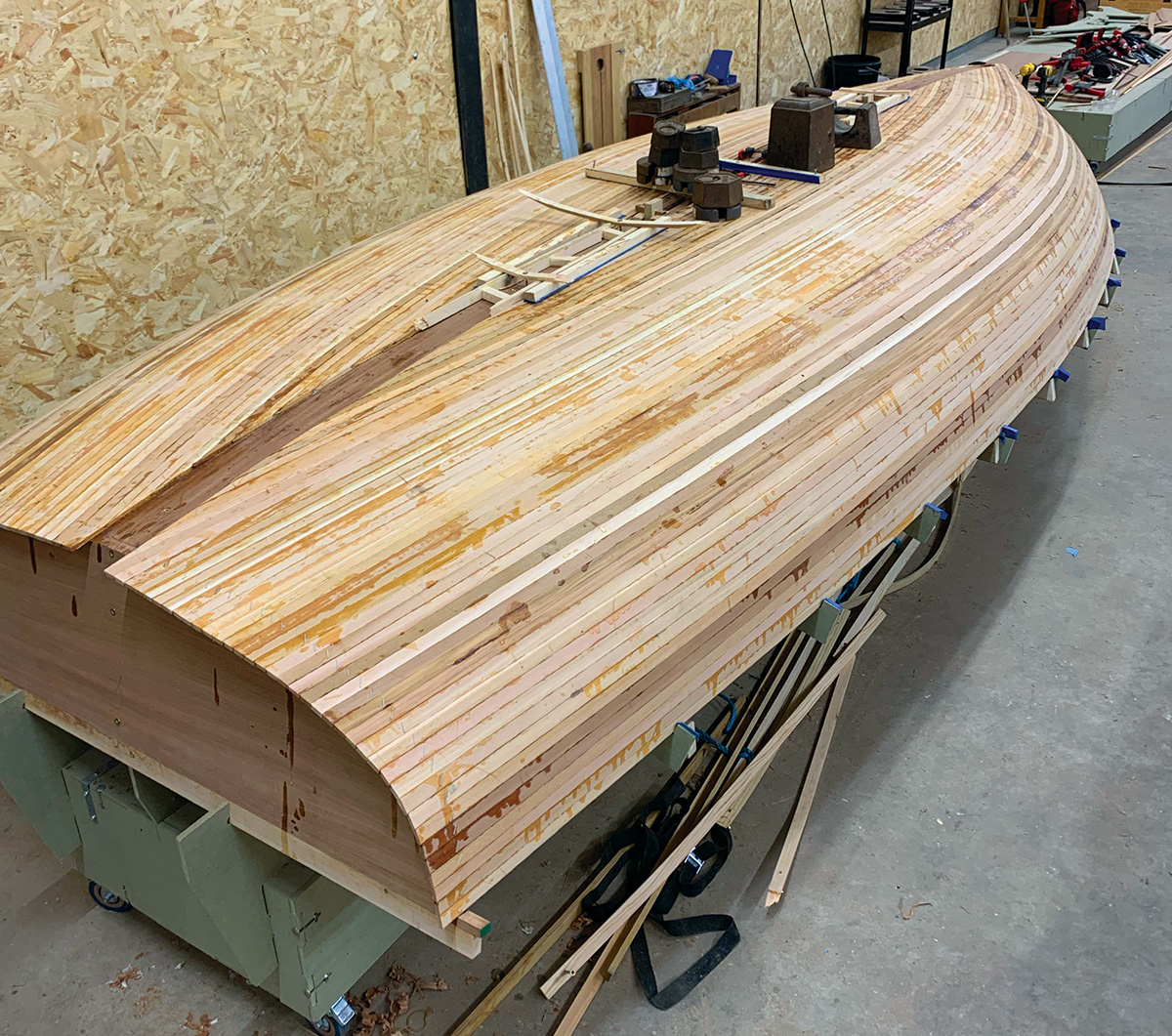 5. The final planks are crescent-shaped and quite hard to keep under control: wedges are used to keep them tight to their neighbors, while heavy weights keep them pressed to the molds. The ends are feathered and cut slightly over length. Once the planking is completed, the ends are cut to a neat line to make a channel to receive the keel.
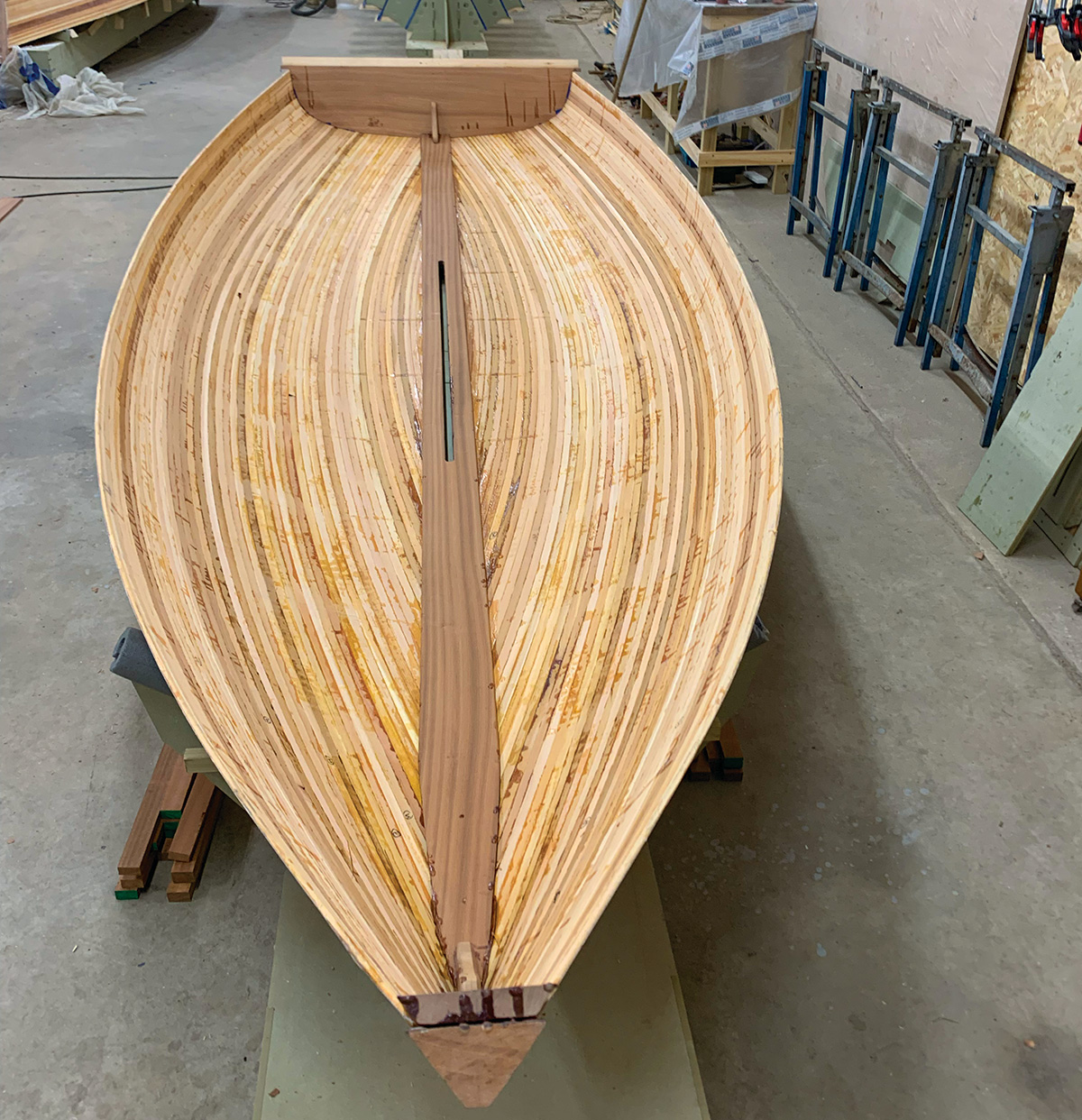 6. Over she goes! The first hull was flipped over and placed in a cradle, which was also fitted with wheels, freeing up the construction jig for the next boat (seen with molds in place behind).
The next step is to sand the interior to achieve a fair base ready to be sheathed with fiberglass and epoxy. Fairing takes the best part of day. Applying the ’glass and epoxy to the concave interior surface is much more difficult than applying it to the convex exterior, John said; pressing too hard with the squeegee would stretch the ’glass cloth, potentially creating flat spots rather than having the ’glass follow the curve of the hull.
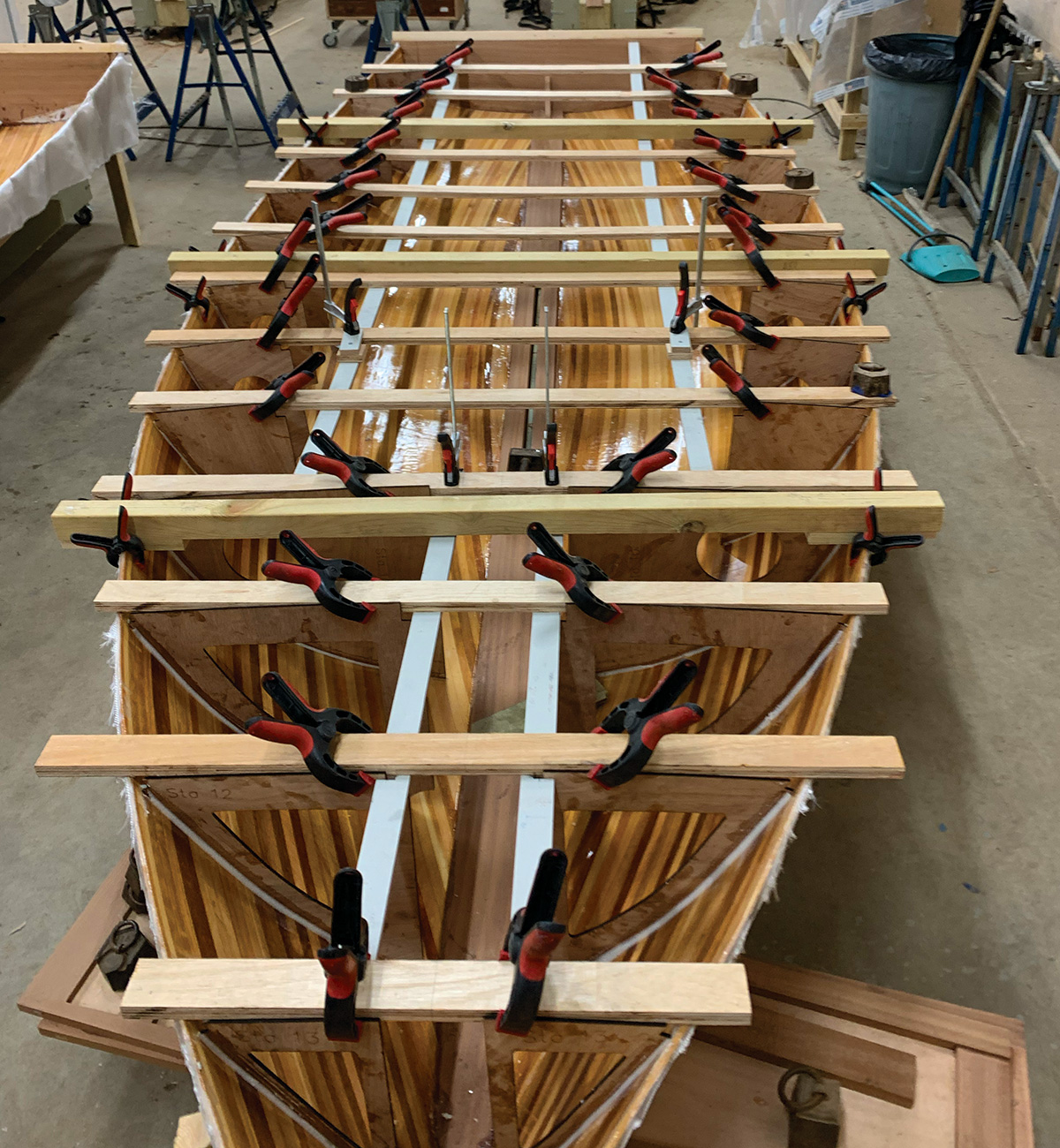 7. When the planked hull is removed from the jig and turned right-side up, its top edge along the sheer is very floppy. Freezing it to the designed shape requires a methodical approach. First, a string is stretched down the centerline, then temporary cross spalls are fixed from sheer to sheer at exact 1′ intervals. Half-breadths measured from the plans at the cross-spall intervals ensure that the sheerstrakes (and therefore the topsides) are lining up correctly. Once the hull has been fixed to its designed dimensions, half-bulkheads are hung from the spalls and epoxy-filleted in place.
Unlike most boatbuilders, who tend to fit bulkheads starting at the bow and working aft, John follows the “Uffa Fox way,” proceeding from the stern to the bow. The reason for this is that the transom is a fixed element that provides a more reliable reference than the stem, which is more likely to move. Once it’s all in place, there’s no going back, so it pays to get it right.
“The eye is very important,” John said. “The final analysis, after everything has been checked and measured, is to walk around the boat six times, taking time to look at it from all angles and all heights.”
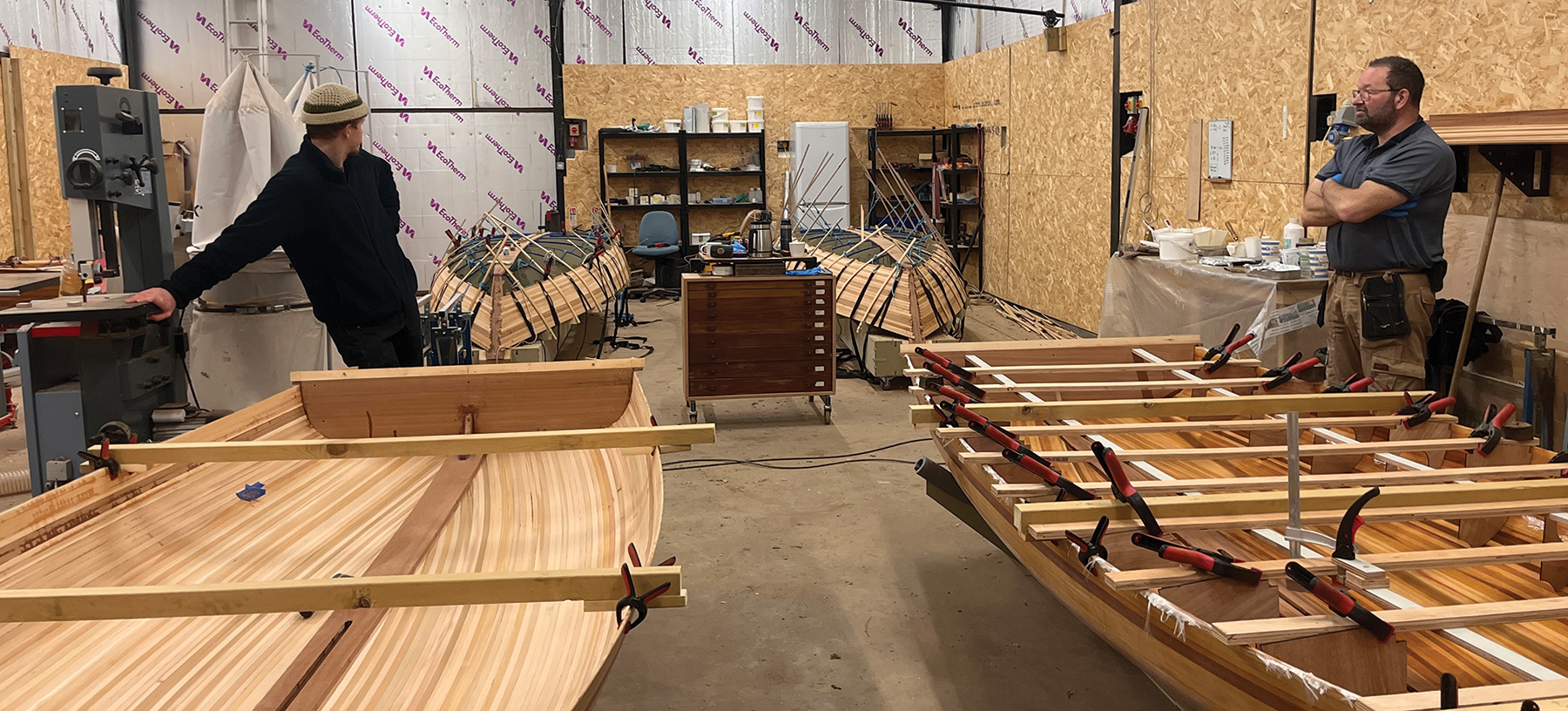 8. Boatbuilders Chris Lane (right) and Arthur Vasey take a moment to contemplate their work. A “moaning chair” (an idea made famous by naval architect Howard Chapelle) is clearly visible at the far end of the workshop, though not currently in use.
Removing the first two hulls from the jig made way for the next two to be planked up. Having four boats under construction means there is always something to work on while other things are curing. For example, the hull on the right has all the half-bulkheads fitted while the one on the left has been cleaned out and awaits fitting out. The cross spalls on the left-hand hull keep it roughly in shape while it is being worked on, before the rest of the cross spalls and permanent half-bulkheads are fitted.
John and his team were fortunate to be able to rent a barn on a nearby estate with three-phase electricity already wired in; they insulated the building and fitted it out specifically to build Windsongs.
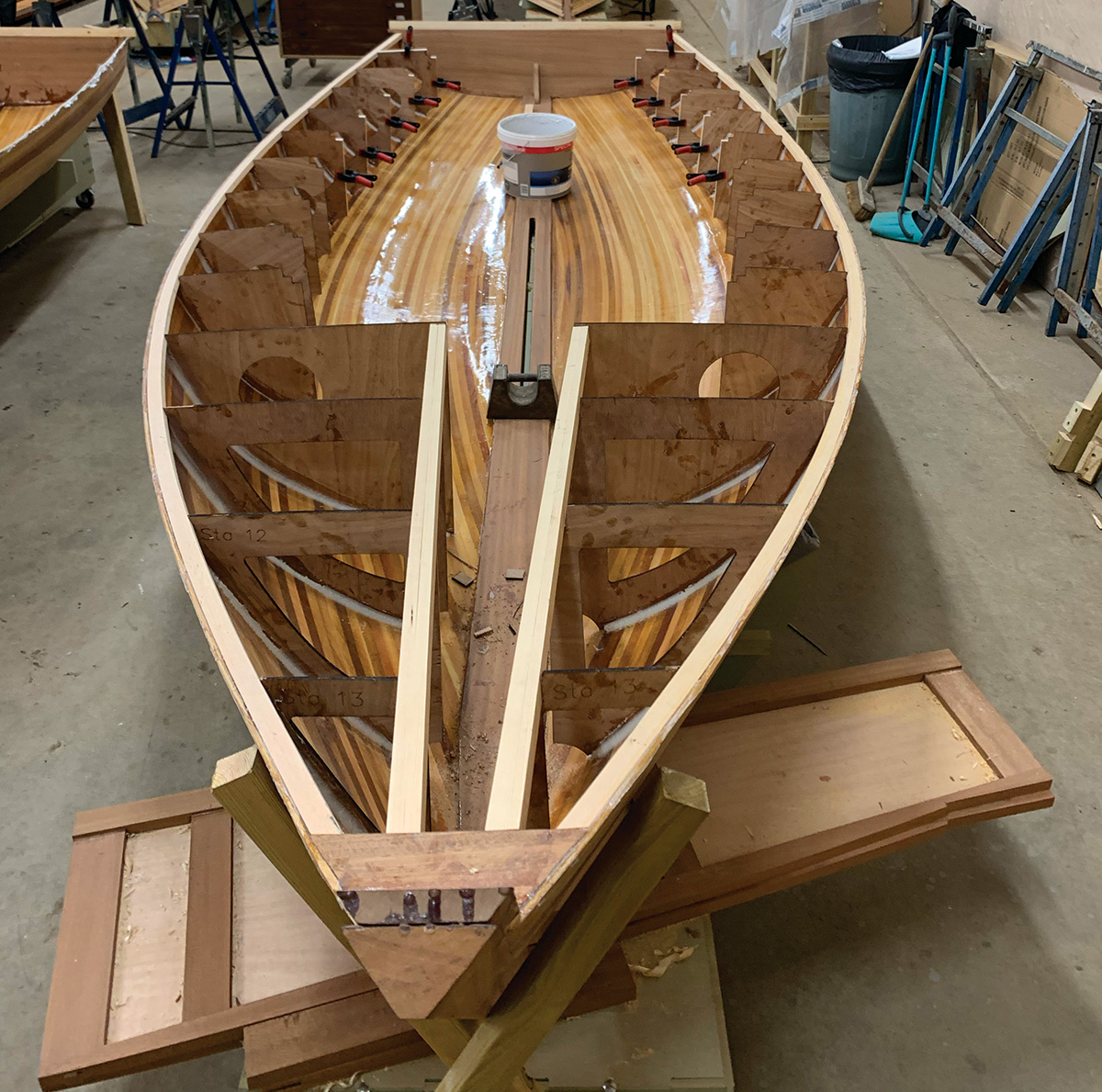 9. Hull No. 2 (the first Mk2 Windsong) reveals a channel that runs down the foredeck between the half-bulkheads. This channel accommodates a second maststep forward. This is present because the boat has two sail configurations: sloop and cat rig. Changing from one to the other is a simple matter of removing the jib and bowsprit, and then restepping the mast in its forward position.
“The idea is that if you want to sail to Scolt Head Island [at the mouth of the River Burn] for a picnic, you can head off with the sloop rig and have a poke around. Then, if the wind gets up, or you have a falling out with your partner and one of you decides to walk home, you can rerig the boat as a catboat and sail back up the river,” John explained. “Harry’s done it several times with the prototype and has got it down to a fine art.”
Large cutouts in the half-bulkheads serve as lightening holes but also increase air flow to keep the buoyancy tanks “nice and sweet,” John said, because “even with the best will in the world, you’re always going to get some water in there.”
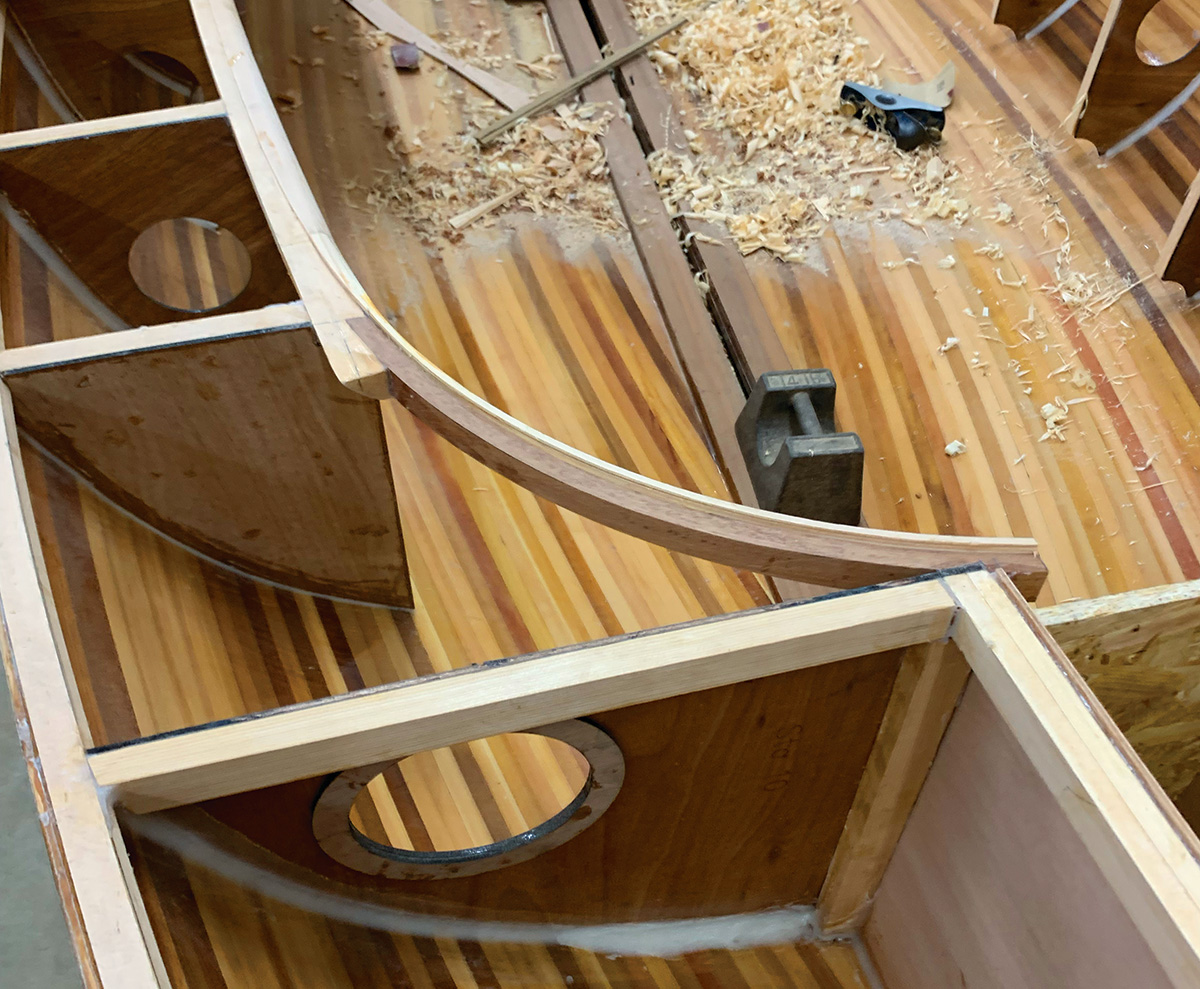 10. The cockpit carlins are the most difficult part of the boat to make and fit, according to John, because each has a rounded corner and two rabbets, and they have to be sprung into place to create a pleasing curve. He accepts full responsibility for creating “a hell of a challenge” for the boatbuilders while seeming to relish what he describes as “the designer’s nasty trick.”
The curved corner piece was laminated from two layers of mahogany, finished with a layer of spruce to match the main carlins.
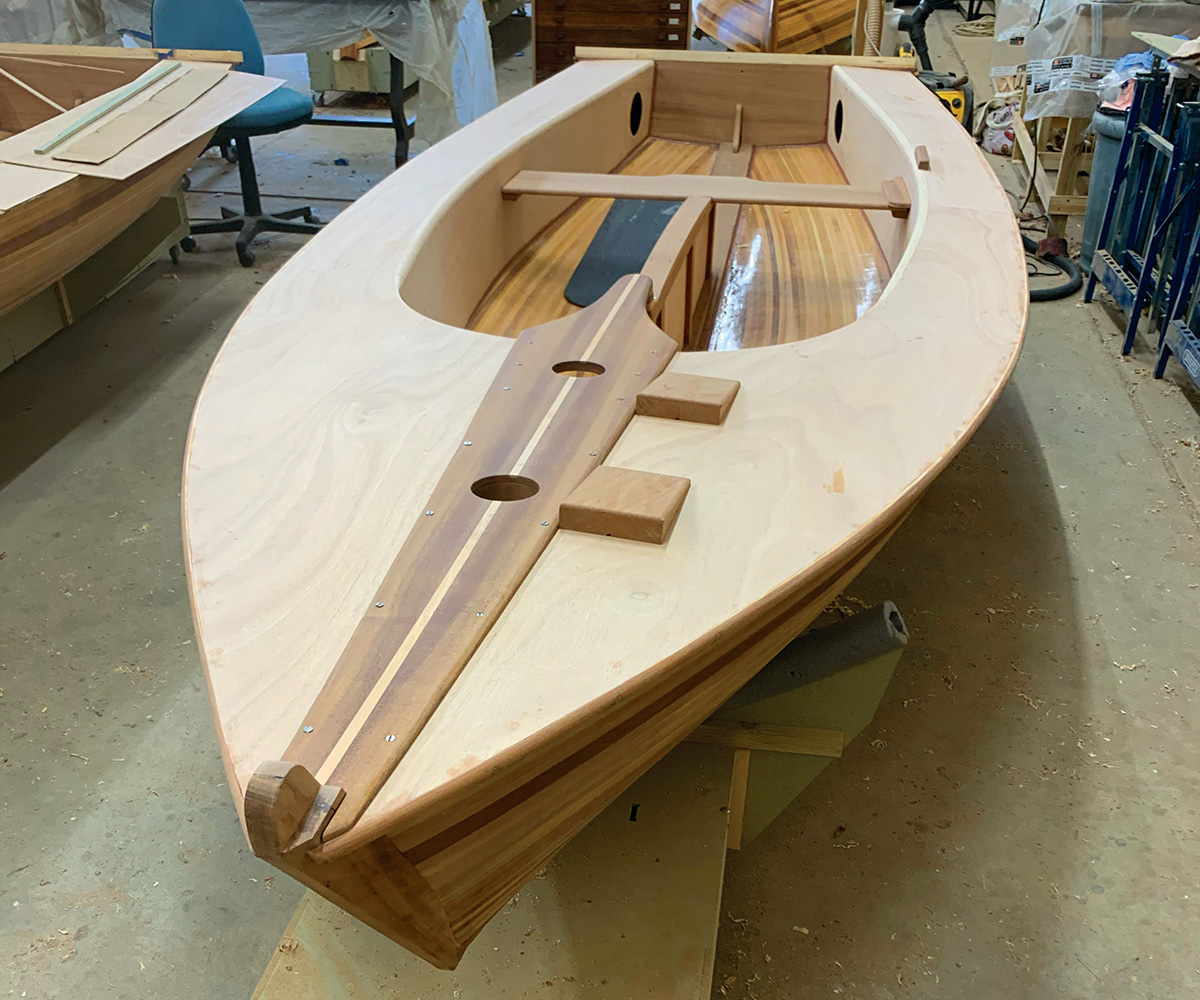 11. Unlike conventional mast partners, which normally run athwartships, the Windsong’s mast partner runs fore and aft. The partner is made from a single piece of sapele, with a strip of inlaid spruce to make it look less chunky. The athwartship strength comes from the halfbulkheads of the buoyancy tanks, to which the partner is attached. The partner can be unscrewed and removed to allow access to the maststeps.
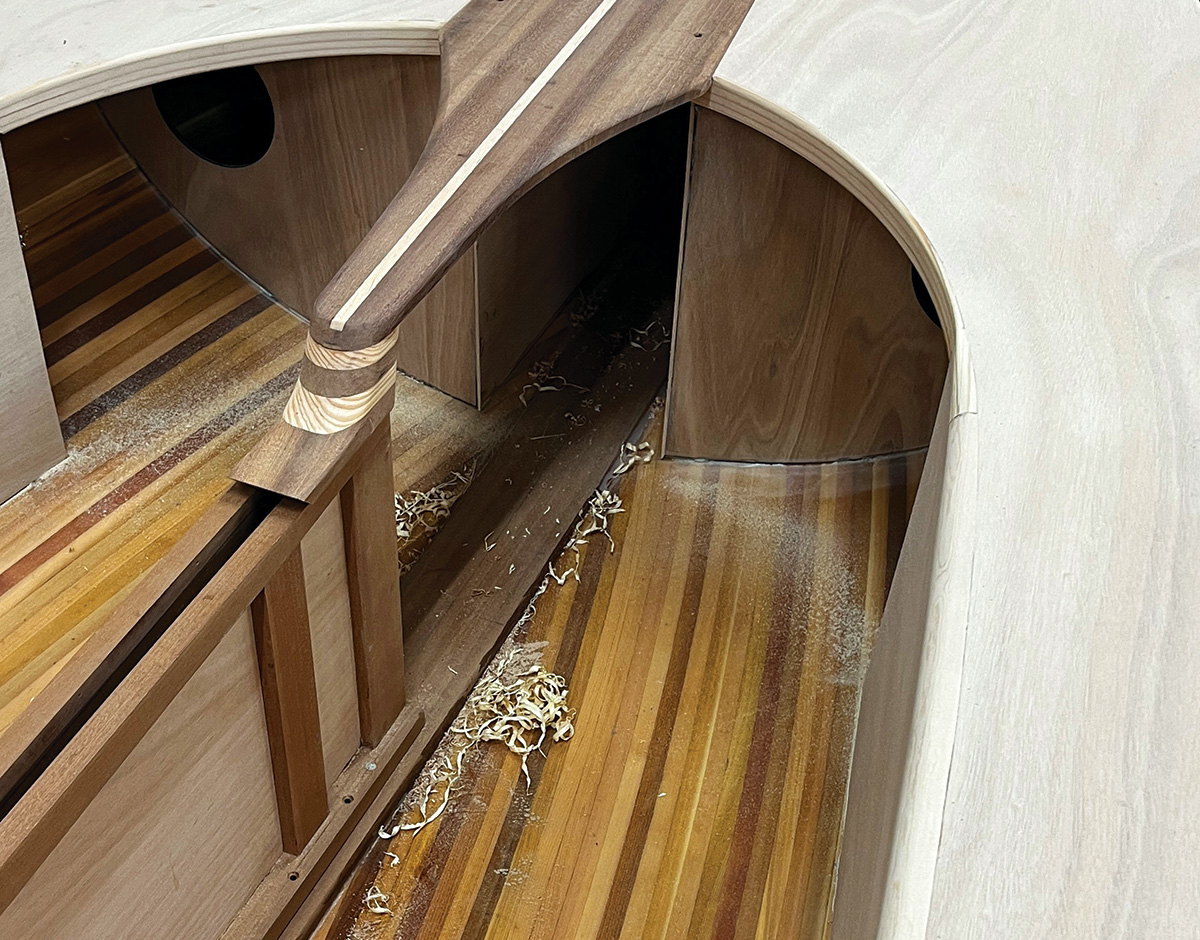 12. John raised the topsides for the Mk2 Windsong but left the centerboard trunk at its original height. This meant there was a discrepancy between the height of the mast partner and the top of the trunk, which are in the same plane on the prototype. John left the problem for Chris to sort out; his solution was a nicely shaped “step,” laminated out of sapele and spruce, which they jokingly refer to as “the pommel.” It’s a good example of how a problem can be turned into an opportunity.
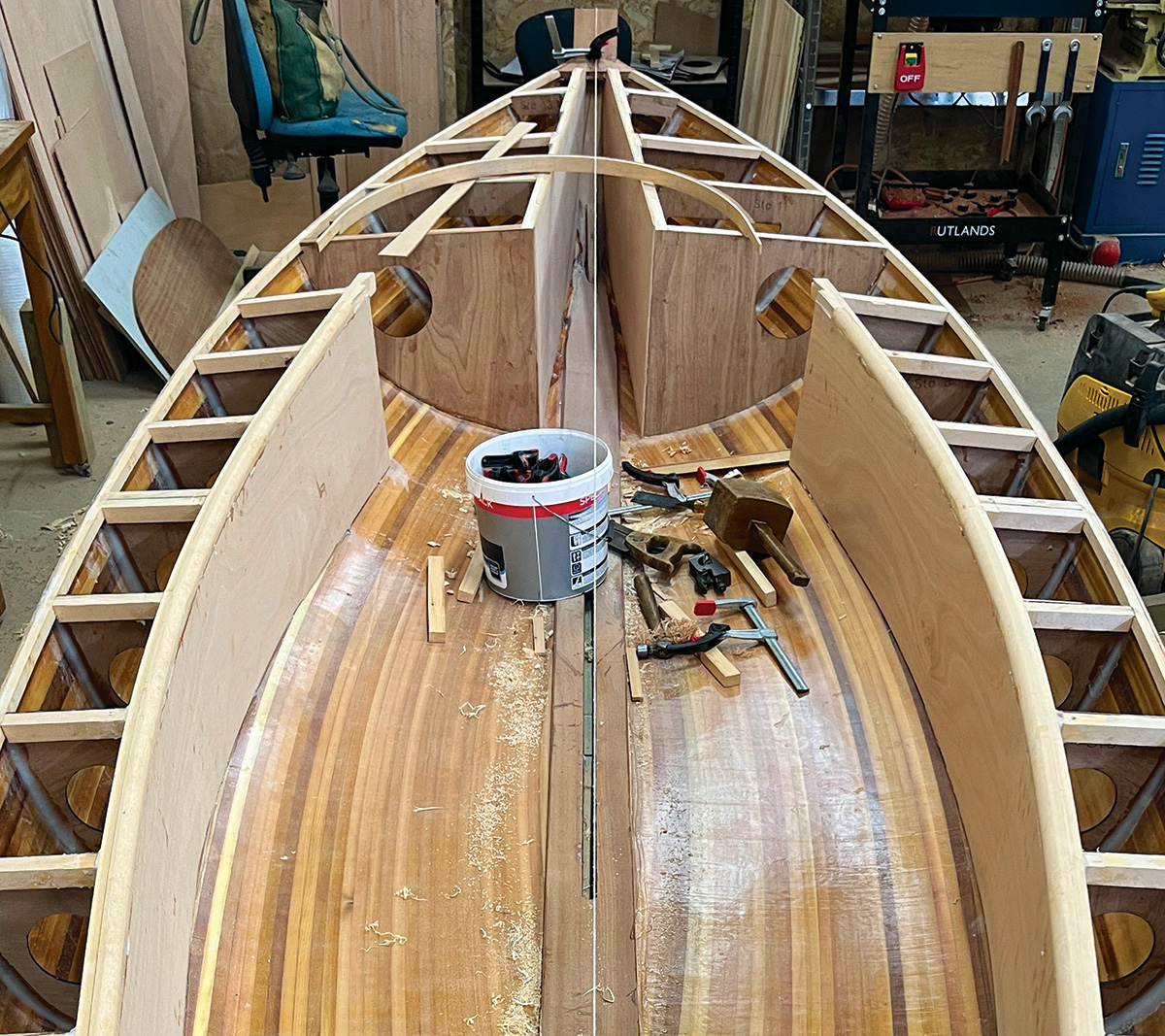 13. Those tricky carlins, half beams, and side buoyancy tanks are all clearly visible here—as is the split forward compartment. John keeps a centerline string in place throughout this process in case anything needs to be checked for accuracy.
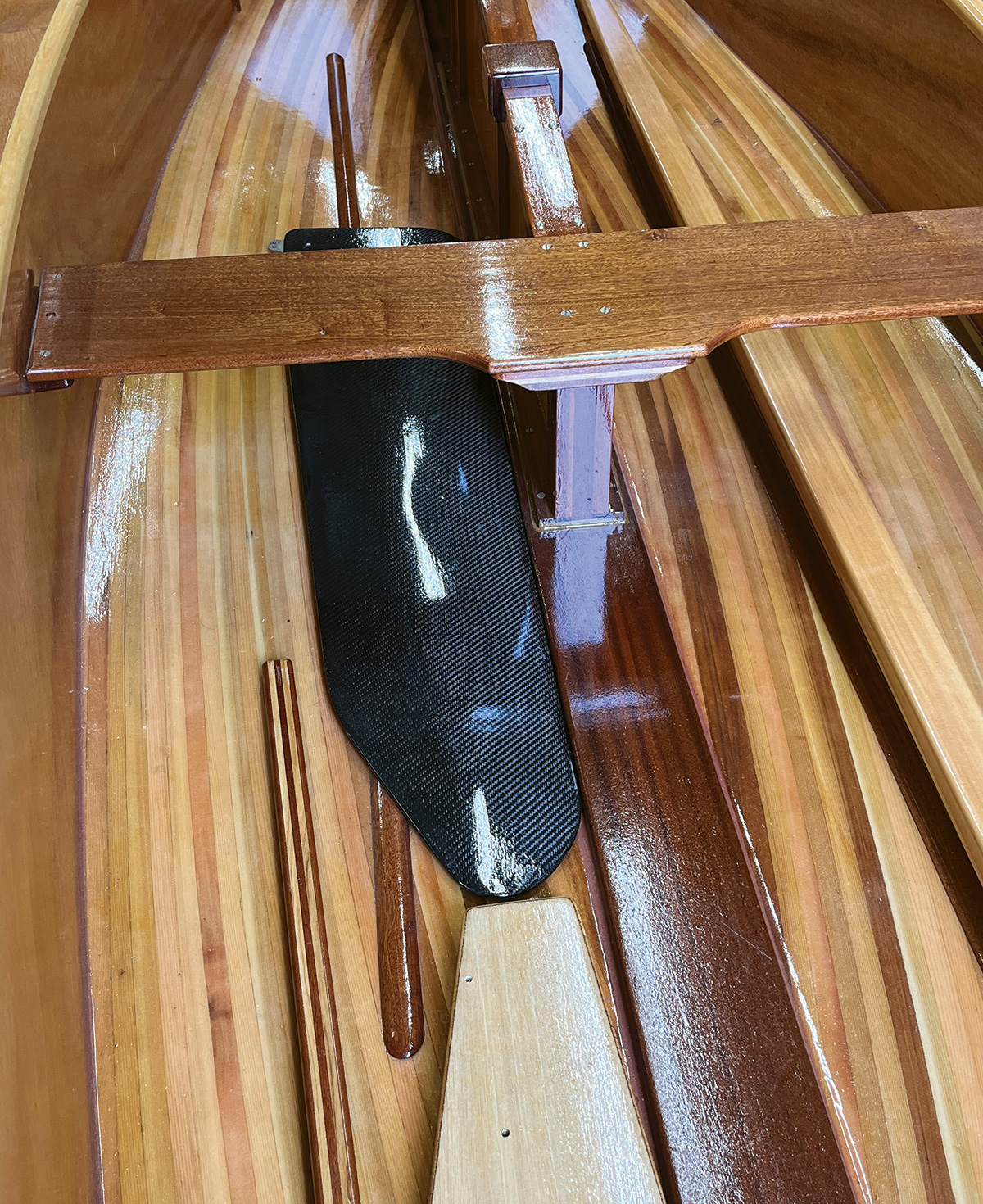 14. The centerboard might look like nothing much, but it’s been carefully designed for maximum stiffness and optimal weight distribution. Three layers of plywood—the center one set at 45 degrees to the outer layers—are sandwiched together with a layer of carbon fiber between the center layer and each outer one. The center layer has four discs of lead set into its lower portion, partly to add a bit of stability (though John argues this idea is a “fallacy”) but mainly because it helps the board sink easily. The layers are glued together with epoxy and vacuum-bagged to achieve a good bond. Once the epoxy has cured, the board is profiled to its designed shape and then sheathed with a layer of carbon fiber and epoxy.
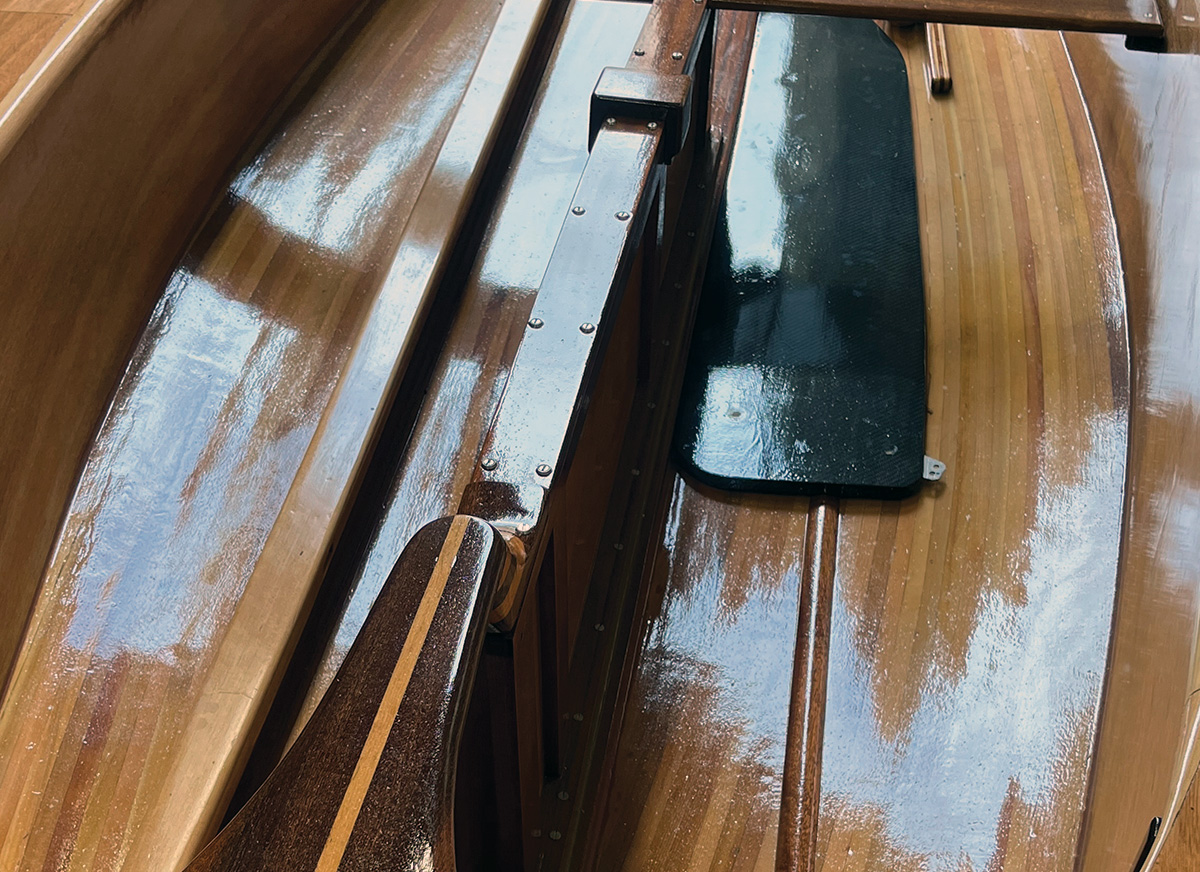 15. Attention to detail continued with the varnishing. All the solid wood is coated with what John calls “Gortex in a tin”: a microporous two-part varnish. He explained that under heat, this product allows gases in the wood to escape through the varnish rather than staying trapped and causing blisters. He hot coats most of it, meaning he doesn’t sand between applications, and estimates the finish should remain maintenance-free for eight years.
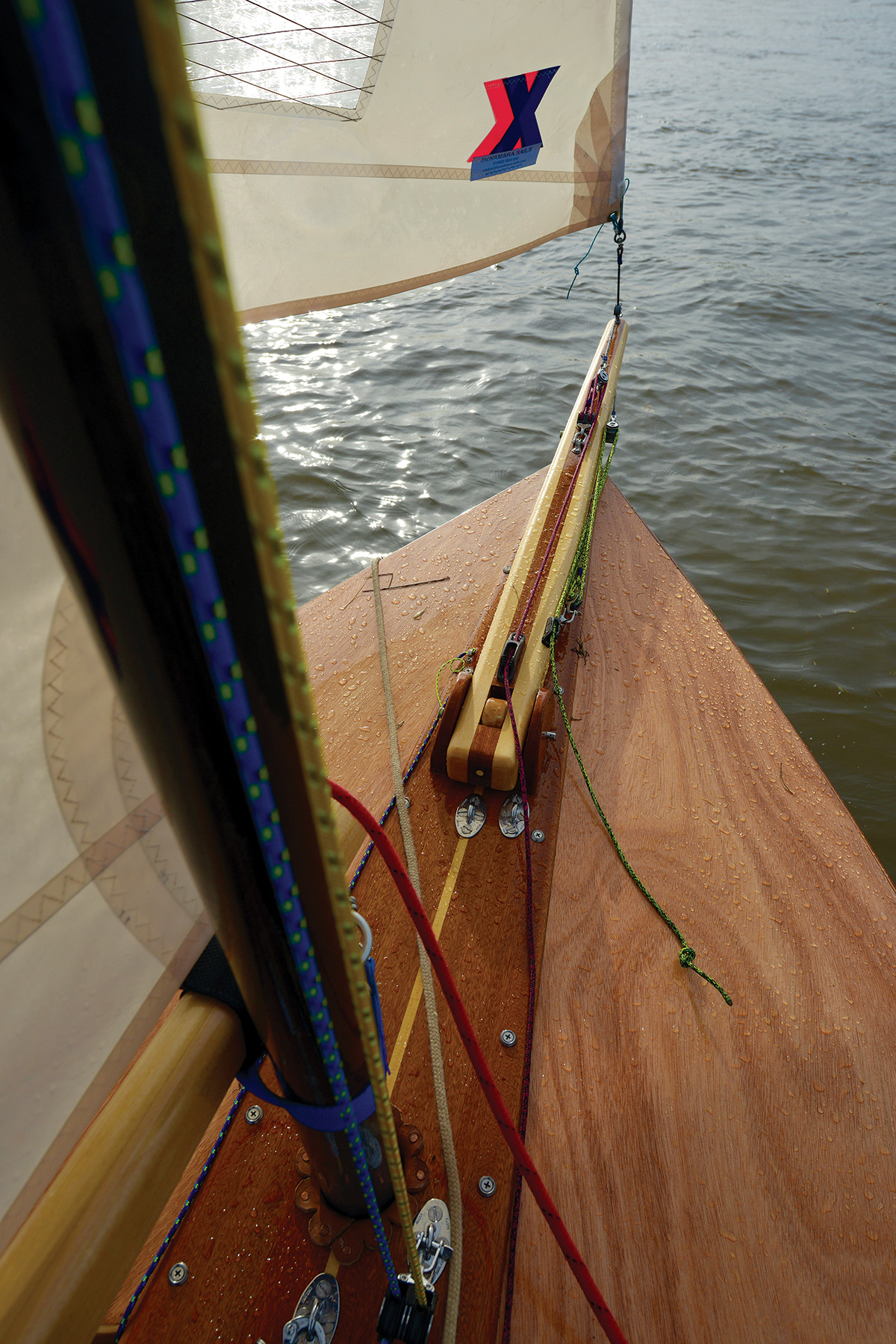 16. The laminated bowsprit slots into the bitts on the foredeck and is held in place by a metal pin. It is easily removed to reveal the second mast hole, allowing the mast to be moved forward to change from sloop to cat rig. The halyards and boom vang are also unshackled and attached to the forward eye plates, visible aft of the bowsprit.
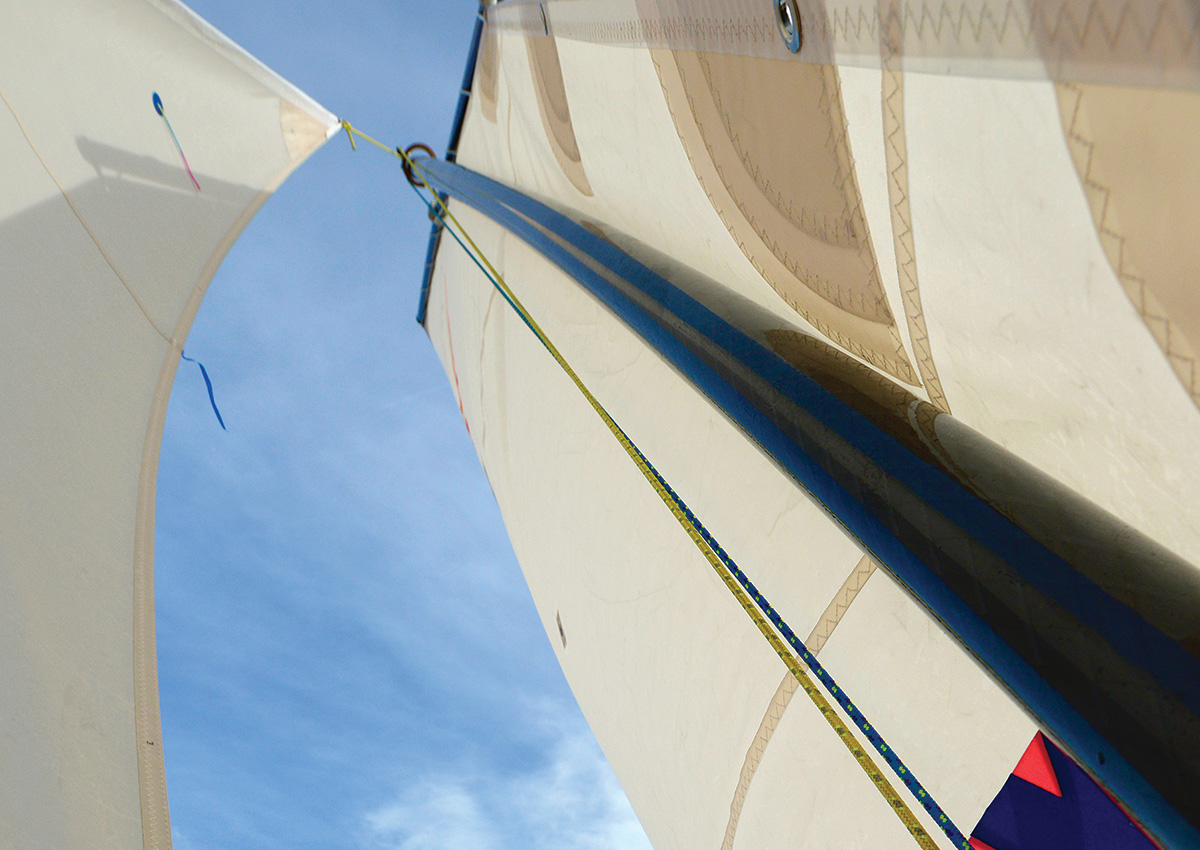 17. The prototype Windsong was built with a hollow, box-sectioned wooden mast. This bent excessively when tacking to windward, however, and John had to stiffen it by wrapping it in carbon fiber. For the new boats, he chose pure carbon-fiber masts. The carbon tubes were sourced with the help of OK-class builder Alex Scholes, who uses them on his boats, so John and his team only had to add the wooden ends. John calculated that doing it this way cost just a few dollars more than building the masts himself from scratch. Some bend in the mast of a lugger is desirable, because in strong winds it spills air where it is least wanted: at the top of the sail.
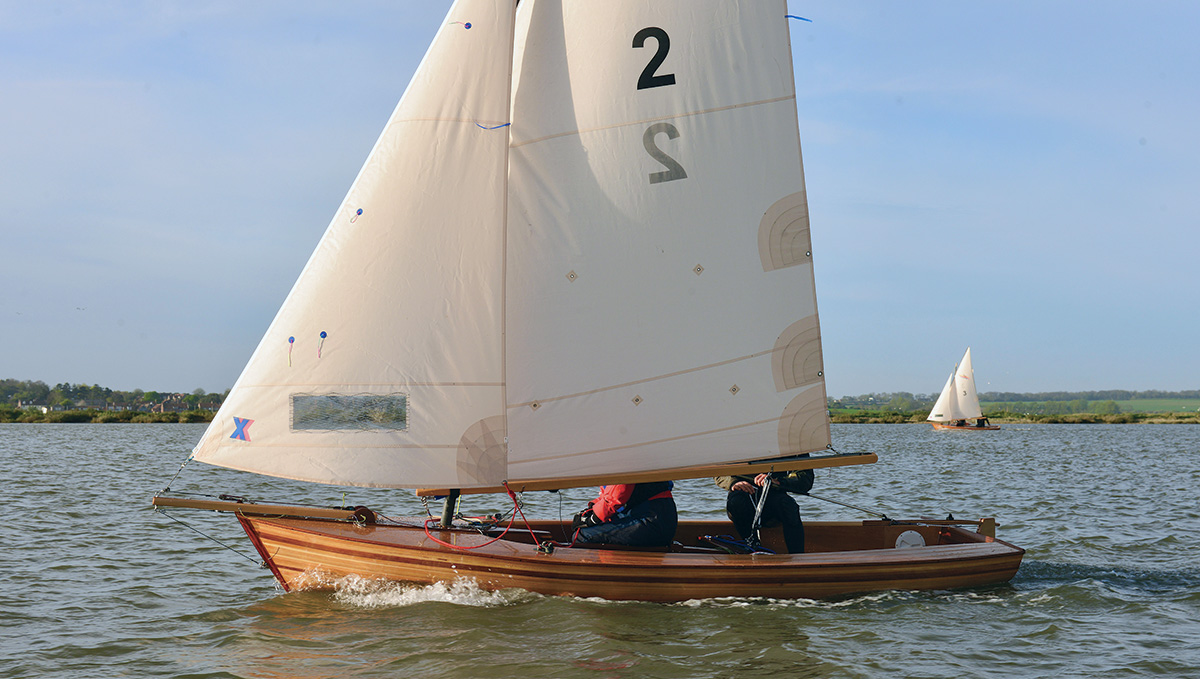 18. The Windsong has enough rigging to make it interesting to sail without it becoming too fussy. “The loose-footed main means you get a better sail shape, but you do have to control it,” John said. “It’s all about the clew outhaul and the tack downhaul, which you have to juggle between. If there are creases at the throat, you need to tighten the tack downhaul; if there are creases at the clew, you need to tighten the clew outhaul. You set the clew according to the weather conditions: downwind, you ease off on the tack; if it’s windy, pull in the clew outhaul. You’ll be surprised how quickly she gets on plane!”
Nic Compton is a freelance writer and photographer based in Devon, England. He lived on boats in the Mediterranean until the age of 15 and worked as a boatbuilder for many years before swapping his chisel for a pen and his router for a computer. He sails a Rhode Island–built Freedom 33, currently based in Greece.
All Construction Photos by Harry Cory Wright.
For more information, visit www.windsongboats.co.uk