John Harris of Chesapeake Light Craft adapting a 900-year-old Norse design.Blaine Skilling/Chesapeake Light Craft

John Harris of Chesapeake Light Craft (CLC) has developed a staggering variety of epoxy-plywood boats. There’s nothing he likes more than a challenge, and adapting a 900-year-old Norse design came as a particularly thorny one.

Every four or five years, I like to zig when the business plan suggests zag. I’ll build interesting things such as proas—the Esperanto of the sailing world—canoe yawls, raid boats, or solar-electric launches. Various business writers on deadline have acclaimed these high-visibility projects as marketing genius on my part. In fact, of the last five oddballs the only one that earned back its investment was a teardrop camper, not a boat.

Some of my design adventures have a practical purpose, such as to serve as the centerpiece of the stitch-and-glue boatbuilding class I teach every summer at WoodenBoat School in Brooklin, Maine. An unusual new design challenges the class, and I get a Tom Sawyerish boost on the prototype in the form of a dozen hardworking students to build it.

Some years ago, I watched a traditional Norwegian faering take shape in an adjacent classroom. Driven half-mad by the beauty of those singular lines, I thought, “Aha! Next year’s stitch-and-glue class!”

Twelfth-century Nordic clinker boatbuilding and 21st-century stitch-and-glue boatbuilding are broadly similar. In simple terms, the project begins in both cases with flat planks cut to precise shapes and joined along their edges. In the same way that reassembling the flattened petals of a banana peel will yield the 3D shape of a banana, the desired hull shape springs to life as planks are fastened one to the next. Only then are stiffening frames and interior structures added to this monocoque hull, in contrast to boatbuilding methods in which the frames or station molds dictate the final shape of the hull skin.

the stem structure is V-shaped in cross section formed by bending plywood sides around tiny temporary molds.Chesapeake Light Craft

As in the original boat, the stem structure is V-shaped in cross section, but instead of being carved to shape it is formed by bending plywood sides around tiny temporary molds.

Using Chesapeake Light Craft’s (CLC) trademarked plank-lap system, I’d had some successes with large and intricate shapes. A number of 32′ Cornish-style rowing gigs have been built stitch-and-glue style in lapstrake plywood to a CLC design, and I’d even figured out how to replicate the look and feel of a good Maine peapod that way (see WB 277). Why, then, could we not run out a set of plywood strakes that would stitch up into a Viking craft?

From the Viking Ship Museum in Roskilde, Denmark, the Gislinge Boat Open Source Project crossed my desk at just the right moment to become the subject of the stitch-and-glue class scheduled for summer 2020. I would preside over the assembly—in just five days, if everything went as planned—of a magnificent miniature Viking ship, the zenith of grace under sail, documented from an archaeological find.

But in substituting computer-cut okoume plywood for split oak, and epoxy for iron rivets, there was an uneasy sense of defiling the temple. To fumble those beautiful proportions was unthinkable. My plywood replica would have to summon the essence of that classic Norse hull shape. Towing the Gislinge boat on the highway, to look in the rear-view mirror is to see this magazine’s logo following you, close astern.

The stepped sides of the stems are rabbeted to receive the hood ends of the plywood planks.Chesapeake Light Craft

The stepped sides of the stems are rabbeted to receive the hood ends of the plywood planks. The complex shapes were worked out in CAD for precise cutting by CNC machines, making the boat suitable for kit construction.

In solitude, I spent hours studying the published drawings of the circa-1130 A.D. Gislinge boat, plotting the lines in CAD, and satisfying myself that a CNC-cut kit could be faithful to the spirit of the original and accessible to amateur builders. After all, there are a great many Viking-age re-enactors in the world, but very few boatbuilders with authentic Gislinge-level boatbuilding chops, let alone materials.

Complex planks precut from okoume plywood.Chesapeake Light Craft

Complex planks precut from okoume plywood, incorporating CLC’s scarfing system and trademark lap joints, were glued into nearly 25’ full-length strakes, making them ready to hang.

Arguments over the authenticity of a replica will exercise the self-appointed authenticators. I joked that CLC’s Gislinge boat reproduction would use “only the CNC machines, marine plywood, and epoxy available to the 12th-century Danes.” Not everyone laughed. In response to an Instagram post about CLC’s plywood Gislinge project, one talented but agitated boatbuilder wrote, “What’s the point, even?”

“Authenticity” is always arbitrary. I wondered if the critic padded into the forest wearing soft leather turnshoes and a woolen tunic, carrying an iron axe to fell oak trees for his Gislinge boat. Or did he bring a chainsaw? For me, the point is that everyone loves that hull shape. There should be more Gislinge boats in the world, even if they aren’t hewn from oak. May the god Njörðr strike me down.  

Satisfied that a shipshape replica of the 25′3″ Gislinge boat could be built in plywood, I was ready to bring in Jay Hockenberry, currently CLC’s chief of computer-assisted design and manufacturing. Jay’s job for most of the past 20 years has been turning two-dimensional plywood into three-dimensional boat shapes, including suffering through many of my strangest ideas and impulses. Jay has the kind of visualization skills, patience, and persistence to make giant jigsaw puzzles work. And as puzzles go, this project would be a corker.

Like the original boat, the plywood one has widely spaced frames.Chesapeake Light Craft

Like the original boat, the plywood one has widely spaced frames. All of the boat’s surfaces were coated with epoxy.

Many people write in to tell me that this or that old design would “make a great boat kit.” I think there’s a misapprehension that CAD is somehow automated, that one need only select “convert to stitch-and-glue” from a pull-down menu, and in minutes the CNC machine will be zipping out parts for a Snipe or a Snowbird. The reality is that CAD struggles with complex intersecting spline curves and must be prodded, cajoled, and even tricked into forming subtle shapes. In CAD, you can draw curves that wood will not follow and create awkward fits that will infuriate builders. Combine a boatbuilder’s experience and intuition with CAD’s repeatability and precision, and you have…Jay.

As with most wooden boats, the planking is fastened to the Gislinge boat’s stems, and that’s where we started. The original Gislinge’s “stepped stems,” hewn from oak, are among its most arresting features. What’s unusual is that the stems are monolithic hand-carved sculptures, V-shaped in cross-section, of almost unfathomable intricacy, forming in solid timber the signature arc of a Viking-age bow and stern. The carved stems are mesmerizing.

The CLC boat is faithful to the historic boat’s shape as recorded in a 2016 lines plan from the Viking Ship Museum in Roskilde, Denmark.Chesapeake Light Craft

Despite using materials radically different from the original, the CLC boat is faithful to the historic boat’s shape as recorded in a 2016 lines plan from the Viking Ship Museum in Roskilde, Denmark. Harris downloaded plans from the museum’s Gislinge Boat Open Source Project.

Stitch-and-glue boats don’t ordinarily have structural stems, but in anything larger than a dinghy or a canoe, the alignment of the plywood planking at the stems can be unruly. Having something plumb and solid as a landing for the strakes seemed like a good idea at this scale, and it gave us an excuse to try to replicate the sculpted Danish original. This would take the form of a hollow, slot-together fabrication of CNC-cut plywood. The resulting fusion of folk art with technology was clever…but it didn’t work. We tried it on a 33-percent scale model and with full-scale mockups of the bow, and at best it seemed like a lot of labor just to create hollow spaces where water could collect.

I wandered off and left Jay to cogitate. It took several fiercely complex design evolutions, but the result requires nothing more of our prospective stitch-and-glue Gislinge boat kit builders than copper wire and a bottle of superglue for “tack-welding.” The stems are still three-dimensional sub-assemblies, serving the function of creating solid lands for the hull planking, but the imitation of the solid-oak “stepped stems” was set aside. As the 25′-long strakes are stitched together, they sweep up to the stems, landing with space-age accuracy in CNC-cut “gains” and half-laps in the stem assemblies. The plank laps shrink gracefully to become the flush sides of the stems, the curves converging at the top peak of each distinctive stemhead. Whatever your feelings about epoxy and plywood, it’s elegant design work.

The installation of continuous side seats that function almost like a deck.Chesapeake Light Craft

An unusual feature of Harris’s boat is the installation of continuous side seats that function almost like a deck. The structure stiffens the hull while also providing seating for crew under sail and housing flotation. Thwarts, fitted later, provide rowing positions.

At this point, the Covid-19 pandemic forestalled boatbuilding classes, so there would be no Gislinge boat construction at WoodenBoat School. We wore our masks and sat on our hands, and it seemed probable that we would finish out 2020 subsisting on boiled okoume. But with CLC’s showroom closed and classroom empty, and with so much intricate design work complete, we couldn’t wait to see if the thing would work. Late in that strange year, we machined all the parts, and in about five days a small team stitched-and-glued a Gislinge boat.

Okoume plywood is a marvelous, sustainable, structural material. It’ll also turn into mulch if it stays wet, so okoume boats must be sealed in epoxy. That’s when the scale of the project comes into focus: 16 sheets of plywood is a lot of surface area to coat with epoxy and then sand smooth. In 2021, I towed the boat to Maine so that the students at WoodenBoat School could continue construction, but it would have been mean to make them do all that sanding. The unfinished hull hung around into winter 2023, when at last Jay conscripted a work party to grind the epoxy smooth. His crew then mopped the boat with dark Cetol to counter the light color of okoume, and sorted out her rigging in the parking lot.

Re-enactment groups and fans of the seafaring Vikings are the kind of folks who might build CLC’s variation of the Gislinge boat. This inspired one of the most visible departures from the 900-year-old artifact: the narrow plywood deck-like side seats around the perimeter of the interior at thwart height. This skinny structure stiffens the hull remarkably, and it’s great for seating while under sail. But it has one primary function: to provide a surface to whose underside foam flotation is glued, positioned out to the sides to provide some flooded stability. Depending on the loading and the sea conditions, it’s enough buoyancy to allow self-rescue; at worst, it’s enough to make the boat a haven while awaiting rescue.

Having never sailed a Gislinge boat of any construction type, or really any boat like it, I had no idea what to expect in sea trials. Would the boat be cranky and wet? (Not at all.) Would the side-slung rudder actually work? (It worked great.) With nothing more than a 5″-deep, 21′-long, straight keel, could we sail upwind? (Better than you’d think.) Was my substitution of a dipping lugsail for the square sail a sound choice? (Maybe.)

Showing the configuration of the stems.Blaine Skilling/Chesapeake Light Craft

Harris found the configuration of the stems on this type of boat to be “among its most arresting features.”

We slid the varnished wood-epoxy Gislinge boat into the warm mid-July bathwater of Eastern Bay, a half-hour from Annapolis, Maryland. If recollection serves, it was the only occasion when a replica of a 12th-century Danish working craft has parted those waters. Up went the sail in the Chesapeake’s humid hair-dryer summer breeze. Trials over several weeks took place in winds up to 18 knots with a bumpy chop.

Initial stability is low; we step to the center when boarding. But at around 15 degrees of heel, there’s a hard shelf of secondary stability. You let her heel a bit, she powers up, and the acceleration is dinghy-like. Indeed, asked how our Gislinge boat replica handles, I find myself reaching for comparisons to racing dinghies. We placed 225 lbs of ballast amidships in the hollow plywood box keel (in lieu of beach cobbles), which seems about right. The displacement-to-length ratio is the same as an International 110.

I fretted about the side-slung rudder, often mentioned as a source of trouble in the accounts of replica projects. I had visions of foaming, gurgling cavitation while the boat flew out of control. Greg Flanigan, who logged five months as a shipwright and deckhand aboard the mighty DRAKEN HARALD HÅRFAGRE, a 115′ LOA replica launched in Norway in 2012 (see Review, WB No. 250), stopped by the shop and helped sketch a simple set of struts with a rope hinge for the rudder. Under sail, I cannot distinguish the responsiveness of the side-slung rudder from that of a stern-hung rudder. It just feels normal.

The surface area of the salient keel is two or three times that of the centerboard one might install in a boat of these proportions. The shallow keel just isn’t very efficient as lateral resistance. The faster you’re sailing, the more lift the shallow keel generates, and the higher she’ll point: in trials, about 70 degrees off the wind. If you have urgent business to windward, ship the oars, as the Danes no doubt did. (By fitting a daggerboard with a nice foil shape in a discreet trunk, this boat would murder the traditional small craft at messabouts, and on handicap it would even give J-24s something to think about.)

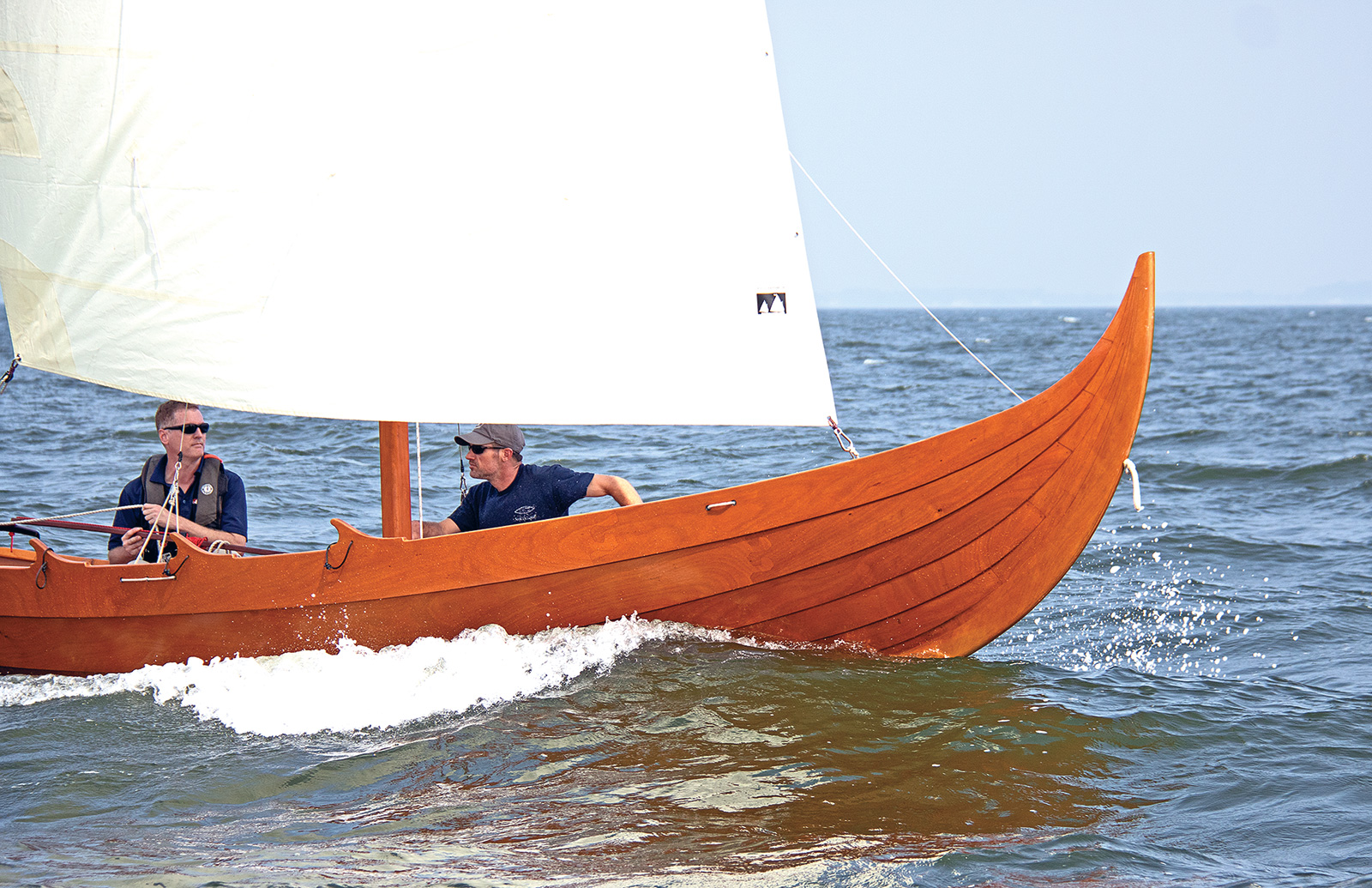
Harris decided to use a dipping lug sail.Blaine Skilling/Chesapeake Light Craft

Harris decided to use a dipping lug sail instead of the traditional square sail to keep the rigging simple. The boat’s displacement-to-length ratio, he says, is similar to an International 110.

I substituted a dipping lug for the square sail to simplify the rigging. The dipping lug has only three pieces of running rigging (halyard, sheet, and tack downhaul), compared to as many as six with square-sail rigs used on these boats. Dipping the lug is slower than shunting one of my Pacific proas, though with practice we were able to do it without getting stuck in irons. I wouldn’t stop anyone from sticking with the more authentic square sail, but along with learning the terminology for all that Norse running rigging, they may want to pick up some authentic Danish vulgarities to bellow when it gets tangled.

While development was prolonged and tricky, I think the plywood Gislinge boat honors the ancient original in look and spirit. Nothing feels synthetic. In the windiest, bumpiest stretches during the sea trials, she seemed to waken and leap for joy. I’d give her the reins and she’d surge ahead, tossing the spray out to the sides, a sailing machine for the ages.  Article ends.


John C. Harris designs, builds, and writes about boats at Chesapeake Light Craft in Annapolis, Maryland.