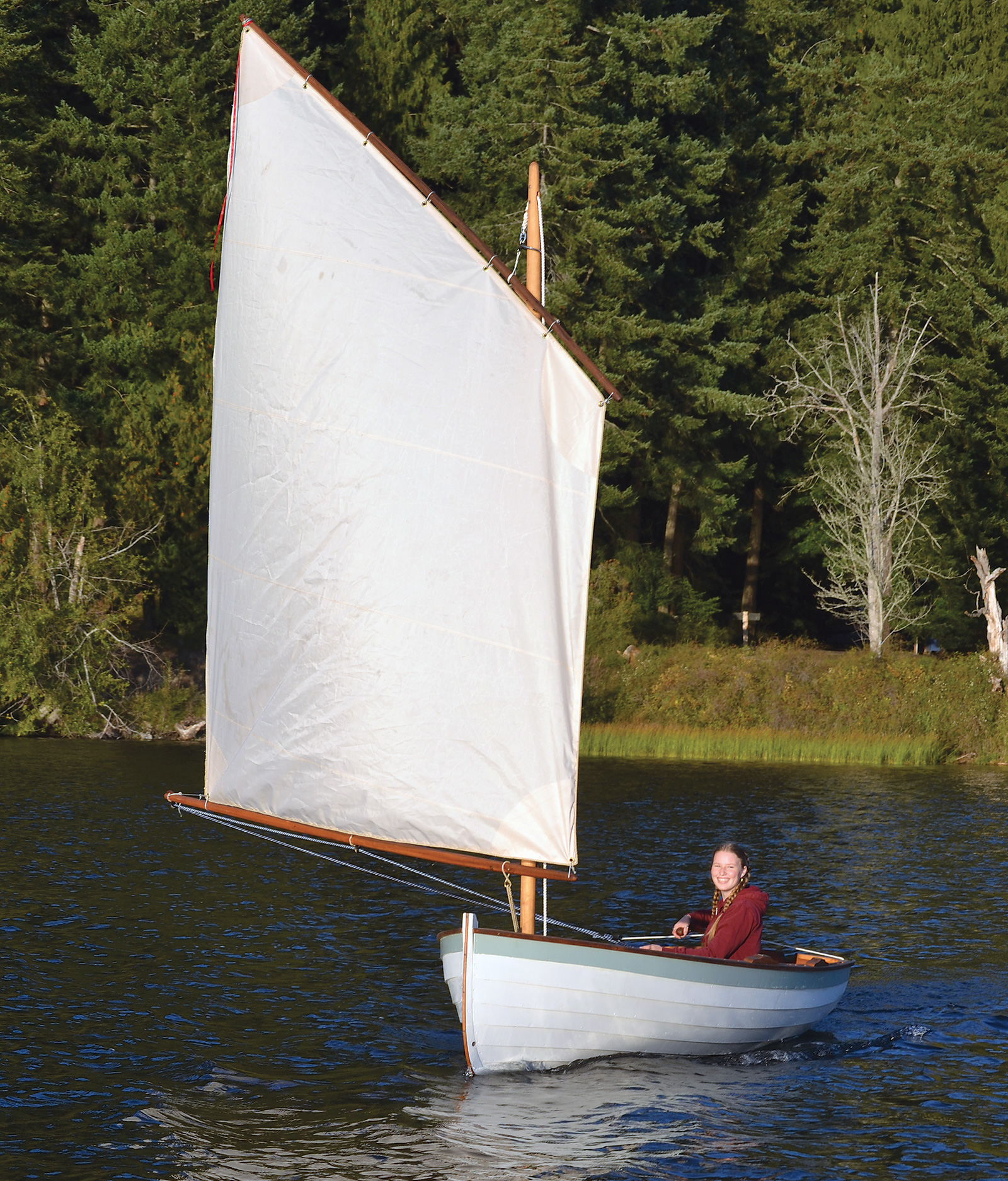
Solianna Halabisky sailing LA BELLE SAUVAGE.Bruce Halabisky

Beginning at age 13, Solianna Halabisky spent six years building, with her father, an 11′ dinghy whose design she specified with designer Laurie McGowan. Here, she sails the boat, LA BELLE SAUVAGE, on Cascade Lake on Orcas Island, Washington.

As a traditional boatbuilder and a father, I naturally hoped that someday my children might take an interest in my trade; I had romantic visions of passing on the lessons and myriad woodworking tricks of building a wooden boat to my two daughters. However, I was also aware of the fickle nature of the parent-child relationship: push too hard or appear too eager and they might run in the opposite direction like the sea captain’s son who moves to Idaho to raise cows. I had to approach my daughters’ woodworking education with finesse and self-awareness; I knew I could be a bit of a fanatic when it came to explaining the intricacies of the dipping-lug rig or marveling at the cleverness of a finely sharpened compass plane. My oldest daughter, Solianna, could execute a sly eye roll as I droned on about some obscure bush used in boatbuilding or the chemical composition of a proper keelbolt. I resolved to bide my time, play it cool, and not be that weird old dude yammering on about pine tar, caulking irons, and the tragedy of a lumpy sheer.

I was therefore caught off guard one morning when Solianna, who was 13 at the time, approached me and casually said, “Hey, Papa, I think we should build a sailing dinghy.”

Woah! Breathe deep. Restraint. Years of subtle and not-so-subtle brainwashing were coming to fruition! Don’t blow it. Play it cool. “Oh?” I said, trying to hide the shaky excitement in my voice. “What did you have in mind?”

“Umm…I was thinking of a traditionally built sailing dinghy with a standing-lug sail that would also be good to row.”

Sweet Jesus! Where did this child come from? This would be the father-daughter dream project! I slid a copy of WoodenBoat over the stack of small-craft designs I had been keeping at the ready for this very moment. And then, going impulsively off script, I looked at the magazine in front of me and thought of its Sketchbook section that ran for several years, in which a reader described a boat idea and a designer sketched it up as a concept.

“Why don’t you write to WoodenBoat and see if they will design a boat for you?”

And so she did.

Solianna’s letter to designer Laurie McGowan appeared in WB No. 276. It read:

Dear WoodenBoat,

I am a 13-year-old girl that loves sailing and rowing. I want to build my own boat with the help of my father, who is a traditional boatbuilder. I am imagining a dinghy about 9′ long with lapstrake planking that I can use around the waters of Orcas Island, where I live. I currently have a 7′ fiberglass dinghy with a standing-lug rig and centerboard, but it is too small. My new boat might also have a standing-lug rig.

The boat must not be too heavy or hard to handle, which I realize is a challenge with traditional construction. I know that there are already designs that meet these needs, except the ones I’ve seen are all made of plywood, glue, or fiberglass. One of the main reasons I want to build this boat is to learn to use woodworking tools with real wood, and to not use any fiberglass or plastic. I imagine time in the shop with my father without having to strap on a respirator and latex gloves every time we get to work.

Can you design me a traditional boat that will be a pleasure to build and fun to sail and row?

Solianna Halabisky
Eastsound, Washington

WoodenBoat chose Solianna’s letter, and we were fortunate that Laurie McGowan designed the ideal boat based on her description. McGowan understood our desire to keep the build traditional but also to include some modern performance characteristics. At some point in our discussions with him, the dinghy was stretched out to 11′ and his sketches appeared in the magazine. Solianna named the boat LA BELLE SAUVAGE after a fictional boat in a book by Philip Pullman of the same name. In La Belle Sauvage, a boy flees the evil forces of a fantastically flooded London, England, by captaining his handmade craft down the River Thames to safety.

LA BELLE SAUVAGE traditionally built with lapstrake planking.Bruce Halabisky

LA BELLE SAUVAGE is traditionally built with lapstrake planking, steam-bent frames, and a solid-wood keel whose rabbet Solianna is cutting.

Once we had the design, I had to think carefully about the construction. What specifically did I want Solianna to learn? Was the goal simply to get a finished boat into the water so we could start using it? Obviously, I hoped that her woodworking skills would improve, and I wanted her to embrace the complex problem-solving necessary to build a boat from scratch. But there was something more, when I really thought about it: I wanted her to learn to be resourceful. I wanted her to make something beautiful and useful without going to the store or ordering it online. I wanted her to always reflect before buying something made from afar. What did boatbuilders do 100 years ago? Can I make a particular part without spending any money?

From the start, we conceded that we would buy copper nails and roves to fasten LA BELLE SAUVAGE. I say “conceded,” because one option would have been to clench-nail the whole boat with recycled iron nails (as many fishing skiffs have been built all over the world), just to show Solianna that it could be done. For the wood, however, I proposed to her that it all would come from the forests around our house, driftwood from the beach, or my collection of offcuts. This would have been more difficult if we didn’t live on an island in the Pacific Northwest. There is an abundance of Douglas-fir that I can cut to usable dimensions with my chainsaw mill, and our beach often has beautiful cants of old-growth red cedar and hemlock that wash in with the tide. We also had a lot of friends in our community with their own stashes of shop scraps we could draw on.

Solianna cuts a plank gain on LA BELLE SAUVAGE.Bruce Halabisky

Solianna cuts a plank gain on LA BELLE SAUVAGE. The planking stock came from old-growth western red cedar that washed up on the beach near her house.

With this approach of not buying any wood, we would need lots of time—time to hunt the beaches for wood, time to split the cedar to sizes we could carry, and time to let it air-dry. In fact, in the end, we spent about four years collecting wood and drying it. Before we even started gathering wood, the design work with McGowan had taken a year. Once we had the wood ready, the construction took a year, and then making the sail and rig took another year. Six years to build an 11′ dinghy!

If we had gone to a lumberyard, the story would have been simple: wood ordered and paid for. Done. But because we were scrounging, every piece had its own story. The molds for LA BELLE SAUVAGE came from cast-off forms from a concrete pour. The keel was from an old Douglas-fir tree that grew alongside our driveway until it came down in a windstorm. A friend had a chunk of Port Orford cedar that had the perfect sweep to make the stem and forefoot out of a single piece of wood.

Solianna sets a rivet on one of LA BELLE SAUVAGE’s frames.Bruce Halabisky (both)

The boat’s plank laps, as well as the frames, are fastened by copper rivets. Here, Solianna sets a rivet on one of LA BELLE SAUVAGE’s frames. The daggerboard trunk was added later by cutting the frames spanning the daggerboard slot.

“Just think how much time we are saving,” I told Solianna, somewhat sarcastically, as we assembled the boat’s backbone, “by finding a piece of curved wood that matches the curve of the bow.”

After a big winter storm came through the Northwest, a promising boatbuilding log washed up on the beach in front of our house. “What do you think it is?” I asked Solianna as we stood on the black rock beach with a snow-covered Mount Baker on the horizon.

She whacked at it with a small hatchet; “Smells like red cedar.”

We ran a steel tape along its length: 12′ of good wood, enough to make 11′-long planks with no butts and very few knots. I hacked off a bit of the end-grain and could see the tight, closely lined growth rings. “This is some of the finest planking material in the world,” I told Solianna in a hushed voice. Using iron wedges and a pair of crowbars, we split the log into pieces we could carry up from the beach.

All of the wood for LA BELLE SAUVAGE was foraged locally.Bruce Halabisky

All of the wood for LA BELLE SAUVAGE was foraged locally. The frames are of steam-bent hemlock, and the thwarts and sternsheets are of red cedar.

When the cedar was milled and dry (which took several years) we began building the dinghy upside-down on the molds. First, the backbone was assembled and the rabbet cut to receive the ⅜″-thick planking. Every plank was riveted to its neighboring plank and screwed onto the stem and transom. The planks’ hood ends were curved enough to require a bit of steam using the old trick of a large innertube slid over the end of the plank and connected to the steamer.

I did not keep track of the hours we spent building LA BELLE SAUVAGE. The planking alone took many months of evenings and weekends. Sometimes I worked on her by myself, or sometimes Solianna would work alone—but mostly, we worked together. The project was pleasurable. A typical scene was a fire in the woodstove of the shop, music on the stereo, and Solianna spiling a plank with me or cutting a gain with a rabbet plane. Sometimes her teenage friends would come by to help out. I could tell she was proud of the skills she was learning. I remember one day when her athletic 6′-tall boyfriend fumbled a bit too long with a cordless screw gun to fasten the boat’s forms to the shop floor. Solianna let out an exasperated sigh, grabbed the tool, and confidently drove home a 3″-long deck screw while allowing just the tiniest smile of satisfaction to show on her lips.

Laurie McGowan developed this concept.Laurie McGowan

Laurie McGowan developed this concept drawing for LA BELLE SAUVAGE, then called “BELLE,” in response to a letter from Solianna stating her wishes for a boat.

Typically, a traditionally built small boat is framed with steam-bent oak frames. However, there is not much oak in the Pacific Northwest. Adhering to our theme of not buying any wood, Solianna and I made up a bending jig to test the alternatives available to us using a stick of oak from my shop scraps as a control sample. The Douglas-fir proved to be too splintery, but surprisingly some very fine-grained, old-growth hemlock driftwood bent very well. “Now you can say your dinghy is made mainly from driftwood,” I told Solianna. “Most people will imagine a roughly hewn raft, but the truth is that you couldn’t buy better wood even if you wanted to.”

After the slow, meticulous work of planking, it was fun to share with Solianna the excitement and speed of framing a whole boat in a day or two. Along with the drama of a few broken frames, there was the pressure of a hot stick of wood emerging from the steambox every 15 minutes and magically taking the shape of the hull before cooling and being riveted into place.

The final design has less V in its sections.Laurie McGowan

The final design has less V in its sections, for greater stability (“though I’m sure Solianna could have handled it,” McGowan says). The daggerboard was moved aft, and the rudder enlarged, to reduce weather helm.

With the planking and framing finished, we turned to the reinforcements of quarter knees, breasthooks, and inwales, plus essential pieces such as thwarts, the daggerboard trunk, and the maststep. Every piece had a story attached to it. One friend came by with plum-wood crooks that he was going to use for firewood. “Thirty years ago, I planted these trees along Main Street in town,” he said with tears in his eyes. “Then when the county widened the road a couple of years back, they chopped them all down.” Solianna and I shaped the plum wood with a power planer and bandsaw and turned it into perfect thwart knees for BELLE.

Finally, by the summer of 2024, LA BELLE SAUVAGE was nearing completion—complete enough, at least, to float and be used as a rowboat. We decided to plan a launch date and finish the sailing rig later. We painted the hull white and Solianna mixed a custom blue-green color for the sheer. Soli-blue, her friends called it.

LA BELLE SAUVAGE awaits her launching.Ben Luna (left), Bruce Halabisky (right)

Above left—Bruce and Solianna carry LA BELLE SAUVAGE out of the shop for the first time. Above right—LA BELLE SAUVAGE awaits her launching on the north side of Orcas Island. Much of the wood that went into her came from this same beach—including the carved nameboards of Alaska yellow cedar.

On September 1, 2024, LA BELLE SAUVAGE emerged from our little shop. Friends helped carry the dinghy down to the water. More than 80 people showed up on the same beach that much of the wood had come from. Most had never been to a boat launching, but many of them had contributed in small ways to the building of LA BELLE SAUVAGE. Some had helped with the building, and others had contributed a scrap of wood. More important, they had helped to build Solianna into the 18-year-old woman that stood next to me on the beach. With the crowd gathered around, I described each piece of wood in the boat and where it had come from. Sometimes I pointed to where the tree had grown or been found on the beach. Often, I could look someone in the eye who had contributed in some way to the construction.

Bruce and Solianna enjoy a row.Tiffany Loney

Bruce and Solianna enjoy a row on launching day.

With a cheer and a splash of home-brewed beer on her bow, LA BELLE SAUVAGE was launched. Solianna took the oars (made from hemlock driftwood) and took a turn rowing through the kelp bed and out to the open water of the Salish Sea. A few days later we towed BELLE down to the Port Townsend Wooden Boat Festival behind VIXEN, our 34′ Atkin gaff-cutter (see WB No. 246).

We still had to make the sailing rig, The winter following the launching of LA BELLE SAUVAGE, we lofted the sail on the dance floor of the local performing arts center. The costume room had a heavy-duty sewing machine up to the task of sewing the panels of cream-colored Dacron. I leaned heavily on Emiliano Marino’s book The Sailmaker’s Apprentice, which offers a step-by-step process to build a traditional sail such as the standing-lug for BELLE.

LA BELLE SAUVAGE awaits an outing.Bruce Halabisky

LA BELLE SAUVAGE awaits an outing on Cascade Lake.

As Solianna was coming to the end of her senior year of high school, we found time to make a daggerboard and rudder. The final pieces came together with a pair of mast-partner knees made of madrona, a Pacific Northwest hardwood, and a tiller made of Pacific yew. Just a couple of weeks before Solianna was to leave for university, we had everything finished and a perfect late-summer day for sailing. With me taking photos from VIXEN’s dinghy, Solianna sailed circles around me, smiling and laughing, amazed at the speed and grace of this craft that we had built together.

I remember when I was a boatbuilding apprentice, just a few years older than Solianna is now, WoodenBoat had published an article titled “Building the Six-Hour Canoe”—a how-to-build piece detailing how to make a canoe from just two sheets of plywood. My fellow apprentices and I were spellbound by the idea of becoming boat owners with just six hours of effort. Saturday morning, we were all scarfing up lengths of plywood and making plans to go canoeing on Sunday. But the design was rather plain, and we each thought there might be ways to make improvements. This led to unexpected complications, and because we were inexperienced and feeling rushed by the promise of finishing in six hours, the scarfs weren’t properly cut and the epoxy wasn’t properly cured. Glue-joints failed. We grew frustrated, and ultimately not a single canoe made it to the water.

Sailing LA BELLE SAUVAGE.Bruce Halabisky

Cascade Lake is one of Solianna’s favorite venues for sailing LA BELLE SAUVAGE.

The building of LA BELLE SAUVAGE was the antithesis of the Six-Hour Canoe. Six years to build a dinghy. There is a part of me that still wants to build that Six-Hour Canoe, just to see if I can do it, but my attitude toward boatbuilding has changed a lot in 30 years of working with wood. It takes time to make beautiful things. And maybe the thing isn’t even the important part of the building. My mentor, Lance Lee, the founder of The Apprenticeshop boatbuilding school in Maine, has always said, “The boat builds the boy.” I think he is right. But, also, the boat builds the girl. The boat builds the father. And together we very slowly built LA BELLE SAUVAGE.  Article ends.


In 2004 Bruce Halabisky left Victoria, British Columbia, with his wife, Tiffany, in their Atkin cutter, VIXEN, and spent the next 11 years sailing around the world. Along the way they had two daughters: Solianna and her younger sister, Seffa Jane. Bruce lives on Orcas Island in Washington State and works as a boatbuilder and sailing captain.

Plans for LA BELLE SAUVAGE are available from the WoodenBoat Store (www.woodenboatstore.com).