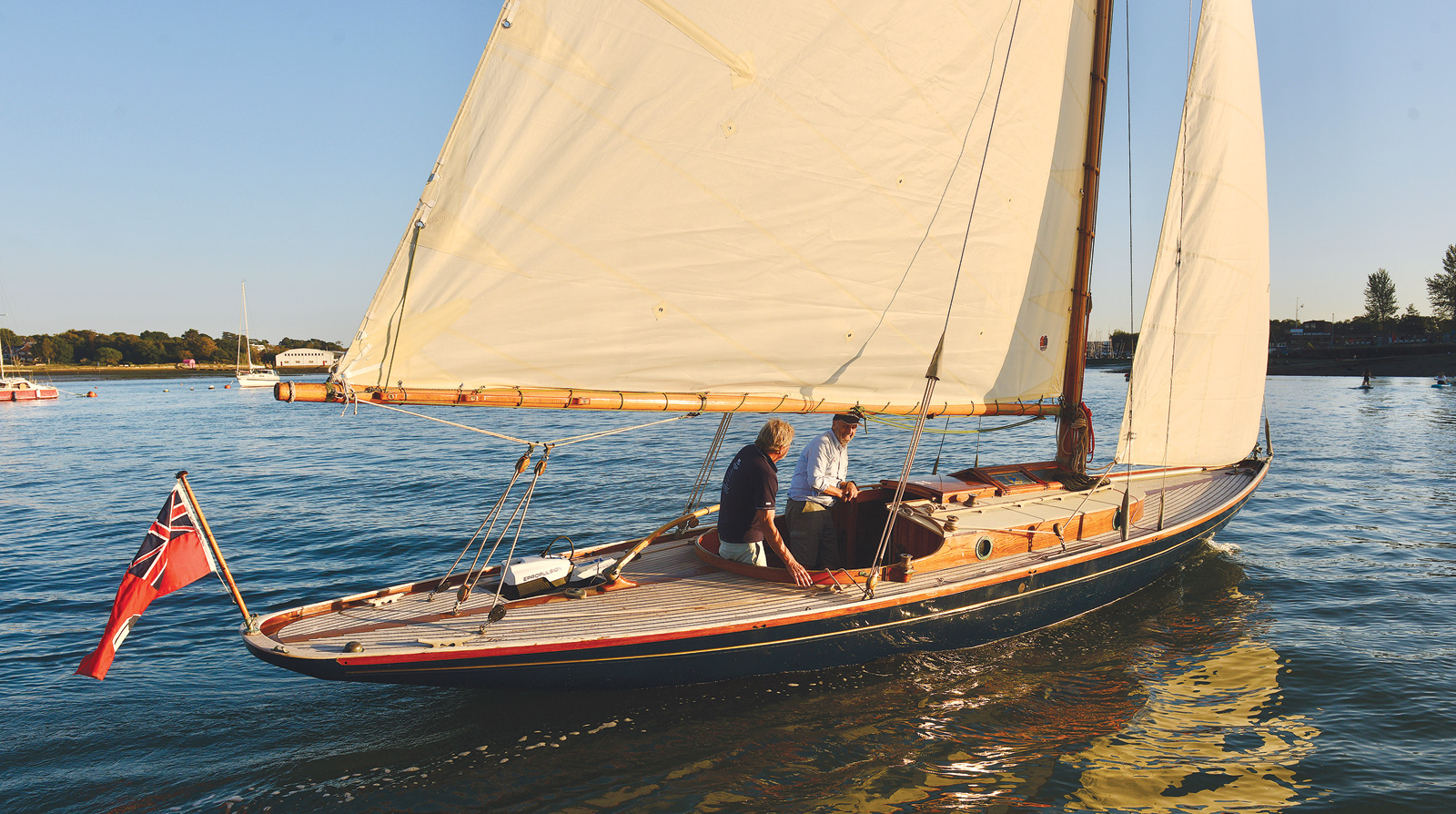
DOROTHY was originally designed as a gunter-rigged sloop; an optional yawl rig was never used. Her current gaff rig dates from the 1980s and is fitted with a new suit of sails made by Sanders Sails in Lymington, England. The logo on her ensign is that of National Historic Ships U.K.; she is No. 2477 on the NHS register, where she is described as a Thames Rater, as opposed to a Thames A-Rater, which is a lightweight river-racing craft.
Canadian boating enthusiasts in Ladysmith, British Columbia, were overjoyed when the 30′ wooden sloop DOROTHY was relaunched in May 2023 after an 11-year restoration. Built in 1897, she was billed as one of Canada’s oldest yachts and possibly the oldest still sailing. An extensive archive of papers showed she was built in Canada from a set of lines drawn by British yacht designer Linton Hope. Her design was based on another boat, also named DOROTHY, that had been built in England in 1894, although that boat’s fate was unknown to the Canadian restoration team (WB No. 296).
By a strange coincidence, just a few weeks before the Canadian launching, I was aboard the “original” DOROTHY, catching the last rays of autumn sunshine on the River Hamble on the south coast of England. The owners were aware of the Canadian DOROTHY but had never contacted anyone to let them know that her sistership was alive and well.
There is little doubt that this is the original boat. The British DOROTHY was designed by Linton Hope as what he called a “single-handed cruiser” and built at his yard on the River Thames in 1894. Her dimensions don’t quite fit with this narrative, but I suspect this is because of different ways of measuring length. In Hope’s 1895 drawings, the British DOROTHY’s length is given as 30′ LOA and 20′ LWL. But the 1895 Lloyd’s Register of Yachts shows her at 20′ LWL and 25′ between perpendiculars, a measure naval architects use to mark the forwardmost and aftermost plank intersections with a boat’s stem and its transom or sternpost. A broker’s listing in 2015 had her as 32′10″ LOA and 22′ LWL. By contrast, the Canadian DOROTHY is said to be 30′ LOA with a waterline length of 24′4″.
Looking at photographs of the two boats side-by-side, the British boat appears to have a flatter sheer than the Canadian one, and her bow overhang appears much longer. The British boat has the original stemhead sloop rig, whereas the Canadian one had a bowsprit added in about 1950. The British boat has a longer coach roof than the Canadian one, and her mast passes through the coach roof instead of through the deck. It also has a skylight over the saloon, which the Canadian version lacks. Yet they are almost certainly the same design, interpreted differently by builders 4,700 miles apart and tweaked by a succession of owners over more than a century.
The British DOROTHY’s current owners are an unlikely duo: Ossie Stewart is a former Olympic sailor who won bronze in the Soling Class in 1992 and went on to win the Fastnet Race in 1993. As part of his “day job” running a boatyard on the River Thames, he has restored several Thames A-Raters designed by Linton Hope as well as his own 1890s motoryacht; he says he thought it would be fun to own an 1890s sailing yacht, too. His boat partner is Damon Roberts, the man behind the DynaRig fitted to huge sailing yachts such as the 289′ MALTESE FALCON and 350′ BLACK PEARL. Having regularly sailed on J-Class yachts, he enjoys sailing what he regards as a “mini-J.”
Together, they’ve raced DOROTHY in multiple classic yacht regattas on the south coast of England, regularly winning their class. This year, they plan to ship the boat to the south of France to compete in the Mediterranean circuit (see WB. No 298). At 130 years old, Linton Hope’s lightweight racer shows no sign of slowing down.
What’s in a name?

DOROTHY’s current owner believes that the name was given to the design by Linton Hope and that both the British and Canadian boats were named after the design. We’ll probably never know who the original Dorothy was—or perhaps Hope just liked the name.
Mirror finish
DOROTHY went to the Elephant Boatyard on the Hamble River on the south coast of England in autumn 2022 for repairs to a damaged plank. She ended up having quite a bit more work done, including resplining the hull seams and repainting. “We’ve kept her at the Elephant because the guys in the yard understand wooden boats,” co-owner Ossie Stewart said. “You know they are going to be looking at your waterline every now and then, whereas in a big marina they don’t have a clue.”
A legacy of restoration

When DOROTHY was discovered on a beach near Dartmouth, Devon, in the 1980s, there was nothing much left of her, apart from her hull. A local boatbuilder, John Holden of the Nash Holden yard, repaired the hull and fitted a new deck made of plywood topped with a glued layer of sprung teak planks. All the deck fittings date from then, including the Wykeham Martin roller-furling gear photographed here with the furling line accidentally hooked around the mushroom vent. These things happen.
Following the curve
The beautifully crafted mainsheet cleat follows the curve of the cockpit coaming. Subtle details such as this are the mark of a bespoke wooden boat rebuilt with love by an experienced craftsman.
Hidden purpose

Contrary to expectations, this is not a traditional wooden winch or a turning block but the base of a very modern piece of equipment: an autopilot. It was most likely fitted in the 1980s and certainly looks the part—even if the line around it is somewhat deceptive.
Matching original style
The cabin trunk was built by John Holden in the 1980s “in the style of the original.” In fact, it is quite a bit longer than the cabin shown in Linton Hope’s drawings, which stops aft of the mast, as it does on her Canadian sistership. Each boat is fitted with an oval cockpit coaming, which was not shown in the original drawings.
A discreet outboard

Another important modification was the outboard well fitted on DOROTHY in the 1980s. (The Canadian boat remains engineless). This was much more sympathetic to the boat’s structure than fitting an inboard engine would have been. The current owners use a 1kW Epropulsion Spirit 1.0 Plus to motor silently up and down the Hamble River. A wooden hatch covers the well when the outboard is not in use.
Fitting addition
The large, central skylight is another departure from the original plans, although it was built to a traditional design. It provides welcome light and air belowdecks and is decorated with John Holden’s star logo, which shows well from below (right). The health and safety brigade can rest assured that the glass is in fact Perspex (aka Plexiglas, a cast acrylic sheeting), which is capable of taking the weight of a clumsy sailor should it need to.
Racing trim
Stripped out for racing, DOROTHY has spartan accommodations. None of the interior is original; it was built by John Holden in the 1980s. The previous owner raced the boat at dozens of regattas on both sides of the English Channel, sleeping on board at night. DOROTHY won her class at almost every event.
Simple living
Linton Hope conceived DOROTHY as a singlehanded cruiser, although it’s likely she was used mainly for daysailing and racing, with a paid helper to rig the boat and prepare her for the owner. Only minimal accommodation was required, mainly as shelter from rain or as a place to have a nap after a hard day’s racing. Her current owners use her in much the same way, but without the benefit of a paid hand.
Signature motif
This superb rudderhead fitting was made for DOROTHY during the 1980s rebuild. It was specially cast with the star logo, which is used throughout the boat. The varnished kingplanks are a nice touch, though they add considerably to the maintenance workload. Previous owner Lance Rowell estimates he spent 400 hours a year varnishing and polishing the boat.
The winning streak
DOROTHY’s current owners are high-flyers in the U.K. boating scene. Damon Roberts, left, is better known for developing the DynaRig used by superyachts such as MALTESE FALCON, while Ossie Stewart’s claim to fame is winning bronze in the Soling Class in the 1992 Olympics, along with a string of victories in classes such as 505s, Fireballs, 470s, and RS Elites. They’ve kept up their winning streak by racing DOROTHY successfully in classic yacht regattas in The Solent area. ![]()
Nic Compton is a regular contributor to WoodenBoat.