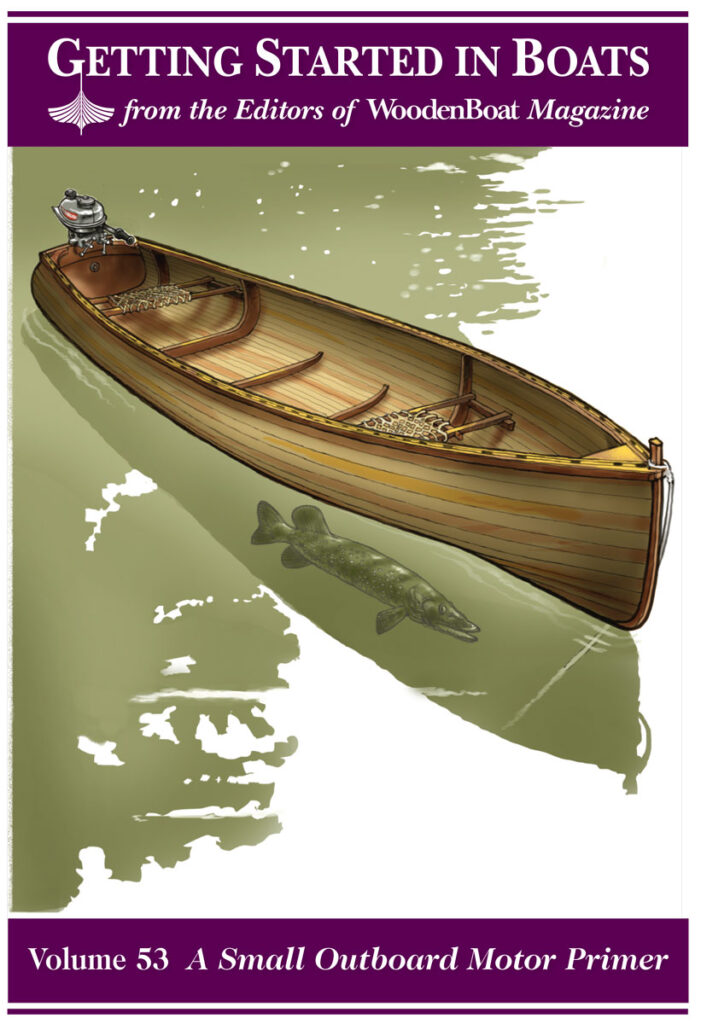
We like oars. They’re simple and efficient. But unless you have a fullback’s shoulders and a lumberjack’s stamina, they limit small boats to local pursuits. Oars must have been a hot topic at the turn of the last century, because the first internal-combustion outboard engines appeared in 1896. Only eight years after Karl Benz’s Motorwagen 3 took its first road-trip, American boaters were putt-putting along rivers and shores with sensible outboard motors, so reliable that a surprising number of them are still running.

By the 1920s, competition in the outboard motor market was stiff. Dozens of manufacturers serviced a lively recreational market. The basic product had basic advantages: you clamped an outboard to a rowboat, canoe, or fishing skiff, and you increased your range by miles. The outboards were simple and powerful, and if they broke down you took the motor—not the entire boat—to a mechanic.

Getting started in boats inevitably involves a fond acquaintance with outboard motors and their uses, their quirks, and most assuredly their dangers.

On the following pages, we’ll deal mostly with small “kickers”—outboard motors of less than 10 horsepower. Why 10? Many state park lakes and rivers limit engine size to “under 10 horsepower” to protect shoreline, nesting areas, and delicate local plants from damaging highspeed wakes—hence, the number of 9.9-hp engines available. These are not small fry. With a good engine of moderate size you can happily power a galaxy of power and sail boat types with assurance.

Electric Outboards

The Torqeedo electric outboard motor (above, left) is a competitive alternative to gasoline-powered ones. Light, with enough push for a small boat, it breaks down and assembles within moments. It’s surprisingly versatile and can be charged with its own roll-up solar panel.

Propane Outboards

The Lehr LP5.0 and LP9.9 (above, right) are “green” alternatives to gasoline-powered engines. They carry their fuel in familiar long canisters that screw into a shaped cowling at the back of the engine. One canister has enough fuel to run the engine full throttle for 90 minutes. The engines can also be hose-fed by a larger, separate propane tank.

Two-Stroke Versus Four

Two-stroke style

Most small outboards in the last century were two-cycle engines. Why? First, because they are inherently more powerful, as each downstroke of the piston is a power stroke. Second, the ingeniously simple design needs no valves, tappets, cams, camshafts, lifters, or timing belts or timing chains, which would add at least a third to the weight of the engine.

The two-stroke’s drawback is its wasteful and polluting exhaust. At the bottom of its power stroke the cylinder takes the fuel-air mixture from the crankcase. Incoming fuel blows through the cylinder, pushing burnt gases out the open exhaust port—along with about 30 percent of the unburned, toxic fuel.

The four-stroke cycle adds the weight of complicated valve arrangements above the cylinder and utilizes an unpowered stroke to push exhaust gases out of the cylinder. Until recent advances in electronic fuel-control solved the two-stroke’s pollution problem, the four-stroke engine, though heavier and less powerful, was the only ecologically sound choice.

Four-stroke style

Today, a “green” two-stroke engine is viable. At the bottom of its power stroke, the exhaust port opens. The rising piston exhausts the burnt gases until the exhaust port closes. Only then is fuel introduced—and not from the crankcase, but from direct injection valves that dispense jets of air-fuel mixture at precise cylinder levels and cycle times calculated from the current speed of the engine and its dynamic loading. This new computer-directed engine is lightweight and efficient, and more ecologically harmonious.

What Can I Power with a Small Outboard?

Various mounting devices have been created for the mounting of outboard motors on small daysailers and pocket cruisers. They require little permanent hardware, so when the motor and mount are removed there’s little evidence of them left behind.

This auxiliary outboard bracket is not as discreet as the removable one shown above, but it has the advantage of serving as a storage device, too. The mounting board is simply slid down to get the propeller and cooling water intake submerged; there’s no fussing with the screw-clamp mounts in this case.

Canoes, too, can carry small outboard motors. In this case, a shop-made bracket connects motor to boat. Some canoes are even designed for outboard propulsion, forgoing the traditional pointed stern and instead employing a transom stern such as the one on this issue’s cover.

Duckboats generally require the stealth of pole or paddle power, but an outboard may be used to cover a long distance to the hunting grounds.

Small plywood hydroplanes were popular in the 1940s and ’50s, and have made a comeback in recent years as kit boats. While they’re often powered by lowhorsepower outboard motors, they provide a surprising level of thrill and competition.

An outboard motor concealed in a covered well helps to preserve the looks of a traditionally styled boat. The well must be carefully designed to allow the motor to turn and tilt freely.

Many small houseboats are powered by small outboards, which might be used only occasionally to get the boat to a peaceful cove for an extended stay.

With good soundproofing and restraint on the throttle, a small power cruiser driven by an outboard motor can provide satisfaction similar to that of a sailing pocket cruiser.

Small Outboard Maintenance

Today’s small outboard motors have become reliable and companionable for boaters. They’re quieter and more powerful than their ancestors. They don’t appear to be tainted by planned obsolescence. Remember their inherent dangers, use the kill-switch lanyard (see Outboard Motor Safety below), and treat them decently. With attention to a few commonsense precautions they can propel your exploration of the water world for years.

After running in salt or brackish water, a washdown and flushing of the cooling system with fresh water is sensible.

Storing or carrying an outboard motor can’t be haphazard. Storing vertically on a stand is always ideal. If you must store them horizontally, two-stroke motors must rest on the port or the starboard side, depending on the make and model, to prevent engine oil from leaking into the combustion chamber. Many have dedicated “pins” or bumps that make their resting posture steady.

Gearbox lubrication, engine lubrication, and spark plugs should be replaced at regular intervals based on engine-hours—usually 100 or 200 hours. Check your manual for specified intervals.

Two-stroke engines require that oil be mixed with the gasoline, and the mix ratio is critical. Check your manual for the proper amount of oil.

Running in shallow water or striking a balk of driftwood may part the shear-pin—the sacrificial key that ties the propeller to the drive-train. Keep several shear pins onboard and go through the replacement procedure as a drill, so you can do it in a pinch. Again, check your manual to learn how to do this.

If your propeller is damaged physically, it will set up a vibration that can place strain on the entire engine and on the boat. A damaged propeller must be removed and repaired or replaced.

Outboard Motor Safety

Outboards have real, mortal dangers. Just below the water’s surface they spin a double or triple berserker’s axe at 3,000 to 4,000 rpm. Blades such as these cut through flesh and bone without a stutter. The Coast Guard’s accident database specifies 28 to 47 boaters killed by propeller mishaps in each of the years between 2001 and 2006. In the same period only seven were killed by snakebite and eight by shark attack. The Coast Guard also points out that propeller strikes have a particularly high morbidity rate because the wounds are deep, almost invariably multiples (those blades keep turning!), are deeply contaminated by surrounding water and debris, and because boaters are by definition distant from professional trauma aid.

Many authorities want a shift to water-jet outboards or a retrofitting of propeller shrouds. Water-jet outboards exist, but they are neither economical nor generally available. Propeller shrouds may degrade propeller efficiency (but what is half a knot worth?). Propeller shrouds are also recommended for navigating water sown with lobster or crab pots.

One particular scenario recurs in so many mishaps that it has a name: “The Death Spiral.” For any reason (inattention, slippery hands, a reflex reach for something) the helmsperson’s steering hand leaves the outboard tiller/handle.

A. Unequal resistance between the deep propeller blade and the shallow propeller blade exerts torque that twists the outboard motor to port.

B. The small boat turns violently to starboard, the stern kicking to port, the hull heeling to starboard, quite often dumping the helmsperson into the water.

C. The boat is now lighter and responds more readily to the unmanned, hardover handle-tiller, making a quick, tight circle, returning within seconds to the helmsperson, whose thighs are treading water at the level of the spinning blades. The sharp spinning propeller can cause disastrous flesh and skeletal wounds.

The Death Spiral should be extinct. Every new motor has a kill switch—a lanyard attached to a wrist or clothing connects you to an on-off insert in the outboard. When the “plug” is pulled, the motor stops instantly. There’s a problem with this device, though: A Texas safety survey found that fewer than 30 percent of boaters use the safety lanyard. It’s up to you.

The Venerable British Seagull

The British Seagull outboard was designed in the Sunbeam Motorcycle Plant in 1930, with British aplomb and restraint: It has only three moving parts on its upper power end. Every ungainly, businesslike part is essential, a minimalist achievement, tubes and castings, unchanged in most aspects between the first Seagull to the last shipped out in the late 1990s. No battery, no valves, old technology friendly to abuse and inexact dimensions. It was so simple that it simply kept working. The slogan for this engine was “The Best Outboard For the World.” It’s a bold boast, but perhaps it’s even true.

During World War II, thousands of these engines were issued for light assault craft and bridge-building barges. A good percentage of them are still running. Tighter environmental restraints pinched off the sales of its admittedly smoky two-stroke design. But the cult of Seagull-borne boaters across the world points out that real conservation is preventing waste of resources. Scrapping a recently made outboard is distinctly un-green.

The resource-friendly Seagull, however, is famous for stubborn endurance. Royal Navy divers pulled one up from a harbor bottom encrusted with weeds and barnacles, dried it out with an air hose, fueled and lubed it, clamped it to their rigid inflatable’s stern, and yanked the starter cord. It drove the RIB merrily across the harbor, flinging green weed along its path. Seagulls forgotten for decades in sheds or under docks respond like Lazarus called from his crypt. Children yet unborn will power small boats with Seagulls manufactured before their fathers were born. Rule Brittania.