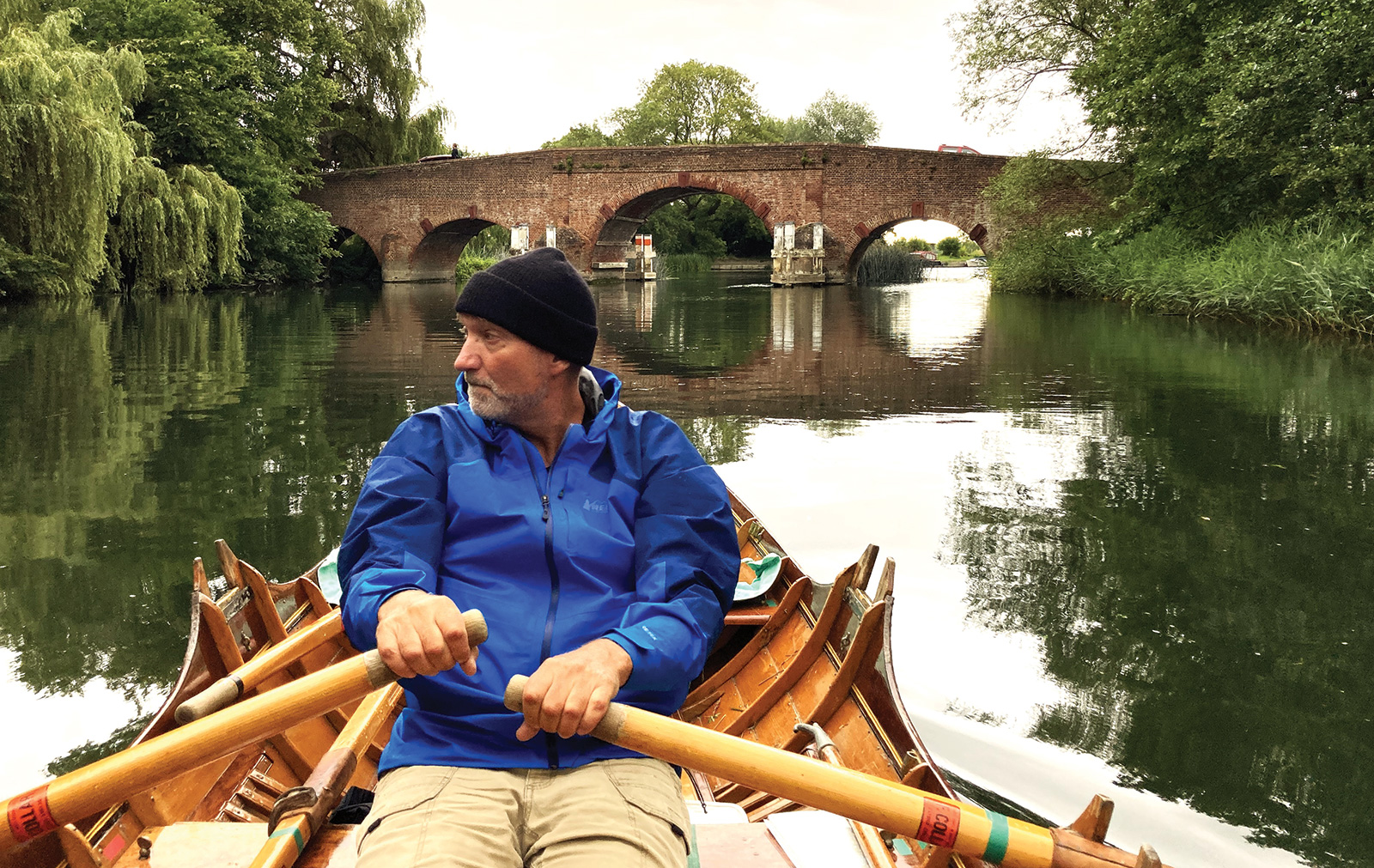
Cathy PamperinThe author and his wife undertook a 75-mile rowing trip on the River Thames in EALA, a 25′ traditionally crafted Thames skiff built by Tom Balm. Though the trek took them through terrain that wouldn’t have seemed out of place in the author’s native Wisconsin, dozens of arched bridges built of brick and stone lent a distinctly English charm to the surroundings.
When I contacted Tom Balm of Thames Skiff Hire to ask about renting a traditional camping skiff for a weeklong trip on the River Thames in England, he said I was in luck: although his fleet was often fully booked during the summer, there was a boat available in late July, after the finish of Swan Upping. I had no idea what Swan Upping was, but I immediately reserved a skiff for six days and started thinking about how I might convince my wife, Cathy, to join me. Her opinion of small boats aligns closely with that of playwright James Albery, whose 1876 Cassell’s Family Magazine article “Camping Out on the Thames” carries a warning for prospective boat campers:
…remember that you are travelling in a vehicle that, if it were not for the charm of the scene and the pleasure of the companionship of good fellows, you would vote a monstrously inconvenient and uncomfortable machine.
But the prospect of visiting the picturesque villages and charming riverside pubs that I assured Cathy we’d discover on our journey outweighed her reservations. She agreed to come along, and I was more than happy to have her. In addition to having pleasant company for the trip, it would be far simpler to navigate the locks with a two-person crew. I suspected the quality of our meals at camp would be significantly improved by her participation as well.
Cathy PamperinAfter encountering thick nettles at a mooring near Beale Park, the author chose to row to an alternative landing the next morning to reload.
Despite the tongue-in-cheek rustic squalor and discomfort depicted in Victorian-era travel writing like Albery’s article and Jerome K. Jerome’s 1899 bestseller Three Men in a Boat, the Thames skiff type is, in fact, the culmination of a long, gradual refinement toward beauty and efficiency. The boat, a general type rather than a specific design, had its antecedents in the wherries used by professional watermen since the 16th century to ferry passengers to riverside destinations in and around London. In 1820, there were still more than 3,000 wherries on the Thames, but steam power, railways, and a proliferation of bridges contributed to a steady decline throughout the 19th century. At the same time, the increased leisure time enjoyed by the Victorian-era middle class made recreational boating an increasingly popular pastime. The need for small, light boats that could be hired out for a casual picnic outing or used for a multiday meander of the type recounted in Three Men in a Boat, contributed significantly to the development of the Thames skiff.
Our skiff, EALA (pronounced AY-lah, the Irish word for “swan”), was built mostly by Tom Balm in about 1993, based on a set of lines and offsets included in Eric McKee’s 1983 book Working Boats of Britain: Their Shape and Purpose. The lines were taken from an existing Thames skiff that McKee measured in 1976, a boat identified in his book as “W.A.B. Hobb’s [sic] Skiff—Henley-on-Thames.” However, W.A.B. Hobbs was not the builder. Hobbs and Sons, now Hobbs of Henley, was founded in 1870 as a Thames boat livery, and the original “W.A.B. Hobb’s Skiff” was part of their rental fleet for many years before it was loaned to the Racing and River Boat Museum in Goring, about 50 miles west of London. In a July 30, 2013, Facebook post, the museum noted that the lines in McKee’s book show a skiff that was actually built in 1906 by Wally Downes while he was working for E.T. Ashley, a Thames boatyard and livery that was later acquired by Hobbs and Sons.
As with all traditional Thames skiffs, EALA is “clinker-built” (the European term for lapstrake planking) over sawn frames, with a long slender hull and minimal rocker. The narrow waterline beam and flaring sides serve to minimize drag while keeping the oarlocks as far apart as possible for efficient rowing without resorting to outriggers. A raked transom and moderate overhang at the bow stretch the overall length to 25′, with a maximum beam of just over 4′—a beam-to-length ratio greater than 6:1. By comparison, my “slender” Whitehall-inspired beach cruiser checks in at just under 4:1. Thames skiffs range in size from singles (with or without a coxswain) to three or even four rowing stations. With two rowing stations and seating for a coxswain, EALA lies near the middle of the range.
Courtesy Of Tom BalmThe author and his wife took time for a photo at the ramp in Abingdon before using a light hand trolley to launch EALA for her six-day meander on the River Thames.
According to McKee, typical Thames skiff framing demonstrates how “under the pressures to lighten these lovely boats, [builders have] taken their structures to the limits of possibility with wood.” Floor timbers are fixed to the keel, helping to tie the structure together while also serving as supports for floorboards and sole grates. Sawn partial frames support the upper planking; they overlap the floor timbers without extending inboard to the centerline. Aboard EALA, they run from the second strake to the top of the “saxboard,” an extra strake above the gunwale. In the drawings in the McKee book, partial frames span the second to fifth strakes and are paired with adjacent floors near the ends of the hull; amidships, there are more futtocks than floors, and they are positioned on separate stations rather than adjacent to each other.
Instead of oarlocks, Thames skiffs rely on wooden thole pins set into the saxboard on either side of a hardwood bearing surface on which the oars slide freely, another example of how builders “designed out weight even down to the oarlocks,” as McKee notes. Although the use of lightweight construction and minimal scantlings were crucial for good racing performance, it was probably not as important for a heavily laden camping skiff or picnic boat. Even for casual rowing, however, light weight is desirable. Another advantage of thole pins is that they are simple, cheap, and easily repaired. The components are fully interchangeable, since each rowing station uses the same set-up. When I had to replace the port-side thole pin partway through our journey because it had started to wobble a bit more than I liked, all I needed to do was loosen a couple of screws, remove it, slide the replacement in place, and retighten the screws. For livery boats used frequently by rowers with widely varying levels of competence, it’s hard to imagine a better solution.
Tom PamperinThere was ample mooring space above and below each lock, which made it easy for EALA and her crew to stay out of anyone’s way while waiting to lock through.
Technical aspects and structural details aside, my first impression of EALA was one of pure elegance, grace, and form-follows-function beauty.As I helped Tom Balm roll her down the launching ramp on a light hand trolley, I couldn’t wait to get aboard. It was hard to believe that it was still possible to rent a hand-built traditional wooden boat for a week on the Thames; hard to believe that we could immerse ourselves for a while in the world of Kenneth Grahame’s 1908 classic The Wind in the Willows:
Whether you get away, or whether you don’t; whether you arrive at your destination or whether you reach somewhere else, or whether you never get anywhere at all, you’re always busy, and you never do anything in particular; and when you’ve done it there’s always something else to do, and you can do it if you like, but you’d much better not.
Grahame’s vision of river life seemed far better suited to a boat like EALA than the clumsy humor of Jerome or Albery. A “monstrously inconvenient and uncomfortable machine”? I didn’t believe it.
We were launching from Abingdon, on the Upper Thames River just south of Oxford and about 60 miles west of London. Tom led us through a brief orientation at the ramp: a practice run at setting up and breaking down the boat tent; an introduction to the kit of spares and tools; a quick review of proper rowing technique; a few words of advice on finding mooring sites. Once we were comfortable, it was time to stow our gear, a process Tom supervised closely to help maintain good trim and balance. The heavy canvas boat tent, foldable cast-iron hoops, and food supplies were stored on the sole aft of the coxswain’s seat; the camping stove, cook set, and water jugs, along with our personal gear and clothes, went in the bow. Cathy promptly claimed the coxswain’s role, leaving me to manage the oars, and we were off.
Cathy PamperinOn the third day of the trip, the author—who served as the primary rower—enjoyed a rare moment in EALA’s comfortable coxswain seat to review his route on a map of the Thames Path.
We left Abingdon just after noon, wrapped in full rain gear under a drizzly sky that we feared might prove all too typical for an English summer. Our ultimate destination was Walton-on-Thames on the southwest side of London, giving us six days to cover 75 river miles, passing through 26 locks along the way. I hadn’t thought to ask about the specifics of locking through at our orientation, but we weren’t too worried. Our only plan for the day was to find a mooring by early evening. We’d figure out the locks on the way.
The Upper Thames River is non-tidal and delightfully anti-industrial, winding through green countryside fronted by narrow strips of woodland interrupted by occasional waterside cottages and boathouses. We might have been rowing a mid-sized river in my native Wisconsin, though the black-hulled narrowboats and Thames barges moored along the riverbanks suggested otherwise. There were plenty of birds. We passed flotillas of ducks and Canada geese and saw dozens of swans every day, apparently none the worse for their recent Swan Upping, an annual ceremony in which they are captured, tagged, and released (see sidebar, page 82). We learned to recognize the split-tailed silhouette of red kites soaring overhead and the swoop-dip-swoop of a crested kingfisher passing from bank to bank.

The 75-mile journey involved rowing an average of about 12 or 13 miles per day through the English countryside from Abingdon to Walton-on-Thames, sleeping aboard the boat or camping ashore at public moorings or locks each night.
The coxswain’s seat was luxurious by open-boat standards, with a firm cushion, angled backrest, and ample legroom. It was easy for Cathy, facing forward, to steer the boat using lines from the rudder yoke. I rowed from the aft station for proper trim, with my feet braced against an adjustable mahogany-plank foot stretcher. After years of conventional oarlocks, and a longstanding habit of not feathering my oars, it took me a while to adjust. With a bit of experimentation, though, I settled into what must have been at least a rough approximation of the Thames waterman’s stroke. (For a good overview of this technique, see “The Thames Waterman’s Stroke” in WB No. 240.)
A bit of tallow smeared on the leathers allowed the oars to slide freely between the tholes, and the curve of the buttons against the side of the hull helped twist the blades to the proper angle with a quick snap of the wrist as they left the water. There was a touch of overlap at the oar handles, and I quickly learned to let one hand lead the other to avoid pinched thumbs. It felt very different from using conventional pivoting oarlocks, with the oars slipping back and forth a few inches from thole to thole at each stroke rather than being anchored firmly in place. But soon enough I was pulling smoothly, leaning back straight-armed while pushing with my legs, and finishing the stroke with a slight bend of my arms, elbows tucked close to ribs, and shoulder blades squeezed together. The oar blades whispered across the surface of the water through each recovery, not quite flat, until a quick flick of the wrist squared the blades just as they dug in for the next stroke.
Cathy PamperinGood raingear proved to be essential, with typically damp English-summer drizzles prevailing for almost half the journey.
We passed through two locks the first day, which turned out to be far simpler than I had imagined. Controls for the gates and sluices were electric, with detailed instructions posted at each console. One of us would remain on board, fending off the concrete walls with a boathook as the water level dropped, while the other went ashore to push buttons and open gates. There was always a dock or mooring immediately below each lock, making it easy to rejoin the boat. When there was a lock keeper on duty, as there often was, we didn’t even need to come ashore.
Eventually, the persistent drizzle eroded my enthusiasm for further refinements of my rowing technique, and we found a bankside mooring beside a cow pasture just upstream of Day’s Lock, 8 miles, more or less, from our starting point—far enough. Not wanting to deal with the iron hoops and heavy canvas of the boat tent in the rain, we hurriedly set up a dome tent on shore, cooked our first dinner, and crawled inside. We fell asleep to the sound of thunderstorms sweeping through the skies.
Cathy PamperinWhen the lock gates opened, the author had to be ready to exit quickly. Paddling proved to be more efficient than rowing in the narrow chambers.
We had better weather the rest of the week, with only an occasional drizzle to remind us that this was an English summer, after all. Hour after hour slipped by, and day after day. Days Lock. Beale Park. Shiplake Lock. Cliveden House. Runnymede. Each night we’d find a quiet stretch of riverbank to moor up, where I’d bail out the bilges, then wrestle the iron hoops and heavy canvas of the boat tent into place and remove the thwarts to clear a sleeping space while Cathy cooked dinner on shore. The riverside evenings were long and pleasant, the nights aboard snug.
We were navigating—though that seems too grand a word—with a 1:60,000 topographic map of the Thames Path National Trail, which not only showed the location of each lock, but also allowed us to see what was hidden behind the leafy greenbelt at the river’s edge: villages, pubs, public toilets, and prominent landmarks that seemed worthy of exploration. With only a single rower, we spent long hours on the water each day, but we managed to fit in some shoreside diversions, too: a side trip to Wallingford Castle; a tour of the enchanting Wind in the Willows exhibit at the River and Rowing Museum at Henley-on-Thames; brunch at the Mad Duck Café in Purley on Thames; an overnight stay and early-morning ramble on the high bluffs of the sprawling Cliveden House estate; a picnic under the shady oaks at Bath’s Island in Windsor.
We spent our last evening at a free public mooring in Runnymede, just downstream from the Wraysbury Skiff and Punting Club. I wandered up to the clubhouse to watch the action for a while as a couple of classic Thames skiffs were being run through their paces. I tried to imagine a skiff and punting club on any Wisconsin river—tried, and failed. It seemed a quintessentially British thing, this preoccupation with small boats. We had passed dozens of rowing clubs and sailing clubs, watched fleets of dinghies tacking up stretches of river barely 100 yards wide, seen hundreds of narrowboats and barges moored on the riverbank. The River Thames seemed like a vital thread in the fabric of the nation; boats mattered here, in a way that they didn’t, back home.
Six days, five nights; 75 miles; 26 locks. How little such numbers mean, how small the fraction of a life they convey. As I helped Tom Balm load EALA on her trailer in Walton-on-Thames, I was already beginning to consider a return trip. Another rainy week on the river, aboard such a monstrously inconvenient and uncomfortable machine? It sounded pretty good to me.
Thames Skiffs at Work
Swan Upping, an annual census of mute swans along the River Thames, dates back to medieval times, making it one of the longest-running traditions in England—a tradition in which the Thames skiff plays a central role. Apart from a partial cancellation in 2012 because of flooding and a full cancellation in 2020 because of Covid-19 restrictions, Swan Upping has run every year since the 12th century. Though originally intended to protect the Crown’s right of ownership to all unmarked mute swans on open water—swans were popular dishes at royal feasts—the census today focuses on conservation and education.
Besides the Crown, two other organizations maintain historic rights to swan ownership: the Worshipful Company of Vintners and the Worshipful Company of Dyers, trade associations, or guilds, that still operate liveries in the city of London. During the third week of July, when adult swans are molting and cygnets are still too young to fly, the Crown, the Vinters, and the Dyers send an official swan marker, accompanied by a team of Swan Uppers, to conduct the census. Each team is assigned two traditional Thames skiffs, which they row upriver from Sunbury to Abingdon, covering roughly 80 river miles over five days.
Quaint as it may seem, the use of Thames skiffs at Swan Upping is more than mere affectation; the lack of engine noise allows teams to approach the swans closely, surrounding them with minimal stress to the birds. Each family group of swans and cygnets is corralled within a circle of skiffs, at which point the Swan Uppers go into action, lifting each swan and cygnet from the water and taking them ashore—a daunting task that involves leaning over the side of a narrow-beamed pulling boat to “up” a swan that may weigh more than 30 lbs and have a wingspan of 8‘. According to David Barber, the royal swan marker, the crucial step is to wrap your arms around the swan’s powerful wings before lifting it into the boat.
Once ashore, each swan is measured, examined, and treated for illness or injury if necessary (swans often tangle with fishing lines and hooks). Based on their parentage, cygnets are then marked with the appropriate lightweight plastic leg ring to signify ownership by the Vinters or Dyers; those left unmarked are owned by the Crown. Finally, the adult swans and cygnets in each family group are released simultaneously to ensure that they remain together.
Cathy PamperinAfter performing their traditional toast to the king, six boatloads of “swan uppers” swarmed the dock at Abingdon in a flurry of unloading. The author jumped in to help load each skiff onto its waiting trailer.
Swan Upping traditionally ends with a toast to the reigning monarch, which is performed just below Abingdon Bridge: the crews raft up side-by-side in their skiffs, and—with care—stand up to deliver a formal salute. Cathy and I arrived in Abingdon the night before our own trip to witness the event, joining a crowd of bystanders lining the riverbanks on both sides.
Unfortunately, 2023’s Swan Upping revealed a 40 percent reduction in the population of mute swans on the Thames: only 94 cygnets were found, compared to 155 in 2022. The United Kingdom’s goose and swan monitoring program reports a 10 percent decline in mute swans over the past decade. According to Barber, this year’s decline probably reflects the effects of an ongoing outbreak of pathogenic avian influenza.
—TP
Resources and Reading
- Thames Skiff Hire, 64 Carlton Rd., Walton-On-Thames, Surrey KT12 2DG, U.K.; www.skiffhire.com.
- Richmond Bridge Boat Hire, Bridge Boathouses, Richmond upon Thames, Surrey TW9 1TH; www.richmondboathire.co.uk.
- River & Rowing Museum, Mill Meadows, Henley on Thames, Oxfordshire RG9 1BF, U.K.
- Royal Swan Upping, www.royalswan.co.uk.
- Alberly, James. “Camping Out on the Thames.” Cassell’s Family Magazine. 1876. www.victorianvoices.net/ARTICLES/CFM/CFM1876/CFM1876-Camping.pdf
- Grahame, Kenneth. The Wind in the Willows. Methuen Publishing Ltd., London, 1908.
- Jerome, Jerome K. Three Men in a Boat (To Say Nothing of the Dog). Arrowsmith, Bristol, 1889.
- McKee, Eric. Working Boats of Britain: Their Shape and Purpose. Conway Maritime Press, London, 1983.

Tom Pamperin is a small-boat sailor based in northwestern Wisconsin. He is a regular contributor to WoodenBoat and Small Boats.